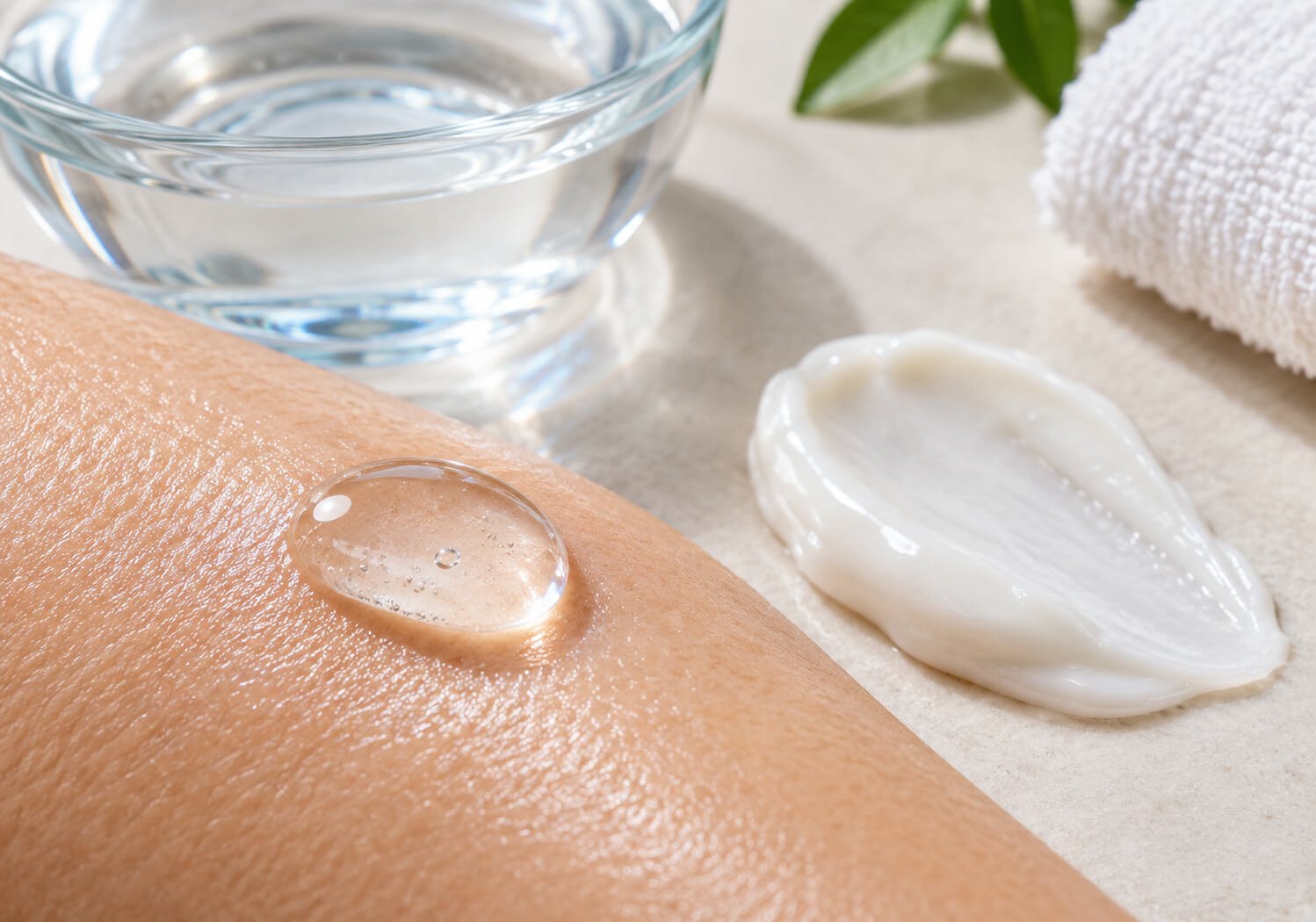
Hyaluronic acid is a popular ingredient in facial serums, moisturizers, and other skincare products. Its main appeal is its ability to attract and hold water, helping the outer layers of the skin feel smoother, softer, and more hydrated. But how does hyaluronic acid hydrate skin, and does it work as well as skincare advertisements suggest?
The answer depends on how the ingredient works, how it is formulated, and what your skin needs. Topical hyaluronic acid can improve skin hydration, but it does not replace every function of a moisturizer, repair every type of skin damage, or permanently remove wrinkles.
Research supports its role as a moisturizing ingredient, although the results of individual products vary. Understanding how it works can help you use it more effectively and choose products that fit your skin type.
Quick Answer
Hyaluronic acid hydrates skin by attracting and binding water in the outer skin layers. As a humectant, it helps increase moisture and can make skin appear smoother and temporarily plumper. For the best practical results, apply a suitable hyaluronic acid serum to slightly damp skin and follow with a moisturizer that helps reduce water loss.
How Does Hyaluronic Acid Hydrate Skin?
Hyaluronic acid, also called hyaluronan, is a substance naturally found in the body. It is present in the skin and other tissues, where it helps maintain a hydrated environment and supports the structure surrounding cells.
In skincare, hyaluronic acid works primarily as a humectant. Humectants attract water and help hold it near the skin’s surface. This makes them useful for improving the moisture content of the stratum corneum, the outermost layer of the skin.
According to a review of topical hyaluronic acid research, hyaluronic acid has water-binding properties that contribute to skin hydration and help improve the appearance of aging skin. However, its effects depend on the formulation and the characteristics of the molecule used.
1. It attracts and holds water
Hyaluronic acid has a molecular structure that allows it to associate with water. When included in a skincare product, it helps attract moisture and retain it within the skin’s superficial layers.
Think of it as a moisture-binding ingredient rather than a source of water itself. It does not create water, and applying it to dry skin does not automatically guarantee better hydration. Its performance depends partly on the water available in the skin and surrounding environment.
2. It helps the outer skin layer stay hydrated
The stratum corneum contains skin cells surrounded by lipids, including ceramides and other fats that help limit water loss. Maintaining enough moisture in this layer supports a smoother surface and helps the skin remain flexible.
Hyaluronic acid can increase the water content of this outer layer. Research on topical formulations has found improvements in measured skin hydration after application.
For example, a clinical study of hyaluronic acid creams evaluated 76 women who applied different molecular weights of hyaluronic acid around the eyes for 60 days. The researchers reported improvements in skin hydration and elasticity compared with the control treatment.
The findings support its moisturizing role, although they do not mean every serum will produce identical results.
3. It can make fine lines less noticeable
When the outer skin layer is dehydrated, small lines can become more visible. Improving its water content may make the surface look smoother and temporarily fuller.
This is a cosmetic effect, not the same as permanently removing wrinkles. Hyaluronic acid does not replace lost facial volume in the way that injectable fillers can, and an ordinary topical serum should not be expected to produce the same effects as a medical procedure.
4. It works best as part of a complete moisturizing routine
Hyaluronic acid is useful for attracting water, but a good skincare routine also needs to help keep that water from escaping too quickly.
The American Academy of Dermatology’s moisturizer guidance identifies hyaluronic acid and ceramides as useful ingredients in products intended to moisturize skin.
A practical routine combines three functions:
- Humectants: Ingredients such as hyaluronic acid and glycerin attract and hold water.
- Emollients: Ingredients such as certain oils and fatty substances soften the skin and improve its feel.
- Occlusives: Ingredients such as petrolatum help reduce water loss by forming a protective layer.
Not every moisturizer contains all three categories, but combining complementary ingredients can be especially helpful when skin is dry.
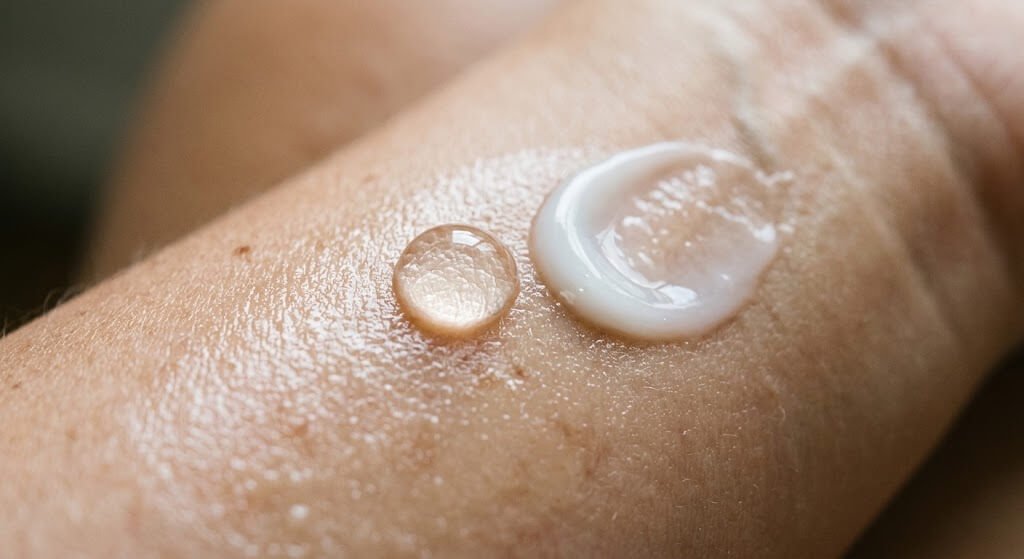
What Is Hyaluronic Acid, and Why Is It Important for Skin?
Hyaluronic acid is a naturally occurring molecule that belongs to a group of substances called glycosaminoglycans. It is found in the extracellular matrix, the material surrounding cells in tissues such as skin.
Its ability to interact with water makes it important for maintaining the environment in which skin cells function. In the skin, hyaluronic acid contributes to hydration and the physical properties of the surrounding tissue.
Natural hyaluronic acid in the skin
Your body produces hyaluronic acid naturally. In the skin, it is found in different compartments, including the dermis and living portions of the epidermis.
The dermis contains structural components such as collagen and elastin, along with other substances that support tissue organization. Hyaluronic acid contributes to the hydrated environment around these structures.
The epidermis, meanwhile, provides much of the skin’s protective barrier. Water balance in this layer is essential for maintaining a comfortable, flexible surface.
Natural hyaluronic acid is continually produced and broken down. Its amount and distribution can change with age and other biological or environmental factors. However, skin aging is complex and cannot be explained by changes in hyaluronic acid alone.
Is hyaluronic acid the same as sodium hyaluronate?
Not exactly. Sodium hyaluronate is the sodium salt of hyaluronic acid and is commonly used in cosmetic formulations.
Both ingredients are associated with water binding and moisturization. Sodium hyaluronate may be selected for formulation reasons, including its solubility and compatibility with other ingredients.
When reading a skincare label, you may encounter either name. Their presence suggests a product is designed to provide some moisturizing benefit, but the ingredient name alone does not establish how effective the finished product will be.
Does topical hyaluronic acid replace the hyaluronic acid already in your skin?
No. A topical serum adds an ingredient to the skin’s surface and, depending on the formulation and molecular size, may affect different superficial skin layers.
It does not simply replace all the hyaluronic acid naturally present in the dermis. The way a cosmetic formulation behaves on the skin is different from the biological processes that produce and break down hyaluronic acid within the body.
That distinction matters when evaluating claims about skin repair, deep hydration, or reversing aging.
What Does Research Say About Hyaluronic Acid for Skin Hydration?
Research suggests that topical hyaluronic acid can improve skin hydration. However, studies differ in their formulations, participants, treatment periods, and outcome measurements. The evidence is best understood by looking at what individual studies actually measured.
Clinical studies show improvements in hydration
A 2021 clinical study of a topical hyaluronic acid serum evaluated 40 women with signs of facial photoaging. Participants applied the serum twice daily alongside sunscreen.
The researchers reported an increase in measured skin hydration immediately after application and continued improvements during the six-week study. They also reported changes in skin smoothness and the appearance of fine lines.
These findings are encouraging, but the study evaluated a particular formulation in a specific group of participants. The results should not be treated as a guarantee that every hyaluronic acid product will deliver the same percentage of improvement.
Molecular weight may influence the results
Hyaluronic acid molecules come in different sizes, often described as high, medium, or low molecular weight. Molecular weight affects how the ingredient behaves in a cosmetic formulation and how deeply it can interact with the skin.
A 2024 randomized controlled trial studied 36 older adults with dry skin. Participants used moisturizers containing either low-molecular-weight hyaluronic acid, high-molecular-weight hyaluronic acid, or a comparison formulation on separate areas of the legs.
After four weeks, the low-molecular-weight formulation produced greater improvements in measured skin hydration than the other two treatments. However, the study did not find significant differences in transepidermal water loss or the overall symptom score.
This is an important distinction: an improvement in skin hydration measurements does not necessarily mean every sign of dryness or skin-barrier function will improve to the same extent.
What are the limitations of the research?
Some studies have relatively small participant groups, short follow-up periods, or formulations containing other ingredients that may contribute to the results.
A product’s concentration, molecular weight distribution, vehicle, and supporting moisturizing ingredients can all influence performance. Researchers also use different instruments and methods to measure hydration.
For these reasons, it is more accurate to say that topical hyaluronic acid can help hydrate skin than to promise a specific result, wrinkle reduction, or long-term anti-aging effect.
The practical takeaway is simple: hyaluronic acid is a useful moisturizing ingredient, but the whole formula and your regular skincare habits matter just as much as the ingredient name on the label.
How to Use Hyaluronic Acid Serum for Better Hydration
Using hyaluronic acid is usually straightforward. You do not need a complicated skincare routine or several products containing the same ingredient. The goal is to apply it in a way that supports moisture retention and works well with the rest of your routine.
Step 1: Cleanse your skin gently
Start with a gentle cleanser that removes dirt, excess oil, sunscreen, and other residue without leaving your skin feeling tight.
Avoid using very hot water or harsh cleansing products if your skin is already dry. These can contribute to irritation or make dryness more noticeable.
After cleansing, pat your face with a clean towel. You want your skin to remain slightly damp rather than completely wet.
Step 2: Apply hyaluronic acid to slightly damp skin
Apply a small amount of serum according to the product’s instructions. Spread it gently over your face without rubbing aggressively.
Slightly damp skin provides water that a humectant can help retain. This is a practical application method, not a requirement that applies identically to every formula.
You do not need to soak your face or use a large amount of serum. A thin, even layer is usually sufficient.
Step 3: Follow with moisturizer
After applying the serum, use a moisturizer appropriate for your skin type.
This step is especially useful if your skin is dry, you live in a low-humidity environment, or your skin tends to feel tight after cleansing. Moisturizers can combine humectants, emollients, and occlusives to support hydration and reduce water loss.
The NCBI overview of moisturizers explains that humectants may contribute to water loss under certain conditions if they are not accompanied by suitable occlusive ingredients.
That does not mean hyaluronic acid always dries skin out. It means that humectants work within a larger moisturizing system, and the rest of your formula matters.
Step 4: Use sunscreen in the morning
If you apply hyaluronic acid in the morning, finish your routine with a broad-spectrum sunscreen with SPF 30 or higher.
Sunscreen protects against ultraviolet radiation, which contributes to premature skin aging. Hyaluronic acid provides hydration but does not replace sun protection.
Allow products to settle according to their instructions, and apply sunscreen in the amount recommended on its label.
Step 5: Repeat according to your skin’s needs
Many hyaluronic acid products are designed for once- or twice-daily use. Follow the product label and adjust your routine if you experience irritation, pilling, or discomfort.
You do not need to reapply serum repeatedly throughout the day just because your skin feels dry. If dryness continues, you may benefit more from changing your moisturizer, adjusting your cleansing routine, or identifying another cause of the problem.
Coach’s Tip — Build the routine around your moisturizer.
Think of hyaluronic acid as one part of your hydration routine, not the entire routine. If you can only choose one product for very dry skin, a well-formulated moisturizer may provide more complete support than a standalone serum.
Can Hyaluronic Acid Hydrate Skin Without Moisturizer?
Hyaluronic acid can improve hydration when used on its own, depending on the formulation and conditions. However, using it without a moisturizer may not be the most effective option for someone whose skin loses water easily.
A serum can attract and hold water, but it may not contain enough emollient or occlusive ingredients to reduce water loss effectively.
Why moisturizer still matters
The outer skin barrier helps control how much water escapes from the skin. When this barrier is functioning well, the skin generally feels more comfortable and flexible.
When the barrier is disrupted, water can escape more easily. Skin may then feel tight, flaky, rough, or irritated.
A moisturizer helps address this problem by combining ingredients that improve surface softness, attract water, or reduce evaporation. For this reason, dermatologists commonly recommend moisturizing products for dry skin rather than relying on a single hydrating ingredient.
What if you have oily skin?
Oily skin can still become dehydrated. Oil production and water content are different things, so having a shiny complexion does not guarantee that your skin has enough moisture.
If your skin is oily, you may prefer a lightweight gel moisturizer or a non-greasy lotion. You can still use a hyaluronic acid serum if you find it comfortable.
Look for a formula that does not leave an unpleasant film and avoid adding unnecessary layers if they make your skin feel congested.
What if you live in a humid or dry climate?
Humidity may influence how humectants behave, but it is not the only factor affecting hydration. Your skin condition, indoor heating or air conditioning, cleansing habits, and moisturizer formulation also matter.
In dry conditions, a moisturizer that reduces water loss may be particularly helpful. In humid conditions, a lighter formulation may be more comfortable.
There is no universal humidity threshold that guarantees hyaluronic acid will work well or poorly. Adjust the complete routine to your skin’s response rather than relying on climate alone.
What Type of Hyaluronic Acid Is Best for Skin?
There is no single form of hyaluronic acid that is best for every person or every skincare product. The ingredient’s molecular weight, concentration, formulation, and supporting ingredients can influence how it performs.
High-molecular-weight hyaluronic acid
High-molecular-weight hyaluronic acid generally remains closer to the skin’s surface. It can form a moisture-retaining film that helps the surface feel smoother and more comfortable.
This may be useful for people who want an immediate moisturizing effect. However, a surface film is not the same as deep penetration into the skin.
Low-molecular-weight hyaluronic acid
Low-molecular-weight hyaluronic acid consists of smaller molecules. Some formulations containing smaller molecules have demonstrated improvements in superficial skin hydration.
However, smaller does not automatically mean better. The degree of penetration depends on molecular size, the formulation, and the skin itself. Claims that a low-molecular-weight product always reaches deep skin layers or produces superior anti-aging results should be treated cautiously.
The 2022 review of topical hyaluronic acid discusses the potential benefits of topical formulations while also highlighting differences in the available evidence.
Products that combine different molecular weights
Some products combine different molecular weights to provide complementary effects at the skin surface and within superficial epidermal layers.
This can be a reasonable formulation approach, but a product containing several types of hyaluronic acid is not automatically more effective than one containing a single type.
Look for evidence about the finished product rather than relying only on marketing phrases such as “multi-depth hydration” or “deep moisture technology.”
What concentration should you look for?
There is no universally established concentration that guarantees the best results for every skin type.
A higher concentration does not necessarily mean better hydration, and the full formulation can be more important than the percentage alone. A well-formulated product with a suitable moisturizer may perform better for your needs than a highly concentrated serum that leaves your skin uncomfortable.
Choose a product based on its intended use, ingredient list, texture, tolerability, and how it fits into your routine.
Hyaluronic Acid vs. Glycerin: Which Hydrates Skin Better?
Hyaluronic acid and glycerin are both humectants. They attract and retain water, but they differ in their chemical structures, formulation properties, and how they are used in skincare.
Neither ingredient is universally superior. Both can be useful, and many moisturizers contain them together.
| Feature | Hyaluronic acid | Glycerin |
| Main role | Helps bind water and improve skin hydration | Attracts water and supports skin hydration |
| Common product types | Serums, gels, lotions, creams | Creams, lotions, cleansers, serums |
| Skin feel | Often lightweight or slightly slippery, depending on the formula | Often smooth and moisturizing, depending on concentration |
| Compatibility | Can suit many skin types when well formulated | Can suit many skin types when well formulated |
| Best choice | Depends on the formula and your skin’s needs | Depends on the formula and your skin’s needs |
When should you choose hyaluronic acid?
A hyaluronic acid serum may suit you if you prefer a lightweight layer under your moisturizer or want to add a specific humectant to your routine.
It can be especially appealing if you want a product that layers easily with sunscreen or other skincare products.
When should you choose glycerin?
Glycerin is a well-established moisturizing ingredient used in many creams and lotions. If your skin is dry and you want a simple, affordable moisturizer, you may already get useful hydration from a product containing glycerin.
You do not need to buy a separate hyaluronic acid serum if your existing moisturizer keeps your skin comfortable and hydrated.
Can you use both together?
Yes. Hyaluronic acid and glycerin can be used in the same routine, and some products contain both.
There is no need to layer multiple separate serums simply to increase the number of humectants. Choose a formula that feels comfortable, then follow with a moisturizer when needed.
Does Hyaluronic Acid Help With Dry Skin and Dehydrated Skin?
Dry skin and dehydrated skin are related but not identical.
Dry skin often refers to a skin type or condition involving insufficient surface lipids. Dehydrated skin refers to a lack of water. A person can experience both at the same time, and the symptoms may overlap.
Hyaluronic acid can help increase the water content of the skin’s outer layers. However, it may not address all the causes of persistent dryness.
Signs of dehydrated skin
You may notice:
- A tight feeling after washing your face.
- Fine lines that appear more noticeable when the skin is dry.
- A rough or less supple surface.
- Temporary dullness or reduced smoothness.
- Discomfort after exposure to dry air or frequent cleansing.
These signs are not specific to dehydration. Irritation, eczema, and other skin conditions can produce similar symptoms.
Signs that your skin may need a richer moisturizer
If your skin frequently flakes, cracks, becomes rough, or feels uncomfortable despite using a hydrating serum, you may need a more protective moisturizer.
Creams and ointments can be more suitable than lightweight gels for some people with very dry skin. Ingredients such as petrolatum and ceramides can help support moisture retention.
The American Academy of Dermatology’s dry-skin guidance recommends moisturizers containing ingredients such as hyaluronic acid, glycerin, and petrolatum, depending on the person’s needs.
If your skin is persistently inflamed, painful, cracked, or itchy, consider seeing a dermatologist rather than assuming you only need more hydration.
Can Hyaluronic Acid Make Your Skin Dry?
Hyaluronic acid is generally used to moisturize skin, but some people report that their skin feels tighter or drier after applying a product containing it.
That does not mean hyaluronic acid inherently dries out skin. The experience may relate to the product’s full formulation, environmental conditions, existing skin-barrier problems, or another ingredient in the formula.
Why might skin feel tight after application?
Several factors may explain this experience:
- Insufficient moisture retention: A lightweight serum may not provide enough protection against water loss for very dry skin.
- Dry environmental conditions: Humidity and the surrounding environment can influence how moisture behaves on the skin.
- Other ingredients: Fragrance, alcohol, preservatives, or additional active ingredients may irritate some users, depending on the product.
- An impaired skin barrier: Skin affected by eczema, irritation, or overuse of exfoliating products may need a simpler, more protective routine.
Humectants can behave differently depending on the surrounding conditions and the rest of the formulation. The NCBI discussion of moisturizers explains why humectants and occlusive ingredients can serve complementary roles.
How can you reduce the chance of dryness?
Try these practical steps:
- Apply the serum to slightly damp skin.
- Follow it with a moisturizer suited to your skin type.
- Use a gentle cleanser instead of a harsh, drying product.
- Avoid introducing several new skincare products at once.
- Stop using the product if it causes persistent burning, redness, itching, or irritation.
If the tightness continues, discontinue the serum and assess whether another product or skin condition may be responsible.
Common Mistake — Assuming that more serum means more hydration.
Applying repeated layers will not necessarily improve results. Excess product can feel sticky, pill under sunscreen, or irritate some skin types. Start with a thin layer and focus on the quality of your overall routine.
Does Hyaluronic Acid Reduce Fine Lines and Wrinkles?
Hyaluronic acid may make fine lines look less noticeable by increasing water content in the skin’s outer layers. Hydrated skin often appears smoother and temporarily fuller than dehydrated skin.
This can be useful when fine lines are partly emphasized by surface dryness.
However, there is an important difference between improving the appearance of fine lines and changing the deeper structures responsible for wrinkles.
What happens when skin becomes hydrated?
Water helps maintain the flexibility and appearance of the stratum corneum. When this layer is better hydrated, its surface may look smoother, and small dehydration-related lines may become less obvious.
Clinical studies of topical hyaluronic acid have reported improvements in hydration and some measures of skin elasticity and wrinkle appearance. The randomized study of hyaluronic acid formulations found that different molecular-weight formulations improved hydration, while wrinkle-depth improvements varied between formulations.
These results are promising but should not be interpreted as proof that every hyaluronic acid serum reverses aging.
What can hyaluronic acid not do?
A standard topical product should not be expected to:
- Permanently eliminate deep wrinkles.
- Restore all lost facial volume.
- Reverse all sun-related skin damage.
- Replace sunscreen or other protective skincare habits.
- Produce the same effect as injectable hyaluronic acid fillers.
For long-term skin care, hydration works best alongside sun protection, gentle cleansing, and a moisturizer suited to your skin.
If your primary concern is persistent or pronounced wrinkling, a dermatologist can explain which treatments have evidence for your specific concern.
How Often Should You Use Hyaluronic Acid?
Many topical hyaluronic acid products can be used once or twice daily, provided the product label permits it and your skin tolerates the formulation.
A simple starting routine is:
| Time | Suggested approach |
| Morning | Gentle cleanser, hyaluronic acid serum if desired, moisturizer, broad-spectrum SPF 30+ sunscreen |
| Evening | Gentle cleanser, hyaluronic acid serum if desired, moisturizer |
| When skin feels dry | Review your moisturizer and cleansing routine before adding more serum |
You do not need to use hyaluronic acid at both times of day to benefit from it. Once daily may be enough for your routine, especially if your moisturizer already contains humectants.
How long does it take to notice results?
Some formulations can increase measured skin hydration shortly after application. You may notice that your skin feels softer or looks temporarily plumper.
Longer-term changes vary by product and individual. Research studies have assessed outcomes over several weeks, but their findings cannot predict exactly how quickly a different product will work for you.
Use the product consistently according to its instructions and evaluate whether your skin feels more comfortable over time. Do not assume that a more expensive serum or a higher concentration will necessarily produce faster results.
Should you stop using it once your skin feels hydrated?
Not necessarily. If you like the product and it fits your routine, you can continue using it as directed. Skin hydration also depends on cleansing habits, environmental conditions, moisturizers, and the condition of the skin barrier.
There is no special requirement to cycle ordinary topical hyaluronic acid in the way some people cycle stronger active ingredients.
Is Hyaluronic Acid Safe for Sensitive Skin?
Topical hyaluronic acid is generally well tolerated, but no cosmetic ingredient is guaranteed to suit everyone.
The finished product contains more than just hyaluronic acid. Its other ingredients, preservatives, fragrances, and delivery system may influence how your skin responds.
How to introduce it safely
If you have sensitive skin, choose a simple, fragrance-free product and introduce it gradually.
- Apply a small amount according to the label.
- Avoid adding multiple new products at the same time.
- Watch for persistent redness, itching, swelling, or burning.
- Stop using the product if a reaction develops.
A small-area test may help you assess tolerability, but it cannot guarantee that you will never experience irritation or an allergic reaction.
If you have eczema, rosacea, a damaged skin barrier, or another diagnosed skin condition, ask a dermatologist about an appropriate routine if your symptoms are active or difficult to manage.
Is topical hyaluronic acid the same as injectable filler?
No. A topical serum and an injectable hyaluronic acid filler are different products with different purposes, formulations, and methods of administration.
Topical products are intended for use on the skin’s surface. Injectable fillers are medical products administered into tissue by qualified professionals to achieve specific cosmetic or medical effects.
Never attempt to inject a topical skincare product. If you are considering a cosmetic procedure, discuss its benefits, risks, and alternatives with an appropriately qualified medical professional.
How to Choose a Hyaluronic Acid Product
You do not need the most expensive serum to support skin hydration. Instead, look at the product as a whole and consider how it will fit into your daily routine.
Check the ingredient list
Look for hyaluronic acid or sodium hyaluronate if you specifically want this ingredient. You may also see glycerin, ceramides, dimethicone, or other moisturizing ingredients.
A product containing several complementary ingredients may be more useful for your needs than a serum that focuses on hyaluronic acid alone.
Match the texture to your skin type
- Oily skin: Consider a lightweight serum or gel moisturizer.
- Dry skin: Consider a serum followed by a richer cream.
- Combination skin: Use a lightweight moisturizer overall, adding richer products to drier areas if needed.
- Sensitive skin: Consider a simple, fragrance-free formula with fewer potential irritants.
These are starting points, not strict rules. Skin type labels do not always predict how an individual product will feel on your skin.
Avoid unsupported marketing promises
Be cautious of claims that a serum provides permanent wrinkle removal, repairs every layer of the skin, or guarantees dramatic anti-aging results.
Hyaluronic acid has a useful moisturizing role, but the strength of evidence varies by claim. Research on one particular formulation cannot automatically validate every product using the same ingredient.
Consider the complete cost of your routine
A separate serum is optional if your current moisturizer already keeps your skin comfortable. If you do buy a serum, choose one you can use consistently without irritation.
For many people, a gentle cleanser, a suitable moisturizer, and daily sunscreen are more important foundations than a large collection of specialty products.
Frequently Asked Questions
1. How does hyaluronic acid hydrate skin?
Hyaluronic acid acts as a humectant, attracting and binding water in the skin’s outer layers. This can increase surface hydration, improve softness, and make skin look temporarily plumper. For better moisture retention, follow a hyaluronic acid serum with a moisturizer suited to your skin type.
2. Should you apply hyaluronic acid to damp skin?
Applying hyaluronic acid to slightly damp skin is a practical way to support hydration. After cleansing, leave the skin lightly damp, apply the serum according to its instructions, and follow with moisturizer. You do not need to soak your face, and the best method can vary with the product formulation.
3. Can you use hyaluronic acid every day?
Yes, many hyaluronic acid products are designed for daily use, sometimes once or twice a day. Follow the label and pay attention to how your skin responds. If a product causes persistent irritation, stop using it rather than increasing or continuing the application.
4. Does hyaluronic acid help with dry skin?
Hyaluronic acid may help improve the water content of dry skin, but it does not address every cause of dryness. People with very dry skin may benefit from a richer moisturizer containing ingredients that soften the skin and reduce water loss. Persistent cracking, itching, or inflammation warrants medical advice.
5. Is hyaluronic acid better than glycerin?
Neither ingredient is universally better. Both are humectants that help attract and retain water. Their performance depends on the finished formula and your skin’s needs. Many moisturizers contain both, so you may not need separate products to benefit from these ingredients.
6. Does hyaluronic acid permanently remove wrinkles?
No. Hyaluronic acid can temporarily soften the appearance of some fine lines by improving skin hydration. It does not permanently remove deep wrinkles or restore lost facial volume when used as an ordinary topical serum. Results vary by product, and hydration should not be confused with a permanent anti-aging treatment.
Conclusion: How Does Hyaluronic Acid Hydrate Skin?
Hyaluronic acid hydrates skin by attracting and binding water, helping the outer layers stay softer, smoother, and more flexible. It is a useful ingredient for many skincare routines, and clinical research supports its ability to improve measured skin hydration.
However, its effectiveness depends on more than the ingredient name. Molecular weight, formulation, environmental conditions, and your skin’s existing moisture barrier can all influence the outcome.
For practical results, apply a suitable serum to slightly damp skin if that method works for your product, follow with moisturizer, and use sunscreen during the day. If you already use a moisturizer that keeps your skin comfortable, a separate hyaluronic acid serum may be optional.