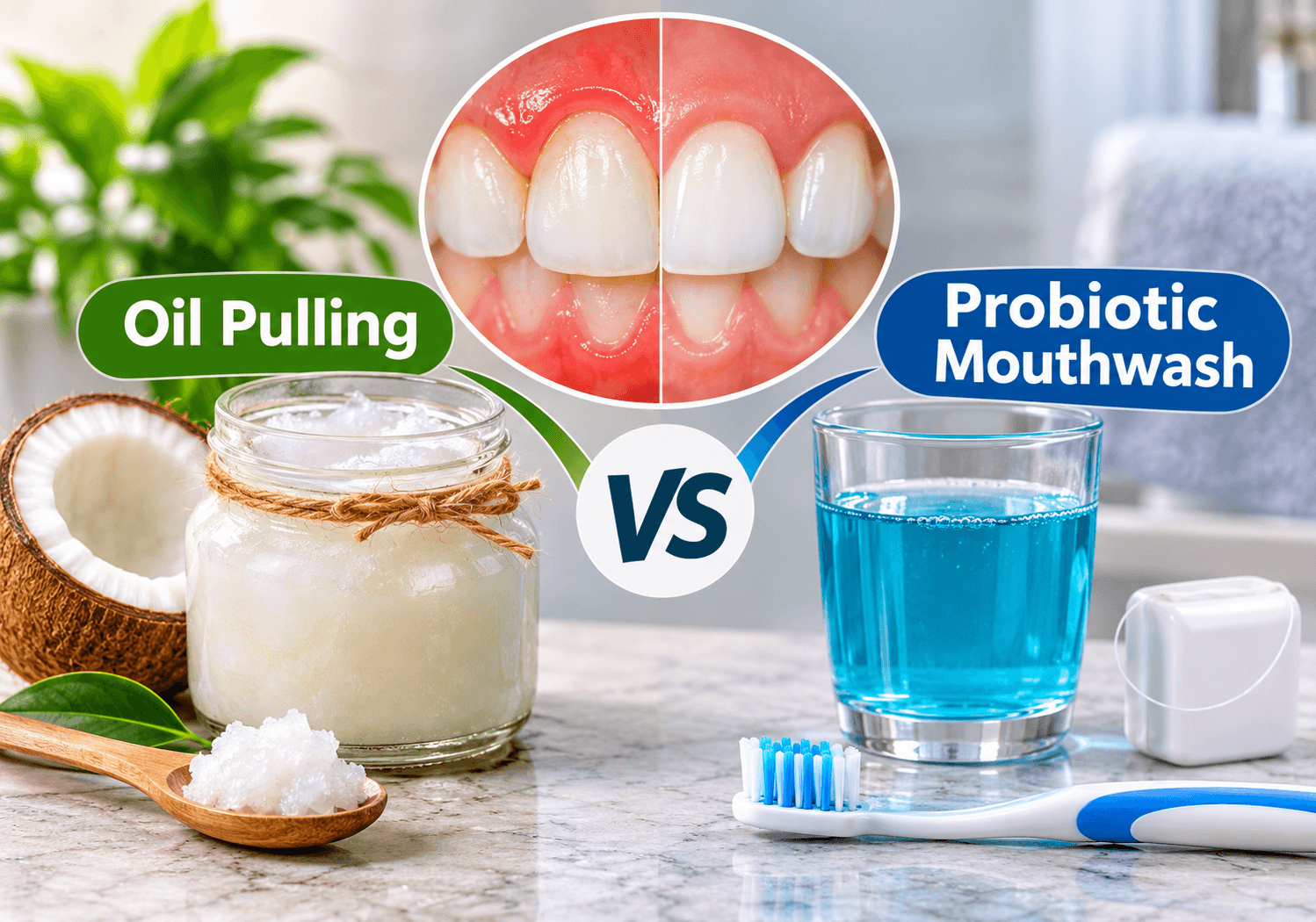
Your gums are doing more work than you think. They hold your teeth in place, protect the bone underneath, and act as the first line of defense against the billions of bacteria that live in your mouth. When that defense breaks down, you get red, swollen gums that bleed when you floss. Left unchecked, it can turn into periodontal disease.
If you’ve been searching for oil pulling vs probiotic mouthwash for gum health, you’re not alone. Both options promise a natural edge over your regular brushing-and-flossing routine, but they work in completely different ways. One relies on mechanical swishing and the antimicrobial fats in plant oils. The other introduces live beneficial bacteria to crowd out the harmful ones.
So which one actually moves the needle on plaque, gingivitis, and that morning bad breath? I’ve broken down the research, the practical steps, the costs, and the trade-offs so you can pick the one that fits your routine.
Quick Answer: Neither oil pulling nor probiotic mouthwash replaces brushing and flossing. For modest plaque and gingivitis reduction, coconut oil pulling (10–15 min swish) has a small but consistent body of evidence. For targeted microbiome rebalancing and halitosis control, probiotic mouthwash with Lactobacillus reuteri or L. rhamnosus strains shows promising results. If your priority is a low-cost, zero-ingredient routine, choose oil pulling. If you want a product with defined probiotic strains and clinical trial data, choose probiotic mouthwash. Many people use both at different times of day.
Side-by-Side Comparison at a Glance
| Factor | Oil Pulling | Probiotic Mouthwash |
| Primary mechanism | Mechanical swishing + lauric/oleic acid antimicrobial action | Competitive exclusion by live beneficial bacteria |
| Key active ingredient | Coconut oil (lauric acid), sesame oil, or sunflower oil | Lactobacillus reuteri, L. rhamnosus, Bifidobacterium strains |
| Typical duration per use | 10–20 minutes | 30 seconds to 2 minutes |
| Frequency | Once daily (morning, before brushing) | 1–3 times daily, as directed |
| Cost per month (approx.) | 5–12 (one bottle of cold-pressed coconut oil) | 15–35 (one bottle of probiotic mouthwash) |
| Evidence base | 6–8 small RCTs, mostly from India | 5–10 RCTs and 2 systematic reviews |
| Best for | General plaque reduction, simple routine, budget-friendly | Halitosis, microbiome rebalancing, post-antibiotic recovery |
| Replaces brushing/flossing? | No | No |
| Shelf life / storage | Cool, dark place; 12–18 months | Refrigerate after opening (check label); 6–12 months |
How Each One Actually Works
Oil Pulling: The Swish-and-Spill Method
Oil pulling is an ancient Ayurvedic practice that has been used in South Asian households for centuries. The modern version is straightforward: you take about one tablespoon (15 mL) of cold-pressed coconut oil, sesame oil, or sunflower oil, and you swish it around your mouth for 10 to 20 minutes. You push the oil between your teeth, let it flow over your gums, and periodically spit it into a trash can (not the sink, because oil can clog pipes).
The working theory has two parts:
- Mechanical action. The swishing physically loosens and lifts plaque biofilm from the tooth surfaces and the gum line. Think of it like a very slow, very gentle rinse that gets into tight spots.
- Lipid-based antimicrobial effect. Coconut oil is roughly 50% lauric acid, a medium-chain fatty acid. When lauric acid breaks down, it forms monolaurin, which has been shown in lab (in-vitro) studies to disrupt the cell membranes of certain oral bacteria, including Streptococcus mutans, the main player in cavity formation. Sesame oil contains sesamol and sesamin, which also show mild antimicrobial activity in test-tube studies.
The oil does not “dissolve” bacteria the way an antibiotic kills them. It more gently reduces the bacterial load and the inflammatory markers in the saliva.
Probiotic Mouthwash: Seeding the Good Guys
Probiotic mouthwash works on a completely different principle. Instead of trying to kill or dislodge bacteria, it introduces a measured dose of live beneficial bacteria—most commonly Lactobacillus reuteri, Lactobacillus rhamnosus, or Bifidobacterium species—directly into your oral environment.
The logic is competitive exclusion. Your mouth is already home to 700+ bacterial species. When you add a healthy strain, those good bacteria compete with harmful species like Porphyromonas gingivalis and S. mutans for the same attachment sites on your teeth and gums and for the same nutrients. Over days to weeks, the balance shifts. The harmful bacteria get crowded out, and the inflammatory response in the gum tissue calms down.
Most probiotic mouthwashes on the market are alcohol-free and contain between 10 million and 1 billion colony-forming units (CFU) per dose. You swish for 30 seconds to 2 minutes, then spit. Some products are formulated as lozenges or tablets that dissolve in the mouth instead.

What the Research Says
This is where the two options diverge the most, so let’s look at the evidence honestly.
Oil Pulling: Small but Real Effects
A 2010 randomized controlled trial published in the Journal of Alternative and Complementary Medicine compared coconut oil pulling to a chlorhexidine mouthwash over 30 days. Participants who swished coconut oil for 10 minutes each morning showed a statistically significant reduction in plaque index and gingival index scores, though the effect size was smaller than chlorhexidine’s. The study had about 60 participants and was conducted in India. [VERIFY: exact author names and DOI]
A 2013 study in the Journal of the Indian Society of Periodontology compared sesame oil pulling to a 0.2% chlorhexidine rinse. After 30 days, the oil-pulling group saw a reduction in plaque scores from a baseline of about 1.8 to 1.1, while the chlorhexidine group went from 1.9 to 0.7. Oil pulling helped, but it was not as potent as the chemical rinse. [VERIFY: exact author names and DOI]
A 2012 RCT looked at sunflower oil versus coconut oil and found both reduced salivary S. mutans counts, with coconut oil showing a slightly larger reduction, likely due to the lauric acid content. [VERIFY: exact author names and DOI]
The honest summary: Oil pulling produces a modest, measurable reduction in plaque and gingival inflammation. The effect is real but small. The studies are generally small (40–80 participants), short (2–4 weeks), and mostly from a single region. There is no large, multi-center, long-term trial. It is not a substitute for brushing twice a day and flossing once a day.
Probiotic Mouthwash: Growing but Still Early Evidence
A 2018 systematic review in the Journal of Clinical Periodontology examined multiple RCTs on probiotic oral products (mouthwashes, lozenges, and yogurts) and found that L. reuteri and L. rhamnosus strains reduced plaque index, gingival bleeding, and halitosis scores compared to placebo. The effect sizes were modest but consistent across studies. [VERIFY: exact author names and DOI]
A 2019 randomized, double-blind, placebo-controlled trial tested a L. reuteri probiotic mouthwash in adults with mild gingivitis. After 4 weeks, the probiotic group showed a 30% greater reduction in bleeding on probing than the placebo group. Salivary levels of P. gingivalis also decreased. [VERIFY: exact author names and DOI]
A 2020 study in the Journal of Dentistry found that a L. rhamnosus lozenge taken twice daily for 6 weeks reduced halitosis (measured by volatile sulfur compound levels) by about 25% compared to placebo. [VERIFY: exact author names and DOI]
The honest summary: Probiotic mouthwash shows a slightly stronger and more specific evidence base than oil pulling, particularly for halitosis and targeted microbiome shifts. However, the total number of well-powered, long-term trials is still limited. The products are newer, and the exact strain, CFU dose, and delivery format matter a lot. Not all “probiotic” mouthwashes are created equal.
Coach’s Tip: If you’re new to either option, start with just one. Give it a full 4 to 6 weeks before you judge results. Plaque and gum inflammation don’t shift overnight. Track your progress by noting whether your gums bleed less when you floss and whether your morning breath is less intense. A simple before-and-after photo of your gum line (taken with your phone) can be surprisingly helpful.
Effectiveness for Specific Gum Issues
Not every gum problem needs the same fix. Here’s how each option stacks up against the issues people actually ask about:
| Gum Concern | Oil Pulling | Probiotic Mouthwash |
| Mild gingivitis (red, swollen gums, occasional bleeding) | Modest reduction in plaque and gingival index over 3–4 weeks | Modest reduction in bleeding on probing; may work a bit faster for inflammation |
| Dental plaque buildup | Mechanical swishing loosens biofilm; small but measurable plaque reduction | Competitive exclusion reduces S. mutans and other plaque-forming species |
| Halitosis (chronic bad breath) | May help if the cause is surface plaque; limited data on VSC reduction | More targeted; L. reuteri and L. rhamnosus show VSC-lowering effects in trials |
| Post-antibiotic oral recovery | No specific evidence | Logical fit: reintroduces beneficial bacteria after antibiotic disruption [VERIFY: direct trial evidence] |
| Early periodontitis (pocket depth 4–5 mm) | Not a treatment; adjunct at best | Limited data; not a replacement for professional periodontal care |
| Gum recession | No evidence it affects recession | No evidence it affects recession |
| Dry mouth (xerostomia) | Oil can coat and temporarily soothe dry tissues | Some probiotic formulations include moisturizing agents; check the label |
If your main concern is general plaque and mild gum inflammation, both options can help as an add-on to your regular routine. If your main concern is bad breath or a disrupted oral microbiome (for example, after a course of antibiotics), probiotic mouthwash has a more targeted mechanism.
Ease of Use and Daily Routine
Oil Pulling: What the Routine Looks Like
- When: First thing in the morning, before you eat, drink, or brush. An empty stomach means the oil is the first thing your oral tissues encounter.
- How much: One tablespoon (15 mL) of cold-pressed, unrefined coconut oil. You can use a small measuring spoon.
- How long: 10 to 15 minutes. Set a phone timer. You don’t need to go to 20 minutes for a meaningful effect.
- Technique: Swish the oil gently. Push it between your teeth with your tongue. Let it flow over your gums. You do not need to force it into tight spaces. The oil will turn milky-white as it emulsifies with saliva and picks up debris.
- Spit: Spit into a trash can. Rinse your mouth with warm water. Then brush and floss as normal.
- Clean up: Wipe the spoon. Store the oil in a cool, dark cabinet. Coconut oil solidifies below about 76 °F (24 °C), so in a cool kitchen it will be a white solid. That’s fine; just scoop it out.
Time cost: 10–15 minutes of active swishing. You can’t really do anything else during that time (you can’t talk much, and you shouldn’t eat or drink).
Probiotic Mouthwash: What the Routine Looks Like
- When: After brushing and flossing, usually in the evening. Some products direct you to use it in the morning too. Follow the label.
- How much: Usually 10 mL (about 2 teaspoons) or one lozenge/tablet.
- How long: Swish for 30 seconds to 2 minutes. Much shorter than oil pulling.
- Technique: Swish around the entire mouth, paying attention to the gum line and back molars. Don’t swallow. Spit it out.
- After: You don’t need to rinse with water afterward. Rinsing can wash away the probiotic bacteria before they have a chance to adhere.
- Storage: Many probiotic mouthwashes need to be refrigerated after opening. Check the label. The live bacteria are sensitive to heat.
Time cost: 1–2 minutes. It slots easily into an existing brushing-and-flossing routine.
Common Mistake: People who try oil pulling often skip it after a week because 15 minutes of swishing feels tedious. If that’s you, probiotic mouthwash is the easier habit to maintain. A 30-second swish after your evening brushing is far less likely to become a chore. Consistency matters more than the specific product.
Safety and Side Effects
Both options are generally safe for healthy adults, but there are a few things to watch.
Oil Pulling
- Aspiration risk. If you fall asleep or zone out while swishing, you could accidentally inhale a small amount of oil. Stay upright and keep your eyes open.
- Gagging. Some people find 15 minutes of oil in their mouth uncomfortable. Start with 5 minutes and build up.
- Acne or clogged pores. Coconut oil is comedogenic. If you have oil-sensitive skin, wipe your lips and chin after spitting.
- Not for children. The swishing-and-spitting routine is hard for young kids, and there’s a choking/aspiration risk.
- Allergies. Rare, but sesame oil can trigger reactions in people with sesame allergies. Coconut oil is generally safe but can be an issue for those with coconut allergy.
Probiotic Mouthwash
- Live bacteria in the mouth. For healthy individuals, this is low risk. If you are immunocompromised (for example, undergoing chemotherapy or on long-term immunosuppressants), talk to your doctor before using any product with live organisms.
- Allergic reactions. Check the ingredient list for carrier agents, sweeteners, or flavorings you might be sensitive to.
- Antibiotic interaction. If you’re taking systemic antibiotics, the antibiotic will kill the probiotic bacteria in the mouthwash, making it ineffective. Wait until you finish the antibiotic course, then start the probiotic product.
- Not a treatment for active infection. If you have an abscess, severe periodontal pockets (6 mm or deeper), or uncontrolled bleeding, you need a dentist or periodontist, not a mouthwash.
Bottom line: Neither product is a replacement for professional dental care. If your gums bleed consistently, you have deep pockets, or you notice a bad taste or pus, see a dentist. These are signs of periodontal disease that need clinical intervention, not a home remedy.
If you have a diagnosed gum condition, are pregnant, or are on immunosuppressive medication, check with your dentist or doctor before adding oil pulling or probiotic mouthwash to your routine.
Cost Comparison
| Item | Typical Price Range | Monthly Cost (approx.) | Notes |
| Cold-pressed coconut oil (16 oz / 454 g bottle) | 8–15 | 5–12 | Lasts 2–3 months at 1 tbsp/day |
| Sesame oil (16 oz bottle) | 6–12 | 4–10 | Slightly less lauric acid than coconut |
| Probiotic mouthwash (100 mL / 3.4 oz bottle) | 20–35 | 15–35 | Lasts 1–2 months depending on frequency |
| Probiotic lozenges (60-count box) | 25–40 | 15–25 | 1–2 lozenges/day |
| Regular alcohol-free mouthwash (500 mL) | 8–15 | 4–8 | For comparison; no probiotics |
Oil pulling is the clear budget winner. A single bottle of good coconut oil will last you two to three months. Probiotic mouthwash costs more because you’re paying for the live culture, the specific strain research, and the formulation. If cost is a major factor, oil pulling is the easier choice.
When to Choose Oil Pulling
Pick oil pulling if:
- You want a zero-additive, single-ingredient routine. No preservatives, no flavorings, no alcohol. Just oil.
- Budget matters. A $10 bottle of coconut oil outlasts several bottles of probiotic mouthwash.
- You already enjoy the meditative, slow-paced nature of a 10-minute morning ritual. It can work as a small mindfulness break before you start your day.
- You want a gentle, mechanical way to help loosen surface plaque in addition to brushing.
- You’re curious about Ayurvedic or traditional oral health practices and want to try them with a reasonable safety profile.
When to Choose Probiotic Mouthwash
Pick probiotic mouthwash if:
- Your main complaint is chronic bad breath (halitosis) that brushing and flossing don’t fully fix.
- You’ve just finished a course of antibiotics and want to help rebalance your oral microbiome.
- You prefer a quick 30-second-to-2-minute step that slots into your existing evening brushing routine.
- You want a product with defined probiotic strains and CFU counts listed on the label, backed by at least some clinical trial data.
- You have mild gingivitis and want an adjunct that targets the bacterial balance specifically.
Can You Use Both Together?
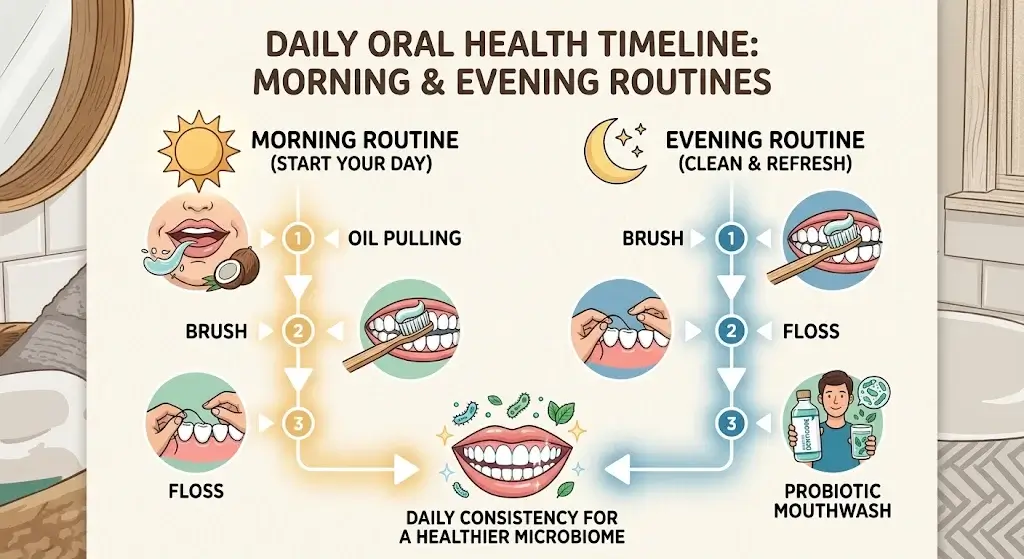
Yes, and there’s no known interaction that makes combining them harmful. A practical split routine looks like this:
- Morning: Oil pulling (10–15 min) → rinse with water → brush → floss.
- Evening: Brush → floss → probiotic mouthwash (swish 30 sec–2 min) → spit, don’t rinse.
This way, you get the mechanical and lipid-based benefits of oil pulling in the morning and the microbiome-targeted benefits of the probiotic in the evening, when your mouth is about to be undisturbed for 7–8 hours of sleep.
Just keep in mind the time and cost. If 15 minutes of swishing in the morning feels like too much, drop the oil pulling and stick with the probiotic mouthwash. Consistency beats complexity.
Who Should Be Careful
- Children under 8: Oil pulling involves swishing and spitting a large amount of oil. Young children may not follow the instructions reliably. Probiotic mouthwash is also not typically formulated or tested for young children. Stick with age-appropriate brushing, flossing, and fluoride.
- Immunocompromised individuals: The live bacteria in probiotic mouthwash pose a small theoretical risk. Talk to your doctor first.
- People with active periodontal disease or dental abscesses: Neither product is a treatment. You need a dentist or periodontist for scaling, root planing, or other clinical interventions.
- Pregnant or postpartum individuals: Both products are generally considered safe, but if you have any medical condition or are taking medication, confirm with your OB-GYN or dentist.
- People with a coconut or sesame allergy: Choose a different oil (sunflower oil) or skip oil pulling entirely.
FAQ
Does oil pulling actually work for gum health?
Research from several small randomized trials suggests that coconut and sesame oil pulling can produce a modest reduction in dental plaque and gingival inflammation over 3–4 weeks. The effect is real but smaller than that of chlorhexidine mouthwash. It works best as an add-on to brushing and flossing, not a replacement. [VERIFY: specific trial citations]
Is probiotic mouthwash better than regular mouthwash for gums?
For specific targets like halitosis and oral microbiome balance, probiotic mouthwash with L. reuteri or L. rhamnosus shows a small but measurable advantage over placebo and, in some trials, over standard alcohol-free mouthwash. For general antimicrobial rinsing, a fluoride or chlorhexidine mouthwash may still be more effective. The “better” choice depends on your specific goal.
How long should you oil pull for gum health?
Most studies use 10 to 15 minutes of swishing once a day. You don’t need to go to 20 minutes. Start with 5 minutes if 15 feels uncomfortable, and build up over a week. The key is consistency: do it at the same time every morning, before eating or drinking.
What probiotic strains are in mouthwash?
The most studied oral probiotic strains are Lactobacillus reuteri (often strains DSM 17938 or ATCC PTA 5289) and Lactobacillus rhamnosus (often strain GG or DSM 71181). Some products also include Bifidobacterium species. Look for the specific strain name and CFU count on the label, not just the word “probiotic.”
Can oil pulling replace brushing and flossing?
No. No amount of oil pulling removes the mechanical abrasion that brushing provides or the interdental cleaning that flossing provides. Oil pulling may help loosen surface plaque and reduce bacterial load slightly, but it does not clean the tooth surfaces or the spaces between teeth the way a toothbrush and floss do. Keep both in your routine.
Can you use oil pulling and probiotic mouthwash on the same day?
Yes. A common approach is oil pulling in the morning (before brushing) and probiotic mouthwash in the evening (after brushing and flossing). There’s no known negative interaction. Just make sure you’re not using a chlorhexidine or alcohol-based mouthwash at the same time as the probiotic, as those can kill the live bacteria.
Conclusion: Pick the One You’ll Actually Use
The honest answer to “oil pulling vs probiotic mouthwash for gum health” is that both are gentle, low-risk add-ons with modest but real benefits, and neither replaces the two things that actually protect your gums: brushing twice a day with fluoride toothpaste and flossing (or using an interdental cleaner) once a day.
If you want the simplest, cheapest, most natural option and you don’t mind a 10-to-15-minute morning swish, go with coconut oil pulling. It’s one ingredient, it’s inexpensive, and the research supports a small but genuine reduction in plaque and gingival inflammation.
If your priority is bad breath, microbiome balance, or a quick step that fits into your evening routine, go with a probiotic mouthwash that lists a specific Lactobacillus strain and CFU count. The evidence base is slightly stronger for targeted outcomes, and the 30-second-to-2-minute swish is easier to stick with long-term.
And if your budget and schedule allow, using both at different times of day gives you the mechanical and lipid benefits of oil pulling in the morning and the competitive-exclusion benefits of probiotics at night.
Whatever you choose, give it four to six weeks before you decide it “doesn’t work.” Track your gum bleeding, your morning breath, and how your floss feels. And if your gums are bleeding heavily, you have deep pockets, or you see pus, book a dental appointment. No mouthwash, no oil, and no probiotic strain can fix what needs a scaler and a periodontist.