Introduction
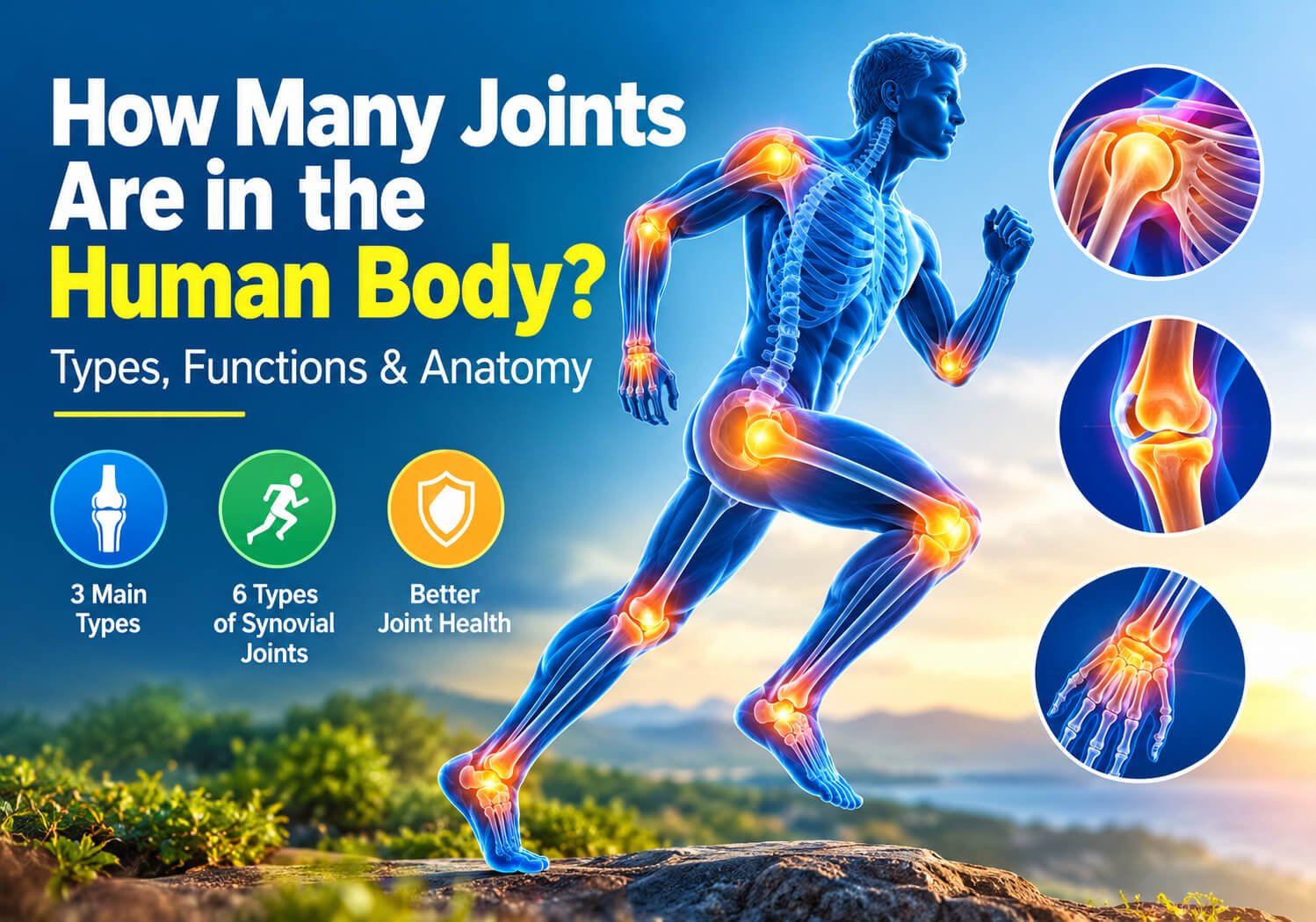
How many joints are in the human body? Adults have approximately 350 joints, according to Cleveland Clinic, although the exact total depends on how a joint is defined and which anatomical connections are included in the count. Some sources commonly cite 360 joints, but this number is not a universally established anatomical total. Joints, also known as articulations, are the places where bones connect and work together to provide stability, support, and movement.
Think about the movements you make every day. You bend your knees when sitting, turn your head when someone calls your name, grip a cup with your fingers, and rotate your shoulders when reaching for an object. These movements depend on joints working with muscles, bones, ligaments, tendons, and other connective tissues.
However, not every joint allows the same amount of movement. Some joints, such as those between many skull bones, are designed primarily for protection and stability. Others, including the shoulder and hip, allow movement in several directions. The spine and pelvis contain connections that balance limited movement with the strength needed to support the body.
Understanding how many joints the human body has requires more than remembering a single number. It also involves learning how joints are classified, what structures they contain, and how they change throughout life.
In this guide, you will discover the estimated number of joints in adults, the three principal structural types of joints, the six types of synovial joints, the locations of major joints, and practical ways to maintain joint health.
How Many Joints Are in the Human Body?
How Many Joints Does an Adult Human Have?
The adult human body has hundreds of joints, with approximately 350 being one commonly cited estimate. The exact number is difficult to establish because anatomists do not always use the same criteria when identifying and counting articulations. Some count every recognized connection between bones, while others focus on particular joint types or connections that permit movement.
A joint may connect two bones directly through connective tissue or cartilage, or it may contain a cavity that allows the connected bones to move relative to one another. These differences affect how joints are categorized and counted.
For example, the fibrous connections between skull bones are joints even though they permit very little movement. The knee, in comparison, is a highly mobile synovial joint with specialized structures that support walking, running, and bending. Both belong to the skeletal system, but their anatomy and functions are different.
Do Humans Have 350 or 360 Joints?
The figures 350 and 360 are both frequently encountered in educational articles and general anatomy discussions. Nevertheless, neither number should be presented as the single, exact total accepted by every anatomical reference.
Cleveland Clinic uses approximately 350 joints as a general estimate for adults and specifically notes that the total depends on how researchers define a joint. The number 360 is also widely repeated, but it should be treated as an approximate figure rather than a definitive scientific count.
When comparing sources, check whether they count all articulations or focus only on movable joints. The distinction matters because the human body contains both mobile and relatively immobile bone connections.
Why Does the Number of Human Joints Vary?
Several factors explain the variation. First, anatomical classification can differ according to the structures being counted. Second, the skeleton changes during childhood and adolescence as bones develop and some previously separate bones fuse. Third, some anatomical descriptions count connected bone surfaces differently from others.
There is also a difference between a joint as a physical connection and a functional joint region. The knee, for instance, is frequently discussed as a single joint, but its anatomy includes more than one articulation. Depending on the counting convention, this can affect a regional total.
How Many Bones and Joints Are in the Human Body?
The typical adult skeleton is described as having 206 bones, whereas the number of joints is usually expressed as an approximate total. These figures measure different things: bones are individual skeletal structures, while joints describe the connections between them.
The key takeaway: If you are asked how many joints are in the human body, approximately 350 is a reasonable commonly cited estimate. The more accurate scientific explanation is that the total varies with anatomical definitions and counting methods.
What Is a Joint in the Human Body?
A joint is a place where two or more bones meet, or where skeletal structures connect in a way recognized as an articulation. The anatomical term for a joint is articulation. Joints form an essential part of the musculoskeletal system because they help the skeleton maintain its shape while allowing the body to move when movement is needed.
What Is the Main Function of a Joint?
The main functions of joints are to connect skeletal structures, provide stability, and allow movement where necessary. Their precise roles depend on their location and type.
For example, the joints of the fingers support delicate movements used for typing, writing, and holding small objects. The hip joints transmit forces between the trunk and the lower limbs, helping support body weight during walking and standing. The joints between skull bones provide strength and protection around the brain while permitting very little movement.
Joints also help the body distribute forces. When you walk, the lower-limb joints coordinate bending and straightening while muscles control the movement. Cartilage and other joint structures help manage mechanical loads and reduce friction at the surfaces of many mobile joints.
What Are Joints Made Of?
The structures found in a joint depend on its type. A synovial joint, such as the knee, has several important components.
Articular cartilage: This smooth connective tissue covers the ends of bones that meet within most synovial joints. It helps create a low-friction surface and distributes loads across the joint.
Ligaments: Ligaments are strong bands of connective tissue that connect bones and help stabilize joints. Their arrangement limits excessive or unwanted movement.
Synovial fluid: This fluid is found inside synovial joint cavities. It lubricates the articulating surfaces and supports the normal functioning of the joint.
Synovial membrane: This tissue lines the inner surface of the joint capsule, except where articular cartilage covers the joint surfaces, and produces synovial fluid.
Joint capsule: A fibrous capsule surrounds a synovial joint and helps hold the joint together. Its structure permits movement while contributing to stability.
Other connective tissues: Some joints contain additional structures, such as menisci, which are specialized fibrocartilage structures that help distribute forces in the knee.
These components do not exist in the same arrangement in every joint. Fibrous joints, for instance, connect bones with dense connective tissue, whereas cartilaginous joints rely on cartilage. Neither has the characteristic fluid-filled cavity of a synovial joint.
Understanding these differences explains why some joints move freely while others primarily provide structural support. A joint’s anatomy is closely related to its purpose.
What Are the Three Main Types of Joints in the Human Body?
Anatomists commonly classify joints into three main structural categories: fibrous, cartilaginous, and synovial. These categories are based on the tissues connecting the bones and whether a joint cavity is present. A separate functional classification describes joints according to the amount of movement they allow.
1. Fibrous Joints
Fibrous joints connect bones through dense fibrous connective tissue. They generally allow very little movement, making them useful in places where strength and stability are more important than flexibility.
One familiar example is the suture between the bones of the skull. These connections hold the skull together and protect the brain. Although the skull bones develop and change during growth, mature skull sutures typically permit little movement.
Another example is a gomphosis, the fibrous connection between a tooth and its socket. The periodontal ligament helps anchor the tooth within the jaw while allowing very small movements under normal forces.
Syndesmoses are another type of fibrous joint. In these connections, bones are held together by ligaments or a sheet of connective tissue. The connection between the tibia and fibula in the lower leg is an example. It provides stability while permitting limited movement appropriate to the joint’s function.
These examples demonstrate that fibrous joints are not all identical. Their permitted movement depends partly on the length, arrangement, and flexibility of their connecting tissues.
2. Cartilaginous Joints
Cartilaginous joints connect bones through cartilage. They usually provide limited movement and help the skeleton combine stability with a degree of flexibility.
There are two main categories: synchondroses and symphyses.
A synchondrosis joins bones through hyaline cartilage. Growth plates in developing long bones are a well-known example. These plates allow bones to lengthen during childhood and adolescence. As development progresses, the growth plates eventually close and the relevant bone regions fuse.
A symphysis connects bones through fibrocartilage, with hyaline cartilage covering the bone surfaces in the typical arrangement. The connections between vertebral bodies and the pubic symphysis are important examples.
The intervertebral discs between vertebral bodies help absorb and distribute loads while allowing the spine to bend and rotate within limits. The pubic symphysis connects the left and right pubic bones and contributes to pelvic stability.
Cartilaginous joints therefore play an important role in activities that require the skeleton to withstand pressure without becoming completely rigid.
3. Synovial Joints
Synovial joints are the most common structural joint category in standard anatomy descriptions and are particularly important for movement. They contain a joint cavity filled with synovial fluid, articular cartilage covering the relevant bone surfaces, and a surrounding joint capsule.
The knee, shoulder, elbow, hip, and wrist contain synovial joints. Their structures allow different combinations of bending, straightening, rotation, gliding, and other movements.
Not every synovial joint has the same range of motion. The shoulder provides substantial freedom of movement, while the knee emphasizes stability and flexion-extension with some rotation. Ligaments, surrounding muscles, bone shape, and other tissues help determine which movements are possible.
The three structural categories explain why a single numerical total cannot capture everything about human joints. Some joints mainly protect and connect skeletal structures, while others are specialized for mobility. Both groups are essential to normal human function.
What Are the Six Types of Synovial Joints?
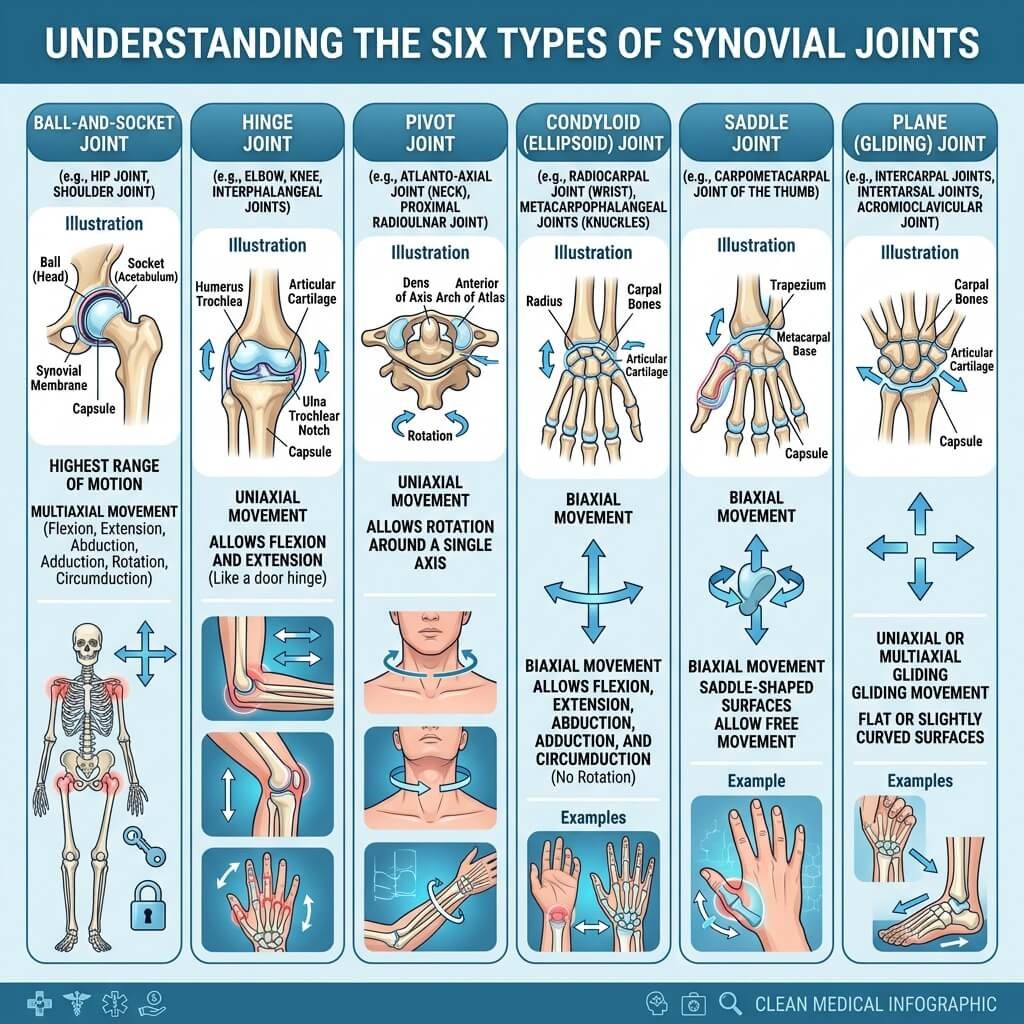
Synovial joints are further divided into six commonly recognized types according to the shape of their articulating surfaces and the movements they permit. Learning these categories helps explain why different parts of the body can perform such different tasks.
Ball-and-Socket Joints
Ball-and-socket joints allow movement in multiple directions, including flexion, extension, abduction, adduction, and rotation. In these joints, the rounded end of one bone fits into a cup-like surface of another bone.
The shoulder and hip are the two principal examples. The shoulder permits a broad range of movement, allowing the arm to reach overhead, move across the body, and rotate. Its mobility comes with a need for coordinated muscular and ligament support.
The hip also allows movement in several directions. However, its deep socket and surrounding structures provide substantial stability for bearing body weight during standing, walking, and running.
Hinge Joints
Hinge joints primarily allow bending and straightening, much like a door hinge. The elbow and the joints between the finger bones are common examples. The knee and ankle are often described as hinge-type joints, although their movements are more complex than a simple mechanical hinge.
These joints allow controlled movement along a principal axis, enabling tasks such as stepping, lifting, and gripping.
Pivot Joints
Pivot joints allow rotation around an axis. A well-known example is the atlanto-axial joint between the first two cervical vertebrae. This joint helps you turn your head from side to side when looking over your shoulder.
Its structure permits rotational movement while maintaining the necessary relationship between the upper cervical vertebrae.
Condyloid Joints
Condyloid, or ellipsoid, joints allow movement in more than one plane but generally do not allow the unrestricted rotation associated with ball-and-socket joints.
The radiocarpal joint of the wrist and the metacarpophalangeal joints, commonly called the knuckles, are examples. They help the hand bend forward and backward, move sideways, and combine movements when manipulating objects.
Saddle Joints
A saddle joint has articulating surfaces shaped to fit together in a way that permits movement in two principal directions. The carpometacarpal joint at the base of the thumb is the classic example.
This joint makes thumb opposition possible, allowing the thumb to move toward the fingertips. Opposition is essential for gripping a pen, buttoning clothing, and holding tools.
Plane or Gliding Joints
Plane joints have relatively flat articulating surfaces that permit sliding or gliding movements. Examples include joints between some of the small carpal bones of the wrist and tarsal bones of the foot.
Although each individual gliding movement is limited, several joints can work together to provide useful overall mobility.
Why these types matter: Joint shape influences possible movement, but it does not determine movement alone. Ligaments, muscles, surrounding tissues, and the demands placed on a joint all contribute to its function. The six categories are a useful framework for understanding the anatomy of everyday movement.
Where Are the Major Joints Located in the Human Body?
Joints appear throughout the body, from the skull and spine to the fingers and toes. Each region has a different arrangement of bones and connective tissues, which is why assigning exact totals to individual body parts requires a clearly defined counting method.
How Many Joints Are in the Human Hand and Fingers?
The hands contain many small articulations that support precise movement. Each hand has joints between the carpal bones of the wrist, between the metacarpal bones and the finger bones, and between the phalanges themselves.
The metacarpophalangeal joints form the knuckles where the fingers meet the palm. The interphalangeal joints allow the fingers to bend and straighten. The thumb has its own joint arrangement, including the highly mobile saddle joint at its base.
These joints work together to support grasping, writing, typing, and intricate finger movements. A single exact joint total for the hand depends on whether the wrist and all smaller articulations are included.
How Many Joints Are in the Wrist?
The wrist is not just one simple connection. The wrist region contains the radiocarpal joint, the midcarpal region, and multiple intercarpal joints between the small carpal bones.
Together, these articulations allow the hand to bend forward and backward, move from side to side, and adjust its position during gripping and lifting. Counting the wrist therefore requires deciding whether the term refers only to the primary wrist joint or to the broader group of articulations in the region.
How Many Joints Are in the Knee?
The knee region is commonly discussed as one large joint, but its anatomy includes the tibiofemoral articulation between the femur and tibia and the patellofemoral articulation between the patella and femur.
These articulations help the leg bend and straighten and contribute to controlled movement while standing, walking, and running. The menisci and ligaments help distribute forces and stabilize the knee. Its classification as a modified hinge-type synovial joint reflects the fact that it allows some rotation as well as flexion and extension.
How Many Joints Are in the Hip?
There are two hip joints: one on the right and one on the left. Each connects the head of the femur to the socket in the pelvis.
The hip’s ball-and-socket design permits movement in multiple directions while providing the stability needed to support the body. These joints work with the surrounding muscles to maintain balance and produce movements such as walking, climbing stairs, and getting up from a chair.
How Many Joints Are in the Spine?
The spine contains several types of articulations. Intervertebral discs connect adjacent vertebral bodies through cartilaginous joints, while facet joints between vertebrae are synovial joints. The joints connecting the skull to the upper cervical spine also allow controlled head movement.
These connections permit the spine to bend and rotate while supporting the trunk and protecting the spinal cord. Exact totals depend on which vertebral levels and associated articulations are included.
How Many Joints Are in the Foot and Ankle?
The ankle region includes the talocrural joint, which allows the foot to move upward and downward relative to the lower leg. The foot also contains joints between the tarsal bones, between the tarsal bones and metatarsals, and between the metatarsals and toe bones.
These structures work together to maintain balance, adapt to uneven surfaces, distribute forces, and support walking and running. The ankle and foot should therefore be understood as a connected system of articulations rather than a single joint.
What Joints Are Found in the Shoulder, Elbow, and Neck?
The shoulder region includes the glenohumeral joint, along with additional articulations that coordinate movements of the shoulder girdle. The elbow complex includes articulations that work together to bend and straighten the arm and support forearm rotation.
In the neck, joints between cervical vertebrae permit controlled bending and rotation. The atlanto-occipital joint helps move the head forward and backward, while the atlanto-axial joint contributes to turning it from side to side.
Taken together, these regions demonstrate the extraordinary variety of human joint anatomy. Rather than relying on unverified regional totals, it is more useful to understand which articulations are present and how they support movement and stability.
How Do Joints Allow the Human Body to Move?
Joints make movement possible by connecting skeletal structures in ways that either permit motion or provide the stability required for other body parts to move safely. Muscles generate the forces that move bones, tendons transmit muscular force to bones, and joints guide or limit the resulting motion.
What Is the Difference Between Movable and Immovable Joints?
Functional classification groups joints according to their range of movement. The three principal categories are synarthroses, amphiarthroses, and diarthroses.
Immovable joints, or synarthroses, permit little or no movement. Skull sutures are a familiar example. Their principal role is to join bones securely.
Slightly movable joints, or amphiarthroses, allow limited movement. The symphyses between vertebral bodies illustrate how a relatively firm connection can provide flexibility while supporting the trunk.
Freely movable joints, or diarthroses, permit substantial movement. All synovial joints belong to this functional category, although their individual ranges and movement patterns differ.
What Are Freely Movable Joints?
Freely movable joints allow the body to perform activities such as walking, reaching, lifting, and throwing. The ball-and-socket shoulder supports extensive arm movement, while hinge-type joints help the elbow bend and straighten.
The term freely movable does not mean that the joint can move without limits. Bone shape, ligaments, the joint capsule, and surrounding muscles restrict motion to help maintain stability. Excessive movement beyond the joint’s normal range can contribute to injury.
What Are Slightly Movable Joints?
Slightly movable joints provide a useful balance between flexibility and structural support. The connections between vertebral bodies are one example. Their cartilage-based design allows small movements at individual levels, while the combined effect across the spine permits bending and rotation.
What Are Immovable Joints?
Immovable joints provide strong connections where major movement is unnecessary. Skull sutures hold the bones around the brain in place. Their structure reflects their protective purpose rather than a need for flexibility.
The key principle is that mobility and stability work together. A joint designed for extensive movement has different structural demands from one designed primarily to hold bones securely together.
What Is the Difference Between Joints, Bones, and Ligaments?
Bones, joints, ligaments, cartilage, and synovial fluid are related parts of the musculoskeletal system, but they are not interchangeable terms. Understanding their differences helps make sense of how the skeleton functions.
Are Joints and Bones the Same Thing?
No. A bone is an individual skeletal structure, whereas a joint is a connection between bones or other recognized skeletal structures. The adult skeleton is commonly described as having 206 bones, but that figure does not establish the number of joints.
For example, the femur is the thigh bone. It forms part of the hip joint with the pelvis and contributes to the knee joint with the tibia and patella. The bone is a structure, while the joints are the places where it articulates with other skeletal components.
What Is the Difference Between a Joint and a Ligament?
A joint is the articulation or connection between skeletal structures. A ligament is a band of connective tissue that connects bones and helps stabilize particular joints.
At the knee, ligaments help control the relationship between the bones during movement. They do not replace the joint itself; they are supporting structures within the joint region.
Ligaments also differ from tendons. Ligaments primarily connect bone to bone, while tendons attach muscles to bones and transmit forces that contribute to movement.
What Is the Difference Between Cartilage and Synovial Fluid?
Articular cartilage is a specialized tissue that covers the surfaces of bones in most synovial joints. It helps reduce friction and spread loads across those surfaces.
Synovial fluid, by contrast, is the lubricating fluid within the joint cavity. It supports smooth movement and helps maintain the joint environment.
Cartilage is a tissue; synovial fluid is a fluid. Both are important for synovial joint function, but they have distinct roles.
These differences show why joints should be understood as complex anatomical systems rather than simply empty spaces between bones. Some joints depend on cartilage-based connections, some rely on fibrous tissue, and synovial joints contain specialized structures for movement.
What Happens to Joints as You Age?
Joints change as the body grows, matures, and ages. These changes affect skeletal development, movement, flexibility, and the way joints respond to physical demands.
Do Babies Have More Joints Than Adults?
It is not accurate to assume that every baby has a higher countable number of joints than every adult. Babies have developing skeletons that contain more separate skeletal elements than the typical mature skeleton. As growth progresses, some bones and bone regions fuse, and particular joint relationships change.
For example, areas of cartilage involved in growth gradually ossify as certain bones mature. This changes the structure of the developing skeleton over time. However, the number of joints cannot be compared reliably without using the same definition and counting method at each stage of life.
How Does Aging Affect Joint Flexibility?
Age-related changes can affect cartilage, connective tissues, muscles, and the range of motion available at a joint. Some people experience more stiffness or discomfort as they get older, while others maintain good mobility through regular activity and appropriate strength training.
The degree of change varies according to genetics, previous injuries, physical activity, overall health, and the presence of joint conditions.
Osteoarthritis is one condition associated with changes in cartilage and other joint tissues. It can cause pain, stiffness, and difficulty with everyday activities, although not everyone experiences the condition in the same way.
Can Joints Become Stiff Over Time?
Yes. Stiffness may result from inactivity, muscle weakness, an injury, inflammation, or an underlying joint condition. Morning stiffness or stiffness following prolonged sitting can have different causes, so persistent or worsening symptoms should not automatically be attributed to age alone.
Regular movement, appropriate exercise, and professional assessment when symptoms persist can help people manage joint function. People with ongoing pain, marked swelling, or declining mobility should consult a healthcare professional to identify the cause and discuss suitable treatment.
Aging does not automatically mean that joints must stop working well. Maintaining strength, mobility, and appropriate activity levels can help support function throughout adulthood.
How Can You Keep Your Joints Healthy?
Joint health depends on several interacting factors, including physical activity, muscle strength, injury prevention, body weight, nutrition, and the management of existing medical conditions. Although no lifestyle routine can guarantee that joint problems will never occur, healthy habits can support movement and overall musculoskeletal function.
Exercise Regularly
Regular activity helps maintain muscle strength, mobility, and physical function. Walking, swimming, cycling, water exercise, and appropriately designed resistance training can be useful options for many people.
The U.S. Centers for Disease Control and Prevention recommends that adults, including many adults with arthritis, aim for at least 150 minutes of moderate-intensity aerobic activity each week and muscle-strengthening activity on at least two days a week. Activity can be divided into shorter sessions, and individuals should choose movements suited to their health and abilities.
Start gradually if you are new to exercise. Increase duration and intensity as your body adapts, and seek professional guidance if a particular movement causes persistent or severe pain.
Maintain a Balanced Diet
A varied, nutrient-rich diet supports general health and the maintenance of bones and muscles. Adequate protein helps maintain muscle tissue, while calcium and vitamin D are important for bone health.
A balanced eating pattern may include vegetables, fruit, whole grains, legumes, sources of protein, and appropriate calcium-rich foods. Individual nutritional needs differ, so supplements should not be considered a guaranteed solution for joint problems. Anyone considering supplements for a diagnosed condition should discuss them with a qualified healthcare professional.
Protect Your Joints From Injury
Use suitable footwear, learn proper exercise techniques, and increase training intensity gradually. Protective equipment is appropriate for many sports, while safe lifting techniques and regular movement breaks may help reduce avoidable physical strain.
Muscle strengthening and balance exercises can also help support joint stability and reduce the risk of falls.
When Should You See a Healthcare Professional?
Arrange a medical assessment for persistent joint pain, repeated swelling, reduced movement, unexplained stiffness, or visible changes in joint shape. Seek prompt medical assessment for severe pain, inability to bear weight after an injury, or a hot and swollen joint accompanied by fever, because these symptoms can indicate a problem requiring urgent treatment.
Keeping joints healthy is not about preventing every possible change. It is about maintaining useful movement, supporting the surrounding muscles, reducing avoidable risks, and addressing symptoms appropriately.

Discover Joint Genesis — a daily wellness supplement designed to support joint health, mobility, and an active lifestyle.*
Frequently Asked Questions About Human Joints
How many joints are in the human body?
Adults have approximately 350 joints according to one commonly cited medical reference, Cleveland Clinic. The exact total depends on how anatomists define a joint and whether all articulations or only certain types are included. Therefore, it is more accurate to describe the total as an estimate than to state a universal exact number.
Are there really 360 joints in the human body?
The figure 360 is frequently repeated in general anatomy discussions, but it is not a universally agreed exact total. Different sources may use different criteria for counting joints. Approximately 350 is another commonly cited estimate for adults, and the important distinction is that both figures depend on the anatomical counting method.
How many movable joints are in the human body?
There is no single universally accepted count of movable joints because the answer depends on which articulations are counted and how much movement qualifies. Synovial joints are classified as freely movable in the functional system, although individual synovial joints differ in their range of motion.
What are the three main types of joints?
The three principal structural types are fibrous, cartilaginous, and synovial joints. Fibrous joints connect bones with dense connective tissue, cartilaginous joints use cartilage, and synovial joints contain a fluid-filled cavity that supports movement.
What is the most common type of joint in the human body?
Synovial joints are described as the most common structural joint type in standard anatomy references. They include the knees, hips, shoulders, elbows, and many joints in the hands and feet. Their joint cavities and specialized supporting structures allow a wide range of movements.
Which joint has the greatest range of motion?
The shoulder is often highlighted for its extensive range of movement because its ball-and-socket structure allows motion in multiple directions. However, its mobility comes with a different balance of stability compared with the hip. The hip also allows multidirectional movement while providing strong support for the body’s weight.
What is the largest joint in the human body?
The knee is generally recognized as the largest joint in the human body. It plays a major role in weight-bearing, walking, climbing stairs, and running. Its complex anatomy includes articulations, cartilage, ligaments, and other supporting tissues that help balance mobility and stability.
Is the knee a hinge joint?
The knee is commonly classified as a modified hinge-type synovial joint. It primarily allows bending and straightening, while also permitting some rotation under appropriate conditions. This combination helps the knee function during walking, sitting, climbing, and other everyday movements.
How many joints are in the human hand?
The number depends on whether a count includes the wrist and all the small articulations of the hand. The hand contains joints between the carpal bones, between the metacarpal bones and finger bones, and between the phalanges. Together, these structures enable gripping, writing, typing, and fine motor control.
Do all joints allow movement?
No. Joints differ in their permitted range of movement. Some, such as skull sutures, are essentially immovable; others permit limited movement; and synovial joints allow more extensive movement. These differences reflect the functions that particular skeletal connections need to perform.
Can you increase the number of joints in your body?
Exercise can improve strength, mobility, balance, and physical function, but it does not ordinarily increase the number of anatomical joints. Joint number is related to skeletal anatomy and how articulations are defined, not to how frequently a person exercises.
Conclusion — Understanding the Number of Joints in the Human Body
So, how many joints are in the human body? Approximately 350 joints is a commonly cited estimate for adults, although some sources give figures such as 360. There is no single universally agreed total because the answer depends on anatomical definitions and counting conventions.
The human body contains three principal structural categories of joints: fibrous, cartilaginous, and synovial. Within the synovial category, six recognized types help explain how the shoulder, hip, knee, wrist, fingers, and other regions support different movements.
Joints do more than connect bones. They help provide stability, guide movement, distribute forces, and make everyday activities possible. Understanding their anatomy also clarifies the differences between bones, ligaments, cartilage, and synovial fluid.
Regular physical activity, appropriate strength training, balanced nutrition, injury prevention, and timely medical care can all support joint function. Persistent pain or swelling should not be ignored, particularly when accompanied by fever or significant difficulty moving.
The most important lesson is that the precise number matters less than understanding how the joints work together to support a healthy, active life. Explore related anatomy resources on the skeletal system, the 206 bones in the adult body, types of synovial joints, and practical approaches to maintaining joint mobility.