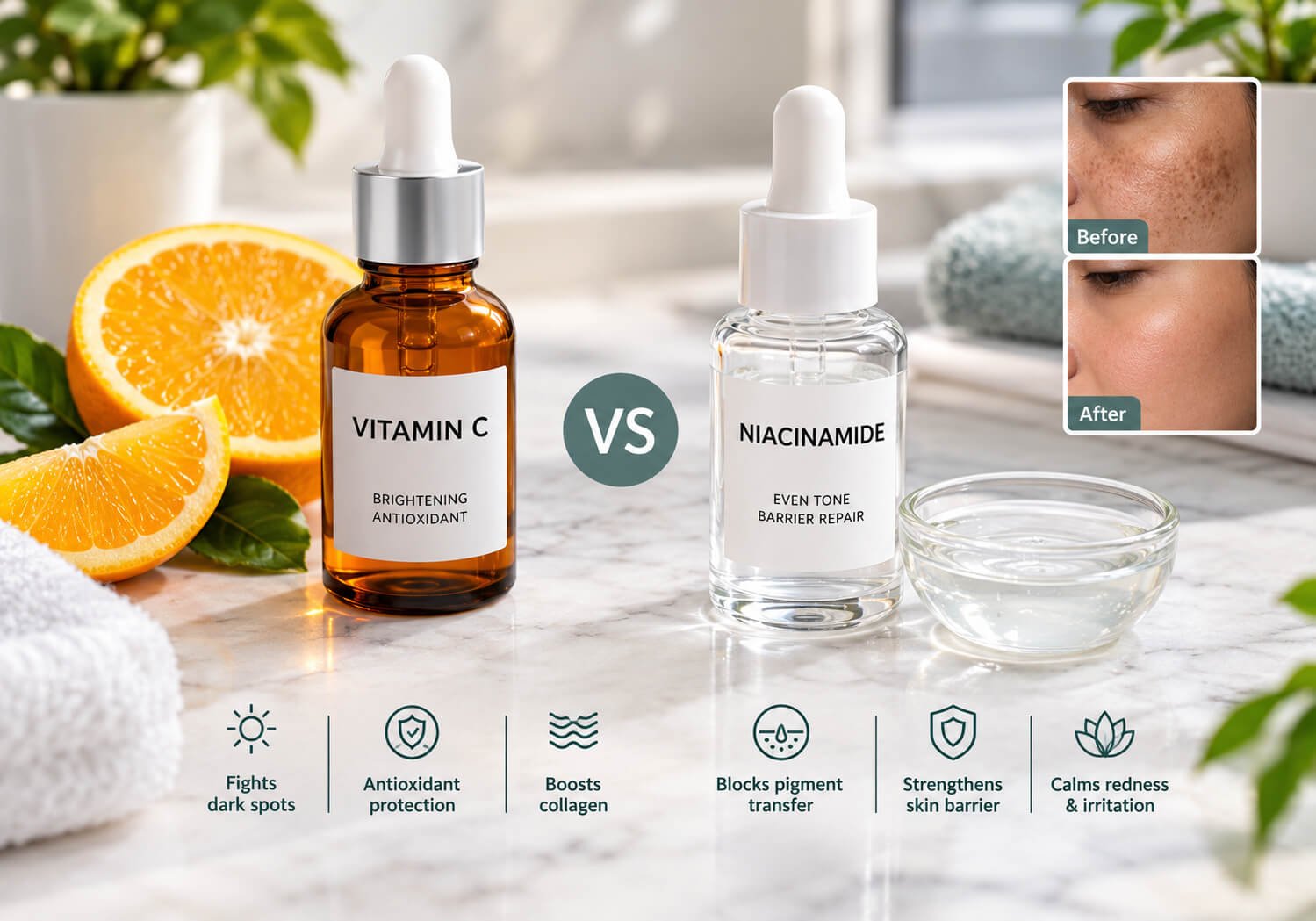
If stubborn dark spots, post-inflammatory acne marks, or uneven skin tone have you frustrated, your skincare search has likely led you to two heavy-hitters: vitamin C vs niacinamide for hyperpigmentation. Both ingredients boast glowing reputations in the dermatology and wellness world for brightening complexions, but they approach skin discoloration through entirely different biological pathways. Understanding how these compounds work, how they affect your skin barrier, and whether they can be used together will help you build an effective, irritation-free routine.
Quick Answer: Vitamin C acts primarily as an antioxidant that inhibits tyrosinase to stop new pigment formation while neutralizing free radicals, whereas niacinamide blocks pigment transfer to skin cells and strengthens the moisture barrier. Vitamin C offers faster brightening for stubborn dark spots, while niacinamide is gentler and excels at overall tone and barrier repair. You can—and often should—use both.
Understanding Hyperpigmentation and Skin Discoloration
Hyperpigmentation occurs when excess melanin—the pigment responsible for skin, hair, and eye color—is overproduced in specific areas. This overproduction is frequently triggered by ultraviolet (UV) radiation from the sun, hormonal fluctuations, inflammation, or physical trauma to the skin, such as acne lesions.
Addressing this discoloration requires disrupting the melanin production cycle at various stages. Dermatological research shows that targeting multiple steps of melanogenesis yields superior results compared to relying on a single mechanism Mayo Clinic. This is where comparing active ingredients becomes essential for crafting an effective topical routine.
Vitamin C: Mechanisms, Benefits, and Application
Vitamin C—most commonly formulated as L-ascorbic acid in clinical skincare—is a powerhouse antioxidant. Its primary role in treating hyperpigmentation involves interacting with copper ions at active sites of tyrosinase, the enzyme responsible for converting the amino acid tyrosine into melanin.
By neutralizing tyrosinase, vitamin C effectively slows down the creation of new dark spots. Additionally, its potent antioxidant properties scavenge free radicals generated by UV exposure and environmental pollution, preventing oxidative stress from triggering further pigment flare-ups Harvard Health. Beyond brightening, vitamin C plays a vital role in collagen synthesis, improving overall skin firmness and texture.
Key Benefits of Vitamin C
- Tyrosinase Inhibition: Directly suppresses the enzymatic steps required for melanin synthesis.
- Antioxidant Protection: Neutralizes reactive oxygen species (ROS) caused by daily UV and pollutant exposure.
- Collagen Support: Promotes structural protein production for firmer, resilient skin.
Niacinamide: Mechanisms, Benefits, and Application
Niacinamide, also known as vitamin B3, takes a completely different approach to achieving an even skin tone. Rather than stopping melanin at the enzymatic source, niacinamide works downstream by inhibiting melanosome transfer—the process by which pigment-containing packages are handed off from melanocytes to surrounding epidermal keratinocytes.
Clinical studies highlight niacinamide’s ability to reduce the appearance of yellowing, redness, and blotchiness while simultaneously boosting ceramides and free fatty acids in the stratum corneum. This strengthens the skin barrier, making niacinamide exceptionally well-tolerated by sensitive skin types who might experience stinging or redness from high-potency acids.
Key Benefits of Niacinamide
- Melanosome Transfer Block: Prevents existing pigment from migrating to the surface layers of the skin.
- Barrier Reinforcement: Stimulates natural lipid synthesis to lock in moisture and reduce transepidermal water loss.
- Anti-Inflammatory Action: Calms redness, making it ideal for skin recovering from acne breakouts or irritation.
Side-by-Side Comparison Table
| Feature / Attribute | Vitamin C (L-Ascorbic Acid) | Niacinamide (Vitamin B3) |
| Primary Action | Inhibits tyrosinase & neutralizes free radicals | Blocks melanosome transfer & repairs barrier |
| Best For | Stubborn sun spots, dullness, and antioxidant defense | Sensitive skin, redness, barrier health, and overall tone |
| Optimal pH Range | Low pH (approx. 2.5 to 3.5 for L-ascorbic acid) | Neutral pH (approx. 5.0 to 7.0) |
| Irritation Potential | Moderate to high (especially at concentrations above 15%) | Very low (exceptionally high tolerance) |
| Stability | Highly sensitive to light, heat, and air oxidation | Highly stable across various formulations |
Can You Use Vitamin C and Niacinamide Together?
A common myth in skincare is that vitamin C and niacinamide cancel each other out or create nicotinic acid, which causes flushing and irritation. Modern chemical stability studies have debunked this old concern. Unless exposed to extreme, prolonged high heat in a laboratory setting, these two ingredients coexist peacefully and complement one another wonderfully.
Combining them offers a dual-action defense against hyperpigmentation: vitamin C stops the initial pigment production, while niacinamide prevents that pigment from traveling up to become visible on your face.
How to Layer Vitamin C and Niacinamide in Your Routine
To maximize the benefits of both ingredients without overwhelming your skin, follow a structured application order. As a general rule in dermatology, skincare products should be applied from the lowest pH to the highest pH, or from thinnest consistency to thickest consistency.
- Morning Cleansing: Start with a gentle, hydrating cleanser that does not strip your natural lipid barrier.
- Vitamin C Application: Apply 3 to 4 drops of your vitamin C serum to dry skin, allowing it 60 to 90 seconds to absorb fully.
- Niacinamide Application: Follow with your niacinamide serum or moisturizer containing niacinamide.
- Sun Protection: Finish your morning routine with a broad-spectrum sunscreen of SPF 30 or higher. Daily UV defense is non-negotiable when treating hyperpigmentation, as sunlight reactivates melanin production instantly.
Coach’s Tip: Patience and Patch Testing
Coach’s Tip: Skincare results do not happen overnight. Skin cell turnover takes roughly 28 to 45 days depending on your age, meaning you need to use a consistent routine for at least 8 to 12 weeks before evaluating whether an ingredient is working. Always perform a patch test on your inner forearm or behind your ear for 48 hours before applying a new active ingredient to your face.
Common Mistakes and How to Fix Them
- Mistake 1: Skipping Daily Sunscreen. Applying brightening serums while skipping SPF is like mopping the floor with the faucet running. UV exposure immediately reverses any progress made against dark spots. The Fix: Apply a broad-spectrum mineral or chemical sunscreen every single morning, rain or shine.
- Mistake 2: Mixing Too Many Actives at Once. Layering high-strength vitamin C, retinoids, and exfoliating acids like glycolic acid simultaneously compromises the skin barrier. The Fix: Introduce one active at a time, allowing your skin two weeks to adjust before adding another.
- Mistake 3: Storing Serums Improperly. L-ascorbic acid oxidizes rapidly when exposed to sunlight and air, turning dark yellow or brown and losing efficacy. The Fix: Store your vitamin C in a cool, dark place (or the refrigerator) and tightly seal the cap immediately after use.
Frequently Asked Questions
Which is better for dark spots, vitamin C or niacinamide?
Vitamin C generally works faster on stubborn, deep-set dark spots and sun damage due to its direct action on the tyrosinase enzyme. However, niacinamide is superior if you have sensitive skin or want to improve overall skin texture, redness, and barrier health while gradually fading discoloration.
Can I use vitamin C and niacinamide in the same routine?
Yes, you can safely use both ingredients in the same routine. Modern formulations are stable, and combining them provides a multi-pathway approach to fading hyperpigmentation by stopping melanin creation and blocking its transfer to the skin’s surface.
How long does it take to see results on hyperpigmentation?
Most clinical studies indicate that visible lightening of hyperpigmentation takes between 8 to 12 weeks of consistent daily use. Because skin cells take roughly a month to turn over, patience and daily sun protection are critical for success.
Does niacinamide cause purging?
Niacinamide does not increase cell turnover rates, so it does not cause true skin purging. If you experience breakouts or irritation after starting a niacinamide product, it is likely a mild sensitivity reaction to the formulation or an inactive ingredient rather than purging.
Can sensitive skin tolerate vitamin C?
Pure L-ascorbic acid can sometimes cause stinging, redness, or dryness in sensitive skin. If your skin is easily irritated, look for gentler vitamin C derivatives like sodium ascorbyl phosphate or magnesium ascorbyl phosphate, or opt for niacinamide instead.
Conclusion
When evaluating vitamin C vs niacinamide for hyperpigmentation, the right choice depends on your specific skin type and goals. Vitamin C delivers powerful antioxidant defense and rapid enzymatic inhibition for stubborn spots, while niacinamide excels at strengthening the moisture barrier and stopping pigment transfer gently. For many individuals, incorporating both ingredients strategically creates an unstoppable duo for a clearer, brighter, and more balanced complexion.