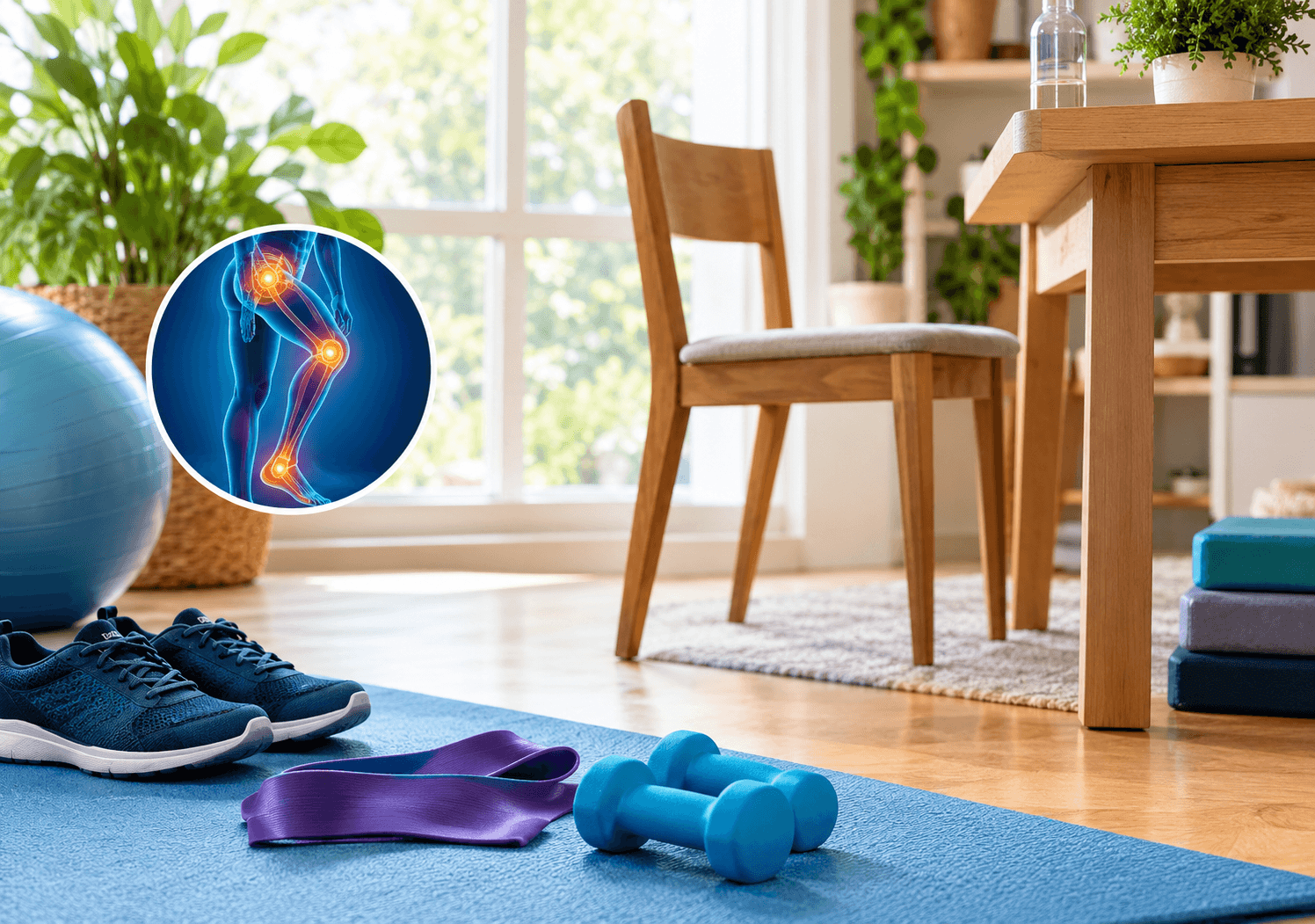
Maintaining physical independence as we grow older comes down to two vital physical attributes: balance and joint mobility. Many older adults notice that tying their shoes, stepping over high curbs, or getting out of deep armchairs becomes progressively harder over time. Learning how to improve balance and mobility in seniors is not just about staying active—it is a proven strategy to prevent falls, protect joint health, and maintain total daily freedom.
Staying upright and moving comfortably requires a coordinated team effort between your brain, nerves, inner ear, eyes, and muscles. When joint mobility drops, your feet cannot clear the floor cleanly, changing your stride and raising your fall risk. Thankfully, age-related loss of balance and joint range of motion is not permanent. With consistent, gentle exercises, older adults can restore their stability, rebuild core strength, and feel confident on their feet again.
Quick Answer
To improve balance and mobility in seniors, practice daily functional movements that combine dynamic balance, ankle dorsiflexion, and hip mobility. Exercises like single-leg stands, heel-to-toe tandem walks, sit-to-stands, and seated ankle circles rebuild neural connections, strengthen core and lower-body muscles, and reduce fall risk in as little as 4 to 8 weeks.
Why Seniors Lose Balance and Mobility
As the body ages, several physiological systems experience natural changes. Understanding these factors helps us target the right muscles and joints during training.
- Age-Related Muscle Loss (Sarcopenia): Starting around age 30, adults naturally lose muscle mass if they do not perform resistance training. By age 70, this loss can accelerate, particularly affecting the lower body muscles needed to step quickly and catch yourself during a slip.
- Reduced Proprioception: Proprioception is your brain’s internal GPS. Tiny receptors in your joints and tendons send constant signals to your brain about where your body is in space. As these receptors become less sensitive, reaction time slows down.
- Inner Ear and Vision Changes: The vestibular system in your inner ear works alongside your vision to maintain spatial orientation. Age-related changes in vision or vestibular function make visual depth perception harder, relying more heavily on clear signals from your feet and ankles.
- Joint Stiffness and Decreased Dorsiflexion: Decreased synovial fluid production and tight connective tissues lead to stiff hips and tight calves. Poor ankle dorsiflexion—the ability to pull your toes up toward your shins—causes older adults to drag their feet, dramatically increasing tripping hazards.
The Essential Rules of Safe Balance Training
Before beginning any routine, safety must be your top priority. Balance exercises are meant to challenge your neurological system safely without causing a fall.
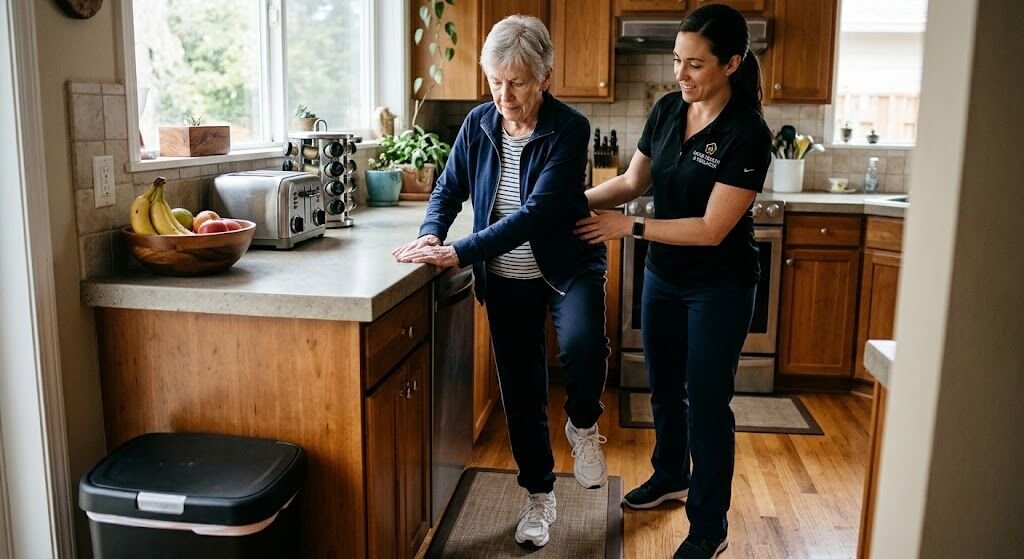
- Use a Sturdy Support: Always perform standing exercises next to a sturdy kitchen counter, a solid table, or a wall. Avoid using chairs with wheels or flimsy towel racks for support.
- Wear Proper Footwear: Perform these drills wearing flat, supportive athletic shoes with non-slip rubber soles. Avoid loose slippers, slick socks, or high heels.
- Clear the Floor: Clear your exercise space of throw rugs, electric cords, pets, and clutter.
- Focus on Quality Over Duration: Neurological adaptation requires focus. Short, 10-to-15-minute daily sessions are much more effective than one long session once a week.
Top 10 Exercises to Improve Balance and Mobility in Seniors
Here is a complete, progressive list of exercises designed specifically for older adults. Each exercise features step-by-step coaching cues, common mistakes, and adjustments to make the movement easier or harder.
1. Supported Single-Leg Stand
- Primary Muscles Worked: Gluteus medius, quadriceps, ankle stabilizers.
- Why It Works: Single-leg balance forces the lateral hip muscles to fire, stabilizing the pelvis during every step you take while walking.
How to Do It Step-by-Step:
- Stand upright near a sturdy counter or chair back, placing both hands lightly on the surface for support.
- Fix your eyes on a non-moving point on the wall ahead of you at eye level.
- Shift your body weight smoothly onto your right foot while keeping your right knee slightly soft (not locked out).
- Slowly lift your left foot 2–3 inches (5–8 cm) off the ground.
- Hold this position for 10 to 30 seconds while maintaining an upright, tall posture.
- Return your foot to the floor and repeat on the opposite side.
- Sets & Reps: 2–3 sets of 15–30 second holds per leg.
- Regression (Easier): Keep the toes of your lifted foot resting lightly on the floor like a kickstand.
- Progression (Harder): Reduce support from full hands to two fingertips, or hover your hands 1 inch (2.5 cm) above the counter.
Coach’s Tip: Avoid gripping the counter until your knuckles turn white. Pretend the counter is made of wet paint; touch it gently with your fingertips only when you feel an actual balance correction is needed.
2. Seated Ankle Circles and Dorsiflexion Pumps
- Primary Muscles Worked: Tibialis anterior, gastrocnemius, soleus, ankle complex.
- Why It Works: Flexing and circling the ankles restores crucial ankle mobility, allowing your toes to clear the carpet when walking.
How to Do It Step-by-Step:
- Sit upright in a firm, armless chair with your feet flat on the floor.
- Lift your right leg slightly, extending the foot off the ground.
- Slowly point your toes forward away from you, then pull them up toward your shins as far as comfortably possible (dorsiflexion). Repeat 10 times.
- Next, rotate your ankle in a smooth, wide circle clockwise 10 times, then counter-clockwise 10 times.
- Lower your leg and switch to the left side.
- Sets & Reps: 2 sets of 10 pumps and 10 full circles per leg.
- Regression (Easier): Perform the movement with your heel resting gently on the floor.
- Progression (Harder): Write the letters of the alphabet in the air using your big toe while keeping your leg elevated.
3. Heel-to-Toe Tandem Walk
- Primary Muscles Worked: Core stabilizers, calves, gluteal muscles, proprioceptors.
- Why It Works: Tandem walking narrows your base of support, mimicking the dynamic stability needed to navigate tight hallways and crowded spaces.
How to Do It Step-by-Step:
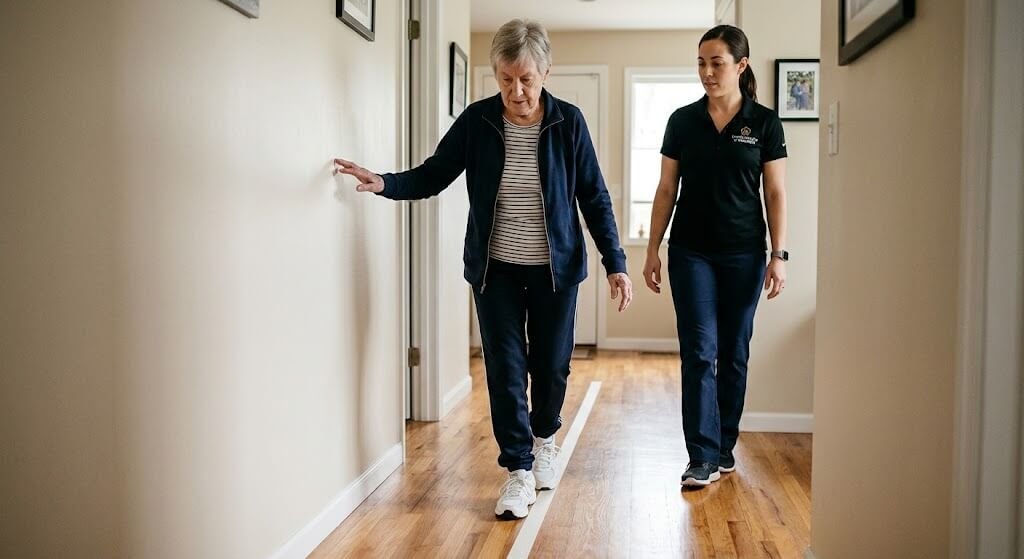
- Stand next to a long, clear wall for safety.
- Place your right foot directly in front of your left foot so that the heel of your right foot touches (or comes close to touching) the toes of your left foot.
- Look straight ahead toward the end of the room rather than staring down at your feet.
- Step forward with your left foot, placing its heel directly in front of your right toes.
- Continue stepping forward in a straight line for 10 to 15 paces, touching the wall lightly for balance if necessary.
- Sets & Reps: 3 lengths of 10–15 steps forward.
- Regression (Easier): Perform a staggered walk where feet are offset slightly wider (about 3–4 inches or 7–10 cm apart) rather than in a strict straight line.
- Progression (Harder): Perform 10 steps backward with fingertips hovering near the wall.
Common Mistake: Looking down continuously at your feet. Staring at the floor curves your upper back forward and disrupts your center of gravity. Keep your chin parallel to the floor and look straight ahead.

4. Chair Sit-to-Stand (Functional Squat)
- Primary Muscles Worked: Quadriceps, gluteus maximus, hamstrings, core.
- Why It Works: Building functional leg strength is the single best predictor of maintaining daily independence. A stronger lower body makes rising from toilets, chairs, and car seats smooth and effortless.
How to Do It Step-by-Step:
- Sit near the front edge of a sturdy dining chair with your feet shoulder-width apart, pulled back slightly behind your knees.
- Lean forward slightly from your hips, keeping your chest open and back flat (“nose over toes”).
- Press firmly through your heels and stand up completely, squeezing your glutes at the top.
- Pause briefly, then bend your hips and knees to lower yourself back down into the chair in a controlled 3-second tempo.
- Sets & Reps: 2–3 sets of 8–12 reps.
- Regression (Easier): Push off the armrests or seat of the chair with your hands to assist the movement.
- Progression (Harder): Cross your arms across your chest, avoiding hand assistance entirely, or pause for 2 seconds halfway down before sitting.
5. Standing Hip Abduction
- Primary Muscles Worked: Gluteus medius, gluteus minimus, lateral core.
- Why It Works: Strong hip abductors prevent your pelvis from dropping sideways during walking, keeping your gait steady and balanced.
How to Do It Step-by-Step:
- Stand facing a sturdy counter or chair, placing both hands lightly on top.
- Keep your posture tall, belly button gently pulled in toward your spine.
- Slowly raise your right leg out to the side, keeping your toe pointed forward (do not rotate your toes outward).
- Pause for 1 second at the top of the movement, then lower your leg back down under control.
- Complete all reps on one side before switching to the other.
- Sets & Reps: 2–3 sets of 10–12 reps per leg.
- Regression (Easier): Slide your foot out along the smooth floor rather than lifting it completely in the air.
- Progression (Harder): Add a light ankle weight—such as 1 lb (0.45 kg) to 2 lb (0.9 kg)—or wrap a light loop resistance band around your ankles.
6. Standing Heel-and-Toe Raises
- Primary Muscles Worked: Calf muscles (gastrocnemius and soleus), shin muscle (tibialis anterior).
- Why It Works: Strengthens the foot-and-ankle complex, boosting your ability to rise onto your toes or pull your feet up when stepping over obstacles.
How to Do It Step-by-Step:
- Stand upright holding onto a counter or chair back with both hands.
- Slowly press through the balls of your feet to raise your heels high off the floor. Pause at the top for 1 second.
- Lower your heels back to the ground under control.
- Immediately rock back onto your heels, lifting your toes and the balls of your feet off the floor. Pause for 1 second.
- Lower your forefeet back down. That equals 1 complete rep.
- Sets & Reps: 2 sets of 10–12 full reps.
- Regression (Easier): Perform calf raises only (heel lifts) without rocking back onto your heels.
- Progression (Harder): Perform single-leg heel raises while holding lightly onto the counter.
7. Seated Spinal Twists and Thoracic Mobility
- Primary Muscles Worked: Obliques, erector spinae, thoracic spine stabilizers.
- Why It Works: Rotation in the upper back (thoracic spine) allows you to look over your shoulder, reach for items in the car, and maintain fluid arms-and-torso movement while walking.
How to Do It Step-by-Step:
- Sit tall in a chair with both feet flat on the ground, shoulder-width apart.
- Cross your arms over your chest or place your left hand on the outside of your right knee.
- Inhale to lengthen your spine tall toward the ceiling.
- Exhale as you gently twist your torso to the right from your mid-back, turning your head comfortably in the same direction.
- Hold for 3–5 seconds, return to center, and twist to the left.
- Sets & Reps: 2 sets of 8 smooth twists per side.
- Regression (Easier): Keep your eyes forward and rotate only your shoulders gently.
- Progression (Harder): Extend your trailing arm out behind you as you rotate, opening your chest wider.
8. Weight Shifts (Side-to-Side and Front-to-Back)
- Primary Muscles Worked: Quadriceps, hamstrings, gluteals, ankles, core.
- Why It Works: Weight shifts train your neurological system to handle sudden center-of-gravity displacements, helping you catch your balance if bumped in a crowd.
How to Do It Step-by-Step:
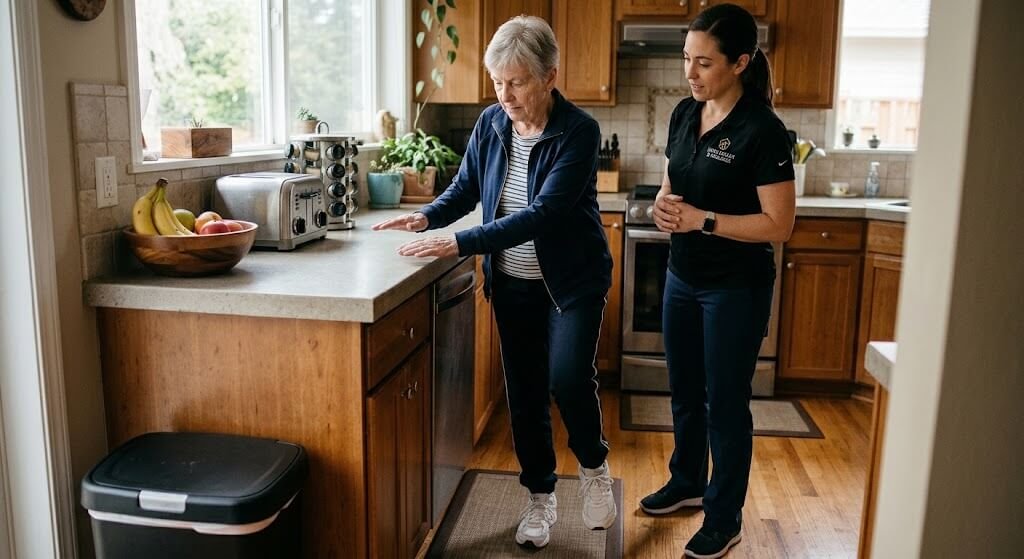
- Stand tall with your feet slightly wider than shoulder-width apart, holding a counter lightly.
- Slowly shift your weight onto your right foot, allowing your left heel to rise slightly while keeping left toes touched down.
- Hold for 3 seconds, feeling your right foot and leg activate to support your weight.
- Shift smoothly back through the center over to your left foot. Hold for 3 seconds.
- Repeat for 10 complete side-to-side cycles.
- Sets & Reps: 2 sets of 10 side-to-side and 10 front-to-back weight shifts.
- Regression (Easier): Keep both feet completely flat on the floor while shifting weight.
- Progression (Harder): Lift the non-supporting foot completely 1 inch (2.5 cm) off the floor as you shift.
9. Clock Reach Drill
- Primary Muscles Worked: Core, standing leg glute and calf, shoulder stabilizers.
- Why It Works: Challenges multi-directional dynamic balance while requiring single-leg control on a stable stance leg.
How to Do It Step-by-Step:
- Stand on your left leg with your left hand lightly touching a counter or chair back.
- Imagine standing in the center of a clock face where 12 o’clock is directly ahead and 6 o’clock is directly behind.
- Reach your right foot forward to tap 12 o’clock lightly on the floor. Return to center.
- Reach your right foot out to 3 o’clock (side). Return to center.
- Reach your right foot back to 6 o’clock. Return to center.
- Perform 3 complete clock cycles, then switch standing legs.
- Sets & Reps: 2–3 full clock cycles per leg.
- Regression (Easier): Tap only 12 o’clock and 6 o’clock while maintaining a firmer two-hand grip.
- Progression (Harder): Reach further out to 1 o’clock, 3 o’clock, and 5 o’clock without letting your reaching foot rest heavy on the floor.
10. Seated Hamstring and Hip Flexor Stretch
- Primary Muscles Worked: Hamstrings, hip flexors, lower back.
- Why It Works: Tight hamstrings pull down on your pelvis and restrict your stride length, making steps short and stiff. Keeping these muscles pliable improves stride mechanics.
How to Do It Step-by-Step:
- Sit near the front edge of a firm chair.
- Extend your right leg straight out in front of you, placing your heel on the floor with toes pointing toward the ceiling.
- Keep your back straight and chest lifted tall.
- Hinge forward gently from your hips (not rounding your waist) until you feel a comfortable, gentle stretch along the back of your right thigh.
- Hold for 20 to 30 seconds while breathing deeply.
- Switch to your left leg.
- Sets & Reps: 2–3 holds of 20–30 seconds per leg.
- Regression (Easier): Allow a gentle bend in the knee if pulling feels too tight behind the knee joint.
- Progression (Harder): Gently reach toward your toes with your right hand while keeping your back long and straight.
Exercise Sets, Reps, and Goal Matrix
To make consistent progress, use this guide to structure your daily or weekly sessions according to your personal fitness level and goals.
| Training Focus | Recommended Exercises | Sets & Reps / Duration | Weekly Frequency | Primary Benefit |
| Beginner Balance & Safety | Supported Single-Leg Stand, Seated Ankle Circles, Sit-to-Stand (Assisted) | 2 sets x 8–10 reps or 15–20 sec holds | 4–5 days per week | Rebuilds basic nerve signals, ankle joint range, and chair independence. |
| Intermediate Mobility & Gait | Heel-to-Toe Tandem Walk, Standing Hip Abduction, Heel & Toe Raises | 2–3 sets x 10–12 reps or 10 paces | 3–4 days per week | Improves walking posture, balance, and obstacle clearance. |
| Advanced Dynamic Stability | Clock Reach Drill, Unassisted Sit-to-Stand, Dynamic Weight Shifts | 3 sets x 12 reps or 30 sec holds | 3 days per week | Enhances quick reaction times, dynamic core stability, and full balance confidence. |
Weekly Balance and Mobility Schedule
Consistency beats intensity when training your brain and nervous system. Here is a balanced, practical weekly template designed for older adults.
When building overall health, balance work pairs nicely with other lifestyle habits. For instance, maintaining healthy lean muscle mass is supported by getting adequate nutrition; reading our guide on how protein helps control hunger can help you structure nutritious meals that fuel your workouts. Furthermore, overall energy and nervous system health go hand-in-hand with rest—learn more in our analysis on how sleep affects metabolism to ensure your body recovers fully between training sessions.
Key Safety Precautions and When to Seek Help
While physical activity is safe for most older adults, listening to your body is crucial. Always consult a healthcare professional before starting a new exercise program, especially if you have chronic health conditions or past injuries.
- Dizziness or Vertigo: If you feel lightheaded, dizzy, or faint, stop immediately and sit down. Dizziness can stem from blood pressure fluctuations, medication side effects, or inner ear issues that require medical evaluation.
- Joint Pain: You should feel muscle engagement and gentle stretching, but never sharp, shooting, or pinching joint pain in your hips, knees, or spine.
- History of Unexplained Falls: If you have experienced multiple unexplained falls over the past 6 months, ask your doctor for a referral to a licensed physical therapist for a comprehensive gait evaluation.
Frequently Asked Questions
What are the best exercises to improve balance in seniors?
The most effective balance exercises for older adults combine leg strength and core control with proprioceptive challenges. Top choices include single-leg stands next to a counter, heel-to-toe tandem walking, seated-to-standing chair squats, and standing hip abductions. Combining these with ankle mobility exercises provides the best overall improvements in balance and walking stability.
How often should seniors do balance exercises?
Seniors can safely perform balance and mobility exercises 3 to 5 days per week. Because balance exercises focus on neurological coordination rather than high-intensity muscle damage, short 10-to-15-minute daily sessions yield faster results than long, infrequent workouts.
Why do seniors lose balance and flexibility as they age?
Age-related decline in balance and flexibility is caused by a mix of muscle loss (sarcopenia), reduced joint flexibility, stiff connective tissue, and slower neural signaling between the brain, inner ear, and lower body joints. Inactivity accelerates these changes, but targeted balance training can reverse much of the lost function.
How long does it take for older adults to improve balance?
Most seniors notice initial improvements in confidence and stability within 4 to 6 weeks of consistent practice 3 to 4 days per week. Research shows that structured balance and functional strength programs produce measurable balance improvements within 8 to 12 weeks according to the CDC physical activity guidelines.
Can older adults regain lost mobility?
Yes, older adults can regain lost mobility, flexibility, and strength at almost any age. Neurological adaptation and muscle tissue building continue throughout life. Practicing daily functional movements, progressive joint mobility drills, and basic leg strengthening allows seniors to restore lost range of motion and preserve daily independence.
Is walking enough to improve balance in seniors?
While walking is fantastic for heart health, circulation, and mood, it is generally not enough on its own to significantly improve balance. Balance requires specific multidirectional challenges—like turning, stepping sideways, single-leg balancing, and ankle flexibility work—that standard forward walking does not provide.
Conclusion
Learning how to improve balance and mobility in seniors is one of the most rewarding steps an older adult can take to protect their physical freedom, build confidence, and prevent life-altering falls. By dedicating just 15 minutes a day to simple exercises like single-leg stands, sit-to-stands, heel-to-toe walking, and gentle ankle mobility drills, you can retrain your nervous system, strengthen key lower-body muscles, and feel sturdy on your feet again. Start slowly using solid support, remain consistent, and celebrate every small improvement in your stability and comfort.