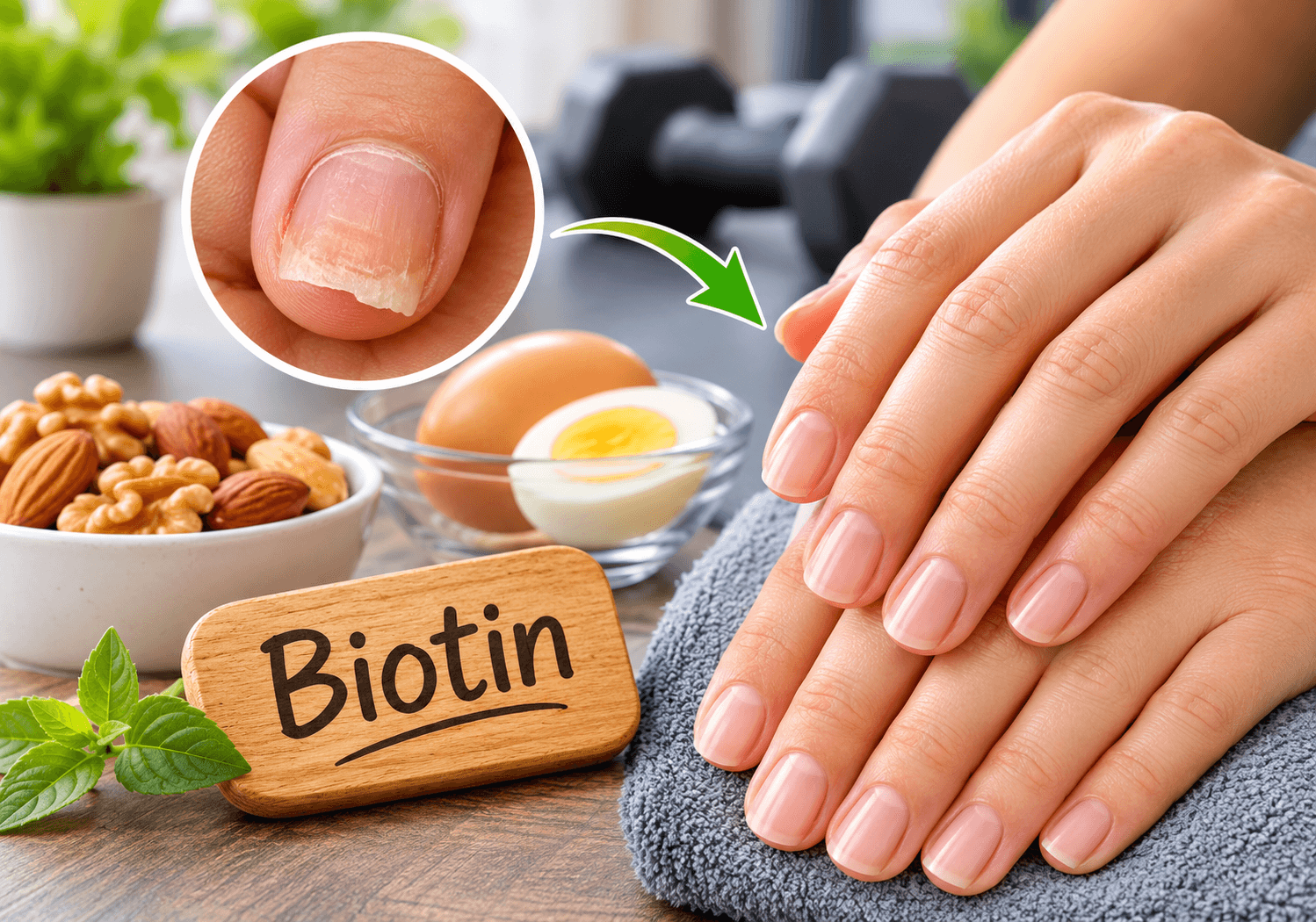
Your nails crack, peel, or split at the edges, and you keep seeing biotin recommended as the fix. But does biotin help brittle nails in a way that’s backed by real evidence, or is it just another supplement trend? I’ve coached people through nutrition and recovery plans for years, and I see this question come up constantly in the gym and in online forums. The short answer is: the evidence is promising but limited, and the right dose, timing, and expectations matter a lot.
Below, I’ll walk you through what the published research says, how much biotin to take, a practical step-by-step plan, safety considerations, and the other habits that actually move the needle on nail strength.
Quick Answer: Research suggests oral biotin (2.5 mg daily) may improve nail thickness and reduce splitting in people with brittle nail syndrome, based on a small 2016 randomized trial published in JAMA Dermatology. Results took 6–8 months to appear. Biotin is a water-soluble B vitamin (B7), and deficiency is uncommon in people eating a varied diet. It is not a cure-all, and it works best alongside other nail-care habits.
What the Research Says About Biotin and Nail Health
The 2016 JAMA Dermatology Study
The most-cited clinical trial on this topic is a randomized, double-blind, placebo-controlled study by O’Connell and colleagues, published in JAMA Dermatology in 2016. Here’s what they did:
- Participants: 25 women aged 18–65 diagnosed with brittle nail syndrome (onychoschizia – the peeling or splitting of the nail plate).
- Intervention: 2.5 mg (2,500 mcg) of oral biotin daily for 6 to 8 months.
- Control: Matching placebo.
- Outcome: The biotin group showed a statistically significant increase in nail thickness and a reduction in the rate of nail splitting compared with placebo.
The study was small, and the authors themselves noted the need for larger trials. But it is the only double-blind, placebo-controlled trial specifically testing biotin for brittle nails, and it gives us a real data point rather than anecdotal evidence. You can read the full paper through PubMed / NCBI.

What Biotin Actually Does in Your Body
Biotin (vitamin B7, sometimes called vitamin H) is a water-soluble B vitamin that acts as a coenzyme for four carboxylase enzymes. These enzymes are involved in:
- Fatty acid synthesis – building the lipid structures in cell membranes
- Amino acid metabolism – breaking down and rebuilding the amino acids that form keratin
- Glucose metabolism – converting glucose into energy your cells can use
- Purine synthesis – building DNA and RNA precursors
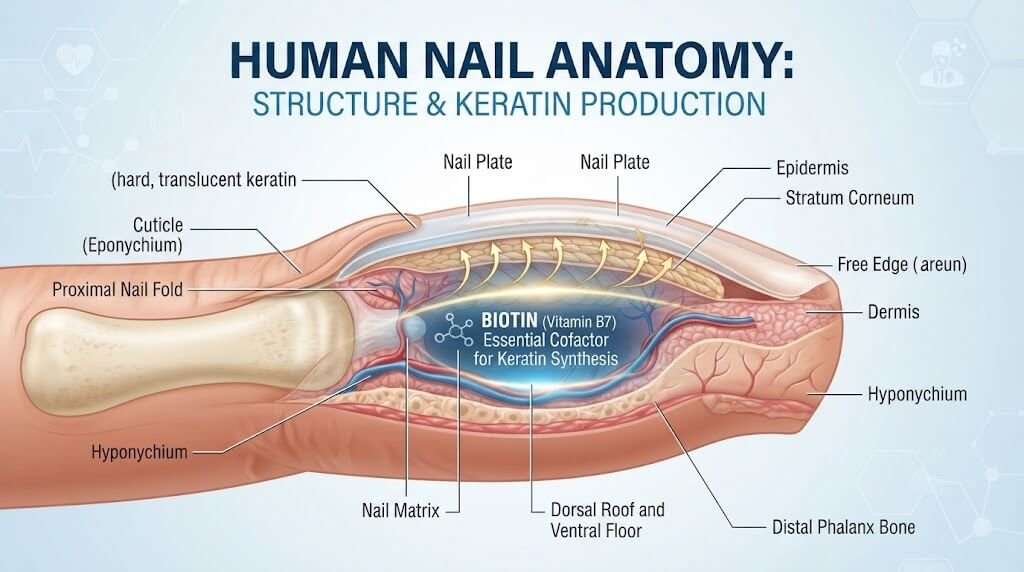
Keratin is the structural protein that makes up your nail plate, hair shaft, and the outer layer of skin. Keratinocytes in the nail matrix (the tissue under the base of your nail) produce keratin protein, which hardens and forms the visible nail. Biotin supports the enzymatic steps that feed keratin production, but it is not keratin itself. Think of it as a tool the factory uses, not the raw material on the conveyor belt.
The NIH Office of Dietary Supplements notes that biotin deficiency is rare in people who eat a balanced diet but can occur with prolonged raw egg-white consumption (raw egg whites contain avidin, which binds biotin), certain genetic disorders in biotin metabolism, or long-term antibiotic use.
What the Research Does NOT Show
To keep things honest:
- There is no large-scale, multi-center trial confirming biotin as a first-line treatment for brittle nails.
- Biotin has not been shown to reverse nail damage caused by fungal infection, psoriasis, trauma, or thyroid disease.
- No study has proven that biotin speeds up nail growth rate beyond the normal cycle (fingernails grow roughly 3.5 mm per month, or about 0.14 inches).
If your brittle nails are tied to an underlying medical condition, a supplement alone will not fix the root cause.
How Much Biotin Do You Need for Nails? Dosage and Timing
The 2016 trial used 2.5 mg (2,500 mcg) per day. That is well above the Adequate Intake (AI) of 30 mcg per day set by the National Academies of Sciences, Engineering, and Medicine. There is no established Upper Tolerable Intake Level (UL) for biotin because no adverse effects have been documented at high oral doses in healthy adults.
Here’s a practical breakdown:
| Factor | Detail |
| AI (daily minimum) | 30 mcg (adults) |
| Dose used in the nail study | 2,500 mcg (2.5 mg) per day |
| Typical supplement range | 1,000–10,000 mcg per day |
| Time to see changes | 6–8 months (one full nail-growth cycle) |
| Form | Oral capsule or tablet; no topical biotin data for nails |
| Best time to take | With a meal containing some fat (improves absorption consistency) |
| Food sources | Eggs (cooked), nuts, salmon, sweet potatoes, liver, whole grains |
A few practical notes:
- Start at 2,500 mcg. That matches the studied dose. Going to 10,000 mcg is common in commercial supplements, but no trial has shown added benefit over 2.5 mg for nails.
- Be patient. A fingernail takes about 6 months to grow from the matrix to the free edge. You will not see results in two weeks.
- Consistency matters more than dose. Taking 2,500 mcg every day for 8 months will outperform taking 10,000 mcg sporadically.
Coach’s Tip: Track your progress with a photo. Take a well-lit, close-up photo of your nails (fingertips and toes) on day 1, then again at month 3 and month 6. Hold the phone at the same angle and distance. It’s the simplest way to see whether the nail plate is getting thicker and splitting less, because subtle changes are hard to notice week to week.
How to Apply Biotin for Brittle Nails: A Practical 8-Month Plan
I break this into two tiers so you can start where you are and build from there.
Tier 1: The Basic Approach (Weeks 1–8)
- Get a baseline. Visit your primary-care doctor or a dermatologist to rule out fungal infection, psoriasis, thyroid issues, or iron deficiency. Ask for a basic blood panel (CBC, ferritin, TSH, zinc). This matters because biotin will not fix a fungal nail or iron-deficiency-related brittleness.
- Start a 2,500 mcg biotin supplement daily. Take it with breakfast or lunch. No need to take it on an empty stomach.
- Fix the basics.
- Wash hands with a mild soap; dry thoroughly.
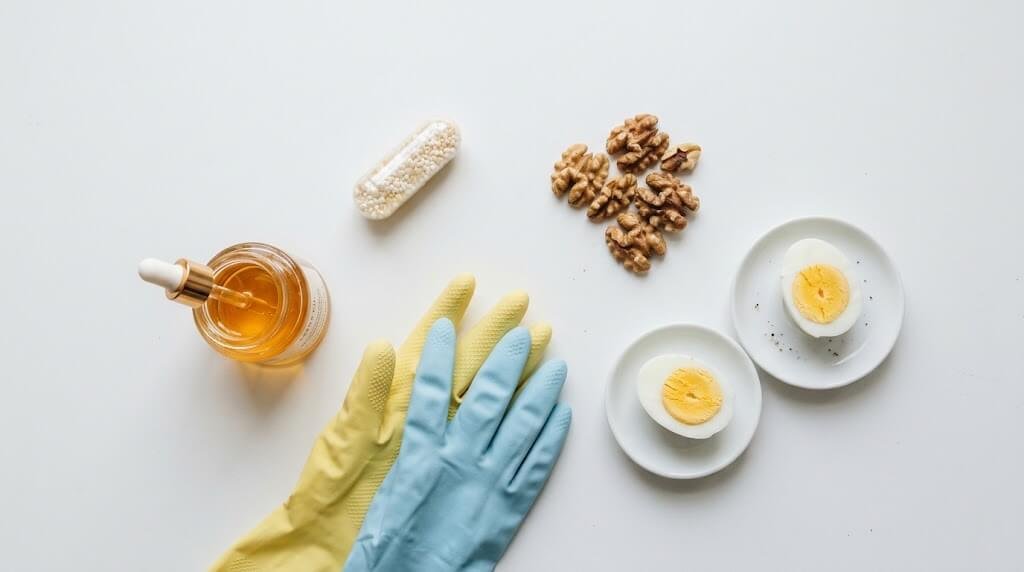
- Wear gloves for dishes, cleaning, or anything with prolonged water exposure.
- Use a moisturizer or cuticle oil (jojoba, almond, or a dedicated cuticle cream) every night.
- Trim nails straight across; avoid biting or peeling.
- Avoid acetone-based nail polish removers more than once a week.
- Check your diet. Are you getting enough protein (aim for roughly 0.5–0.7 g per lb of body weight, or 1.1–1.6 g/kg), iron, zinc, and omega-3 fatty acids? Keratin is a protein, and you need the building blocks. If you are training hard, your protein needs are on the higher end. You can read more about nutrients that support normal energy metabolism to make sure your overall micronutrient picture is solid.
Tier 2: The Comprehensive Approach (Months 3–8)
Once you’ve been consistent for 8–12 weeks, layer in:
- Add a second nail-supporting nutrient if your doctor clears it. Zinc (15–30 mg) and iron (if your ferritin is low) both play roles in keratin structure and cell turnover. Do not megadose these without lab work.
- Evaluate your full supplement stack. If you are taking multiple supplements, check for interactions and whether you are over-supplementing. A practical framework for evaluating supplement ingredients applies here: look at the dose, the form, the third-party testing, and whether the ingredient has clinical evidence for the claim you care about.
- Reduce mechanical stress. If you type a lot, do manual labor, or play a string instrument, consider a short break or a protective barrier (lightweight gloves) during the most stressful tasks.
- Reassess at month 6. Take your comparison photos. If the nail plate is noticeably thicker and splitting has decreased, continue through month 8. If there is zero change, go back to your doctor to look for another cause.
Common Mistake: People take biotin for 3–4 weeks, see no change, and quit. A fingernail grows about 3.5 mm per month. The nail that was at your matrix in January will not reach your free edge until roughly July. If you stop at month 3, you are stopping before the new, stronger keratin has even finished growing out. Commit to the full 6–8 month window before judging results.
Easier Version vs. Harder Version
- Easier (minimum viable plan): Take 2,500 mcg biotin daily, wear gloves for dishes, moisturize nightly, and eat one protein-rich meal plus a serving of nuts or eggs per day. That’s it.
- Harder (full protocol): Everything above, plus a targeted micronutrient plan based on bloodwork, a 12-week strength-training program (which supports overall tissue health and circulation), a consistent 7–8 hour sleep schedule, and a monthly “nail check-in” photo.
Safety Notes and Who Should Be Cautious
Biotin is generally well tolerated at the doses used in studies. The NIH ODS fact sheet reports no known adverse effects from oral biotin supplementation in healthy adults. However, a few important caveats:
- Lab-test interference. Biotin at doses of 5 mg (5,000 mcg) and above can interfere with certain immunoassay blood tests, including thyroid panels, troponin (heart-attack marker), and vitamin B12 levels. If you are scheduled for bloodwork, stop biotin 48–72 hours before the draw and tell your lab or doctor you are taking it.
- Pregnancy and breastfeeding. The AI for biotin is 30 mcg, and there is no established UL. Talk to your OB or midwife before starting any supplement, including biotin, during pregnancy or lactation.
- Biotinidase deficiency. A rare genetic condition in which the body cannot recycle biotin. People with this condition need medical management, not just a supplement.
- Kidney or liver disease. If you have chronic kidney or liver issues, check with your doctor before adding any supplement to your routine.
- Allergic reactions. Rare, but if you develop hives, swelling, or difficulty breathing after taking biotin, stop and seek medical attention.
If your brittle nails are accompanied by pain, discoloration, thickening, or a change in the nail shape, see a doctor before starting any supplement. Those symptoms can point to a fungal infection, psoriasis, or a systemic condition that needs specific treatment.
This article is for general information and is not a substitute for advice from a doctor or physical therapist.
Related Tips for Stronger Nails Beyond Biotin
Biotin is one piece of a bigger picture. Here are the other levers that have a real impact on nail integrity:
Nutrition and Hydration
- Protein. Keratin is a protein. If you are in a calorie deficit or not eating enough protein, your body will prioritize vital organs over your nails and hair. Aim for 0.5–0.7 g per lb of body weight (1.1–1.6 g/kg) daily.
- Iron and zinc. Both are cofactors in keratin synthesis. Deficiency is more common in women, especially those with heavy menstrual cycles.
- Omega-3 fatty acids. Found in salmon, sardines, walnuts, and flaxseed. They support the lipid layer of the nail plate, which helps prevent water loss and brittleness.
- Water. Chronic dehydration dries out the nail plate and the surrounding skin. Aim for at least 64 oz (about 1.9 L) of water per day, more if you train or live in a hot climate.
Daily Habits
- Keep nails short and filed. Long nails act as levers; a small catch can split the plate. File in one direction rather than sawing back and forth.
- Wear gloves. Prolonged water exposure and harsh cleaning chemicals strip natural oils from the nail plate.
- Skip the acetone. Acetone-based removers dehydrate the nail. If you wear polish, use a non-acetone remover and limit polish to 2–3 weeks at a time.
- Moisturize nightly. A small amount of cuticle oil or a thick hand cream under cotton gloves overnight keeps the nail plate and surrounding skin hydrated.
Training and Circulation
- Regular strength training and aerobic exercise improve peripheral circulation, which means better nutrient delivery to the nail matrix. The HHS Physical Activity Guidelines recommend at least 150 minutes of moderate aerobic activity plus two days of muscle-strengthening work per week. Even a 20-minute walk after dinner helps.
- If you are a home-gym owner or a gym regular, make sure you are not over-gripping barbells or dumbbells to the point where you are stripping the skin around your cuticles. A light grip and chalk (if available) protect the nail bed area.
Sleep and Recovery
- Keratin production and tissue repair peak during deep sleep. If you are chronically sleeping 5 hours or less, your nails (and your hair, and your skin) will show it. Prioritize 7–8 hours. You can read more about how sleep affects overall metabolic and recovery processes to understand the hormonal side of this.
When to See a Doctor
- Nails that are yellow, thickened, or crumbling (possible fungal infection)
- Nails with pitting, ridges, or discoloration (possible psoriasis, thyroid disease, or trauma)
- Sudden, severe brittleness that appeared over a few weeks (possible nutritional deficiency, medication side effect, or systemic issue)
- Nails that are brittle along with hair loss, fatigue, or cold sensitivity (possible iron deficiency or hypothyroidism)
A dermatologist can do a KOH prep, a fungal culture, or a nail biopsy to identify the cause. No supplement replaces a proper diagnosis.

Does biotin actually make nails grow faster?
No. Biotin has not been shown to increase the rate of nail growth. Fingernails grow at a fixed rate of roughly 3.5 mm per month. What biotin may improve is the quality of the nail plate – making it thicker and less prone to splitting – not the speed at which it grows.
How long does biotin take to strengthen nails?
Based on the 2016 JAMA Dermatology trial, measurable improvements in nail thickness and reduced splitting took 6 to 8 months of daily 2.5 mg biotin supplementation. Because a full nail grows out in about 6 months, you need to wait for the new keratin to reach the free edge before you can judge results.
What is the best dose of biotin for brittle nails?
The studied dose is 2,500 mcg (2.5 mg) per day. Most over-the-counter supplements range from 1,000 to 10,000 mcg. There is no evidence that 10,000 mcg outperforms 2,500 mcg for nail health. Start at the studied dose and be consistent.
Can I get enough biotin from food alone?
The AI is 30 mcg per day, and a varied diet with eggs, nuts, salmon, sweet potatoes, and whole grains can meet that. However, the nail-strengthening dose (2,500 mcg) is far above what food provides. If your nails are brittle and your diet is already solid, a supplement fills the gap.
Is biotin safe to take every day for months?
No adverse effects have been documented at oral doses up to 10 mg in healthy adults. The main caution is lab-test interference at doses of 5 mg or higher. Stop biotin 48–72 hours before any bloodwork and inform your lab. If you have kidney or liver disease, or are pregnant, check with your doctor first.
Will biotin help if my nails are brittle from a fungal infection?
No. Biotin supports keratin production but does not treat or prevent fungal infections. If your nails are thickened, discolored, or crumbling in a pattern consistent with onychomycosis, you need a dermatologist’s diagnosis and likely an antifungal treatment. Biotin can be a supportive addition but not a replacement.
Conclusion
Does biotin help brittle nails? The best available evidence – a small but well-designed randomized trial – says yes, it may help, specifically by increasing nail plate thickness and reducing splitting over a 6-to-8-month period. It is not a magic pill, it will not speed up growth, and it will not fix a fungal infection or a thyroid problem. But for the person whose nails simply peel and split with no underlying medical cause, a daily 2.5 mg biotin supplement, combined with good hydration, adequate protein, protective gloves, and nightly moisturizing, is a reasonable, low-risk strategy worth trying.
Start at the studied dose, give it the full nail-growth cycle, track your progress with photos, and see your doctor if you see no change or if your nails show signs of a deeper issue. Your nails are a window into your overall nutrition and recovery, and the same habits that support them – protein, sleep, circulation, and patience – support the rest of your body too.