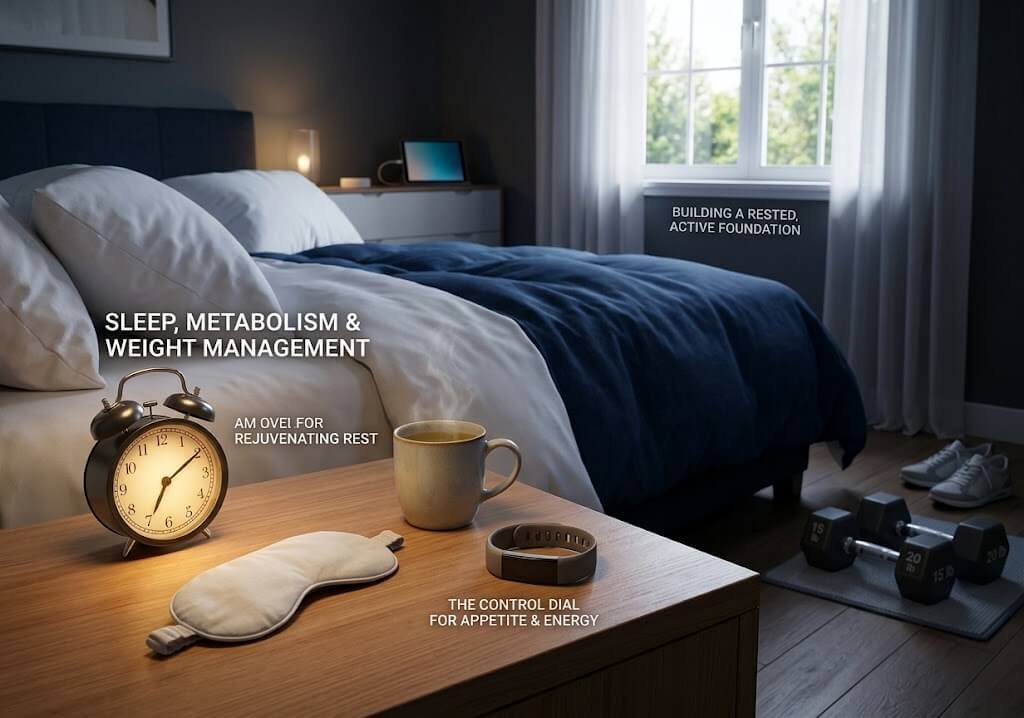
How does sleep affect metabolism and weight management? The short version is that sleep works like a quiet control dial for hunger, blood sugar, and energy use. Turn it down for a few nights, and your body tends to push you toward eating more while handling sugar a little less well.
Think of this as the plain-English explanation a good coach would give a client: no hype and no magic numbers. Sleep will not melt fat on its own, and most lab studies are short and small. Still, the pattern across studies is consistent enough that sleep deserves a place beside training and nutrition.
In this guide, you’ll see what the research says, where the evidence is thinner, and how to turn it into a simple weekly plan that pairs better sleep with strength training and walking.
Quick Answer
Quick Answer: Short or poor sleep may shift appetite hormones, raise calorie intake, reduce insulin sensitivity, and slightly lower resting energy use. Together these changes can make weight management harder. Research suggests aiming for at least seven hours a night, which may help you eat less without tracking every bite.
What “Metabolism” Really Means (and Where Sleep Fits In)
Metabolism is the sum of the chemical processes that turn food into energy and building material. People often treat it as a single speed setting, like a thermostat. In practice, three separate things matter for body weight, and sleep touches all three.
- Energy in: how hungry you feel, what you crave, and how much you eat.
- Energy out: your resting metabolic rate (the energy you burn just staying alive), plus daily movement and exercise.
- Fuel handling: how well your body uses insulin to move sugar out of your blood and into muscle.
Resting metabolic rate is the largest component of daily energy expenditure, which is why people focus on it so much. But as you’ll see below, sleep seems to affect the “energy in” side far more than the “energy out” side.
Here is the coach’s framing: sleep is not a metabolism booster. It is closer to a metabolism protector. Good sleep helps keep appetite, blood sugar, and energy use working in your favor, so your training and nutrition can do their jobs.

How Does Sleep Affect Metabolism and Weight Management? Start With Hunger Hormones
Two hormones sit at the center of the appetite story. Ghrelin is made mainly in the stomach and stimulates appetite. Leptin is made by fat cells and signals fullness. Think of ghrelin as the “feed me” signal and leptin as the “I’m good” signal.
In the Wisconsin Sleep Cohort analysis of 1,024 volunteers, shorter sleep was linked to lower leptin and higher ghrelin. The researchers estimated about 15.5% lower leptin for habitual sleep of 5 hours versus 8 hours. They also estimated about 14.9% higher ghrelin, and these differences held independent of body mass index (BMI).
That study is observational, so it shows a link rather than proof of cause. Controlled lab work adds more detail. A 2022 review in Nature Reviews Endocrinology explains that when diet is kept at the level needed for a normal day, restricted sleep raises ghrelin and lowers leptin, which increases hunger.
The picture changes when people can eat freely. In that setting, the same review notes that hunger hormones can drift the other way, probably because people end up eating more. Even so, energy intake stays excessive despite lower hunger, which suggests other drivers, such as the brain’s reward response to food, also play a role.
Results are not uniform, either. In a controlled trial of middle-aged adults who spent 5.5 versus 8.5 hours in bed, researchers found no significant difference in 24-hour leptin and ghrelin, and no significant difference in energy expenditure. Participants did have unlimited access to snacks, and the study reported higher calorie intake from snacks when sleep was short.
What does that mean for you? Hormones are one piece of the puzzle, not the whole story. The consistent finding is the end result: when sleep is cut, people tend to eat more.
Coach’s Tip: On a short-sleep day, decide what you’ll eat before you get hungry. Pack a protein-and-fiber snack and set a loose plan for dinner. Tired brains negotiate badly with vending machines, so remove the negotiation.
Sleep, Cravings, and Calories: What Happens in Real Life
Lab studies are useful, but most people don’t live in a sleep lab. A randomized clinical trial led by Esra Tasali at the University of Chicago tested sleep extension in everyday settings. The 80 adults were overweight and typically slept less than 6.5 hours a night.
Half received a session of personalized sleep-hygiene counseling, which covered habits such as setting regular bed and wake times and limiting screen use before bed. The other half kept their usual routines. Over two weeks, the counseled group increased their sleep by an average of 1.2 hours.
The calorie result is the part worth noticing. The sleep-extension group ate about 270 fewer calories per day than the control group . Nobody was told to diet. Calorie intake was worked out from energy expenditure, weight, and body composition data rather than from food diaries.
To put 270 calories in perspective, that’s roughly a small snack a day. Over weeks, that kind of gap can matter, although this trial was only two weeks long and cannot tell us how long the effect lasts.
Keep in mind who was studied. Participants were young adults with overweight who were short sleepers. If you already sleep well, adding more sleep is unlikely to produce the same effect.
Common Mistake: Cutting sleep to fit in an early workout every day. A 5 a.m. session feels productive, but if it turns a 7.5-hour night into a 5.5-hour night, you may lose more than you gain. On most days, protect the sleep and move the workout to a better time slot.
Sleep, Insulin Sensitivity, and Blood Sugar
Insulin is the hormone that helps move sugar from your blood into your cells. Insulin sensitivity describes how well your cells respond to it. When sensitivity drops, your body needs more insulin to do the same job, and blood sugar control gets harder over time.
A randomized trial in women published in Diabetes Care in 2024 limited sleep to about 6.2 hours a night for six weeks, which mirrors the median sleep of US adults who sleep too little. The authors reported impaired insulin sensitivity, and body fat changes did not explain the result. That matters because it suggests sleep can affect blood sugar handling on its own, not only through weight.
Weekends are the other common question. An NIH research summary describes a study in which volunteers who stayed sleep-deprived for two weeks saw insulin sensitivity fall by about 13%. A group allowed weekend recovery sleep did not come out ahead.
The weekend-recovery group went back to late-night eating once the short nights resumed, and the summary reports about a 27% decrease in insulin sensitivity and roughly 3 lb (1.4 kg) of average weight gain in that group . In plain terms, one long Sunday sleep-in does not cancel five short nights.
If you’re reading about blood sugar, you might also be curious about supplements. We cover inositol and insulin sensitivity and chromium picolinate and glucose metabolism in separate guides. Neither replaces sleep, and anyone with a blood sugar concern should talk with a doctor before adding supplements.
Energy Burn and Stress Hormones: A Smaller, Less Certain Effect
Many articles claim that poor sleep “wrecks your metabolism” by lowering the calories you burn. The research is more modest than that headline.
In one controlled study of healthy adults, resting metabolic rate dropped by 2.6% after sleep restriction and returned to baseline after recovery sleep. The authors suggested the body may shift toward conserving energy when sleep is short.
Let’s do the math. If someone burns about 1,600 calories at rest, 2.6% is roughly 40 calories a day. That’s real but small, and it is dwarfed by the 270-calorie intake difference in the sleep-extension trial. This is why most coaches focus on the eating side first.
Cortisol, the stress hormone, is also often blamed. The story sounds neat: poor sleep raises cortisol, which promotes fat storage. The evidence is mixed. A 2024 meta-analysis in Endocrine Journal found no significant overall difference in cortisol after acute sleep deprivation in crossover studies or randomized trials, though results varied depending on how cortisol was measured.
So the honest summary is that cortisol may play a role, but the research does not yet support treating it as the main cause.
Research at a Glance
| What researchers found | Study type | What it suggests | Main caution |
| Short sleep linked to lower leptin and higher ghrelin | Population study, 1,024 adults | Appetite signals shift with less sleep | Link, not proof of cause |
| Restricted sleep with controlled diet raises ghrelin and lowers leptin | Review of lab studies | Hunger rises when sleep is short | Results differ when people eat freely |
| Short bedtimes plus free snacking: more calories from snacks | Controlled trial, middle-aged adults | Late, short nights favor snacking | Small study; hormones did not differ |
| Sleep extension led to lower calorie intake | Randomized trial, 80 adults | More sleep may reduce eating | Two weeks; young adults with overweight |
| About 6.2 hours of sleep for six weeks reduced insulin sensitivity | Randomized trial in women | Chronic mild short sleep affects blood sugar | Women only; effect independent of body fat |
| Weekend catch-up did not reverse the effects | NIH-summarized lab study | Weekend sleep-ins are not a full fix | Small sample, controlled setting |
| Resting metabolic rate fell 2.6% | Controlled lab study | Small energy-conservation effect | Roughly 40 calories for many people |
| No clear overall cortisol change after acute sleep loss | Meta-analysis | Cortisol is not a settled explanation | Measurement methods vary |
What the Evidence Can’t Tell Us
Good coaching includes being honest about limits, so here they are.
Most experiments last days or weeks, not years. They often use healthy volunteers, and many are small. A few nights of lab sleep restriction is not the same as five years of working night shifts.
Sleep also doesn’t operate alone. People who sleep poorly may also move less, stress more, or eat differently for reasons the studies can’t fully separate. And the relationship can run both ways, since weight and conditions such as sleep apnea can themselves disrupt sleep.
Finally, individual needs vary. Some people feel great on seven hours, and others need closer to nine. The goal is not a perfect number but a reliable pattern that leaves you rested.
How Sleep Affects Metabolism and Weight Management: A Practical Plan
Here is how to apply the research without turning your evenings into a project. The CDC defines getting enough sleep for adults as at least 7 hours a day, so that’s your starting target.
Step 1: Set a fixed wake time. A steady wake time anchors your body clock more reliably than a bedtime rule. Choose a time you can keep on weekends, give or take an hour.
Step 2: Work backward to a bedtime. Count back 7.5 to 8 hours from your wake time, and treat that as your “lights out” window. This leaves a buffer for the time it takes to fall asleep.
Step 3: Build a 30-minute wind-down. The counseling used in the sleep-extension trial included regular bed and wake times and limiting screen use before bed. Dim the lights, put your phone on a charger across the room, and do something low-key such as reading or light stretching.
Step 4: Make the bedroom work for you. Aim for cool, dark, and quiet. If you share space with noise or light you can’t control, try earplugs or an eye mask.
Step 5: Plan around late-night eating. Short sleep tends to come with extra snacking. Decide on an evening cutoff that suits you, and keep an easy protein option ready if you’re hungry earlier than usual.
Step 6: Track a simple pattern for two weeks. Write down your bedtime, wake time, and how you felt. A wearable can help, but treat its numbers as rough estimates and focus on the trend rather than any single night.
Coach’s Tip: Change one thing at a time. If you sleep five and a half hours now, aim for six and a half first, not eight. Small, repeatable wins beat a big plan you abandon by Thursday.
Don’t Rely on Weekend Catch-Up
As covered above, the NIH summary suggests that weekend sleep-ins did not reverse the effects of a short-sleep week. A modest weekend lie-in is fine if you need it, but the better strategy is to get closer to your target on weeknights.
Pair Better Sleep With Strength Training and Walking
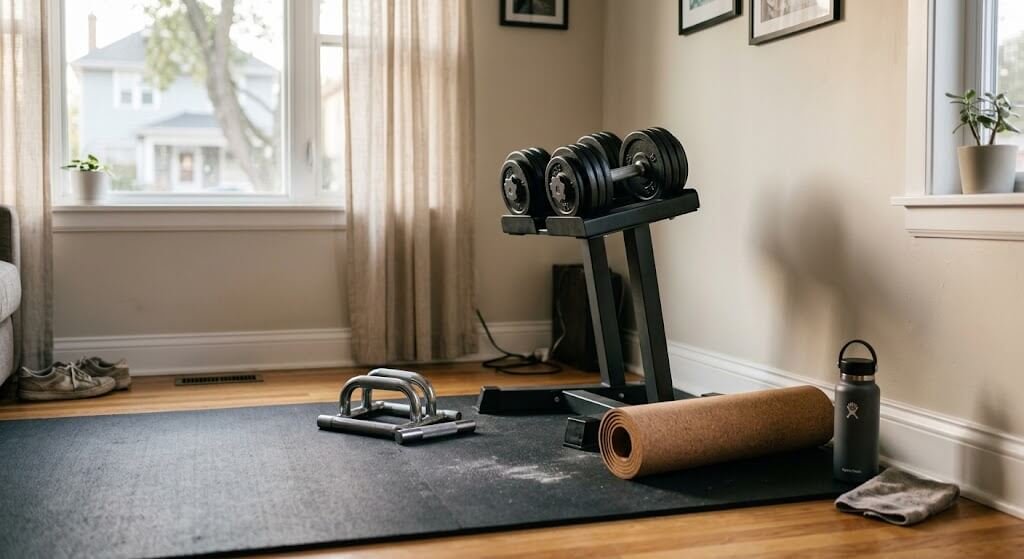
Sleep supports weight management, but it works best alongside movement. The Physical Activity Guidelines for Americans define sufficient activity for adults as at least 150 minutes of moderate-intensity aerobic activity per week plus muscle-strengthening on 2 or more days.
Here’s a simple weekly template. It’s built for beginners and intermediate lifters who are working on sleep at the same time.
- Mon, Wed, Fri: 30-35 minute full-body strength session (below)
- Tue, Thu: Brisk walk, 30-40 minutes (about 1.5-2.5 miles, or 2.5-4 km, depending on your pace)
- Sat: Easy activity you enjoy: a bike ride, a hike, or a recreational sport
- Sun: Rest, with a wind-down evening to set up the week
Sample Full-Body Workout
| Exercise | Sets | Reps | Rest | Starting weight |
| Goblet squat | 3 | 8-12 | 60-90 sec | 10-25 lb (4.5-11 kg) dumbbell |
| Dumbbell Romanian deadlift | 3 | 8-12 | 60-90 sec | 15-30 lb (7-14 kg) each hand |
| Incline or floor push-up | 3 | 6-12 | 60 sec | Body weight |
| One-arm dumbbell row | 3 | 8-12 each side | 60 sec | 15-30 lb (7-14 kg) |
| Forearm plank | 2-3 | 20-40 sec hold | 45-60 sec | Body weight |
These weights are only starting points. Choose a load where the last two reps of each set feel hard but your form stays clean. Use a controlled tempo: about two seconds lowering and one second lifting.

Short Form Cues
- Goblet squat: Hold the dumbbell at your chest, keep your ribs stacked over your hips, sit between your heels, and stand by pushing the floor away. You should feel it in your thighs and glutes.
- Romanian deadlift: Soften your knees, push your hips back as if closing a car door, keep the weights close to your legs, and stop when you feel a stretch in the back of your thighs.
- Push-up: Hands under shoulders, body in a straight line, lower your chest to just above the floor. Your chest, shoulders, and triceps should do the work.
- Dumbbell row: Rest one hand on a bench, keep your back flat, and pull your elbow toward your hip. Think “elbow to pocket.”
- Plank: Squeeze your glutes and keep your ribs down. Stop when your lower back starts to sag.
Easier and Harder Versions
| Exercise | Easier (regression) | Harder (progression) |
| Goblet squat | Bodyweight squat to a chair | Tempo squat (3-second lowering) or heavier dumbbell |
| Romanian deadlift | Hip hinge with no weight | Single-leg Romanian deadlift |
| Push-up | Hands on a countertop or wall | Feet-elevated push-up |
| One-arm row | Lighter weight or band row | Heavier weight with a 2-second pause at the top |
| Plank | Plank from knees | Long-lever plank or shoulder taps |
Common Mistake: Training hard on very little sleep and adding more volume to “make up for it.” On a rough-sleep day, keep the session but trim it: drop one set per exercise, lower the weight slightly, and leave a rep or two in reserve. Consistency over weeks matters more than one heroic session.
Timing is personal. Some people sleep fine after an evening workout, while others feel wired. If hard evening sessions keep you up, move them earlier in the day and keep the late sessions light.
Safety Notes
Sleep, weight, and blood sugar are health topics, so personal context matters. Please check with your doctor before making big changes to your sleep, diet, exercise, or supplements, especially if any of these apply:
- You snore loudly, wake up gasping, or feel exhausted despite long nights. These can be signs of a sleep disorder such as sleep apnea, which needs medical evaluation.
- You’ve had trouble falling or staying asleep for weeks. A doctor can look for causes and treatments.
- You have diabetes, prediabetes, heart disease, or take medications that affect blood sugar, appetite, or sleep.
- You’re pregnant, postpartum, going through menopause, or an older adult with health conditions.
- You’re considering sleep aids or supplements, including melatonin. Products vary, and a doctor or pharmacist can check for interactions.
- You have pain or an injury that affects your training.
Anyone with a history of joint, back, or shoulder problems should check with a doctor or physical therapist before starting the strength routine above.
More Tips to Make the Habit Stick
- Judge the trend, not the night. One bad night happens to everyone. What matters is the average across a week or two.
- Use a “sleep-poor week” rule. If sleep drops for a few days, keep your walks, reduce your lifting volume, and aim to return to your target the next week.
- Link habits. Put your phone charger and a book next to your bed so the wind-down routine starts itself.
- Be patient with the scale. Sleep may support weight management over months, but day-to-day weight shifts for many reasons, so use waist measurements, strength gains, and energy as additional signals.
- Look at the whole day. Protein at meals, regular movement, and a sensible evening routine all work together with sleep.

FAQ
Does lack of sleep slow your metabolism?
It may slow it slightly. In one controlled study, resting metabolic rate fell 2.6% after sleep restriction and recovered after rest. That is a small change. The bigger effect in most studies is on appetite and calorie intake, not on calories burned at rest.
How many hours of sleep do you need to lose weight?
There is no special “weight loss” number. The CDC defines enough sleep for adults as at least seven hours a day. Needs vary by person, so aim for a pattern that leaves you rested. Sleep supports weight management alongside nutrition and exercise rather than replacing them.
Can you lose weight by sleeping more?
Sleep alone is unlikely to cause major weight loss. However, a randomized trial in short sleepers with overweight found that extending sleep was linked with lower calorie intake over two weeks. Longer-term results are not yet clear, so treat sleep as a helpful habit, not a standalone plan.
Why do I crave sugar when I’m tired?
Research suggests short sleep may raise appetite signals and increase eating, especially snacking. Hormones such as ghrelin and leptin may play a role, along with the brain’s reward response to food. Planning protein-rich snacks ahead of time can make cravings easier to manage on low-sleep days.
Can you catch up on sleep on the weekend?
Not completely. An NIH summary of a lab study found that weekend recovery sleep did not reverse the metabolic effects of a short-sleep week, and participants returned to late-night eating once short nights resumed. A small weekend lie-in is fine, but steadier weeknight sleep is the better strategy.
Does exercise help you sleep better?
Many people find regular activity supports better rest, though responses vary. The HHS guidelines recommend at least 150 minutes of moderate aerobic activity weekly plus muscle-strengthening on two or more days. If late workouts leave you wired, shift hard sessions earlier in the day and keep evening sessions light.
Conclusion
So, how does sleep affect metabolism and weight management? Research suggests that short or poor sleep may raise appetite and calorie intake, reduce insulin sensitivity, and slightly lower resting energy use. Each effect is modest on its own, but together they can make healthy habits harder to keep.
The good news is that sleep is one of the more controllable pieces. Set a fixed wake time, build a short wind-down, protect your bedroom, and pair these habits with two or three strength sessions and some brisk walking each week. Start with one change this week and build from there.
Sleep won’t replace training or nutrition, and it isn’t a quick fix. But treated as part of your plan rather than an afterthought, it may help your efforts in the gym and kitchen pay off.