How to Strengthen Bladder Muscles Naturally for Women: A Coach’s Step-by-Step Guide
Leaking a little when you sneeze, laugh, or hit a rep on the squat rack is more common than most women admit. You don’t have to live with it, and you don’t need surgery to make a difference. Learning how to strengthen bladder muscles naturally for women starts with understanding the small, often-overlooked muscle group under your pelvis and giving it the same consistent training you’d give your biceps or quads.
As a strength coach, I program pelvic floor work for women of every age—from first-time mothers to postmenopausal clients who want to run 5Ks without worrying. The good news: the exercises are free, take 10 to 15 minutes a day, and you can do them in your kitchen, at your desk, or in bed. What follows is a practical, step-by-step guide to building that muscle the right way, with sets, reps, progressions, and the mistakes that quietly undo your progress.
Quick Answer
The most effective way to strengthen bladder muscles naturally for women is a daily pelvic floor training routine that includes Kegel exercises (slow holds and quick pulses), bridges, and gentle squats. Aim for 3 sets of 10 slow holds and 10 quick pulses, 3–5 days per week. Most women notice improved bladder control within 4–8 weeks of consistent practice, according to NIH/NIDDK research on pelvic floor muscle training.
The Muscles You’re Training (Primary and Secondary)
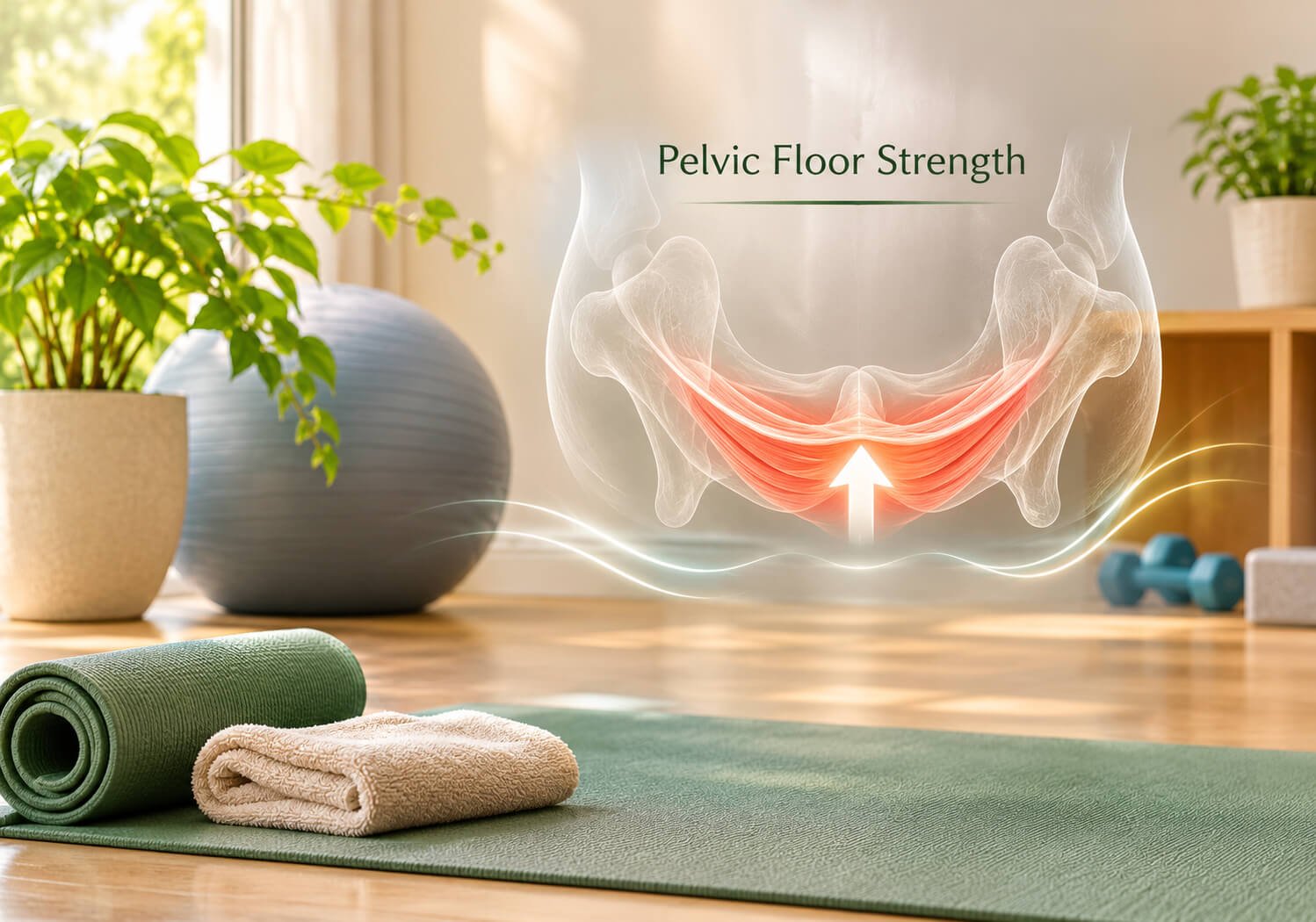
Before you squeeze anything, you need to know what you’re squeezing. The pelvic floor is a hammock-like sheet of muscle and connective tissue that stretches from your pubic bone to your tailbone. It supports your bladder, uterus, and bowel, and it controls the urethral sphincter—the “gate” that keeps urine in.
Primary muscles:
- Pubococcygeus (PC) muscle – the main “Kegel” muscle. It wraps around the urethra, vagina, and rectum and is the first thing you contract.
- Levator ani group – a broader set that includes the pubococcygeus, iliococcygeus, and ischiococcygeus. Together they form the “hammock” that lifts and supports the pelvic organs.
Secondary muscles that support the work:
- Transverse abdominis – your deep core “corset.” A stable core reduces downward pressure on the pelvic floor.
- Gluteus maximus and medius – strong glutes take load off the pelvic floor during standing and walking.
- Hip flexors (iliopsoas) – balanced hip flexors prevent excessive anterior pelvic tilt, which can overload the pelvic floor.
- Diaphragm – the breathing partner to the pelvic floor. When you inhale, the pelvic floor gently descends; when you exhale, it lifts.
Understanding this system matters because you’re not just “squeezing.” You’re coordinating breath, core, and pelvic floor into one unit.
Why This Matters: Benefits of Pelvic Floor Strengthening
A well-trained pelvic floor is one of the most underrated “injuries” you can prevent. Research consistently links pelvic floor muscle training to reduced symptoms of stress incontinence and improved quality of life in women of all ages, as noted in a systematic review published in the Cochrane Database of Systematic Reviews.
Practical benefits you can expect with consistent training:
- Reduced stress incontinence – fewer leaks during coughing, sneezing, laughing, or jumping.
- Improved urge control – a stronger urethral sphincter gives you more time to reach a bathroom.
- Better postpartum recovery – rebuilding after delivery helps restore pre-pregnancy support.
- Support during menopause – declining estrogen thins pelvic tissues; muscle training adds a mechanical “safety net.”
- Improved core stability – the pelvic floor is the floor of your core. Train it, and your squats, deadlifts, and planks feel more solid.
- Greater confidence in daily life – no more “just in case” bathroom trips or avoiding the gym.
These are not overnight fixes. Think of it like building any other muscle: consistency over weeks and months is what produces lasting change.
Step-by-Step: How to Do Kegel Exercises Correctly
This is the core of how to strengthen bladder muscles naturally for women, and it’s where most people go wrong. Follow these steps exactly.
Finding Your Pelvic Floor
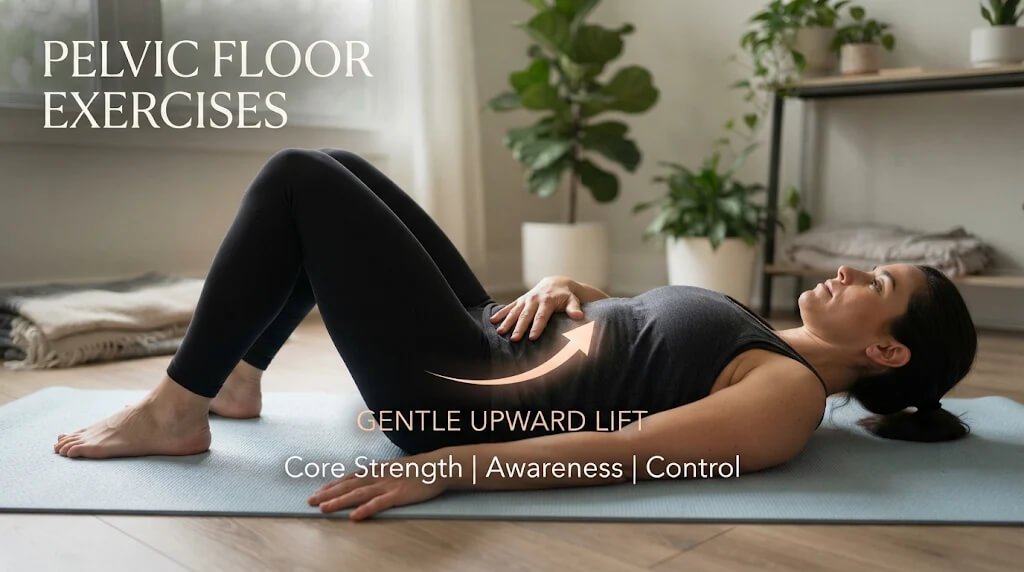
- Sit or lie down comfortably. For your first attempts, lying on your back with knees bent removes gravity from the equation.
- Imagine you’re stopping urine mid-stream. Do this once to locate the muscle. Do not make it a regular habit, as repeatedly interrupting your urine flow can confuse your bladder.
- Now, without using your glutes, abs, or thighs, gently draw that muscle upward and inward. You should feel a slight lift, like you’re “pulling up” from the inside.
- Breathe. Your ribs should still expand on the inhale. If your stomach pushes out or your glutes clench, you’re recruiting the wrong muscles.
The Slow Hold (Endurance)
- Exhale gently and contract your pelvic floor.
- Hold the contraction for 5 seconds, breathing normally.
- Relax completely for 10 seconds. You must fully release—this is as important as the squeeze.
- That’s one rep.
The Quick Pulse (Speed)
- Contract the pelvic floor sharply, as if you’re “flicking” a switch.
- Hold for 1 second.
- Relax for 1 second.
- Repeat.
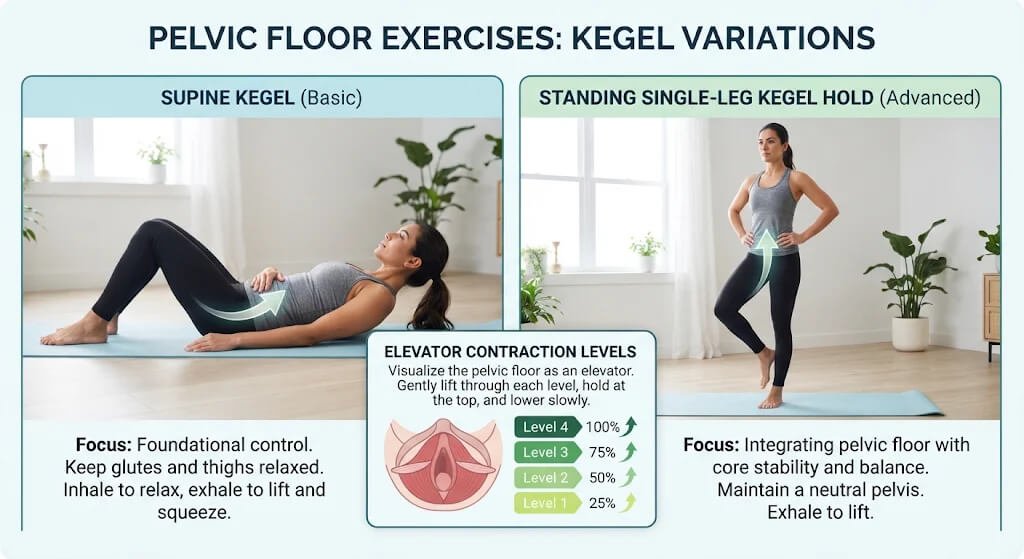
The “Elevator” (Progressive)

- Contract to 25% effort, hold 2 seconds.
- Add to 50%, hold 2 seconds.
- Add to 75%, hold 2 seconds.
- Max effort, hold 2 seconds.
- Release gradually, like lowering an elevator floor by floor.
Coach’s Tip: Do your first 10 reps of each session lying down. Once you can hold a 5-second contraction with a full release while supine, move to sitting, then standing. Standing adds gravity and makes the exercise significantly harder. If you can’t hold a clean 5-second contraction lying down, you’re not ready to progress yet.
Sets, Reps, and Progression by Goal
| Goal | Slow Holds | Quick Pulses | Elevators | Frequency | Notes |
| Beginner / Postpartum | 3 × 5 (5-sec hold) | 3 × 5 | 2 × 1 | 5–7 days/week | Start supine. Full rest between reps. |
| Intermediate / Bladder Control | 3 × 10 (5-sec hold) | 3 × 10 | 2 × 1 | 4–5 days/week | Add standing. Pair with bridges. |
| Advanced / Athlete | 4 × 10 (8-sec hold) | 4 × 15 | 3 × 1 | 4–5 days/week | Add loaded squats, jumping. |
Rest between sets: 30–60 seconds. Total time per session: 10–15 minutes.
Progression rule: When you can complete your current set with a full, clean release and no compensating (no glute clenching, no breath-holding), add one rep or one second to the hold. Don’t rush this.
Common Mistakes and Fixes
Common Mistake: Bearing down (pushing the pelvic floor down) instead of lifting it up. Many women feel the “squeeze” as a downward push, especially if they’ve been straining with constipation or heavy lifting. This is the opposite of what you want.
How to fix it: Place one finger (gently) at the vaginal opening or use a mirror to watch your perineum. When you contract correctly, the perineum should draw up and in, not push out. If you feel a downward pressure, stop, breathe, and try again with less force.
Other frequent errors:
- Holding your breath. You should be able to talk through the exercise. If you can’t, you’re too tight.
- Recruiting the glutes or thighs. Squeeze your knees together lightly. If your quads are working, you’re compensating.
- Skipping the relaxation phase. A muscle that’s always partially contracted is a fatigued, weak muscle. The 10-second release is non-negotiable.
- Doing too many reps too fast. Ten clean reps beat fifty sloppy ones every time.
Variations: Easier to Harder
Regression (Easier)
- Supine with knees elevated on a chair or couch. This tilts your pelvis posteriorly and makes the contraction easier to feel.
- Shorter holds (3 seconds) with longer rests (15 seconds). Gives your nervous system time to learn the movement.
- Only 2 sets of 5 reps, 3 days per week. Low volume, high frequency, low stress.
Standard
- The slow hold + quick pulse combo described above, done in 3 sets, 4–5 days per week.
Progression (Harder)
- Standing with a single-leg balance. Hold a 5-second Kegel while standing on one leg. The core and pelvic floor must work together to keep you stable.
- Kegels under load. Perform a bodyweight squat to 90 degrees and hold the pelvic floor contraction at the bottom for 5 seconds. Add a 20-lb (9-kg) dumbbell for extra challenge.
- Jump squats with a “brake.” Jump, land softly, and immediately contract the pelvic floor to “brake” the descent. This mimics the real-life scenario of landing from a jump or sneezing.
- The “Knack” for coughing/sneezing. Right before you sneeze or cough, contract the pelvic floor. This pre-contraction reduces the pressure spike on the urethra and is a practical skill for daily life.
Supporting Exercises and Natural Strategies
Kegels are the foundation, but a complete pelvic floor strengthening routine includes surrounding work. Here’s what I program alongside the core Kegel work:
Glute Bridges
- Lie on your back, knees bent, feet flat. Drive through your heels to lift your hips to hip height.
- At the top, add a 3-second pelvic floor contraction.
- 3 × 12, 3 days per week.
- Why: Strong glutes reduce the load the pelvic floor carries during standing and walking.
Gentle Bodyweight Squats
- Feet shoulder-width, squat to 90 degrees. Focus on “sitting back” into the hips, not caving the knees.
- At the bottom, engage the pelvic floor and transverse abdominis.
- 3 × 10, 3 days per week.
- Why: Teaches you to brace the pelvic floor under load, which is the real-world application.
Diaphragmatic Breathing (The “360 Breath”)
- Lie on your back. Inhale through your nose and let your ribs expand in all directions (front, sides, back). Your pelvic floor should gently descend.
- Exhale through pursed lips and gently draw the pelvic floor up and in.
- 2 minutes, daily.
- Why: Re-trains the breath-pelvic floor connection. Many women with pelvic floor issues are “breathing into their belly” and pushing the floor down with every breath.
Walking
- A brisk 20–30 minute walk daily improves pelvic blood flow and reduces overall intra-abdominal pressure compared to sedentary sitting.
- The CDC’s physical activity guidelines recommend at least 150 minutes of moderate aerobic activity per week for adults. Walking is the most accessible form.
Lifestyle Factors That Support Bladder Health
- Stay hydrated. Paradoxically, drinking less water concentrates urine, which irritates the bladder lining and can worsen urgency. Aim for 6–8 glasses (about 48–64 oz / 1.4–1.9 L) of water daily.
- Limit bladder irritants. Caffeine, alcohol, artificial sweeteners, and very spicy foods can increase urgency in sensitive individuals.
- Manage constipation. Straining on the toilet pushes the pelvic floor down repeatedly. A fiber-rich diet and adequate water help.
- Maintain a healthy weight. Excess body weight increases chronic pressure on the pelvic floor. Even a 5–10% reduction in body weight can reduce incontinence symptoms, per research from Mayo Clinic.
- Avoid heavy, unbraced lifting. If you must lift, exhale and brace your pelvic floor on the way up. Never hold your breath and bear down.
Who Should Be Cautious (and When to See a Professional)
Pelvic floor exercises are low-risk for most women, but they are not a one-size-fits-all fix.
See a pelvic floor physical therapist or urogynecologist before starting if:
- You have a diagnosed pelvic organ prolapse.
- You experience pain with pelvic floor contractions (a condition called a “hypertonic” or overactive pelvic floor). In this case, relaxation work is needed before strengthening.
- You are in the first 6 weeks postpartum and have not been cleared by your OB or midwife.
- You have a history of pelvic surgery, radiation, or a urinary tract infection that hasn’t resolved.
- You experience pain during sex, urination, or bowel movements.
If your pelvic floor is already too tight (hypertonic), adding more Kegel volume will make things worse. A pelvic floor physical therapist can assess whether you need strengthening, relaxation, or a combination, and can use internal biofeedback to give you real-time feedback on your muscle activity.
This article is for general information and is not a substitute for advice from a doctor or physical therapist. If you have pain, significant leakage, or a diagnosed pelvic condition, get a professional evaluation before starting any exercise program.
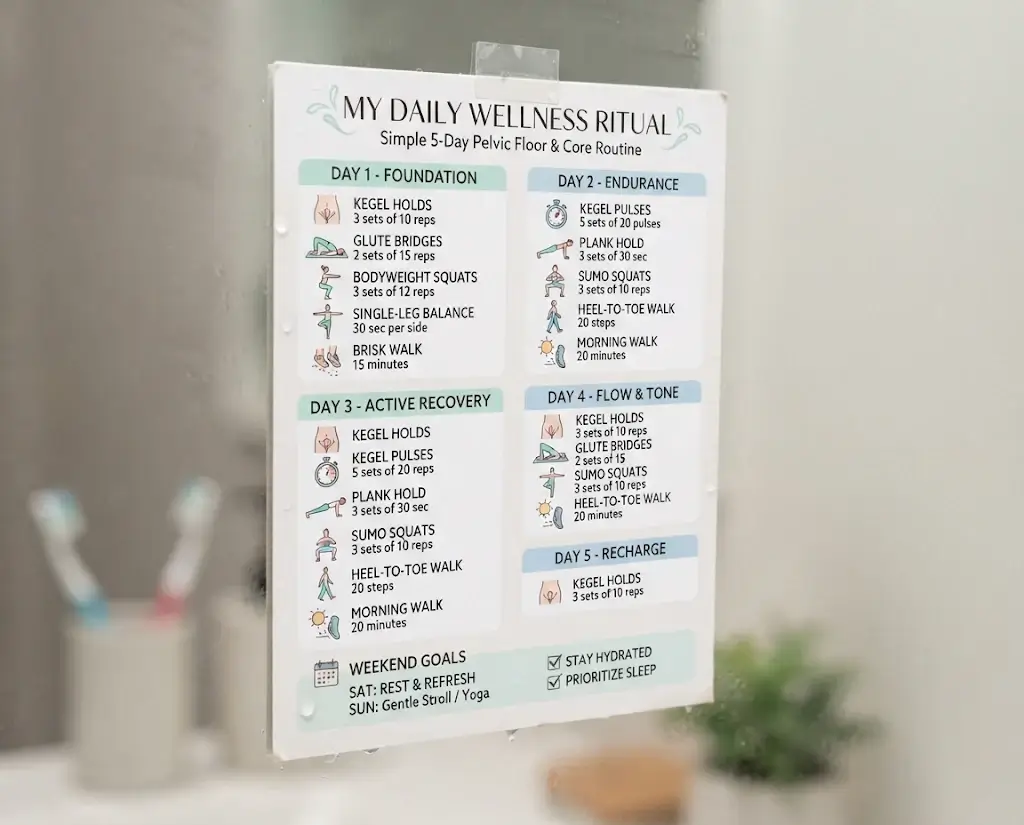
Sample Weekly Routine (15 Minutes, 5 Days)
Here’s a simple, repeatable schedule you can start this week. No equipment needed.
| Day | Focus | Details |
| Mon | Kegel Foundation | 3 × 10 slow holds (5 sec) + 3 × 10 quick pulses. Supine → sitting → standing. 2 min diaphragmatic breathing. |
| Tue | Kegel + Glutes | 3 × 10 slow holds. 3 × 12 glute bridges (3-sec pelvic floor hold at top). 2 min breathing. |
| Wed | Active Rest | 20-min brisk walk. 2 min diaphragmatic breathing. Gentle hip stretches. |
| Thu | Kegel + Squats | 3 × 10 slow holds. 3 × 10 bodyweight squats (pelvic floor brace at bottom). 2 min breathing. |
| Fri | Kegel + Balance | 3 × 10 quick pulses. 3 × 8 single-leg stands (30 sec each side) with pelvic floor engagement. 2 min breathing. |
| Sat | Active Rest | Walk, yoga, or light activity. 2 min breathing. |
| Sun | Rest | Full rest. Gentle stretching if desired. |
Weekly progression: Add 1 rep per set every 2 weeks until you hit the intermediate targets. After 6–8 weeks, move to the advanced column.
How Long Until You See Results?
This is the question every client asks. Here’s the honest answer:
- Weeks 1–2: You’ll learn to find and isolate the muscle. You may not feel much “change” yet. This is normal.
- Weeks 3–4: Many women report fewer “near misses” and a stronger sense of control during sneezes or light activity.
- Weeks 6–8: Noticeable improvement in stress incontinence symptoms for most consistent practitioners. The NIH/NIDDK notes that pelvic floor muscle training is a first-line treatment for stress incontinence, with significant improvement seen in a majority of women after 3 months of consistent practice.
- 3+ months: Long-term maintenance. The muscle, like any muscle, atrophies if you stop training it.
Consistency beats intensity. Ten minutes a day, five days a week, for three months, will outperform a 45-minute “pelvic floor workout” once a month.
How many Kegel exercises should women do per day?
Aim for 3 sets of 10 slow holds and 3 sets of 10 quick pulses, 4–5 days per week. That’s roughly 60–90 contractions per session, split across the day (morning, afternoon, evening) rather than all at once. Quality of each rep matters more than total volume.
How long do Kegel exercises take to work for bladder control?
Most women notice a difference in 4–8 weeks of consistent daily practice. Full benefit for stress incontinence typically takes 12 weeks or more. If you see no improvement after 3 months, see a pelvic floor physical therapist to check your technique and rule out a hypertonic pelvic floor.
Can squats and walking help strengthen bladder muscles?
They help indirectly. Squats and bridges train the glutes, core, and pelvic floor as a coordinated unit, which is how the muscles work in real life. Walking improves pelvic blood flow and reduces chronic pressure. But they don’t replace targeted Kegel work for the pubococcygeus muscle.
How do I know if I’m doing Kegel exercises wrong?
Signs you’re compensating: your glutes are clenching, your thighs are squeezing, your belly is pushing out, or you’re holding your breath. You should be able to talk through the exercise. If you feel a downward push rather than an upward lift, stop and re-locate the muscle. A pelvic floor physical therapist can confirm your form with an internal assessment.
Are Kegel exercises enough to fix bladder problems?
For mild stress incontinence, yes—pelvic floor muscle training is a well-supported first-line intervention. For moderate-to-severe incontinence, prolapse, or a hypertonic pelvic floor, Kegels alone may not be enough. A urogynecologist or pelvic floor PT can build a combined plan that may include biofeedback, manual therapy, and targeted strengthening.
What foods or habits help strengthen bladder muscles?
No single food “builds” the pelvic floor, but supporting overall tissue health helps. Adequate protein (for muscle repair), vitamin C (for collagen in connective tissue), and staying hydrated support the structural components. Avoiding chronic constipation, managing weight, and limiting bladder irritants like caffeine reduce the daily stress on the muscle.
Final Thoughts: Your Pelvic Floor Deserves the Same Attention as Your Biceps
Learning how to strengthen bladder muscles naturally for women isn’t complicated, but it does require the same patience and consistency you’d bring to any strength goal. You wouldn’t expect visible bicep growth after two workouts. You won’t expect a fully retrained pelvic floor after two weeks. Give it 8 to 12 weeks of honest, daily work, and the results are real.
Start where you are. If you can only manage 3 sets of 5 slow holds lying down, that’s your starting point. Build from there. Pair the Kegels with bridges, gentle squats, and good breathing. Walk daily. Drink enough water. And if you hit a plateau or feel pain, don’t push through—see a pelvic floor physical therapist. They’re the specialists in this one muscle group, and a single assessment session can save you months of guessing.