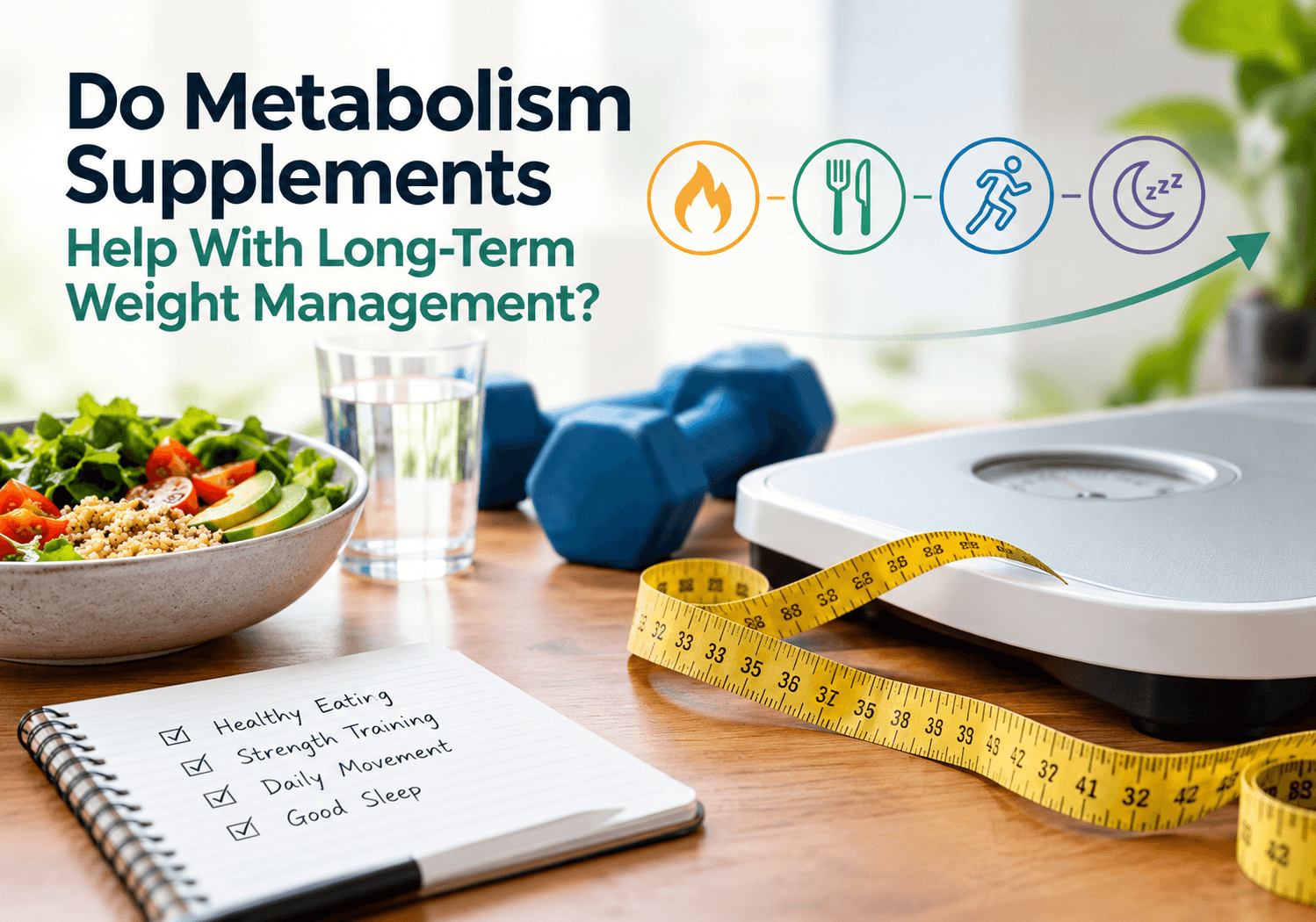
Metabolism supplements promise to help your body burn more calories, control hunger, and lose unwanted body fat. But do metabolism supplements help with long-term weight management, or do they offer only small, short-lived changes that are difficult to maintain?
The answer depends on the ingredients, the quality of the evidence, and the habits surrounding their use. Some ingredients may slightly affect energy expenditure or body weight, but research does not establish most over-the-counter fat burners as reliable tools for keeping weight off over the long term.
For lasting progress, it is more useful to understand how metabolism works, recognize misleading supplement claims, and build a routine around nutrition, strength training, daily movement, and consistent sleep. This guide examines the evidence, potential risks, and practical steps for making an informed decision.
Quick Answer
Do metabolism supplements help with long-term weight management? Usually, not to a meaningful degree on their own. Some ingredients, including caffeine and green tea extract, may produce small short-term effects, but evidence for lasting weight control is limited. Sustainable weight management depends more on a balanced eating plan, regular physical activity, behavior changes, and ongoing support. NIH research on weight-loss supplements explains the evidence and safety concerns.
What Are Metabolism Supplements, and How Do They Work?
Metabolism supplements are dietary products marketed to increase calorie burning, reduce appetite, improve fat oxidation, or support the body’s use of energy. They may come as capsules, tablets, powders, drinks, or blends containing several active ingredients.
These products are often called fat burners, metabolic boosters, or thermogenic supplements. However, these names describe marketing claims rather than proof that a product produces meaningful or lasting weight loss.
Understanding your metabolism
Your metabolism includes the chemical processes that keep your body functioning. For weight management, several parts are particularly relevant:
- Resting energy expenditure: The energy your body uses to support essential functions while resting, including breathing and circulation.
- Physical activity: The energy used during structured exercise and everyday movement, such as walking, climbing stairs, and household tasks.
- Thermic effect of food: The energy your body uses to digest, absorb, and process nutrients.
- Adaptive changes: Adjustments in energy expenditure and appetite that can occur during weight loss.
A supplement may influence one of these processes without producing a meaningful change in body weight. For example, a stimulant might temporarily increase energy expenditure, but the effect may be too small to create substantial fat loss.
The NIH Office of Dietary Supplements’ evidence review explains that ingredients marketed for weight loss work through different proposed mechanisms, and their effectiveness varies considerably.
What does thermogenesis mean?
Thermogenesis refers to heat production in the body. Some ingredients in metabolism supplements are intended to increase thermogenesis, which may temporarily raise the number of calories your body uses.
However, a measurable increase in energy expenditure does not automatically translate into lasting weight loss. Appetite, food intake, activity levels, tolerance to stimulants, and other changes can affect the overall result.
A product can therefore influence a laboratory measurement without producing a noticeable improvement in long-term weight management.
Do Metabolism Supplements Help With Long-Term Weight Management According to Research?
The most important question is not whether a supplement changes metabolism for a few hours. It is whether taking it helps people maintain a healthier weight over months or years without unacceptable risks.
The evidence remains limited.
A 2021 systematic review published in Obesity examined 315 randomized controlled trials involving 14 purported dietary supplements, alternative therapies, or combinations used for weight loss. The authors found that the quality of evidence varied widely, and only a small proportion of the trials were considered both low-risk and sufficient to support efficacy.
The findings do not mean that every ingredient is ineffective. They do mean that strong claims about supplements should be treated cautiously, especially when manufacturers promise effortless or permanent weight loss.
Why short-term results are not enough
Many supplement studies last only several weeks or a few months. That may reveal an early effect, but it cannot reliably establish whether users maintain their results after stopping the product or continue benefiting safely over several years.
Long-term weight management also involves more than changes on the scale. Relevant outcomes include:
- Whether body weight remains relatively stable.
- Whether a person can maintain healthy eating habits.
- Whether strength and physical function are preserved.
- Whether the supplement causes unwanted side effects.
- Whether its cost and routine remain manageable.
- Whether results continue after the initial period of use.
A small short-term reduction in body weight is not proof that a supplement prevents weight regain.
The National Center for Complementary and Integrative Health’s weight-control guidance notes that many supplements marketed for rapid weight loss have not demonstrated effectiveness for long-term weight control, and some carry significant safety concerns.
What about claims that a supplement speeds up a slow metabolism?
A person may struggle with weight management for many reasons, including eating patterns, reduced daily movement, medication effects, sleep problems, and medical conditions.
A perceived slow metabolism does not automatically mean that a metabolic booster is the right solution. If weight changes are unexplained or accompanied by persistent fatigue, unusual cold sensitivity, or other concerning symptoms, a healthcare professional can assess possible underlying causes.
The practical takeaway: Do not judge a supplement by its marketing claims or a few days of scale changes. Look for credible human research that measures meaningful outcomes over an appropriate period.
Which Metabolism Supplement Ingredients Have Evidence Behind Them?
Metabolism supplements often combine several ingredients. Understanding the evidence for each one is more useful than assuming that an entire formula works because it contains a familiar name.
The table below summarizes selected ingredients using the NIH Office of Dietary Supplements’ professional fact sheet and related evidence reviews.
| Ingredient | What it may do | Evidence for weight management | Main concern |
| Caffeine | Temporarily increases alertness and may increase energy expenditure | Long-term weight benefits remain uncertain | Sleep disruption, anxiety, rapid heartbeat |
| Green tea extract | May modestly affect energy expenditure and fat oxidation | Any average weight effect appears small and inconsistent | Possible liver injury and increased blood pressure |
| Green coffee bean extract | Proposed effects on glucose metabolism and fat accumulation | Evidence is limited and study quality is weak | Caffeine-related effects and uncertain long-term safety |
| Chromium picolinate | Studied for effects on glucose metabolism and body composition | Any weight effect appears small and of uncertain clinical importance | Medication interactions and possible adverse effects |
| Bitter orange extract | Marketed to increase thermogenesis | Reliable weight-loss benefits have not been established | Cardiovascular effects, particularly with other stimulants |
| Carnitine | Involved in transporting fatty acids for energy production | Some studies suggest a modest effect, but results do not establish long-term maintenance | Gastrointestinal discomfort and other potential concerns |
| Chitosan | Intended to bind some dietary fat in the digestive tract | Research suggests little meaningful effect on body weight | Bloating, constipation, and digestive discomfort |
These summaries are not endorsements. The effectiveness and safety of an ingredient depend on the dose, formulation, other ingredients, the person’s health, and the quality of the available evidence.
Caffeine: A temporary boost, not a long-term solution
Caffeine stimulates the central nervous system and may temporarily increase energy expenditure. It can also improve alertness, which may make some people feel more prepared for physical activity.
However, regular caffeine use can lead to tolerance, reducing some of its effects. Research on caffeine and weight loss also frequently involves combination products, making it difficult to determine which ingredient caused any observed change.
Using more caffeine to chase a greater calorie-burning effect can create problems with sleep, anxiety, and heart rate. Poor sleep may also make appetite regulation and consistent exercise harder.
Coffee or tea can fit into a balanced routine if tolerated, but concentrated stimulant products should not be treated as necessary weight-management tools.
Green tea extract: Small potential benefits with important caveats
Green tea contains catechins, including epigallocatechin gallate (EGCG), and naturally occurring caffeine. Researchers have investigated whether these compounds affect fat oxidation and energy expenditure.
The NIH review of green tea and weight loss describes possible modest effects, but the overall findings are inconsistent. Any benefit appears too limited to establish green tea extract as a dependable method for maintaining weight loss.
Concentrated green tea extract is also different from drinking brewed green tea. Extracts have been associated with liver injury in some people, making it important to consider safety rather than focusing only on potential benefits.
Chromium picolinate: Not a substitute for balanced nutrition
Chromium is a trace mineral involved in normal nutrient metabolism. Chromium picolinate is a form commonly sold in supplements and marketed for blood sugar support, appetite control, and fat loss.
Research has generally found small effects on body weight, with uncertainty about whether those changes are clinically meaningful. There is not strong evidence that chromium picolinate prevents weight regain or reliably improves long-term weight management.
If you are interested in this ingredient, read our related discussion of chromium picolinate and glucose metabolism. It is particularly important to distinguish normal nutrient functions from proof that taking extra amounts improves weight outcomes.
Green coffee bean extract and bitter orange
Green coffee bean extract has been studied for possible effects on body weight, but the available clinical trials have important methodological limitations. Its caffeine content may also contribute to unwanted stimulation.
Bitter orange is sometimes promoted as a replacement for older stimulant ingredients. However, its proposed weight-loss benefits remain uncertain, and products containing bitter orange may raise concerns about blood pressure and heart rate, particularly when combined with caffeine or other stimulants.
Neither ingredient should be considered a proven long-term solution.
What about inositol and other nutrients?
Some people also consider nutrients that have been studied for specific aspects of metabolic health. Inositol, for example, has been investigated in relation to insulin sensitivity and certain metabolic or hormonal conditions.
That does not mean inositol is a general-purpose fat burner. Research in a specific patient group cannot automatically be applied to everyone seeking weight loss. See our overview of inositol and insulin sensitivity research for more context.
Coach’s Tip: Evaluate the ingredient, not just the supplement’s name. A product labeled “advanced metabolism support” may contain familiar ingredients in combinations that have never been adequately studied together.
Can Metabolism Supplements Prevent Weight Regain?
There is no convincing evidence that over-the-counter metabolism supplements reliably prevent weight regain over the long term. Maintaining weight loss requires ongoing habits that fit your daily life, even after the initial weight-loss phase ends.
After losing weight, your body may require less energy than it did at a higher weight. Appetite and energy expenditure can also change, making it harder to maintain the same calorie balance. These changes do not mean that your metabolism is broken or that you need a fat burner to fix it.
The NIDDK guide to eating and physical activity for weight management emphasizes sustainable eating habits and regular physical activity as important parts of losing weight and maintaining the loss.
Why weight regain can happen
Several factors can contribute to weight regain:
- Higher calorie intake: Portions, snacks, and drinks may gradually increase after a period of structured eating.
- Lower daily movement: A busy schedule or fatigue may reduce walking and other everyday activity.
- Loss of muscle during weight loss: If weight loss involves substantial muscle loss, physical function and energy expenditure may be affected.
- Increased hunger: Changes in appetite can make it harder to maintain previous eating patterns.
- Poor sleep or high stress: These can interfere with routines, recovery, and food choices.
- Unrealistic restrictions: An overly restrictive eating plan may be difficult to sustain.
A metabolism supplement does not automatically address these factors. Even if an ingredient temporarily increases calorie expenditure, that effect may not be enough to offset changes in eating or activity.
What should you do instead?
Create a maintenance plan before you reach your target weight. Continue eating balanced meals, performing resistance training, staying physically active, and monitoring trends without treating every daily fluctuation as a setback.
The CDC’s guidance on keeping weight off also highlights regular physical activity, monitoring, and consistent habits as useful strategies.
The goal is to develop a routine you can maintain without relying on a product that promises to accelerate metabolism.
How to Manage Your Weight Without Metabolism Supplements
A practical weight-management plan does not need expensive powders or complicated rules. It needs a manageable eating pattern, regular movement, enough recovery, and a way to adjust when progress changes.
The following steps provide a starting point for adults who want to lose weight gradually or maintain a previous loss.
1. Build meals around satisfying, nutritious foods
Choose meals that include protein, vegetables or fruit, fiber-rich carbohydrates, and appropriate sources of dietary fat.
Useful options include:
- Eggs, fish, poultry, beans, lentils, tofu, and plain yogurt for protein.
- Vegetables and whole fruits for fiber and important nutrients.
- Oats, brown rice, potatoes, and whole-grain bread for carbohydrates.
- Nuts, seeds, olive oil, and other suitable sources of unsaturated fat.
You do not need to eliminate carbohydrates or avoid every food you enjoy. The objective is to establish an eating pattern that supports your nutritional needs and is realistic for your schedule, budget, and preferences.
For many adults seeking weight loss, an appropriate reduction in calorie intake is more dependable than trying to increase calorie burning with a supplement. The amount of food needed varies with body size, activity, health, and individual circumstances.
2. Include protein throughout the day
Protein supports the maintenance and repair of muscle tissue, particularly when combined with resistance training. Protein-containing foods may also contribute to meal satisfaction, which can help some people manage hunger.
Instead of relying on a single large protein serving, consider including a suitable source at breakfast, lunch, dinner, and snacks as needed.
For example, breakfast might include eggs and whole-grain toast, lunch could include lentils with vegetables and rice, and dinner could include fish or tofu with potatoes and vegetables.
People with kidney disease or other conditions that affect dietary protein needs should seek individualized advice before making major changes.
3. Perform resistance training consistently
Strength training helps build or preserve muscle and supports physical function. It is useful during weight management because the aim is not simply to make the number on the scale smaller; it is also to support strength and a healthy, active body.
A beginner can start with two full-body sessions each week, leaving recovery time between sessions. Exercises can include chair squats, wall push-ups, dumbbell rows, hip hinges, and supported lunges.

Use a weight that allows you to maintain control throughout each repetition. The final repetitions should feel challenging without forcing you to hold your breath, shorten your range of motion, or lose your balance.
4. Add aerobic activity that fits your ability
Walking, cycling, swimming, and other aerobic activities can increase energy expenditure while supporting cardiovascular fitness.
The HHS Physical Activity Guidelines for Americans recommend that adults work toward 150–300 minutes of moderate-intensity aerobic activity per week, along with muscle-strengthening activities on at least two days.
You do not need to reach that target immediately. Start with an amount that feels manageable and increase your activity gradually.
For example, a 10-minute walk after lunch may be a realistic starting point. As your fitness improves, you could extend the walk to 20–30 minutes or add another session during the day.
5. Protect your sleep and recovery
Sleep is an important part of a sustainable exercise and eating routine. Poor sleep can make it harder to recover, maintain consistent training, and manage everyday habits.
Avoid using stimulant supplements as a substitute for adequate rest. If caffeine affects your sleep, consider reducing your intake or avoiding it later in the day.
Recovery also includes rest days, manageable training intensity, and enough food to support your activity level.
6. Monitor trends instead of reacting to daily changes
Body weight can fluctuate because of fluid balance, food in the digestive tract, and other normal changes. A single measurement cannot reliably show whether body fat has increased or decreased.
If weighing yourself is appropriate for you, use consistent conditions and review the trend over several weeks rather than reacting to each reading. You can also track waist measurements, strength, walking consistency, energy levels, and how comfortably your clothes fit.
If tracking weight causes distress or encourages unhealthy eating behaviors, choose another method of monitoring progress with help from a qualified professional.
A Simple Weekly Exercise Plan for Weight Management
This beginner-friendly schedule demonstrates how to put sustainable habits into practice without relying on metabolism supplements. Adjust it to your fitness level, available equipment, schedule, and medical needs.
| Day | Activity | Suggested duration |
| Monday | Full-body strength workout | 25–35 minutes |
| Tuesday | Brisk walking or easy cycling | 20–30 minutes |
| Wednesday | Full-body strength workout | 25–35 minutes |
| Thursday | Comfortable walk and mobility work | 15–25 minutes |
| Friday | Walking, cycling, or swimming | 20–30 minutes |
| Saturday | Enjoyable recreational activity | 20–40 minutes |
| Sunday | Rest or gentle movement | As comfortable |
These are starting suggestions, not a requirement to train every day. Gradually build toward recommended activity levels as your fitness and recovery allow.
Sample full-body workout
Warm up with 5 minutes of easy walking or marching in place, followed by gentle movements for the hips, shoulders, and ankles.
| Exercise | Sets | Reps | Rest |
| Chair squat | 2 | 8–12 | 60–90 sec |
| Wall or incline push-up | 2 | 8–12 | 60–90 sec |
| Dumbbell row | 2 | 8–12 per side | 60–90 sec |
| Glute bridge | 2 | 10–15 | 60 sec |
| Standing calf raise | 2 | 12–15 | 45–60 sec |
| Standing march | 2 | 30–45 sec | 45–60 sec |

How to choose your weight: For dumbbell rows, begin with a load that lets you complete all repetitions without twisting your torso or shrugging your shoulders. A pair of 5–15 lb (2.3–6.8 kg) dumbbells may suit some beginners, but your appropriate starting weight could be lighter or heavier.
Move with control, taking about 2 seconds to lower the weight and 1–2 seconds to lift it. Breathe continuously, and stop a set if you cannot maintain good form.
Regression: Use a higher chair for squats, perform push-ups against a wall, and complete fewer repetitions if needed.
Progression: When you can complete all prescribed repetitions comfortably with sound technique, add a small amount of resistance, increase repetitions within the range, or choose a slightly more challenging variation.
Common Mistake: Increasing workout intensity while dramatically cutting food intake and adding a stimulant-based fat burner can make fatigue and recovery harder to manage. Build consistency first, then adjust one variable at a time.
This workout is a practical example, not a guaranteed weight-loss program. Results depend on individual circumstances, nutrition, activity, recovery, and consistency.
How to Evaluate a Metabolism Supplement Before Buying
If you are still considering a metabolism supplement, use a careful checklist instead of relying on advertising claims.
Read the complete ingredient label
Look for the amount of each ingredient per serving, the recommended serving size, and the total daily intake. Be especially cautious when a product combines caffeine, bitter orange, guarana, or other stimulants.
A proprietary blend that hides individual ingredient amounts makes it difficult to judge the dose or compare the product with research.
Check whether the evidence matches the product
Ask the following questions:
- Has the finished product been studied in humans?
- Were participants similar to the people the product is marketed toward?
- Did the study measure body weight or weight maintenance, rather than only a short-term metabolic change?
- How long did participants take the product?
- Were side effects and withdrawals reported?
- Was the study independent, adequately controlled, and published in a peer-reviewed journal?
Research on an isolated ingredient does not prove that a commercial mixture produces the same effect. The doses, formulation, and interactions between ingredients may differ.
Treat exaggerated claims as warning signs
Be cautious of products that promise rapid fat loss without dietary changes, claim to permanently reset metabolism, or guarantee results for everyone.
Testimonials and before-and-after photographs cannot establish that a supplement caused the outcome. They also cannot tell you how many people experienced no benefit or developed side effects.
The NIDDK’s guide to choosing a safe and successful weight-loss program recommends looking for realistic goals, evidence-based methods, ongoing support, and a plan for keeping weight off.
Consider the total cost
Calculate the cost over several months, not just the price of one bottle. Consider whether the product requires multiple servings per day or additional supplements.
Ask whether the same money would be better spent on nutritious food, walking shoes, resistance bands, adjustable dumbbells, or professional support.
A supplement that produces no meaningful benefit is not a good value, even if the initial purchase seems inexpensive.
Are Metabolism Supplements Safe for Daily Use?
Not necessarily. Safety depends on the ingredients, dose, product quality, duration of use, and your health history. A product sold as a dietary supplement is not automatically safe simply because it is available without a prescription.
The NIH Office of Dietary Supplements’ consumer fact sheet warns that weight-loss supplements can cause adverse effects, interact with medicines, and contain combinations of ingredients whose effects have not been adequately studied.
Potential side effects to understand
Depending on the formulation, possible problems include:
- Sleep disturbance: Stimulants can make it difficult to fall asleep or stay asleep.
- Anxiety and restlessness: Some ingredients may cause nervousness, shakiness, or agitation.
- Heart-related symptoms: Stimulant combinations may increase heart rate or blood pressure.
- Digestive problems: Certain ingredients can cause nausea, bloating, diarrhea, constipation, or abdominal discomfort.
- Liver injury: Concentrated green tea extracts have been associated with liver damage in some people.
- Medication interactions: Supplements may affect how prescription or over-the-counter medicines work.
The risk is not identical for every ingredient or person. However, combining multiple products can make it difficult to identify the cause of an adverse reaction.
Who should speak with a healthcare professional first?
Consult a qualified healthcare professional before using metabolism supplements if you:
- Have high blood pressure, heart disease, diabetes, liver disease, or kidney disease.
- Take prescription medicines or several other supplements.
- Are pregnant, breastfeeding, or trying to become pregnant.
- Have a history of disordered eating or feel pressured to lose weight rapidly.
- Have unexplained weight changes or symptoms that might indicate an underlying medical condition.
Children and teenagers should not use adult fat-burning supplements without appropriate medical guidance.
If you experience chest pain, fainting, severe palpitations, or other serious symptoms after taking a supplement, seek urgent medical care. Stop taking the suspected product and bring its label or ingredient list when seeking advice.
What Should You Do If Your Weight Loss Has Stalled?
A weight-loss plateau can be frustrating, but it does not automatically mean that your metabolism has stopped working. Before buying a metabolic booster, review your routine and identify what may have changed.
Step 1: Review your routine honestly
For one or two weeks, observe your usual meals, drinks, activity, and sleep. If tracking food is suitable for you, a simple food log can help identify overlooked snacks, liquid calories, or portions that have gradually increased.
Do not use this exercise to judge yourself or create a severely restrictive diet. The aim is to understand your habits and identify one manageable change.
Step 2: Check your activity level
Consider whether you are walking less, skipping workouts, or spending more time sitting. Add movement gradually if your health and schedule allow.
You might add a short lunchtime walk, take the stairs when practical, or schedule two weekly strength sessions.
Step 3: Review your strength training
If your current routine has become easy, you may benefit from gradually increasing repetitions, resistance, or training difficulty. You do not need to exercise to exhaustion or perform high-intensity workouts every day.
For a beginner, consistent technique and a manageable workload matter more than lifting heavy weights immediately.
Step 4: Allow time to assess progress
Daily weight changes can hide the underlying trend. Use consistent measurements and review progress over several weeks, taking into account changes in activity, food intake, recovery, and health.
If your weight remains unchanged despite sustained, appropriate adjustments, a registered dietitian or healthcare professional can help assess your plan and identify possible contributing factors.
Step 5: Consider evidence-based medical support
For some people, lifestyle changes alone may not provide enough support. Depending on their health and circumstances, clinicians may discuss evidence-based weight-management treatment, including prescription medicines or other appropriate interventions.
Prescription weight-management medicines are different from over-the-counter metabolism supplements. They have specific indications, benefits, risks, and monitoring requirements, and they are not appropriate for everyone.
A Practical 30-Day Plan Without Fat-Burning Supplements
A month is enough to establish a routine and evaluate whether it is manageable, although it is not enough to guarantee lasting weight loss or prove long-term maintenance.
Use the following framework as a starting point, adjusting it to your needs and circumstances.
Week 1: Establish your baseline
Choose regular meal times, plan two manageable strength sessions, and identify an achievable walking schedule. Focus on learning your current habits rather than changing everything at once.
Week 2: Build consistency
Keep your strength sessions, add walking where practical, and include protein-rich foods, vegetables, fruit, and fiber-rich carbohydrates in balanced meals.
Week 3: Make small adjustments
If recovery is good, add a few repetitions or slightly increase resistance. Review your activity, sleep, and meal routine to identify realistic improvements.
Week 4: Review and plan ahead
Look at your consistency, strength, energy, and any suitable weight trends. Keep the habits that fit your life and decide what you can maintain next month.
Coach’s Tip: Choose actions you can repeat during busy weeks. A modest plan that you can maintain is more practical than a demanding plan that requires constant motivation or expensive supplements.
The aim is not to prove that you can avoid every setback. It is to build habits that help you respond to setbacks without abandoning your routine.

FAQ: Do Metabolism Supplements Help With Long-Term Weight Management?
1. Do metabolism boosters really work?
Some ingredients can temporarily affect energy expenditure, alertness, or fat oxidation. However, the evidence for meaningful, lasting weight loss from most over-the-counter metabolism boosters is limited. An ingredient that changes a metabolic measurement does not necessarily cause substantial fat loss or prevent weight regain.
2. Can fat-burning supplements prevent weight regain?
There is insufficient evidence that typical over-the-counter fat burners reliably prevent weight regain over the long term. Maintaining weight loss is better supported by sustainable eating habits, regular physical activity, behavioral strategies, and ongoing support. Supplements should not replace these foundations.
3. Are metabolism supplements safe for daily use?
Not all metabolism supplements are safe for daily use. Products containing stimulants or concentrated herbal extracts may cause sleep problems, anxiety, cardiovascular effects, or other adverse reactions. Safety also depends on medications and existing health conditions. Ask a healthcare professional to review the ingredients before using a product regularly.
4. Does green tea extract help with weight loss?
Green tea extract has been studied for possible small effects on body weight and energy expenditure, but results are inconsistent. It is not established as a reliable long-term weight-management aid. Concentrated extracts have also been associated with liver injury, so they should not be assumed to be harmless simply because brewed green tea is commonly consumed.
5. Can caffeine increase metabolism?
Yes, caffeine can temporarily increase energy expenditure and stimulate the nervous system. However, the effect on long-term body weight is uncertain, and regular use can lead to tolerance. Too much caffeine may cause sleep disruption, anxiety, shakiness, or a rapid heartbeat. Increasing the dose is not a dependable weight-management strategy.
6. What is the best way to maintain weight loss?
A sustainable eating pattern, regular physical activity, resistance training, adequate recovery, and ongoing behavioral support provide a stronger foundation than relying on fat burners. Monitoring progress can help you recognize changes early and adjust your routine. A healthcare professional can help tailor the approach if you have medical concerns or need additional treatment.
Conclusion: Do Metabolism Supplements Help With Long-Term Weight Management?
Do metabolism supplements help with long-term weight management? For most over-the-counter products, the evidence does not support relying on them to achieve meaningful, lasting results. Some ingredients may produce small short-term effects, but these changes do not establish that a supplement can prevent weight regain or replace healthy habits.
A more dependable strategy combines balanced nutrition, resistance training, aerobic activity, adequate sleep, and realistic goals. If you are considering a supplement, review its ingredients, research, potential interactions, and safety with a qualified healthcare professional before deciding whether it is appropriate.
The bottom line: You do not need a metabolism booster to build a sustainable weight-management routine. Focus on habits you can maintain, evaluate progress over time, and seek professional support when you need it.