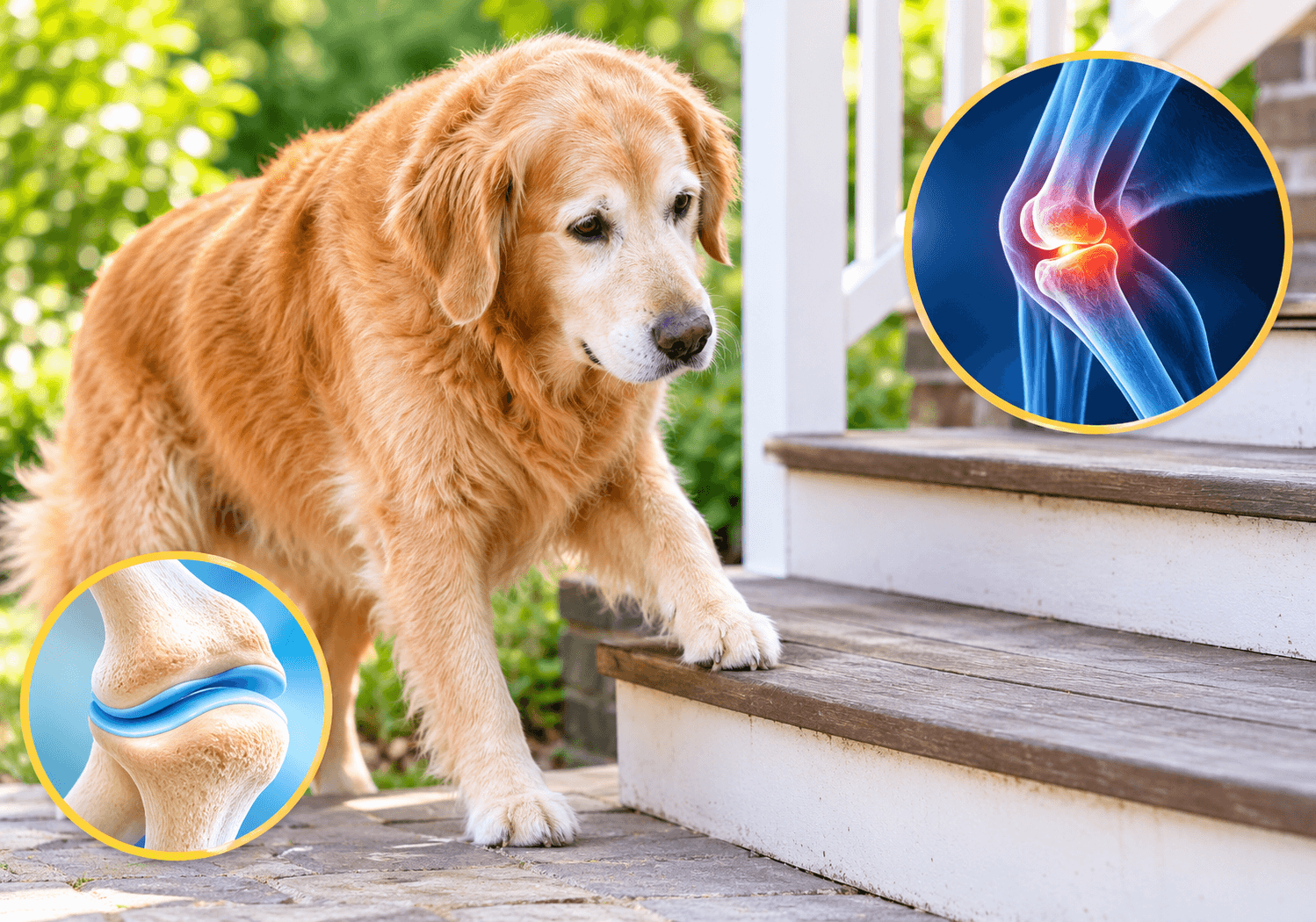
Glucosamine chondroitin MSM for dogs effectiveness is a question most owners ask the first time their dog hesitates at the stairs or takes a little longer to stand up. The pet aisle answers it with chews and powders that all sound promising. The research tells a more mixed story, and it is worth knowing before you spend money month after month.
Joint disease is common. One 2023 trial cites North American estimates that put osteoarthritis at about 20% of dogs older than 1 year and up to 80% of dogs older than 8 years, based on referral-clinic data. With numbers like that, it makes sense that so many owners reach for a supplement.
This guide covers what the dog studies found, why they disagree, what is known about safety, and how to run a fair trial at home with your vet. Think of it the way a good coach walks a client through a plan: plain language, clear steps, and honesty about what we do not know yet.
Quick Answer: Glucosamine, chondroitin and MSM may help some dogs, but the proof is weak. One small trial found benefit by day 70, while a larger placebo-controlled trial and a 2022 review found little to none. Side effects look mild. Treat these supplements as an optional add-on, not a replacement for veterinary pain care.
Check with your veterinarian before starting any supplement, especially if your dog takes medication, has food allergies, or has another health condition.

What Are Glucosamine, Chondroitin and MSM Supposed to Do?
Glucosamine and chondroitin are natural compounds found in cartilage, the smooth cushion at the ends of bones. The thinking behind supplements is simple: supply extra raw material and maybe slow the breakdown of joint tissue. A veterinary review describes glucosamine as a possible helper for collagen building in cartilage, with mild anti-inflammatory effects, and chondroitin sulfate as a possible brake on enzymes that damage cartilage and joint fluid.
MSM, short for methylsulfonylmethane, is a sulfur-containing compound added mainly for its possible anti-inflammatory effect. Most of the research on it is in people. A systematic review in people with knee osteoarthritis found two small MSM trials, 168 patients in all, and called the evidence positive but not definitive.
Many “triple” joint chews add extras. The tablet used in a recent dog trial held 900 mg of glucosamine HCl, 350 mg of chondroitin sulfate, 800 mg of MSM and 90 mg of avocado/soybean unsaponifiables. That matters, because we are often judging a blend, not one ingredient.
| Ingredient | What it is | Why it is added | Status in dog research |
| Glucosamine | A building block of cartilage | May support cartilage and ease mild inflammation | Tested in several dog trials with mixed results |
| Chondroitin sulfate | A cartilage component | May slow enzymes that break cartilage down | Usually tested together with glucosamine |
| MSM | A sulfur compound | May ease inflammation and joint discomfort | Mostly studied in people; no placebo-controlled dog trial of MSM alone found [VERIFY on PubMed] |
What the Research Says About Glucosamine Chondroitin MSM for Dogs Effectiveness
Dog studies on this topic are few, small and different from one another. Here are the ones that matter most, in plain terms.
The trial that found a benefit
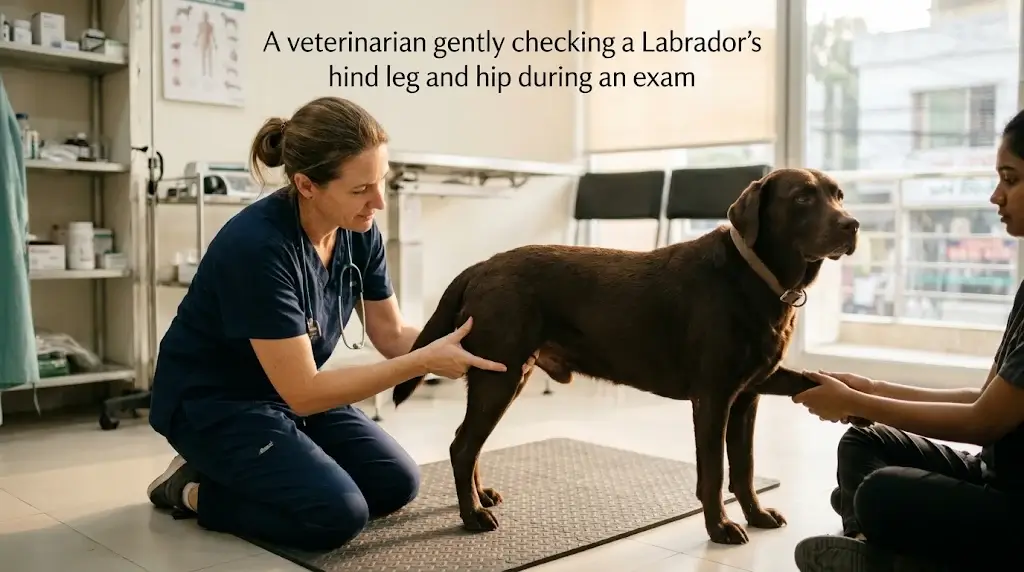
In a 2007 randomized trial, 35 dogs with hip or elbow arthritis were treated with either a glucosamine-chondroitin supplement or the anti-inflammatory drug carprofen. Dogs were rechecked on days 14, 42 and 70. By day 70, the supplement group showed significant improvement in pain, weight-bearing and overall severity, although it worked more slowly than carprofen.
That is real data, but look at the design. The study compared the supplement with a drug, not with a placebo. Without a placebo group, it is hard to say how much of the change came from the supplement and how much came from hopeful owners and good-and-bad-day swings in arthritis. A JAVMA paper has even given the owner effect a name: the caregiver placebo effect.
The placebo-controlled trial that did not
A 2023 trial in Frontiers in Veterinary Science put 75 dogs with hip arthritis into five groups: placebo, carprofen, two marine-lipid products, and a glucosamine-chondroitin-MSM tablet. Most dogs were big. They averaged about 72 lb (33 kg), and nearly half were golden retrievers. The tablet group received 30 mg of glucosamine HCl per kg of body weight daily for six weeks.
The researchers measured peak vertical force, or PVF. That is how much weight a dog puts through the sore leg as it trots across a force plate, so it is an objective gauge of pain. At week 6, PVF rose by 4.21 percentage points with carprofen, compared with 1.08 in the tablet group and a drop of 0.33 with placebo. The authors concluded that the glucosamine-chondroitin group did not show a treatment effect on PVF.
Vet exam scores did not change significantly in any group, including carprofen. The authors also say their scoring system has not been validated, so those scores deserve a pinch of salt.
There are fair points in the supplement’s favor. Six weeks is short, and the authors note that earlier trials reporting benefit ran 70 and 90 days. The study was also funded by Pharmalink, the company behind the marine-lipid products tested, although the authors state the funder had no role in the design, analysis or decision to publish. [VERIFY: a correction to this paper was published in Aug 2023 (Front Vet Sci 10:1252778); confirm what changed.]
What the bigger reviews conclude
A 2022 systematic review and meta-analysis pooled 57 articles covering 72 trials of diets and supplements in dogs and cats with arthritis. It found clear pain-relief evidence for omega-3 supplements and omega-3-enriched diets, weak evidence for collagen, and a very marked non-effect for chondroitin-glucosamine products. The authors went as far as recommending that these products no longer be used for pain management.
The 2017 review of glucosamine and chondroitin in dogs is more cautious in tone. It points to inconsistent glucosamine content between products and poor oral absorption as problems that have muddied results, an issue first seen in human trials [VERIFY]. It also reminds readers that NSAIDs remain the standard drug treatment for dogs with osteoarthritis.
What about MSM on its own?
For people with knee arthritis, the MSM review called for better trials on dose and long-term safety. For dogs, we found no placebo-controlled trial of MSM alone for naturally occurring arthritis [VERIFY]. The best dog data on MSM come from blended tablets, and the one placebo-controlled blend we covered did not show a clear gain in six weeks.
In plain terms, MSM is plausible, but unproven in dogs. It may be fine as part of a product your vet approves, yet it should not be the reason you expect a big change.
Why the studies disagree
The mixed results are not a mystery once you look at what differs between trials.
- Different products. Studies use different salt forms, doses and extra ingredients, so they are not testing the same thing.
- Absorption. In beagles, glucosamine HCl had roughly 12% oral bioavailability, and a later crossover study showed that liquid, chewable and tablet forms are absorbed differently.
- Length. Trials that saw benefit ran 70 to 90 days; the one with the clearest negative result ran six weeks.
- How pain is measured. Force plates, vet exams and owner reports do not always agree.
- Placebo effect. Trials without a placebo group may overstate the benefit.
Evidence at a Glance
| Source | Design | Length | What it found |
| McCarthy 2007 | Drug-controlled trial, 35 dogs finished, no placebo group | 70 days (recheck at day 98) | Pain, weight-bearing and severity improved by day 70; slower than carprofen |
| Kampa 2023 | Placebo-controlled, 75 dogs with hip arthritis | 6 weeks | Glucosamine-chondroitin-MSM tablet showed no treatment effect on PVF; carprofen and marine lipids did |
| Barbeau-Grégoire 2022 | Systematic review, 57 articles, 72 trials | n/a | Very marked non-effect for chondroitin-glucosamine; clear effect for omega-3 |
| Brien 2008 | Systematic review in people (MSM, knee arthritis) | n/a | Positive but not definitive evidence |
| Adebowale 2002 | Absorption study in beagles | Single and repeated doses | Glucosamine bioavailability about 12% |
How to Judge Glucosamine Chondroitin MSM for Dogs Effectiveness at Home
If your vet is open to a trial, treat it like a small experiment. A clear plan keeps hope from doing the judging for you. Here is a simple routine.
- Get the diagnosis first. Limping has many causes, so ask your vet to confirm arthritis and rule out other problems before you try anything.
- Pick one product. Choose a dog-specific product, check the amounts of each ingredient per serving, and ask your vet which dose fits your dog’s weight.
- Write down a baseline. Note how your dog handles stairs, rises from a nap, jumps into the car, and moves after a walk.
- Give it a fair length of time. Trials that reported benefit ran 70 to 90 days, so plan on about 10 to 12 weeks, not two.
- Track weekly. Score each item from 1 (easy) to 5 (struggling). Your vet may also share a questionnaire such as the Canine Brief Pain Inventory or the Liverpool Osteoarthritis in Dogs index.
- Decide with your vet. If scores have not improved after the full trial, stopping is a reasonable call.
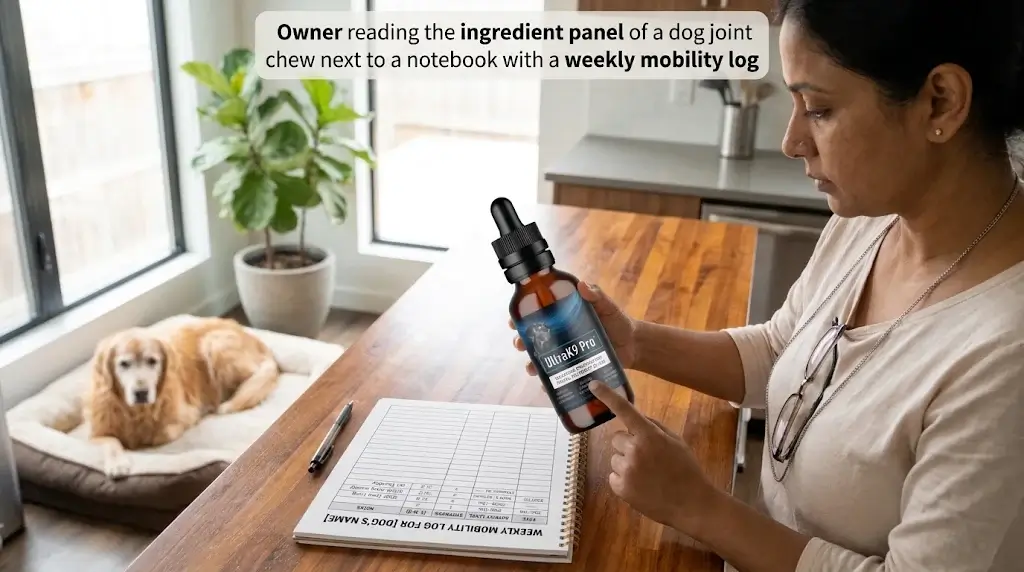
Coach’s Tip: Film your dog standing up from rest and climbing the same three steps every two weeks, at the same time of day. Video does not care how much you hope the supplement is working, so it gives you a fairer comparison than memory.
For scale, the 2023 trial’s dose of 30 mg of glucosamine HCl per kg works out to 750 mg a day for a 55 lb (25 kg) dog. That is the trial’s dose, not a recommendation. Your vet sets the right amount for your dog.
Common Mistake: Changing several things at once. If you start a supplement, switch foods and add a new medication in the same week, you will never know which one made the difference. Change one thing, then wait.
What Usually Matters More for Arthritic Dogs
Supplements are only one piece. Several other steps have better support, and they cost little or nothing.
Vet-directed pain control. NSAIDs such as carprofen are the main drug treatment for canine arthritis. They can cause stomach ulcers and are not suitable for dogs with kidney problems, according to the 2023 trial’s background section, so your vet decides whether they fit.
A leaner body. In a small trial of obese dogs with arthritis, weight loss reduced lameness, with significant improvement starting at about 6% weight loss. Ask your vet for a safe feeding plan and a target weight. [VERIFY: confirm authors and title for the Vet Res Commun 2010 paper.]
Omega-3s. The 2022 review found the clearest pain-relief signal for omega-3 supplements and enriched diets. Product type and dose matter, so ask your vet before buying.
Low-impact movement. Short, steady walks beat weekend marathons. The table below is general coaching guidance, not study data, so check it with your vet or a rehab veterinarian.
| Level | Walks per day | Length of each | Rough distance each | Surface |
| Easier | 2 to 3 | 5 to 10 min | 0.25 mile (0.4 km) | Flat, soft ground |
| Standard | 2 | 15 to 20 min | 0.5 mile (0.8 km) | Flat, mixed ground |
| Harder | 2 | 20 to 30 min | 0.75 to 1 mile (1.2 to 1.6 km) | Gentle slopes |
Move up a level only when your dog finishes the walk and is still comfortable the next morning. Drop back a level after any off day.
Home setup. Lay non-slip runners at least 24 inches (61 cm) wide over slick floors, and use a ramp instead of jumping into the car. These small changes reduce slips on a sore joint.

Safety Notes for Glucosamine, Chondroitin and MSM
On safety, the picture is reassuring but not complete. The 2017 review lists the possible effects in dogs as hypersensitivity and minor stomach and bowel changes such as gas and softer stools. In people, MSM has been linked to minor effects like allergy, stomach upset and skin rash.
Product quality is the bigger unknown. Content varies between products, so the amount on the label may not match what is in the chew. Look for independent third-party testing, and avoid products that list xylitol, a sweetener that is dangerous to dogs [VERIFY: cite FDA or vet-school source].
Who should be extra careful:
- Dogs with food allergies, since some glucosamine is made from shellfish [VERIFY]
- Dogs on any other medication, including NSAIDs
- Dogs with diabetes or other chronic conditions; ask your vet before starting
- Pregnant or nursing dogs and puppies, where we found no useful safety data
Common Mistake: Treating a worsening limp as an arthritis “flare” and adding more supplements. Sudden severe lameness, crying out, a swollen joint or refusing to put weight on a leg needs a prompt call to your vet.
Related Tips
- Skip human joint supplements unless your vet approves, because doses and added ingredients differ.
- Keep the label and lot number of any product you try, so you can report a reaction accurately.
- Store chews well out of reach. Many are flavored like treats.
- Bring your weekly mobility log to each vet visit. It turns “he seems a bit better” into something your vet can use.
Frequently Asked Questions
Does glucosamine chondroitin MSM really work for dogs?
Results are mixed. One 70-day trial without a placebo group reported improvement, while a six-week placebo-controlled trial of a glucosamine, chondroitin and MSM tablet found no significant gain, and a 2022 review leaned against these products for pain. Some dogs may seem better, but strong proof is missing.
How long does glucosamine take to work in dogs?
Trials that reported benefit ran 70 to 90 days, so a fair test takes about 10 to 12 weeks. A six-week trial saw no clear gain. If you notice nothing after a full trial, talk with your vet about stopping and spending the money on better-supported basics like weight control.
Is MSM safe for dogs?
MSM appears well tolerated in people, with only minor effects such as stomach upset, rash or allergy reported. Long-term safety data are limited. Dose and purity vary between products, so ask your vet before adding it, and never give a product that lists xylitol or other ingredients that can harm dogs.
Can dogs take human glucosamine supplements?
Ask your vet first. Absorption in dogs differs by formulation, and human products can carry different doses or added ingredients, including sweeteners that are unsafe for dogs. A vet can help you pick a dog-specific product and a dose based on your dog’s weight rather than guessing from a human label.
Is glucosamine chondroitin better than omega-3 for dogs with arthritis?
Not based on current evidence. The 2022 review of 72 trials found clear pain-relief evidence for omega-3 supplements and omega-3 enriched diets, but a very marked non-effect for chondroitin-glucosamine products. Your vet can advise on the right type and dose for your dog.
Should I give a joint supplement to a young, healthy dog?
No strong dog trial we found shows these supplements prevent arthritis, so there is no clear reason to start early [VERIFY]. Keeping your dog lean is a sound habit, since weight loss lowered lameness in obese dogs with arthritis. Ask your vet whether your dog’s breed or age raises joint risk.
Conclusion
Glucosamine chondroitin MSM for dogs effectiveness is real enough to deserve a conversation with your vet, and weak enough that you should not expect a miracle. One small drug-controlled trial saw improvement by day 70, while a placebo-controlled trial and a 2022 review of 72 trials did not back these products for pain relief. Safety looks reassuring on the available evidence, so a carefully run trial is a reasonable choice for an owner who wants to try.
If you do, change one thing at a time, track your dog’s movement for 10 to 12 weeks, and pair the supplement with the steps that carry more weight: vet-guided pain control, a lean body, omega-3s and steady low-impact walks. Your dog’s comfort is the goal, not any one product.
Talk with your veterinarian before starting any supplement or changing your dog’s care. This article is for general information and is not a substitute for advice from a doctor or physical therapist.