
Stiff joints can make everyday tasks—such as walking, climbing stairs, reaching for an overhead shelf, or simply getting out of a chair—feel unnecessarily difficult. As we get older, particularly after age 40, joint mobility deserves dedicated attention. Fortunately, gentle movement, strengthening exercises, appropriate nutrition, and healthy daily habits can significantly support your body’s ability to move freely.
While there is no single natural remedy that works instantly for every cause of stiffness, building a consistent routine can yield powerful results.
Quick Answer: To improve joint mobility naturally, practice gentle range-of-motion exercises, stretch regularly, strengthen the muscles surrounding your joints, stay physically active, eat a balanced diet, and allow enough time for recovery. Persistent or unexplained stiffness should always be evaluated by a healthcare professional.
If you are looking for natural ways to improve joint flexibility and overall joint health, this guide will provide you with evidence-informed, practical steps and joint mobility exercises you can start today.
Understanding Joint Mobility, Flexibility, and Range of Motion
To improve how your body moves, it helps to understand the terminology often used by fitness and medical professionals.
- Joint mobility: This refers to how comfortably, actively, and freely a joint moves through its available range. It involves the joint capsule, the bones, and your motor control.
- Flexibility: This specifically describes how readily muscles and other soft tissues lengthen to allow movement.
- Joint stability: This is how your muscles, ligaments, and supporting structures work together to control and protect movement, preventing the joint from moving beyond a safe range.
- Range of motion (ROM): This is the measurable extent of movement at a specific joint, usually measured in degrees.
Why Is Good Joint Mobility Important?
Good joint mobility offers practical, daily benefits. It translates to easier everyday movement, allowing you to seamlessly perform actions like squatting to pick something up, bending to tie your shoes, reaching behind you in the car, or turning your head comfortably. Furthermore, adequate mobility supports proper exercise technique, prevents compensatory movement patterns (which can lead to injury), and helps maintain functional independence, movement confidence, and balance as you age.
Can You Improve Joint Mobility After 40 or 50?
Absolutely. While bodies change, you can often improve range of motion and overall mobility after 40 or 50 with consistent, appropriate activity. The results will naturally depend on your personal baseline mobility, underlying health conditions, injury history, and the specific exercise program you follow. Healthy aging and flexibility are highly compatible when approached with a gradual, consistent mindset.
Common Reasons Your Joints Feel Stiff
Understanding the root causes of stiff joints helps you address them effectively. While arthritis is common, it is not the only culprit.
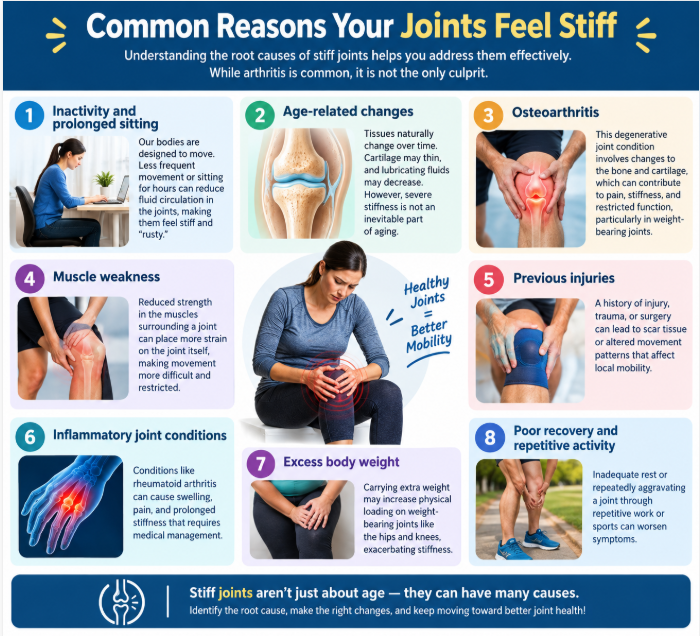
- Inactivity and prolonged sitting: Our bodies are designed to move. Less frequent movement or sitting for hours can reduce fluid circulation in the joints, making them feel stiff and “rusty.”
- Age-related changes: Tissues naturally change over time. Cartilage may thin, and lubricating fluids may decrease. However, severe stiffness is not an inevitable part of aging.
- Osteoarthritis: This degenerative joint condition involves changes to the bone and cartilage, which can contribute to pain, stiffness, and restricted function, particularly in weight-bearing joints.
- Muscle weakness: Reduced strength in the muscles surrounding a joint can place more strain on the joint itself, making movement more difficult and restricted.
- Previous injuries: A history of injury, trauma, or surgery can lead to scar tissue or altered movement patterns that affect local mobility.
- Inflammatory joint conditions: Conditions like rheumatoid arthritis can cause swelling, pain, and prolonged stiffness that requires medical management.
- Excess body weight: Carrying extra weight may increase physical loading on weight-bearing joints like the hips and knees, exacerbating stiffness.
- Poor recovery and repetitive activity: Inadequate rest or repeatedly aggravating a joint through repetitive work or sports can worsen symptoms.
Why Are Joints Stiff in the Morning?
Morning joint stiffness is incredibly common and can have multiple causes. During sleep, fluid can accumulate in and around the joints, and the lack of movement causes tissues to tighten. Brief stiffness that improves within 10 to 30 minutes of gentle movement is typical. However, persistent morning stiffness lasting over an hour, especially when accompanied by warmth or swelling, differs from ordinary stiffness and may signal an inflammatory condition.
When Is Joint Stiffness More Than a Mobility Problem?
It is vital to distinguish ordinary stiffness from symptoms that require clinical assessment. Reduced range of motion that severely limits your life, sudden joint swelling, radiating pain, or joint stiffness in older adults that comes on rapidly should be evaluated by a medical professional.
12 Natural Strategies for Better Joint Mobility
Improving your mobility doesn’t require extreme workouts. Instead, focus on these 12 natural strategies for better joint mobility, combining movement, lifestyle, and nutrition.
1. Start With Gentle Daily Range-of-Motion Exercises
Before jumping into intense workouts, focus on controlled, comfortable movement through your available range. Range of motion exercises for stiff joints help circulate synovial fluid, which lubricates the joint capsule. Start with just a few minutes every morning. Simple daily joint mobility exercises include ankle circles, wrist circles, gentle shoulder rolls, and slow, unloaded knee bends.
2. Stretch Regularly Without Forcing the Movement
There is a profound difference between a gentle stretch and forcing a joint beyond its comfortable limit. Natural joint flexibility exercises should feel like a mild pull, never pain. Incorporate the best stretches for joint mobility into your routine, covering areas prone to tightness: calf stretches, hip flexor lunges, hamstring stretches, and chest openers. Practice slow, deep breathing and allow gradual progression over weeks, not days.
3. Strengthen the Muscles Around Your Joints
Strong muscles act as shock absorbers for your joints. Strengthening exercises for joint stability help control movement and support everyday function. You don’t need heavy weights to build exercises for stronger joints. Incorporate bodyweight movements like sit-to-stands from a sturdy chair, resistance-band rows for the upper back, calf raises, and modified wall push-ups. Emphasize proper technique and gradual resistance.
4. Walk Regularly at a Comfortable Pace
Many people wonder, does walking improve joint mobility? Walking is an accessible, low-impact activity that promotes circulation and overall joint health. Start with short, 10-to-15-minute sessions and build up gradually. If you have painful weight-bearing joints (like severe knee osteoarthritis), you may need an alternative low-impact activity, but for most, regular walking for joint health is highly beneficial.
5. Try Swimming or Water-Based Exercise
Water buoyancy reduces weight-bearing stress on the hips, knees, and spine while still allowing full, resisted movement. This makes aquatic exercise one of the best low-impact exercises for stiff joints. Try water walking, gentle leg sweeps, or a beginner water aerobics class to harness the benefits of water exercises for joint mobility.
6. Break Up Long Periods of Sitting
Joint stiffness after sitting is a common complaint for desk workers. To combat this, stand, change your position, or move gently at regular intervals—ideally every 30 to 60 minutes. Add brief movement breaks to television time. Even a simple seated mobility routine (like torso twists or seated marches) makes great exercises for sedentary adults.
7. Practice Yoga or Tai Chi at an Appropriate Level
Mind-body practices incorporate controlled movement, balance, and deep breathing, complementing any mobility routine. Beginner or adapted gentle yoga for joint mobility can help stretch tight tissues. Tai chi for joint flexibility is also excellent; the fluid movements and balance exercises for older adults are often recommended for arthritis management, though evidence varies by the specific practice and condition.
8. Eat a Balanced, Nutrient-Rich Diet
Your joints rely on nutrients to maintain healthy tissue. Prioritize vegetables, fruit, legumes, whole grains, fish, nuts, and high-quality protein sources. While a balanced anti-inflammatory diet supports overall health and may reduce systemic inflammation, it’s important to understand that no food instantly restores damaged cartilage. Focus on the best foods for joint health as part of long-term natural joint support through nutrition.
9. Maintain a Healthy Weight if Appropriate
Weight management for knee joint health is a practical consideration, as it may reduce the mechanical loading on your hips and knees. Focus on this goal without shame-based language or overly restrictive diets. Emphasize sustainable eating habits and enjoyable physical activity to reduce pressure on joints naturally and safely.
10. Support Recovery With Sleep and Rest
Exercise is the stimulus, but recovery is when your body adapts. Sleep and joint health are closely linked; poor sleep can heighten pain sensitivity and reduce exercise consistency. Support your recovery for joint mobility by getting 7-9 hours of sleep. When symptoms flare, adapt your activity levels—but remember that “rest” usually means modifying activity, not prolonged bed rest or total inactivity.
11. Use Heat or Cold When Appropriate
Temperature therapies offer natural relief for joint stiffness. Heat therapy for stiff joints (like a warm shower or heating pad) may help relax muscles and make you feel more comfortable before movement. Conversely, cold packs for joint discomfort may provide short-term symptom relief after strenuous activity if a joint feels slightly inflamed. Always use a barrier (like a towel) to avoid applying extreme temperatures directly to the skin.
12. Follow a Consistent, Gradual Mobility Routine
Consistency beats intensity. Encourage a manageable, daily mobility routine for beginners rather than occasional, grueling workouts. Track how your comfortable movement, daily function, and symptoms change over time. When figuring out how to improve joint mobility at home, progress gradually, and always seek professional guidance if symptoms persist or worsen.
(Note: The CDC and NIH support appropriate physical activity, strengthening, range-of-motion work, and weight management as fundamental parts of joint health and osteoarthritis management.)
Which Exercises Help Different Joints Move Better?
To build an effective routine, you need joint-specific movements. Use the following instructions for the best joint mobility exercises. Caution: Always stay within a comfortable range of motion and modify these movements to suit your needs. Do not push into sharp pain.
Knee Mobility Exercises
These movements help lubricate the knee joint and improve knee flexibility naturally.
- Seated knee extensions: Sit tall in a chair. Slowly straighten one leg out in front of you, squeezing the thigh muscle gently at the top. Lower it back down with control. Repeat 10 times per leg.
- Gentle heel slides: Lie on your back or sit comfortably. Slowly slide one heel toward your buttocks, bending the knee as far as is comfortable, then slide it back out.
- Supported sit-to-stands: If comfortable, practice standing up from a sturdy chair and sitting back down slowly without using your hands. This builds mobility and strength simultaneously.
Hip Mobility Exercises
To improve tight hips naturally, incorporate these hip mobility exercises at home.
- Gentle hip rotations: Lie on your back with knees bent and feet flat. Slowly let both knees drop slightly to the right, then to the left, like windshield wipers, staying within a pain-free range.
- Supported standing hip movements: Hold onto a counter for balance. Gently swing one leg forward and backward, and then side to side across your body. Keep the movement small and controlled.
- Comfortable hip flexor stretches: Stand in a staggered stance (one foot forward, one back). Keep your back straight and gently tuck your pelvis under to feel a mild stretch in the front of the back hip.
Shoulder Mobility Exercises
Improve shoulder range of motion with these simple, daily actions.
- Shoulder rolls: Sit or stand tall. Roll your shoulders up toward your ears, pull them back, drop them down, and bring them forward. Do 5-10 circles backward, then forward.
- Gentle wall slides: Stand facing a wall. Place your forearms on the wall and slowly slide your hands upward as high as comfortable, then slide them back down.
- Controlled arm raises: While standing, slowly raise your arms straight out in front of you and up toward the ceiling, keeping within a comfortable range.
Ankle and Wrist Mobility Exercises
Don’t neglect your extremities. Ankle mobility exercises and hand joint flexibility are crucial for balance and dexterity.
- Ankle circles and pumps: While seated, lift one foot and slowly draw large circles with your toes. Next, pump your foot up and down (like pressing a gas pedal).
- Wrist circles and bends: Extend your arms and slowly rotate your wrists in clockwise, then counterclockwise circles. Follow by gently bending your wrists up and down.
- Finger opening and closing: Spread your fingers as wide as possible, then gently squeeze them into a soft fist. Repeat 10 times.
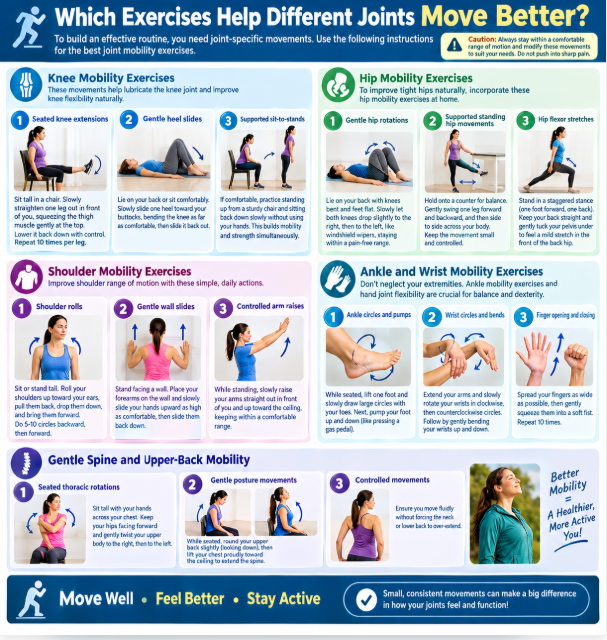
Gentle Spine and Upper-Back Mobility
- Seated thoracic rotations: Sit tall with your hands across your chest. Keep your hips facing forward and gently twist your upper body to the right, then to the left.
- Gentle posture movements: While seated, round your upper back slightly (looking down), then lift your chest proudly toward the ceiling to extend the spine.
- Controlled movements: Ensure you move fluidly without forcing the neck or lower back to over-extend.
Important: Readers with recent injuries, joint replacements, severe pain, or diagnosed joint disease may need a personalized exercise plan from a physical therapist. These exercises should not be viewed as universally suitable for all medical conditions.
What Should You Eat to Support Healthy Joints?
Nutrition plays a supportive role in how your body manages inflammation and repairs tissue. Instead of searching for a cure-all, focus on the best foods for joint health as part of a balanced diet.
Omega-3-Rich Foods
Omega-3 fatty acids are known for their anti-inflammatory properties. Good sources include salmon, sardines, trout, chia seeds, flaxseeds, and walnuts. These foods contribute to a balanced anti-inflammatory diet for joint health, though their specific, measurable effects on day-to-day mobility will vary from person to person.
Protein for Muscle Strength and Support
Adequate protein is vital for maintaining the muscle mass that supports your joints. Incorporate eggs, fish, poultry, tofu, beans, lentils, and yogurt into your meals. Nutrients for healthy joints must include amino acids (from protein) to repair tissues and support strength training efforts.
Vitamin C and Collagen Formation
Foods rich in vitamin C for collagen production include citrus fruits, strawberries, bell peppers, broccoli, and tomatoes. Vitamin C contributes to the body’s normal collagen formation. However, it is important to remember that eating these foods does not guarantee the spontaneous repair of worn cartilage.
Calcium and Vitamin D for Bone Health
While bone health is distinct from joint mobility, strong bones provide the structural foundation for your joints. Incorporate dairy products or fortified plant-based alternatives, leafy greens where appropriate, and safe sun exposure or vitamin D sources.
Mediterranean-Style Eating for Overall Health
An overall healthy dietary pattern is far more useful than relying on a single supposed superfood. The Mediterranean diet—rich in vegetables, fruits, whole grains, legumes, nuts, olive oil, and fish—is widely recommended. It provides foods that support cartilage indirectly by reducing systemic inflammation and helping maintain a healthy weight.
Best Supplements for Joint Health: What Does the Evidence Say?
Supplements should be viewed as an optional addition, not the primary treatment for restricted movement. If you are exploring natural supplements for joint mobility, here is what the current evidence suggests.
Glucosamine and Chondroitin
These are among the most popular supplements for joint stiffness. However, scientific evidence regarding their efficacy for osteoarthritis symptoms is conflicting. While some people report feeling better, clinical trials show mixed results. Do not expect glucosamine to magically rebuild cartilage or reliably restore lost mobility overnight.
Collagen Supplements
Collagen for joint health is heavily marketed today. Collagen is a primary structural protein in joint cartilage. Some studies suggest specific collagen peptides may help reduce joint discomfort in athletes or those with osteoarthritis. However, evidence for particular joint outcomes varies widely by formulation, and more robust research is ongoing.
Omega-3 Supplements
While eating fish is beneficial, taking concentrated omega-3 fish oil supplements is another option. They may help reduce joint tenderness in inflammatory conditions like rheumatoid arthritis, but you should avoid presenting omega-3 supplements as a proven, standalone solution for osteoarthritis mobility.
Curcumin, Turmeric, and Other Joint Supplements
Curcumin (the active compound in turmeric) is an area of ongoing, mixed research. Turmeric for joint discomfort shows promise for its anti-inflammatory effects in some studies, but it is poorly absorbed without additions like black pepper extract. Mention possible medication interactions and product-quality concerns when choosing these supplements.
Safety message: People taking prescription medication, especially blood thinners, or those with existing medical conditions should discuss supplements with a qualified healthcare professional before use. The NCCIH reports uncertainty around glucosamine and chondroitin for osteoarthritis and notes potential supplement interactions.
Your 7-Day Beginner Mobility Routine
Building consistency is the secret to success. Here is an easy 7-day mobility routine to get you started. This is a general example, not a personalized rehabilitation program.
- Day 1: Gentle movement. Spend 5–10 minutes performing comfortable joint circles and range-of-motion exercises (like shoulder rolls and ankle pumps).
- Day 2: Walking or water exercise. Try a short, comfortable walking session or a beginner water aerobics class based on your ability.
- Day 3: Strength and control. Practice suitable strengthening exercises like supported sit-to-stands, calf raises, or gentle resistance-band movements.
- Day 4: Flexibility. Use gentle stretches for the hips, calves, chest, or shoulders, holding each stretch comfortably while breathing deeply.
- Day 5: Low-impact activity. Repeat a suitable walk, a light stationary cycling session, or an aquatic activity.
- Day 6: Balance and mobility. Try supported balance practice (like standing on one leg near a wall) or an adapted tai chi session.
- Day 7: Recovery and review. Perform only light, comfortable movement today. Review how your joints responded to the week’s activities.
How Often Should You Do Joint Mobility Exercises?
It is best to start with short, manageable sessions—even 5 to 10 minutes a day is an excellent start. Adjust the frequency based on your comfort, physical ability, and any professional advice you’ve received. The CDC notes that even brief bouts of appropriate activity can be highly beneficial for joint health.
How Long Does It Take to Improve Joint Mobility?
Some people notice easier movement and a reduction in morning stiffness relatively quickly (within a week or two of regular movement). However, meaningful functional changes in range of motion and tissue adaptation may take several weeks or months. Consistency is key; do not rush the process.
What Should You Avoid When Improving Joint Mobility?
To protect your joints, be aware of common joint mobility mistakes and exercises to avoid with joint pain.
- Forcing painful stretches: Stretching should never cause sharp pain.
- Increasing exercise intensity too quickly: Rapid spikes in activity often lead to flare-ups.
- Ignoring persistent swelling: Worsening symptoms are a sign to pause and evaluate.
- Assuming it’s just “aging”: Don’t dismiss every joint problem as inevitable aging; many issues are highly treatable.
- Relying entirely on supplements: Pills cannot replace the benefits of appropriate physical movement.
- Remaining inactive: Long periods of inactivity without a medical reason generally make stiffness worse.
- Copying advanced routines: Safe exercises for stiff joints are those suited to your current ability, not an internet influencer’s advanced routine.
Should You Exercise With Stiff or Painful Joints?
Gentle, appropriately adapted activity is often beneficial for stiffness. Movement circulates joint fluid. However, if you experience severe pain, an acute injury, significant swelling, or a joint that is hot to the touch, exercise requires extreme caution and potentially prompt medical assessment.
When Is Joint Stiffness a Medical Concern?
While natural strategies are powerful, you need to know when to see a doctor for stiff joints. Seek professional evaluation if you experience:
- Stiffness or pain that persists, recurs frequently, or limits your daily activities.
- Visible swelling, warmth, redness, or a severe reduction in movement.
- Symptoms affecting multiple joints simultaneously, or accompanied by unusual fatigue or a fever.
- Symptoms that continually worsen despite modifying your physical activity.
A suddenly hot, red, swollen joint accompanied by a fever or feeling unwell requires urgent medical assessment to rule out infection. Similarly, a significant injury, visible joint deformity, or an inability to bear weight requires immediate care.

FAQs About Improving Joint Mobility Naturally
How can I improve joint mobility naturally at home?
You can improve mobility at home by practicing daily, gentle range-of-motion exercises, suitable stretching, and bodyweight strength work. Stay active with regular walking, avoid prolonged sitting, and progress your routine gradually.
What is the best exercise for joint mobility?
There is no single best exercise for everyone. The most appropriate routine depends on the specific joint, your physical ability, any existing symptoms, and underlying health conditions. Low-impact movements like walking or swimming are excellent starting points.
Can joint mobility improve after age 50?
Yes, many people can improve or maintain their functional mobility after age 50 with suitable, consistent activity. While the degree of improvement varies based on joint health and arthritis, regular movement keeps joints lubricated and functional.
Which foods are best for joint health?
A balanced dietary pattern is best. Focus on vegetables, fruits, quality protein sources, whole grains, nuts, and omega-3-rich fish where appropriate. This helps manage systemic inflammation and supports muscle and tissue health.
How long does it take to loosen stiff joints?
The timeline depends on the cause. Morning stiffness might loosen up after 15 minutes of movement. However, chronically stiff joints may take weeks of consistent mobility exercises to show lasting functional improvement. Persistent stiffness warrants medical evaluation.
Is walking enough to improve joint mobility?
Walking strongly supports general fitness, circulation, and lower-body functional movement. However, to maximize joint health, most people also need targeted range-of-motion, strength, balance, or flexibility exercises for the upper body and spine.
Do supplements improve joint mobility?
Evidence varies significantly by the supplement and the underlying condition. While some find relief with glucosamine or omega-3s, supplements should not replace appropriate daily exercise, a healthy diet, medical assessment, or prescribed treatments.
Why are my joints stiff after sitting or sleeping?
Prolonged inactivity allows fluids to pool and soft tissues to tighten, resulting in temporary stiffness that usually resolves with gentle movement. However, persistent morning stiffness or joint swelling may indicate an underlying inflammatory condition requiring a doctor’s care.
What is the difference between joint mobility and flexibility?
Mobility involves the active, controlled movement of a joint through its full range of motion. Flexibility relates more specifically to the passive ability of your muscles and other soft tissues to lengthen and stretch.
Start Improving Your Joint Mobility One Step at a Time
Improving how your body moves is a gradual, highly rewarding process. To recap the most important steps: move regularly and start at a manageable level. Combine appropriate mobility work, strength training, and low-impact aerobic activity. Eat a balanced diet, maintain healthy lifestyle habits, evaluate supplements carefully, and always seek professional guidance when symptoms persist or cause concern.
Your Next Step: Don’t try to overhaul your life today. Choose two or three comfortable mobility habits—such as a 10-minute morning stretch routine or a daily walk—and build consistency over the next week before increasing the difficulty.