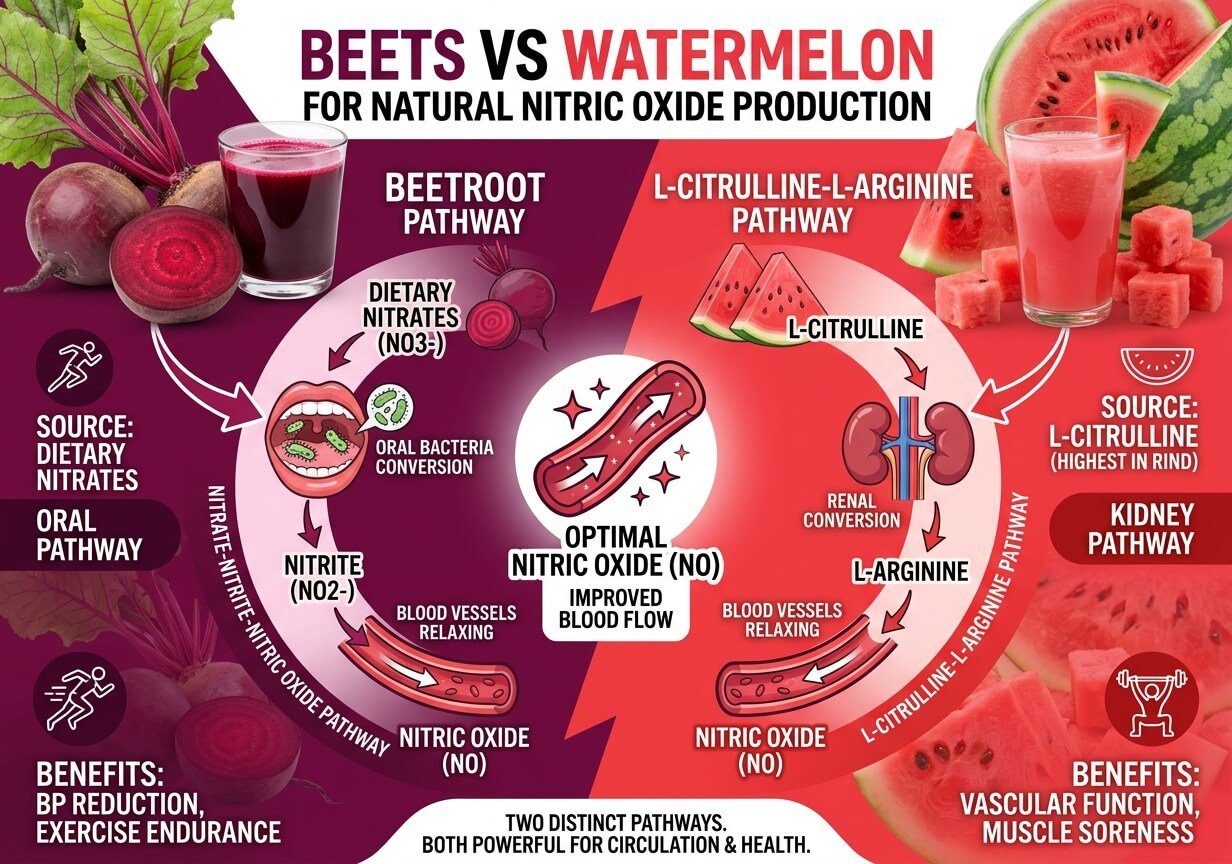
Beets vs Watermelon for Natural Nitric Oxide Production
When evaluating natural, food-based strategies to support healthy blood circulation, vascular function, and physical stamina, beets and watermelon consistently top the list. Both vibrant foods have earned strong reputations as “natural nitric oxide boosters,” but they operate through entirely distinct biological pathways.
To answer the comparison directly: neither food is universally “better” than the other—they serve different biochemical functions. Beets support nitric oxide production via the dietary nitrate–nitrite–nitric oxide pathway, providing inorganic nitrates that oral bacteria and cellular enzymes convert directly into active gas. Watermelon operates through the L-citrulline–L-arginine pathway, supplying the amino acid L-citrulline, which the kidneys convert into L-arginine—the primary building block used by endothelial cells to synthesize nitric oxide.
While both foods provide compelling vascular and athletic benefits in human clinical trials, their effectiveness varies depending on individual health status, oral microbiome composition, renal function, and specific health targets. This guide provides a head-to-head comparison of beets and watermelon across their biological mechanisms, nutritional profiles, clinical research evidence, exercise applications, and daily dietary strategies.
1. What Is Nitric Oxide and Why Does The Body Need It?
What Is Nitric Oxide (NO)?
Nitric oxide is an endogenously produced gaseous signaling molecule that acts as an autocrine and paracrine messenger across human tissues. Though it survives for only a few seconds once synthesized, its influence over the cardiovascular system is foundational.
How Does the Body Naturally Produce Nitric Oxide?
The human body synthesizes nitric oxide through two major routes:
- The Endothelial L-Arginine Pathway: The enzyme endothelial nitric oxide synthase (eNOS) oxidizes L-arginine in the presence of oxygen to yield nitric oxide and L-citrulline.
- The Enterosalivary Nitrate–Nitrite Pathway: Ingested inorganic nitrates from foods like beets are concentrated in saliva, reduced to nitrites by commensal mouth bacteria, and converted into active nitric oxide in the stomach and blood vessels.
How Nitric Oxide Helps Blood Vessels Relax
Once generated, nitric oxide diffuses into vascular smooth muscle cells lining the arteries, activating soluble guanylyl cyclase (sGC). This triggers an increase in cyclic GMP (cGMP), inducing smooth muscle relaxation and blood vessel dilation (vasodilation).
Nitric Oxide and Healthy Blood Circulation
By relaxing blood vessels, nitric oxide reduces peripheral vascular resistance, ensuring that oxygenated blood, glucose, and nutrients flow efficiently to active skeletal muscles, vital organs, and microvascular capillary beds.
Why Nitric Oxide Matters for Cardiovascular Health
Optimal nitric oxide production helps keep blood vessels flexible and compliant, suppresses abnormal platelet aggregation, and protects against endothelial dysfunction—a primary driver of vascular aging and arterial stiffness.
2. What Makes Beets a Natural Source of Nitric Oxide Support?
Do Beets Contain Nitrates?
Yes. Root vegetables, particularly beetroot (Beta vulgaris), are among the concentrated natural dietary sources of inorganic nitrate (NO3-).
How Dietary Nitrates Help the Body Produce Nitric Oxide
Unlike endogenous synthesis via the eNOS enzyme—which requires oxygen and specific amino acids—dietary nitrates offer an external reservoir for generating nitric oxide independently of eNOS activity.
The Nitrate–Nitrite–Nitric Oxide Pathway Explained
When you consume beets or beetroot juice:
- Dietary nitrate (NO3-) is absorbed in the upper gastrointestinal tract and enters the bloodstream.
- Roughly 25% of circulating nitrate is actively concentrated by the salivary glands and secreted into saliva.
- Commensal anaerobic bacteria residing on the dorsal surface of the tongue reduce nitrate to nitrite (NO2-) via nitrate reductase enzymes.
- Swallowed saliva enters the acidic stomach, where nitrite is partially converted into nitric oxide, while remaining nitrite enters systemic circulation to be reduced to NO in hypoxic or acidic vessel tissues.
What Role Do Oral Bacteria Play in Nitrate Conversion?
The oral microbiome is vital to the beet pathway. Studies show that using strong antibacterial mouthwashes or chewing gum immediately after consuming beets can wipe out nitrate-reducing mouth bacteria, significantly blunting subsequent increases in blood nitrite and preventing vasodilation.
Why Beetroot Juice Is Popular for Blood Flow and Exercise
Beetroot juice concentrates dietary nitrates into a small, conveniently consumed volume, delivering standardized nitrate loads studied extensively for supporting exercise efficiency and healthy resting blood pressure.
3. What Makes Watermelon a Natural Source of Nitric Oxide Support?
Does Watermelon Contain L-Citrulline?
Yes. Watermelon (Citrullus lanatus) is nature’s richest dietary source of L-citrulline, a non-essential amino acid named directly after the botanical genus Citrullus.
How L-Citrulline Converts Into L-Arginine
When you consume watermelon, L-citrulline is absorbed in the small intestine and enters systemic circulation without undergoing first-pass degradation by liver or gut enzymes. Upon reaching the kidneys, specialized enzymes (argininosuccinate synthetase and argininosuccinate lyase) convert L-citrulline into L-arginine.
How L-Arginine Supports Nitric Oxide Synthesis
Newly synthesized L-arginine serves as the direct substrate for eNOS enzymes within the endothelium, which oxidize L-arginine to produce nitric oxide gas.
Watermelon Flesh vs. Watermelon Rind: What Should You Know?
While the sweet red or pink flesh of watermelon provides significant amounts of L-citrulline, the firm white and light-green outer rind contains significantly higher concentrations per gram. Juicing or blending the rind alongside the flesh yields a far higher dose of active amino acids.
Can Eating Watermelon Support Vascular Function?
Clinical interventions administering watermelon juice, concentrated watermelon extracts, or pure L-citrulline demonstrate improved arterial flexibility, reduced brachial and aortic systolic pressure, and supported microvascular reactivity.
4. Beets vs Watermelon: Key Nutritional Differences
Beetroot Nutrition and Dietary Nitrate Content
A standard 100-gram serving of raw red beets provides roughly 43 calories, 2 grams of fiber, high concentrations of folate (Vitamin B9), potassium, and roughly 250 mg of inorganic nitrate (though nitrate levels vary based on soil composition and farming conditions).
Watermelon Nutrition and L-Citrulline Content
A 100-gram serving of fresh watermelon flesh contains roughly 30 calories, 91% water, high levels of lycopene and Vitamin C, and between 100 mg and 300 mg of L-citrulline (with rind preparations supplying markedly higher concentrations).
Vitamins, Minerals, Fiber, and Antioxidants
- Beets: Abundant in betalains (deep red antioxidant pigments that combat oxidative stress), manganese, and folate.
- Watermelon: Rich in lycopene (a potent carotenoid antioxidant supporting cardiovascular and prostate health), Vitamin A, and Vitamin C.
Calories and Natural Sugar Content
Watermelon is lower in calories per unit weight due to its high water content, but both fruits contain natural sugars. Beets have a higher glycemic load when concentrated into whole juices, whereas watermelon has a higher glycemic index but a low glycemic load in standard whole servings.
Whole Beets vs. Beet Juice vs. Whole Watermelon
| Comparison Factor | Beets (Beetroot) | Watermelon |
| Primary NO Pathway | Enterosalivary Nitrate (NO3-) Nitrite (NO2-) NO | L-Citrulline L-Arginine NO |
| Key Active Precursor | Inorganic Dietary Nitrate (NO3-) | L-Citrulline (highest in rind) |
| Primary Enzyme System | Commensal oral nitrate reductases & tissue reductases | Renal ASS/ASL enzymes & endothelial eNOS |
| Commonly Studied Form | Concentrated beetroot juice shots (300–500 mg nitrate) | Whole watermelon juice, blended rind, or pure extract |
| Primary Clinical Focus | Blood pressure reduction & exercise oxygen efficiency | Vascular compliance, muscle soreness, and arterial stiffness |
| Key Nutrient Highlights | Betalain antioxidants, folate, potassium, fiber | Lycopene, Vitamin C, Vitamin A, high hydration |
| Practical Limitations | Requires healthy mouth bacteria; high oxalates | Requires high volume or rind consumption to equal clinical citrulline doses |
5. Beets vs Watermelon for Nitric Oxide Production: Which Works Better?
Which Food Provides More Direct Dietary Nitrate?
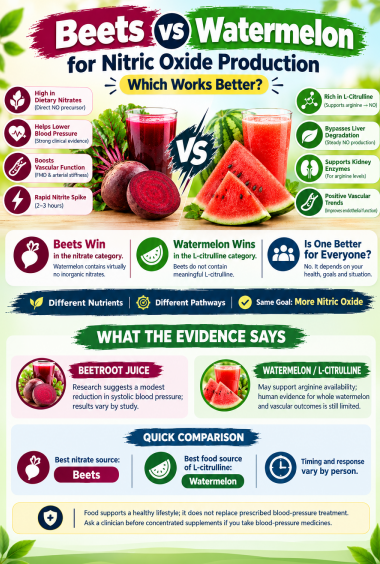
Beets win conclusively in the nitrate category. Watermelon contains virtually no inorganic nitrates, relying exclusively on its amino acid content to influence nitric oxide pathways.
Which Food Supports the L-Arginine–Nitric Oxide Pathway?
Watermelon wins conclusively in the L-citrulline category. Beets do not contain meaningful quantities of L-citrulline.
Beets vs Watermelon for Nitric Oxide Bioavailability
Which Food Has More Evidence for Supporting Blood Pressure?
Which Food Has Been Studied for Vascular Function?
Is One Food Better for Everyone?
No. An individual using chlorhexidine mouthwash or suffering from oral dysbiosis will gain limited nitric oxide benefit from beets, making watermelon a better option.
6. Beets vs Watermelon for Blood Flow and Circulation
How Beetroot Nitrates Influence Blood Vessel Relaxation
How Watermelon L-Citrulline Supports L-Arginine Availability
By supplying L-citrulline, watermelon fuels the endogenous production of L-arginine. This provides a steady supply of substrate to eNOS enzymes, preventing “arginine depletion” in vascular endothelial cells.
Which Food Has More Evidence for Vascular Function?
- Beetroot: Supported by extensive human clinical literature evaluating brachial artery flow-mediated dilation (FMD).
- Watermelon: Supported by human studies demonstrating reduced central aortic systolic pressure and improved wave reflection parameters.
Beets vs Watermelon for Peripheral Circulation
Both foods improve microvascular perfusion and blood flow to peripheral tissues, making them valuable additions to a circulation-focused nutrition routine.
7. Beets vs Watermelon for Blood Pressure and Heart Health
What Research Says About Beetroot Juice and Blood Pressure
A 2024 systematic review and meta-analysis confirmed that daily consumption of inorganic nitrate from beetroot juice produces statistically significant reductions in resting systolic blood pressure (often between 3 to 9 mmHg). The effect is particularly pronounced in adults with untreated hypertension.
What Research Says About Watermelon and Cardiovascular Health
Clinical trials evaluating watermelon supplementation show reductions in ankle and brachial blood pressure in pre-hypertensive and hypertensive adults. Additionally, watermelon’s high lycopene content offers antioxidant protection against LDL cholesterol oxidation.
Nitric Oxide and Healthy Endothelial Function
Can Either Food Replace Blood Pressure Medication?
8. Beets vs Watermelon for Exercise Performance and Endurance
Beetroot juice is one of the most widely researched ergogenic aids in sports nutrition.
Watermelon, L-Citrulline, and Muscle Blood Flow
Potential Effects on Exercise Endurance
- Beets: Excel in aerobic endurance events (running, cycling, rowing) by reducing the VO2 cost of submaximal effort.
- Watermelon: Excels in high-intensity exertion and recovery, helping attenuate delayed-onset muscle soreness (DOMS) 24 to 48 hours post-workout.
Which Food Has Better Evidence for Athletic Performance?
Whole Watermelon vs. Watermelon Juice for L-Citrulline
Eating red watermelon flesh provides modest L-citrulline.
How Processing and Storage May Affect Nutrient Content
- Beets: High-heat boiling can cause water-soluble nitrates to leach out into cooking water. Steaming, roasting, or raw juicing preserves maximal nitrate levels.
10. How to Include Beets and Watermelon in Your Daily Diet
Easy Ways to Eat More Beets
- Roast diced whole beets with olive oil and herbs.
- Grate raw beets over green salads.
- Blend raw beet slices into fruit smoothies alongside berries and citrus.
Simple Ways to Eat Fresh Watermelon
- Enjoy fresh, cold watermelon slices as a hydrating snack.
- Cube watermelon flesh and toss with fresh mint and cucumber for a refreshing salad.
11. Can You Combine Beets and Watermelon for Nitric Oxide Support?
Do Beets and Watermelon Work Through Different Pathways?
Potential Benefits of Eating Both Foods
Combining dietary nitrates with L-citrulline provides dual-action vascular support:
- Immediate/Exogenous Support: Beet nitrates generate NO directly via nitrite reduction in hypoxic or acidic vessel beds.
- Sustained/Endogenous Support: Watermelon citrulline elevates blood L-arginine, feeding eNOS enzymes for steady baseline NO generation.
Creating a Beet-Watermelon Smoothie
12. Beets vs Watermelon: Safety and Precautions
Who Should Be Careful With Beetroot Juice?
- People Prone to Kidney Stones: Beets are exceptionally high in oxalates. Individuals with a history of calcium oxalate kidney stones should limit concentrated beet powders and juices.
- Beeturia: Consuming beets can cause urine or stool to turn red or pink (beeturia).
- Antibacterial Mouthwash Users: Strong antiseptic mouthwashes destroy the oral bacteria necessary to convert beet nitrates to nitrites, blunting vascular benefits.
Watermelon Considerations
- FODMAP Sensitivities: Watermelon contains fructose, which may cause gas or bloating in individuals with irritable bowel syndrome (IBS) or fructose malabsorption.
Medication Considerations
13. What Does Scientific Research Say About Beets vs Watermelon?
Clinical Studies on Beetroot Juice and Dietary Nitrates
Clinical trials confirm that oral watermelon juice or L-citrulline extracts significantly increase plasma arginine and citrulline concentrations, reduce aortic pulse wave velocity, and support exercise recovery.
Research on Watermelon, L-Citrulline, and Vascular Function
Clinical trials confirm that oral watermelon juice or L-citrulline extracts significantly increase plasma arginine and citrulline concentrations, reduce aortic pulse wave velocity, and support exercise recovery.
Differences Between Nitric Oxide Biomarkers and Clinical Outcomes
While both foods reliably elevate systemic NO biomarkers (such as plasma nitrate, nitrite, and arginine), long-term cardiovascular disease reduction depends on overall diet quality, physical activity, and medical management rather than any single superfood.
Nitric Boost: Supporting Circulation, Vascular Wellness & Daily Vitality.
14. Frequently Asked Questions About Beets, Watermelon, and Nitric Oxide
1. Are beets or watermelon better for nitric oxide production?
Neither is universally superior; they work through different pathways.
2. Which food contains more nitric oxide precursors?
3. Do beets increase nitric oxide naturally?
Yes. Oral mouth bacteria convert beet nitrates into nitrites, which are reduced into active nitric oxide throughout the cardiovascular system.
4. How does watermelon support nitric oxide production?
Watermelon supplies L-citrulline, which the kidneys convert into L-arginine—the direct substrate used by endothelial cells to produce nitric oxide.
5. What is the difference between dietary nitrates and L-citrulline?
Dietary nitrate (NO3-) is an inorganic compound reduced to NO via bacterial and non-enzymatic pathways. L-citrulline is an organic amino acid that feeds the enzymatic eNOS pathway via L-arginine conversion.
6. Is beetroot juice good for blood flow?
Yes. Clinical trials consistently demonstrate that beetroot juice increases plasma nitrite, lowers vascular resistance, and supports blood flow.
7. Can watermelon improve circulation?
Yes. The L-citrulline in watermelon elevates blood arginine levels, supporting vascular relaxation and arterial compliance.
8. Which is better for blood pressure, beets or watermelon?
Beetroot juice is widely preferred for aerobic endurance events to improve oxygen efficiency. Watermelon juice is excellent for hydration, high-intensity exercise, and reducing muscle soreness.
10. Can you eat beets and watermelon together?
11. Does watermelon contain L-citrulline?
Yes. Watermelon is the single richest natural dietary source of L-citrulline, with the highest concentrations found in the white rind.
12. Do you get more nitrates from whole beets or beetroot juice?
13. What foods naturally increase nitric oxide?
Leafy greens (spinach, arugula), beets, watermelon, garlic, pomegranate, and citrus fruits all support natural nitric oxide production through various pathways.
14. How often can you eat beets or watermelon?
15. Can beets or watermelon replace nitric oxide supplements?
For many healthy individuals, whole foods and concentrated juices provide effective, natural alternatives to synthetic pre-workout amino acid powders.