
If you lift, sprint, or train hard, you have probably heard that creatine gives you energy and burns fat. Some of that is true, and some of it is marketing. Creatine is one of the most researched sports supplements in the world, and it does help certain types of exercise. It does not work like a fat burner, though, and it does not give you a steady energy boost all day. In this guide, I’ll explain what creatine does in your muscles, what the fat loss research actually shows, who might benefit, and how to use it safely.
Quick Answer: Creatine does not burn fat directly. It helps your muscles regenerate a fuel called ATP faster during short, hard efforts. Some studies show that people who take creatine while lifting lose a small amount of body fat percentage compared with lifting alone, but the effect is small and may come from better training. For real fat loss, calorie balance, protein, and consistent training matter far more.
What Creatine Actually Does in Your Body
Creatine is a compound your body makes from amino acids, and it is also found in foods like meat and fish. About 95% of your body’s creatine is stored in skeletal muscle, where it combines with phosphate to form phosphocreatine. The Stanford Exercise Physiology lab explains that at the start of high-intensity exercise, ATP is rapidly broken down, and creatine phosphate donates a phosphate group back to ADP to regenerate ATP.
Think of ATP as the energy currency your muscles spend when they contract. Your muscles only store a small amount of it. Phosphocreatine acts like a backup battery that recharges ATP during the first few seconds of a hard effort, such as a heavy set of squats or a 10-second sprint. More stored creatine means more backup power to draw on.
That is the core mechanism. Creatine works in the immediate energy system, not in the slow, long-term system that handles hours of steady activity.
Coach’s Tip: When someone says creatine “gives energy,” I translate it to: it helps you push harder for a few more reps or a few more seconds at the top of your effort. It is not a stimulant, so it will not make you feel wired like caffeine does.
Why the Muscle Matters
Your muscles need a fast supply of ATP to produce force. A set of heavy squats or a hard hill sprint can drain phosphocreatine quickly. The NSCA’s Kinetic Select article on creatine explains that phosphocreatine depletion during high-intensity exercise is a major driver of fatigue in those short, intense efforts, and that stores can drop sharply within a 30-second bout.
This is why the research tends to find the biggest benefits in strength, power, and repeated short sprints. If your training is mostly steady cardio, the same benefit is much smaller.
What “Energy” Means Here
The word energy gets used loosely, so it helps to be precise. Creatine does not add calories. It does not change how much food you need. It does not improve your mood or your alertness the way caffeine does.
What creatine can do is help you perform better in the specific moments when your muscles need quick power. Many people feel more “fresh” in training because they can get through more reps at a good weight. That is a real benefit, but it is a training benefit, not a daily energy boost.
A 2020 review in Nutrients by Tardy and colleagues describes energy and fatigue as subjective perceptions with an objective physiological basis, and notes that the terms are defined differently across studies. That same caution applies to creatine. If you feel tired at your desk, creatine is unlikely to be the cause or the cure.
Does Creatine Help With Fat Loss?
This is where the honest answer gets more interesting. Creatine does not burn fat in the way a fat-burning supplement claims to. Its main effect is on muscle, not on fat cells. Still, researchers have studied whether people who take creatine while lifting lose more body fat than people who lift alone.
What the Research Shows
Several meta-analyses, which combine results from multiple studies, have looked at this question. The findings are consistent in one way: the effect on body fat is small.
A systematic review and meta-analysis by Candow and colleagues on resistance exercise and creatine supplementation in adults under 50 included 12 studies with 266 participants. It found that adults who took creatine while doing resistance exercise had a very small but significant reduction in body fat percentage, about 1.19 percentage points compared with the placebo group. The same review found no meaningful difference in absolute fat mass, which was about 0.18 kg.
In adults 50 and older, the picture was similar. A meta-analysis of creatine during resistance training in adults 50 and older found a greater reduction in body fat percentage of about 0.55 percentage points compared with placebo, with a statistically significant result. The absolute fat mass change was not statistically significant, although the group taking creatine lost about half a kilogram more fat on average.
A 2024 meta-analysis in the Journal of Strength and Conditioning Research pooled 12 randomized controlled trials in adults under 50 and reported that creatine users gained more lean body mass and lost a small amount more body fat than resistance-training participants who did not take creatine.
How to Read These Numbers
Read the numbers like a coach. A drop of about one percentage point of body fat is small. On a 180 lb (82 kg) person at 20% body fat, that is about 1.8 lb (0.8 kg) of fat mass, and it is not guaranteed for any single person. Studies also tend to have modest sample sizes, and they measure body composition with different tools.
The bigger takeaway is that the fat loss effect seems to be a side effect of something else. Creatine helps people do more quality training and gain lean mass. Muscle is metabolically active tissue, and the extra training volume may help with the total energy balance. The body fat change appears to follow from that, rather than from creatine acting directly on fat.
Common Mistake: Expecting creatine to melt fat while you eat in a surplus or skip training. A supplement cannot override calorie balance. If you are not eating in a deficit or training consistently, creatine will not make you lean.
The Mechanism Is Still Being Studied
Researchers have proposed several ways creatine might affect fat, including effects on energy use in fat tissue. The 2019 meta-analysis on adults 50 and older discusses these possible mechanisms, but notes that the link is still being studied. For a reader, the honest version is simple: the mechanism is not proven.
Who Might Notice the Biggest Benefit
Creatine is not a one-size-fits-all tool. The research points to a few groups that are most likely to see benefits, and a few that are less likely.
More Likely to Benefit
- Lifters doing progressive resistance training. The research on lean mass and strength is strongest here.
- People doing repeated short, hard efforts, such as sprint intervals, team sports, or circuit training with heavy sets.
- Older adults doing resistance training. The 2019 meta-analysis focused on this group, and the Stanford and ISSN reviews discuss benefits in aging populations.
- Women who lift, who have the same basic physiology for this purpose. The research base in women is smaller, so the evidence is less complete.
Less Likely to Benefit
- People who mainly do steady, low-intensity cardio. The ATP-PC system matters less for long, steady efforts. The NSCA notes that the benefit is most evident in short, high-intensity work.
- People who do not train consistently. Creatine does not replace training.
Coach’s Tip: If you do mostly steady cardio but also do some sprints or intervals each week, creatine may still help those specific sessions. Judge it by how your hard efforts feel and how your strength changes over 8 to 12 weeks, not by how you feel on rest days.
How to Take Creatine
The ISSN position stand on creatine describes the core approach. Creatine monohydrate at about 3 to 5 grams per day will raise muscle creatine stores over roughly three to four weeks, while the performance effects of this slower approach are less supported. Some people use a short loading phase to saturate muscles faster. The position stand describes loading as a way to reach full stores sooner, but the basic daily dose is the same over time.
Creatine monohydrate is the most studied form. Other forms are marketed with bigger claims, and the research does not show they work better. Stick with monohydrate unless your doctor or coach has a specific reason to choose otherwise.
A Simple Protocol
- Pick monohydrate and a daily dose. A dose of about 3 to 5 grams per day is the common starting point the ISSN describes.
- Choose a timing that works for you. Timing matters less than daily consistency. Many people take it with a meal or a shake.
- Take it every day, including rest days. Muscle stores build up over time, and skipping days delays saturation.
- Stay hydrated. Drink water as you normally would. Creatine does not require extra water beyond normal intake, but you should not run low on fluids.
- Track training, not just the scale. Log your sets, reps, and weights for 8 to 12 weeks.
- Reassess with a clear goal. Decide before you start what you want to measure, such as strength, body composition, or sprint times.
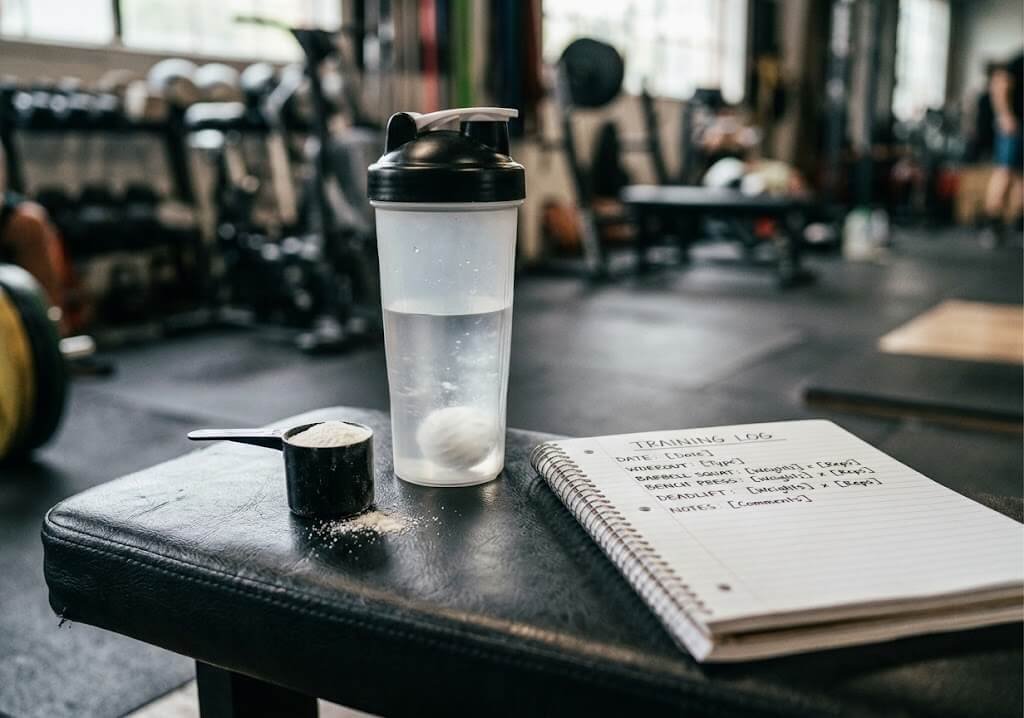
Sample Training Routine Using Creatine Support
Creatine works best as part of a plan. Here is a simple three-day full-body routine that fits the kind of training the research has studied. Use the regression and progression options to match your current level.
Day 1: lower body strength focus
| Exercise | Sets | Reps | Rest | Tempo | Regression (easier) | Progression (harder) |
| Goblet squat | 3 | 8–10 | 90 s | 2-0-2 | Box squat to a bench | Barbell back squat |
| Romanian deadlift | 3 | 8–10 | 90 s | 3-0-1 | Dumbbell RDL | Single-leg RDL |
| Dumbbell row | 3 | 10–12 | 60 s | 2-0-2 | Band row | Chest-supported row |
| Plank | 3 | 20–30 s | 45 s | Hold | Kneeling plank | Weighted plank |
Day 2: Upper Body and Sprint Work
| Exercise | Sets | Reps | Rest | Tempo | Regression | Progression |
| Dumbbell bench press | 3 | 8–10 | 90 s | 2-0-2 | Incline push-up | Barbell bench press |
| Lat pulldown | 3 | 10–12 | 60 s | 2-0-2 | Band pulldown | Pull-up |
| Seated shoulder press | 3 | 8–10 | 75 s | 2-0-2 | Landmine press | Standing barbell press |
| Hill sprints (about 10 s) | 6 | 1 | 60–90 s | All out | Stationary bike sprint | Hill sprint at a steeper grade |
Day 3: Full body strength
| Exercise | Sets | Reps | Rest | Tempo | Regression | Progression |
| Leg press | 3 | 10–12 | 90 s | 2-0-2 | Bodyweight squat | Heavier leg press |
| Kettlebell swing | 3 | 10–12 | 60 s | Explosive | Light dumbbell swing | Heavier kettlebell |
| Cable row | 3 | 10–12 | 60 s | 2-0-2 | Band row | Heavier cable row |
| Dead bug | 3 | 8 each side | 45 s | Controlled | Dead bug with arms only | Dead bug with light weight |
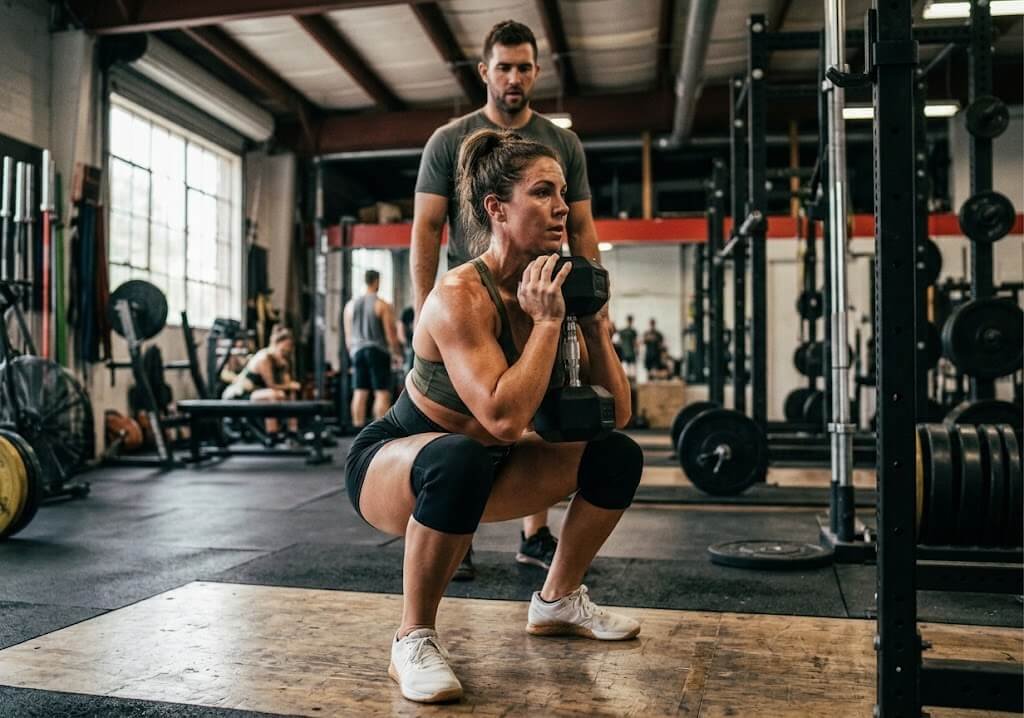
Form Cues for the Core Lifts
Goblet squat: Hold a dumbbell at your chest. Stand with feet about shoulder-width apart, toes slightly out. Sit back and down, keeping your chest tall. Drive through your whole foot to stand. It should feel like a strong, controlled sit, not a fall.
Romanian deadlift: Hold the weight at hip level. Push your hips back while keeping a slight knee bend. Lower until you feel a stretch in your hamstrings, usually around shin level. Squeeze your glutes to stand. You should feel the stretch in the back of your legs, not your lower back.
Dumbbell bench press: Lie on a bench with feet flat. Lower the dumbbells to the sides of your chest, elbows about 45 degrees from your body. Press up and slightly in. Keep your shoulder blades pinned back.
Hill sprint: Warm up for five minutes first. Sprint hard for about 10 seconds, then walk back to recover. The effort should feel close to your maximum. If you cannot hold good form, stop the set.
Common Mistake: Going too heavy too soon on the goblet squat or RDL and losing form. Choose a weight where you can finish each set with clean technique and one or two reps left in the tank. Your back and hips should not do the work your legs should be doing.
Safety and Side Effects
Creatine has one of the strongest safety records among sports supplements, according to the ISSN, but it is not risk-free for everyone. Understanding the common concerns helps you make a clear decision.
Kidney Health
Kidney concerns come up often, so they deserve a careful answer. The ISSN position stand summarizes the research and concludes that creatine supplementation is safe and well-tolerated in healthy individuals and in patient populations ranging from infants to the elderly.
A 2025 review by Longobardi and colleagues in Frontiers in Nutrition states that studies consistently show no adverse effects on renal function in healthy individuals, although caution is advised for those with pre-existing kidney conditions and pregnant women, because evidence is lacking for these populations.
Creatine raises a blood marker called creatinine, which doctors use to estimate kidney function. The increase reflects creatine turnover in muscle, not necessarily kidney damage. Still, that change can confuse results if you are being tested for kidney problems. Tell your doctor you take creatine before any kidney lab work.
If you have kidney disease, diabetes with kidney involvement, high blood pressure that is poorly controlled, or reduced kidney function of any kind, talk to your doctor before starting. A review of studies on creatine and renal function notes that high-dose creatine should not be used by people with pre-existing renal disease or those with a potential risk for renal dysfunction.
Cramps, Dehydration, and Stomach Upset
The idea that creatine causes dehydration or cramps is common, but the research does not strongly support it. Longobardi and colleagues report that claims that creatine leads to dehydration or muscle cramps during exercise are largely unsupported by controlled studies, which show no significant effects on hydration or thermoregulation.
Some people do report stomach upset, especially at higher single doses. Splitting your dose across the day can help. If stomach problems continue, lower the dose or talk to your doctor.
Coach’s Tip: Drink your normal amount of water and keep your electrolytes in check during hard training, especially in hot weather. Do not blame creatine for every cramp without looking at sleep, heat, and training load first.
Pregnancy and Medical Conditions
Pregnant women are not a population with enough research to make firm safety claims. Longobardi and colleagues note that evidence is lacking for them. Anyone who is pregnant, breastfeeding, managing a medical condition, or taking prescription medicine should check with a doctor before starting creatine.
This article is written for general fitness readers. If you have an injury, a chronic health issue, or you are older and returning to training, check with a doctor or physical therapist first.
Cancer Concerns
Some people worry that creatine may raise cancer risk. Longobardi and colleagues state that although some theoretical risks have been discussed, the available research does not support a link between creatine supplementation and cancer. That is a reassuring finding, but it is still a review of available data, so keep an eye on new research.
Creatine for Endurance and Other Sports
Creatine is not a general endurance supplement. A review in Nutrients and other sports nutrition reviews point out that creatine supplementation per se does not enhance endurance exercise performance.
That does not mean endurance athletes cannot benefit. If your training includes sprints, intervals, hill repeats, or heavy strength work, creatine may still support those specific efforts. The key is matching the supplement to the demands of the sport.


Frequently Asked Questions
Does creatine burn fat?
Creatine does not burn fat directly. Some studies show that people who take creatine while lifting lose a small amount of body fat percentage compared with lifting alone. The effect is small, and it seems to come from better training and more lean mass rather than a direct fat-burning action. Diet and consistent training still drive fat loss.
Will creatine make me gain weight?
Creatine can raise your body weight a little in the first weeks. Much of that early change is water stored in muscle, along with the extra muscle you may build over time. It does not add body fat directly. Track your waist, strength, and how your clothes fit, not just the scale.
Does creatine give you energy?
Creatine does not give you energy the way caffeine or food does. It helps your muscles regenerate ATP faster during short, hard efforts. Many people notice they can push through a few more reps. It does not provide a steady energy boost during the day.
How long does it take for creatine to work?
Without a loading phase, the ISSN notes that daily doses of 3 to 5 grams can raise muscle creatine stores over about three to four weeks. A loading phase can speed that up. Most people judge the effect by tracking strength and training quality over eight to twelve weeks.
Is creatine safe for women over 40?
The research on healthy adults is reassuring, and the 2019 meta-analysis focused on adults 50 and older. Women over 40 who have kidney issues, take medications, or are pregnant should check with a doctor first. Research in women specifically is still smaller than in men, so keep expectations modest.
Can creatine help if I only do cardio?
Creatine has its strongest benefit in short, high-intensity work. If your training is mostly steady cardio, the effect is likely small. If you add sprints, intervals, or heavy strength sessions, creatine may support those workouts specifically.
Conclusion
So, does creatine help with energy and fat loss? It helps your muscles recharge ATP faster during short, hard efforts, which can help you train harder and build lean mass. Its fat loss effect is small and appears to follow from better training, not from burning fat directly. For real results, pair creatine with a calorie plan that fits your goals, consistent resistance training, and good sleep.
If you decide to try creatine, choose monohydrate, use a daily dose in the range the ISSN describes, and track your training for at least eight to twelve weeks. Talk to your doctor first if you have kidney issues, are pregnant, or take medications.