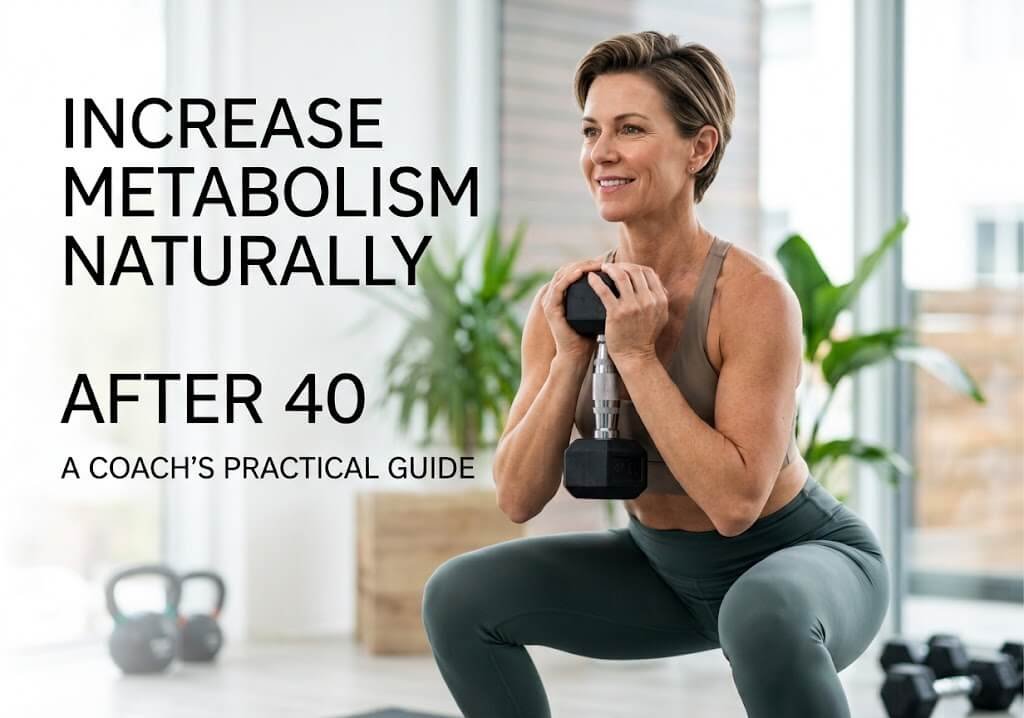
Your metabolism does slow down somewhat after 40, but most of the drop is not inevitable. The biggest factors are how much muscle you carry, how active you stay during the day, and how well you sleep and recover. You can influence all three with habits you can start this week, and you do not need extreme diets or supplements to do it.
Quick Answer
To increase metabolism naturally after 40, build and keep muscle with strength training two to three days a week, eat enough protein at each meal, walk or move more every day, and protect your sleep. Muscle burns more energy at rest than fat does, and daily movement adds more calories burned than most people expect. These steps are slower than a quick fix, but they are the ones that hold up.
Why Metabolism Changes After 40
Your metabolism is the total of all the energy your body uses. Most of it goes to your resting metabolic rate, the energy used to keep your heart, lungs, brain, liver, and kidneys running. The rest comes from digesting food, from everyday movement, and from planned exercise.
For a long time, people blamed age alone for weight gain in the 40s. Research has painted a more nuanced picture. A large study of total daily energy expenditure published in Science found that energy use per kilogram of body weight stays fairly steady through early and middle adulthood and only starts to decline later in life. You can read the study summary in the Science journal archive [VERIFY].
That result matters. It means the sharp drop many people feel around 40 is usually not caused by your metabolism suddenly shutting down. More often, three things change at the same time:
- Muscle mass slowly declines. Adults who do not lift weights gradually lose muscle, a process often called sarcopenia. Commonly cited estimates put the loss at a few percent per decade after 30, though the exact rate varies widely between people [VERIFY estimate and source].
- Daily movement drops. Desk work, driving, and less time on your feet can lower the calories you burn outside the gym. Scientists call this non-exercise activity thermogenesis, or NEAT.
- Sleep and stress shift. Work pressure, family demands, and poor sleep can change appetite and recovery, which affects how consistently you train and eat well.
Coach’s Tip: Stop asking “How do I speed up my metabolism?” and start asking “How do I keep the muscle and movement I already have?” That shift gives you a clear plan.
Why Muscle Is the Main Lever
Muscle tissue is metabolically active. Compared with fat tissue, it uses more energy even when you are sitting still. The difference per pound is not dramatic, so you should not expect building muscle to transform your calorie burn overnight. Over months, though, adding and keeping muscle adds up, and it changes your body composition in ways that matter for strength, posture, blood sugar control, and how your clothes fit.
Muscle also helps protect your joints and balance as you age. A strong lower body makes it easier to climb stairs, get up from the floor, and carry groceries. Those benefits are more useful day to day than any single number on a fitness tracker.
The most effective way to build and keep muscle is resistance training, which means working your muscles against a load. The HHS Physical Activity Guidelines for Americans recommend muscle-strengthening activities for major muscle groups at least two days a week in addition to aerobic activity. The CDC adult physical activity guidelines say the same thing in plainer language.
Step 1: Start Strength Training Two to Three Days a Week
This is the most important step in this guide. If you do nothing else, lift something regularly.
Keep your first program simple. Choose one exercise for each major area of the body, do two or three sets of 8 to 12 reps, and aim to finish each set with about two reps left in the tank. You should feel that the last few reps are challenging but still controlled.
Beginner Full-Body Session (about 35 to 45 minutes)
| Exercise | Sets | Reps | Rest |
| Goblet squat | 3 | 8–12 | 90 seconds |
| Dumbbell Romanian deadlift | 3 | 8–10 | 90 seconds |
| Push-up (incline if needed) | 3 | 6–12 | 60 seconds |
| One-arm dumbbell row | 3 | 8–12 each side | 60 seconds |
| Dead bug | 2 | 6 each side | 45 seconds |
| Farmer’s carry | 2 | 40 steps | 60 seconds |
Goblet Squat: Form, Regression, and Progression
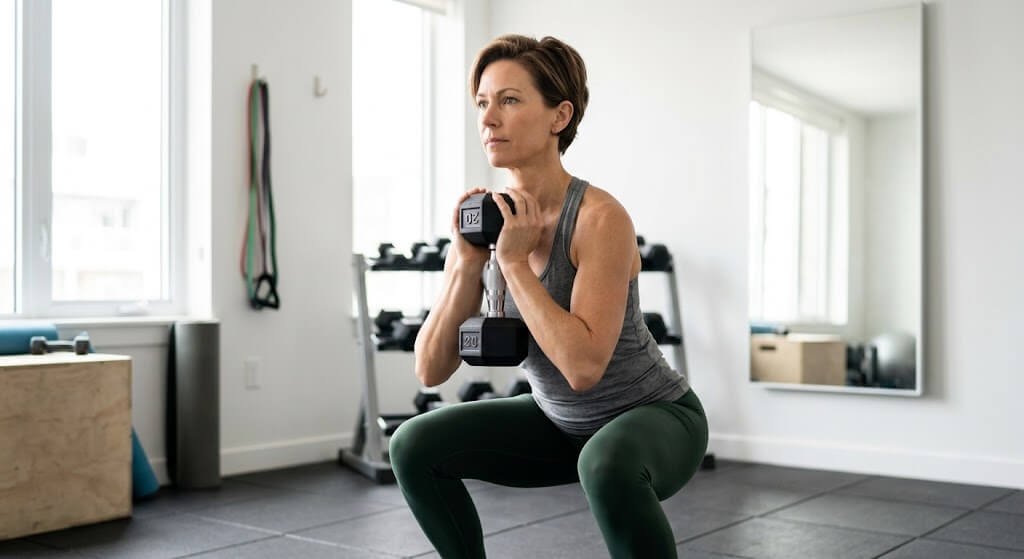
Hold one dumbbell vertically at your chest with both hands. Stand with your feet about shoulder-width apart, toes turned out slightly. Sit your hips down and back as if lowering onto a low stool, keeping your chest tall and your heels flat. Go down until your hip crease is just below your knee if your mobility allows, then drive through your whole foot to stand back up.
- Coach’s cue: Think “spread the floor” with your feet. This keeps your knees tracking over your toes.
- Easier version: Squat to a box or bench at a comfortable height, then stand. Hold onto a sturdy surface for balance if needed.
- Harder version: Use a heavier dumbbell or hold a kettlebell, or slow the lowering phase to a count of three.
Start with a weight you can control for all sets. For many adults new to lifting, that is about 10 to 20 lb (4.5 to 9 kg) in one hand. Go heavier only when every rep looks the same as the first one.
Dumbbell Romanian Deadlift: Form and Progression
Hold two dumbbells in front of your thighs. Keep a soft bend in your knees and push your hips straight back, letting the weights slide down your legs. Stop when you feel a strong stretch in your hamstrings, usually somewhere mid-shin for most people, then squeeze your glutes to stand.
- Coach’s cue: Your back should stay flat from tailbone to head. If it rounds, you have gone too far or lowered too fast.
- Easier version: Use a light pair of dumbbells or a light kettlebell and reduce the range of motion.
- Harder version: Do single-leg versions with a light dumbbell in the opposite hand, or add a slow three-second lowering.
Common Mistake: Turning this into a squat by bending the knees too much. The hinge should come from the hips.
Push-Up Options
Push-ups build your chest, shoulders, and triceps and can be done almost anywhere. If a standard push-up is too hard, place your hands on a bench, table, or countertop and lower your chest toward the edge. Keep your body in one straight line from head to heels.
- Easier version: Incline push-up on a sturdy bench or countertop.
- Harder version: Lower the body to the floor with a three-second count, or use a deficit by placing your hands on two books or a low platform.
One-Arm Dumbbell Row
Place one knee and hand on a bench. Hold a dumbbell in the other hand with your arm straight. Pull the weight toward your hip, keeping your elbow close to your body. Pause briefly, then lower slowly.
- Easier version: Use a resistance band anchored at waist height.
- Harder version: Increase the weight or pause for two seconds at the top of each rep.
Coach’s Tip: Keep the tempo controlled. A simple rhythm of two seconds up, one second pause, and two to three seconds down works well for most beginners and builds strength without rushing.
Step 2: Progress Your Training Over Time
Strength training works best when you slowly ask more of your muscles. This principle is called progressive overload. It does not require you to lift heavy every day.
Use one of these simple progression methods:
- Add reps. If you did 8 reps last week and can now do 10 with good form, keep the same weight.
- Add weight. Once you can complete the top of your rep range for all sets with good form, move up in weight by a small step.
- Add a set. Once an exercise feels easy, add one set.
- Slow the lowering phase. A three-second lowering makes the same weight feel harder.
You should be able to explain to yourself why you chose a weight. If you can’t, your program needs a plan.
The American College of Sports Medicine publishes position stands and guidance on resistance training progression for healthy adults. Look for its current resistance training recommendations [VERIFY current position stand title and URL].
Step 3: Walk and Move More Every Day
Daily movement is one of the most underrated tools for supporting metabolism after 40. It does not feel like a workout, and it adds up across the week.
Aim to build your daily movement gradually:
- Week 1: Find your current average step count for three days. Most people are surprised by how low it is.
- Week 2: Add a 10-minute walk after your largest meal of the day.
- Week 3: Add one more 10-minute walk, ideally outdoors.
- Week 4 and beyond: Work toward a daily total that feels sustainable, then increase gradually.
For many adults, a comfortable pace of about 2 to 3 miles per hour (3.2 to 4.8 km/h) is a good place to start. Long walks are great, but short walks also count. Spreading movement across the day helps reduce long periods of sitting.
Other practical ways to increase NEAT include:
- Stand up every 30 to 45 minutes when working at a desk.
- Take stairs when they are available and safe.
- Park a little farther from the entrance.
- Do light chores such as carrying laundry, gardening, or mopping.
- Take phone calls while walking.
Common Mistake: Believing that one hard workout cancels out a day of sitting. A focused session is valuable, but consistent daily movement matters too. Both work together.
Step 4: Eat Enough Protein at Every Meal
Protein supports muscle repair and growth. If you are lifting weights and trying to hold onto muscle, your protein intake matters.
A widely cited meta-analysis in the British Journal of Sports Medicine by Morton and colleagues found that protein intakes up to about 1.6 grams per kilogram of body weight per day were associated with gains in strength and muscle mass in resistance-training adults. You can find the paper at the British Journal of Sports Medicine [VERIFY URL and figures before publishing].
In practical terms, that is about 0.7 grams per pound of body weight per day, or roughly 1.6 grams per kilogram. For a 160 lb (73 kg) adult, that is about 110 to 115 grams of protein daily. Many people do not need to reach that level exactly, but it gives a useful target range.
A simple way to hit your goal:
- Include a palm-sized portion of protein at each meal (roughly 25 to 35 grams for most adults).
- Add a protein-rich snack, such as Greek yogurt, cottage cheese, eggs, or a lean meat sandwich.
- Spread protein across the day rather than eating most of it at dinner.
Good sources include eggs, fish, poultry, lean beef, tofu, tempeh, beans, lentils, Greek yogurt, milk, and cottage cheese. If you have kidney disease or another medical condition, check with your doctor before increasing protein.
Coach’s Tip: Put protein on your plate first, then add vegetables and carbohydrates around it. This small habit makes it much easier to hit your target without tracking every gram.
Step 5: Protect Your Sleep
Sleep affects hunger hormones, energy levels, training quality, and recovery. Poor sleep often leads to more snacking, lower motivation, and skipped workouts, which all make metabolic health harder to maintain.
The CDC sleep guidance recommends that most adults get seven or more hours of sleep per night. If you consistently sleep less, your body may not recover well from training, and you may feel hungrier the next day.
Simple habits that support better sleep include:
- Keep a consistent wake-up time, even on weekends.
- Stop heavy meals and intense exercise at least two to three hours before bed.
- Limit caffeine after early afternoon.
- Keep your bedroom cool, dark, and quiet.
- Put screens away 30 to 60 minutes before bed.
If you have ongoing trouble sleeping, snoring, or waking up exhausted, talk with a doctor. Sleep apnea and other conditions are more common in midlife and need proper evaluation.
Step 6: Manage Stress and Recovery
Stress does not directly cancel out a good training plan, but chronic stress can make it harder to sleep, eat consistently, and stay active. Treat recovery as part of the program, not an afterthought.
Practical recovery habits include:
- Take at least one full rest day each week.
- Keep one or two easy walks in your schedule even on busy days.
- Use simple breathing or relaxation techniques before bed.
- Schedule training at a time of day you can protect consistently.
A realistic plan you follow for six months will do far more than an intense plan you abandon in three weeks.
Step 7: Add Cardio and Intervals Wisely
Cardiovascular exercise supports heart health, endurance, and overall fitness. It also burns calories, although the exact amount varies widely based on your body size, pace, and effort.
For most adults, a balanced approach works best:
- Moderate cardio: Brisk walking, cycling, swimming, or elliptical training for 150 minutes per week, spread across several days. This is the level the HHS and CDC guidance recommends for adults [HHS guidelines link above].
- Intervals: Short bursts of harder effort, such as 30 seconds fast and 90 seconds easy, repeated six to eight times. Intervals can be effective, but start with one session a week and only if you recover well.
If you are returning to exercise after a long break, or if you have heart disease, high blood pressure, diabetes, joint pain, or another health condition, check with your doctor before starting intervals.
Sample Weekly Plan
This plan is designed for an adult who is new to structured training. Adjust the timing around your schedule.
| Day | Activity | Notes |
| Monday | Full-body strength (beginner session above) | 35–45 minutes |
| Tuesday | 30-minute brisk walk + daily steps | Easy pace |
| Wednesday | Rest or gentle mobility | Stretch, walk if you feel good |
| Thursday | Full-body strength (repeat, add reps or weight if ready) | Track your sets |
| Friday | 30-minute brisk walk + optional intervals | Intervals only if recovered |
| Saturday | Longer walk, hike, bike ride, or active hobby | 45–60 minutes |
| Sunday | Rest | Focus on sleep and meal prep |
Aim for 7,000 to 10,000 steps a day as a general target, and build toward it gradually if you are starting from a lower baseline. Research on step counts and health outcomes is still developing, so treat these numbers as useful guideposts rather than strict rules [VERIFY step-count evidence source before publishing].
Common Mistakes That Slow Progress After 40
Common Mistake: Cutting calories too far. Very low-calorie diets can cause muscle loss along with fat loss, which works against the goal of supporting metabolism. A moderate deficit combined with strength training and enough protein is a better approach.
Common Mistake: Doing only cardio. Long cardio sessions burn calories, but they do little to build or maintain muscle. Strength training should be the core of the plan.
Common Mistake: Training too hard too soon. Beginners often start with heavy weights and get injured or quit. Start light, focus on technique, and increase gradually.
Common Mistake: Ignoring daily movement. Doing a workout and then sitting for most of the day can offset some of the benefit. Build movement into normal life.
Common Mistake: Expecting fast results. Changes in muscle and body composition usually take weeks to months. Track your strength, energy, and how your clothes fit, not just the scale.
Supplements and Quick Fixes: What to Know
Many products promise to “boost metabolism” with pills, teas, or powders. Most of these claims are weak or unproven. Some supplements contain stimulants that can raise heart rate or blood pressure, which is especially risky for people with heart conditions.
Caffeine can give a small, short-term boost in energy expenditure for some people, and many adults enjoy it in moderation. But coffee alone will not make up for low activity or poor sleep. If you take medications or have a health condition, talk with your doctor before using any supplement.
Protein powder can be a convenient way to reach your protein target, but it is not required. Whole foods work well for most people.
Coach’s Tip: If a product promises fast fat loss or a dramatic metabolic boost, skip it. Your money is better spent on a resistance band, a pair of adjustable dumbbells, or a good pair of walking shoes.
Equipment That Helps You Start
You do not need a full home gym, but a few simple tools make training easier:
- Adjustable dumbbells or a set of fixed dumbbells. Many beginners start with a pair in the 10 to 25 lb (4.5 to 11 kg) range and add heavier options later.
- A resistance band set. Bands are useful for rows, presses, and warm-ups, and they are easy to store.
- A sturdy bench or chair. This supports incline push-ups, step-ups, and rows.
- A kettlebell. Useful for goblet squats and carries, though not required.
- Supportive walking shoes. Comfortable footwear makes daily movement easier to keep up.
Measure your space before buying. A typical bench is about 40 to 50 inches (100 to 127 cm) long, and a standard resistance band set takes up very little room.
Who Should Be Careful
Talk with a doctor or physical therapist before starting a new exercise program if you have:
- Heart disease, high blood pressure, or chest pain during activity
- Diabetes or problems with blood sugar control
- Joint pain, a recent injury, or a history of back problems
- Osteoporosis or a fracture risk
- Pregnancy or postpartum recovery
- Menopause-related symptoms you want to address with exercise
- Any condition that makes dizziness or fainting a concern
Seniors with health conditions should also get medical guidance before increasing intensity. Start with lighter loads and focus on controlled movement, balance, and good form.
Coach’s Tip: If something causes sharp pain, numbness, or pain that lasts longer than a day after training, stop and get it checked. Mild muscle soreness is normal for a few days after starting a new routine, but pain is a signal to slow down.
Tracking Progress Without Obsessing Over the Scale
The scale can be useful, but it does not show muscle gain, improved strength, or better sleep. Use several measures together:
- Strength: Record your weights and reps each week.
- Steps: Track your daily average over two or three weeks.
- Energy and sleep: Note how rested you feel most mornings.
- Waist measurement: Measure at the belly button once a week, using the same tape each time.
- Photos and clothing fit: Take a photo every four weeks in the same lighting.
If your strength is climbing, your steps are steady, and your energy is better, your plan is working, even if the scale moves slowly.
Putting It All Together
Here is a simple starting checklist you can use this month:
- Schedule two full-body strength sessions each week.
- Walk 20 to 30 minutes on at least five days.
- Add a protein source to every meal.
- Set a consistent bedtime and wake-up time.
- Stand and move for a few minutes every hour during desk work.
- Track your lifts and steps each week.
After four weeks, review your progress. If you are sleeping better and getting stronger, add a set or a few reps. If you are struggling, scale back and focus on consistency. Small, repeated steps are more effective than a perfect plan you cannot maintain.


Frequently Asked Questions
Does metabolism really slow down at 40?
Your metabolism may change gradually, but research suggests that energy use per kilogram of body weight stays fairly steady through middle adulthood. Much of the perceived slowdown comes from losing muscle and moving less. Strength training and daily activity can help offset these changes.
Why is it harder to lose weight after 40?
Several factors combine, including lower muscle mass, less daily movement, changes in sleep and stress, and sometimes hormonal shifts during perimenopause. Building muscle and staying active usually helps more than cutting calories alone.
What exercise boosts metabolism the most?
Resistance training is the best foundation because it builds and maintains muscle. Walking adds daily calorie burn with low joint stress. Intervals and cardio can add to the plan, but they work best alongside strength training.
How much protein do I need after 40?
Many adults who lift weights aim for about 1.6 grams per kilogram of body weight per day, based on research summarized in the British Journal of Sports Medicine. Spread protein across meals, and check with your doctor if you have kidney disease.
How many steps should I walk each day?
A general target of 7,000 to 10,000 steps is a useful goal for many adults, but you can start lower and build up. Consistency matters more than hitting an exact number on day one.
Does sleep affect metabolism?
Yes, indirectly. Poor sleep can increase hunger, reduce energy for training, and make recovery harder. The CDC recommends seven or more hours of sleep per night for most adults.
Conclusion
You can support a healthy metabolism after 40, but the most effective path is not a trick or a supplement. Build and maintain muscle with strength training, move more every day, eat enough protein, protect your sleep, and progress gradually. These habits improve how you feel and function, and they give your body the best chance to stay strong and energetic for years to come.
Start with one strength session and one daily walk this week. Once those feel routine, add the next step. Over time, that steady approach does more than any quick fix.