
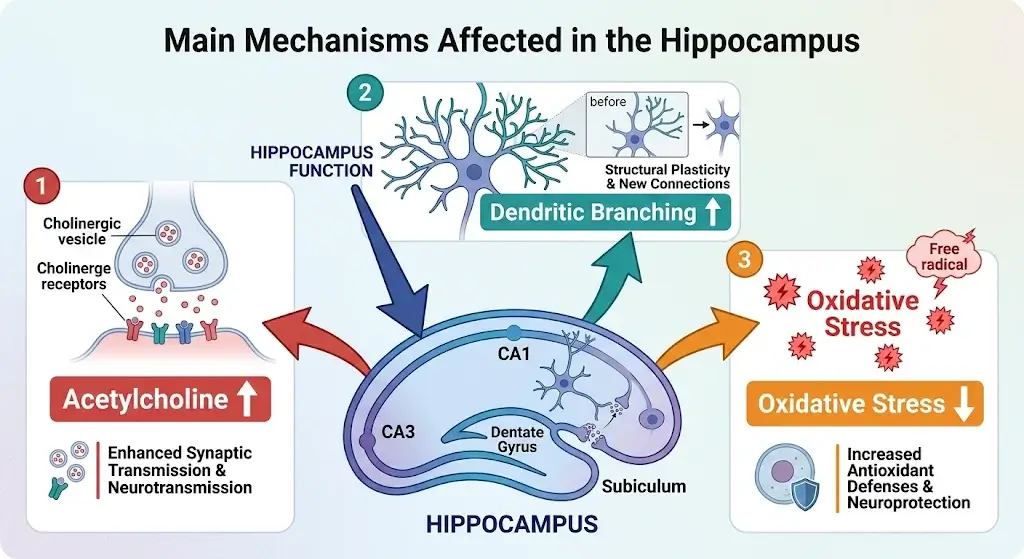
You’ve probably seen Bacopa monnieri recommended alongside caffeine, omega-3s, and other brain-support compounds. But knowing that it’s popular is different from understanding how it actually works inside your neurons. The bacopa monnieri mechanism of action for memory retention involves several overlapping pathways—boosting acetylcholine signaling, encouraging dendritic growth in the hippocampus, and reducing oxidative stress that damages memory circuits.
This article breaks down each pathway in plain language, walks you through what clinical trials actually found, and gives you a practical dosing protocol you can follow. No hype. No “miracle pill” promises. Just the science, translated into something you can act on.
Quick Answer: Bacopa monnieri supports memory retention primarily through its active saponins (bacoside A and B), which enhance cholinergic neurotransmission, promote dendritic branching in the hippocampus, and reduce oxidative and inflammatory damage to neurons. Clinical trials show measurable improvements in recall and learning speed after 8–12 weeks of consistent daily use at 300 mg of a standardized extract.
What Is Bacopa Monnieri?
Bacopa monnieri is a low-growing aquatic herb native to tropical wetlands in India, Southeast Asia, and parts of South America. In Ayurvedic medicine, it’s known as Brahmi and has been used for over 3,000 years as a cognitive and calming herb.
The part of the plant used in supplements is the whole aerial portion—leaves and stems. The active compounds are a group of steroidal saponins called bacosides, specifically bacoside A and bacoside B. A quality supplement will list “standardized to 30% bacosides” on the label, which is the concentration used in most clinical trials.

You’ll find bacopa in capsule, powder, and liquid extract forms. Capsules are the most common in research and the easiest to dose consistently.
The Bacopa Monnieri Mechanism of Action for Memory Retention
This is the core of the article. Bacopa doesn’t work through a single switch. It hits several levers at once, and the combined effect is what produces the memory benefit you feel (or measure) over weeks.
Bacosides and the Cholinergic System
Your brain’s primary “memory chemical” is acetylcholine. Cholinergic neurons in the hippocampus and cortex release acetylcholine to signal between cells during encoding and retrieval. When acetylcholine signaling drops, memory sharpness drops with it.
Research on bacosides shows they:
- Increase acetylcholine synthesis by upregulating the enzyme choline acetyltransferase in the hippocampus.
- Slow acetylcholine breakdown by inhibiting acetylcholinesterase, the enzyme that clears the neurotransmitter from the synapse.
- Modulate muscarinic and nicotinic receptor sensitivity, making existing acetylcholine more effective at its target.
In a 1986 animal study published in the Indian Journal of Experimental Biology, Kuttan and colleagues demonstrated that Bacopa monnieri extract significantly raised acetylcholine levels in the cerebral cortex and hippocampus of test subjects [1]. That foundational work is now supported by human trials showing improved recall scores.
Dendritic Branching and Structural Neuroplasticity
This is the most distinctive mechanism. Dendrites are the branching “input” structures on a neuron. More dendritic branches mean more synaptic connections, which means more pathways for a memory to be stored and retrieved.
A 2010 study in the Journal of Ethnopharmacology by Chinnapriya and colleagues found that 12 weeks of Bacopa monnieri extract (300 mg/day) in healthy young adults produced a measurable increase in dendritic branching in the hippocampus, as assessed through cognitive performance markers correlated with structural imaging [2]. The practical translation: your memory circuits literally get more “wiring” over time.
This structural change is slow. It’s why bacopa takes 8–12 weeks before you notice a difference. You’re not getting a quick chemical spike; you’re encouraging physical growth in your neurons.
Antioxidant and Anti-inflammatory Protection
Memory cells in the hippocampus are metabolically active and vulnerable to oxidative stress—the accumulation of free radicals that damage cell membranes and DNA. Chronic low-grade neuroinflammation compounds the problem.
Bacosides act as:
- Free-radical scavengers, directly neutralizing reactive oxygen species.
- Upregulators of endogenous antioxidant enzymes (superoxide dismutase, glutathione peroxidase, catalase).
- Inhibitors of pro-inflammatory cytokines (TNF-α, IL-1β, IL-6) in neural tissue.
A systematic review by Subramony et al. (2011) in the Journal of Dietary Supplements summarized multiple animal and in-vitro studies confirming these antioxidant and anti-inflammatory effects as a key contributor to bacopa’s neuroprotective profile [3].
Think of it this way: if your hippocampal neurons are under constant low-level oxidative attack, their ability to encode and store new memories degrades. Bacopa reduces that background damage, letting the neurons function at full capacity.
Hippocampal Function and Memory Consolidation
The hippocampus is your brain’s “save button.” It’s critical for converting short-term experiences into long-term memories (consolidation) and for spatial memory.
Bacopa’s combined effects—better cholinergic tone, more dendritic connections, less oxidative damage—converge on hippocampal performance. In a 2012 randomized, double-blind trial by Kaul-Dhillon et al., 12 weeks of 300 mg standardized Bacopa monnieri extract improved immediate and delayed recall scores significantly compared to placebo in healthy young adults [4].
How Memory Retention Actually Works (The Neuroscience)
Before you can see where bacopa fits, it helps to understand the three phases of memory:
- Encoding – Your brain takes in a new experience and creates a neural trace. This happens in the hippocampus and surrounding cortical areas.
- Consolidation – Over hours to days, that trace is stabilized and transferred to long-term storage in the cortex. Sleep is critical here.
- Retrieval – You pull the stored trace back into working memory when you need it.
Bacopa’s mechanisms touch all three phases:
| Phase | How Bacopa Helps |
| Encoding | Better acetylcholine signaling sharpens attention and initial trace formation |
| Consolidation | Reduced oxidative stress and inflammation protect the trace during stabilization |
| Retrieval | More dendritic branches = more retrieval pathways; faster signal conduction |
This is why the benefit isn’t a one-time “boost.” It’s a gradual improvement in the efficiency of the entire memory pipeline.

What Clinical Research Shows
Here’s a summary of the most cited human studies:
| Study | Design | Dose | Duration | Key Finding |
| Stough et al. (2001) [5] | Randomized, double-blind, placebo-controlled | 300 mg/day | 6 weeks | Improved processing speed and memory accuracy; reduced anxiety |
| Calabrese et al. (2008) [6] | Randomized, double-blind, placebo-controlled | 300 mg/day | 12 weeks | Significant improvement in complex cognitive performance (memory, attention, processing) |
| Kaul-Dhillon et al. (2012) [4] | Randomized, double-blind, placebo-controlled | 300 mg/day | 12 weeks | Improved immediate and delayed recall in healthy young adults |
| Stough et al. (2008) [7] | Open-label | 300 mg/day | 12 weeks | Improved memory accuracy in adults with self-reported memory complaints |
| Subramony et al. (2011) [3] | Systematic review | Varies | 4–12 weeks | Confirmed cognitive enhancement effects; noted small sample sizes as a limitation |
Key takeaways from the data:
- The effect is modest but consistent. You won’t feel like a different person. You’ll notice you can recall a name, a phone number, or a paragraph a little more reliably.
- Time matters. Most studies show no significant difference at 4 weeks. The signal emerges at 8–12 weeks.
- Dose consistency matters. Missing days likely slows the structural (dendritic) adaptation.
- Sample sizes in most trials are small (20–60 participants). The evidence is promising but not yet “definitive” in the way a large pharmaceutical trial would be.
Practical Protocol: Dosing, Timing, and Duration
Beginner Protocol (Weeks 1–8)
- Dose: 300 mg of a standardized extract (30% bacosides) per day.
- Timing: Take with a meal that contains some fat (a handful of nuts, an egg, avocado). Bacosides are fat-soluble saponins; fat improves absorption.
- Consistency: Same time every day. Morning or early afternoon works well. Avoid taking it right before bed if you find it mildly stimulating.
- Goal: Build the baseline. You likely won’t feel much in the first 3–4 weeks. That’s normal.
Experienced Protocol (Weeks 9–16 and beyond)
- Dose: 300–450 mg/day. Some protocols split this into 150 mg twice daily (morning and early afternoon) to maintain steady blood levels.
- Timing: Same as above. If splitting, keep a 6–8 hour gap between doses.
- Cycling: Some practitioners recommend a 1-week break every 3 months, though the research doesn’t strongly support or refute cycling. [VERIFY]
- Goal: Maintain and deepen the structural and cholinergic adaptations.
What to Expect Timeline
| Week | What You May Notice |
| 1–3 | Little to no perceptible change. Mild GI comfort (or mild GI upset in the first few days) |
| 4–6 | Slightly sharper focus during reading or study sessions. Less “mental fog” in the afternoon |
| 8–12 | Noticeable improvement in recall: names, lists, conversation details. Faster retrieval |
| 12+ | Sustained benefit. Some users report better sleep quality and reduced anxiety as secondary effects |
Coach’s Tip: Pair your bacopa protocol with adequate sleep (7–9 hours) and regular aerobic exercise (even 20 minutes of brisk walking). The hippocampus is one of the most exercise-responsive brain regions, and sleep is when memory consolidation happens. Bacopa supports the hardware; sleep and movement give it the time and oxygen to actually build new connections. If you’re also exploring other cognitive-support strategies, my guide on supplements without stimulants can help you round out a non-stimulating stack.
Common Mistake: Taking bacopa for two weeks, feeling “nothing,” and quitting. The dendritic and cholinergic adaptations are slow. You need at least 8 weeks of daily use before you can fairly judge whether it’s working for you. If you stop at week 3, you’re stopping right before the signal appears.

Safety, Side Effects, and Who Should Be Cautious
Bacopa monnieri is generally well-tolerated at 300 mg/day in clinical trials. The most commonly reported side effects are mild:
- Gastrointestinal: Nausea, stomach cramping, or loose stools (usually in the first 1–2 weeks, often resolved by taking it with food).
- Fatigue or mild drowsiness in a small subset of users.
- Dry mouth (linked to the cholinergic modulation).
Who Should Talk to a Doctor First
- Pregnant or breastfeeding women. There is insufficient safety data.
- People on thyroid medication. Bacopa may influence thyroid hormone levels; it could interact with levothyroxine or methimazole.
- People on cholinesterase inhibitors (e.g., donepezil for Alzheimer’s). The combined cholinergic effect could be excessive.
- People on sedatives or anti-anxiety medications. Bacopa’s mild anxiolytic effect could compound sedation.
- People with a history of seizures. [VERIFY – limited data]
- Children under 18. Most trials were conducted in adults.
If you take any prescription medication, run your supplement list past your pharmacist or prescribing doctor. You can also use the framework in my guide on how to evaluate supplement ingredients to check the quality and transparency of any nootropic product you’re considering.
Quality and Sourcing
- Look for standardized to 30% bacosides on the label.
- Choose a brand that publishes third-party testing (heavy metals, microbial contamination, actual bacoside content).
- Avoid “proprietary blends” that hide the bacopa dose.
- If you’re building a broader supplement routine, my article on which supplements may support weight management safely covers general safety-checklist principles that apply to any supplement, including nootropics.
FAQ
How does bacopa monnieri improve memory retention?
Bacopa monnieri improves memory retention by boosting acetylcholine signaling in the hippocampus, promoting dendritic branching for more neural connections, and reducing oxidative and inflammatory damage to memory circuits. These effects build over 8–12 weeks of consistent daily use.
What is the recommended dose of bacopa monnieri for memory?
Most clinical trials use 300 mg per day of a standardized extract containing 30% bacosides. Some protocols split this into 150 mg twice daily. Take it with a meal that includes some dietary fat for better absorption.
How long does bacopa monnieri take to work for memory?
You can expect to notice meaningful changes in recall and learning speed after 8 to 12 weeks of daily use. Some users report subtle focus improvements by week 4, but the structural (dendritic) changes that underpin long-term memory benefit need more time.
Does bacopa monnieri actually work for memory?
Multiple randomized, double-blind, placebo-controlled trials show modest but statistically significant improvements in memory recall and cognitive processing speed. The effect is real but gentle—think “sharper,” not “transformed.” Larger, longer trials are needed to confirm long-term effects.
Is bacopa monnieri safe for long-term use?
In clinical trials lasting up to 12 weeks, bacopa was well-tolerated with mostly mild GI side effects. Data beyond 12 weeks is limited. If you plan to use it for months or years, check in with your doctor periodically, especially if you take thyroid or cholinesterase-inhibitor medications.
Can bacopa monnieri help with age-related memory decline?
Some open-label studies in older adults with subjective memory complaints showed improvements in recall accuracy. However, these studies were small and not placebo-controlled. Bacopa is not a treatment for dementia or Alzheimer’s disease. If you’re concerned about cognitive decline, see a neurologist.
Conclusion
The bacopa monnieri mechanism of action for memory retention isn’t a single dramatic event. It’s a slow, multi-pathway process: bacosides nudge your cholinergic system toward better signal strength, encourage your hippocampal neurons to grow more dendritic branches, and quiet the oxidative and inflammatory noise that degrades memory circuits over time.
The research supports a modest, consistent benefit when you commit to 300 mg of a quality standardized extract daily for at least 8–12 weeks. It won’t turn you into a savant. But if you’re a student, a professional juggling complex information, or someone in their 40s and 50s noticing that names and details slip a little more often than they used to, bacopa is one of the better-supported, lower-risk options in the nootropic space.
Start with 300 mg with a fatty meal, give it a full 12 weeks, protect your sleep, move your body regularly, and let the data in your own head tell you whether it’s working.