
If your ears ring, buzz, or hum when the room is quiet, you already know how disruptive tinnitus can be. One factor that keeps coming up in conversations with clients and in the research literature is magnesium. The link between magnesium deficiency and tinnitus relief is not a simple “take a pill and the ringing stops” story, but the mineral does play a real role in how your inner ear and auditory nerve function. Understanding where the evidence is strong, where it is still thin, and how to approach this safely can save you time, money, and frustration.
Quick Answer
Magnesium supports nerve function and blood flow in the inner ear, so a genuine deficiency may contribute to tinnitus symptoms. However, research does not show that magnesium cures tinnitus in most people. If your levels are low, correcting the deficiency through diet or a supplement may help reduce ringing. If your magnesium is already in the normal range, adding more is unlikely to change your tinnitus. Always check with a doctor or audiologist before starting a new supplement.
What Is the Connection Between Magnesium and Tinnitus?
How Magnesium Supports the Inner Ear
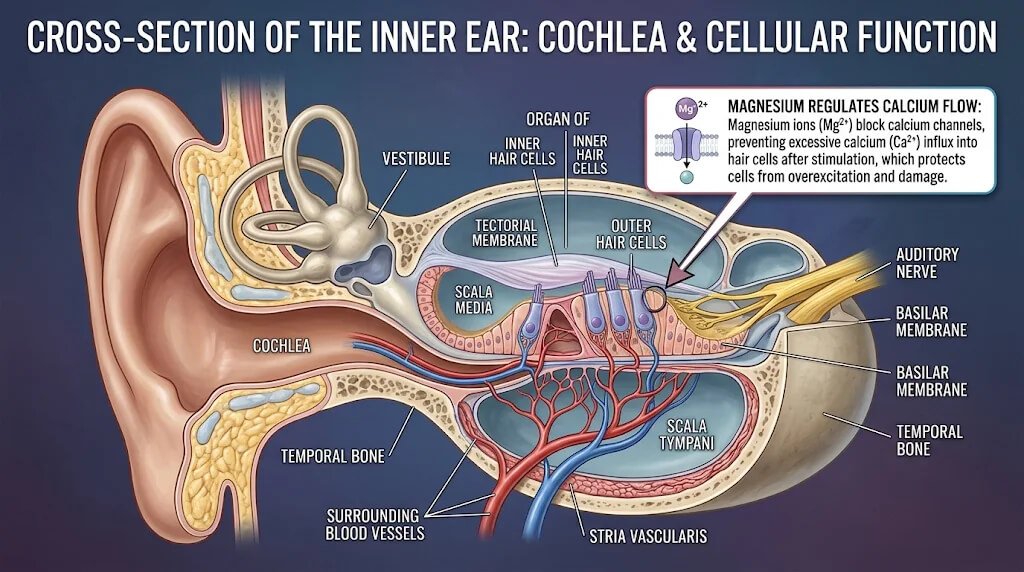
Your inner ear, specifically the cochlea, is packed with hair cells and tiny blood vessels that are extremely sensitive to changes in the chemical environment. Magnesium acts as a natural calcium channel blocker. In plain terms, it helps keep calcium from flooding into cells in excess, which protects nerve cells from overexcitation.
The auditory nerve also relies on magnesium to regulate the release of neurotransmitters. Without enough magnesium, nerve signaling can become erratic, and the auditory cortex (the part of your brain that processes sound) may start generating phantom sounds. That phantom sound is what you experience as tinnitus.
Magnesium also helps relax smooth muscle in blood vessel walls. The cochlea depends on a steady, gentle blood supply. When vessels constrict too tightly, oxygen delivery to hair cells drops, and oxidative stress builds up. Over time, that stress can damage the delicate structures responsible for hearing.
What Happens When Magnesium Levels Drop
True magnesium deficiency (hypomagnesemia) is relatively uncommon in people who eat a varied diet in developed countries, but it does occur. Risk factors include:
- Chronic use of diuretic medications (water pills)
- Long-term proton-pump inhibitors (acid reflux drugs)
- Type 2 diabetes or insulin resistance
- Chronic alcohol use
- Gastrointestinal conditions that impair absorption (celiac disease, Crohn’s disease)
- Prolonged high-stress periods that deplete electrolytes
When serum magnesium falls below the normal range (typically under 1.75 mg/dL), the protective effects described above weaken. Nerve cells become more excitable, blood flow to the cochlea may narrow, and the auditory system becomes more vulnerable to noise damage and age-related decline.
It is important to note: most people with tinnitus do not have a clinically confirmed magnesium deficiency. Tinnitus has many causes—noise exposure, age-related hearing loss, temporomandibular joint (TMJ) issues, earwax buildup, certain medications, and vascular conditions. Magnesium is one small piece of a much larger picture.
What Research Says About Magnesium Deficiency and Tinnitus Relief
Key Studies and Findings
The research base here is smaller than you might expect, and the results are mixed. Here is what the peer-reviewed literature generally points to:
- Animal and in-vitro studies have shown that magnesium can reduce cochlear damage after loud noise exposure. In these controlled settings, animals given magnesium before or after a noise event showed less hair-cell loss and smaller shifts in hearing threshold than controls. [VERIFY – confirm specific study details before publication]
- A small number of human trials have examined magnesium supplementation in patients with tinnitus. Results have been inconsistent. Some small studies reported modest reductions in tinnitus loudness or distress scores, while others found no statistically significant difference from placebo. The sample sizes in these trials are often under 100 participants, which limits how much weight you can put on any single result. [VERIFY – confirm specific trial citations]
- Observational data suggests that people with lower dietary magnesium intake tend to report higher rates of hearing-related complaints, but correlation does not equal causation. Other lifestyle factors (noise exposure, diet quality, stress) confound the relationship.
The NIH Office of Dietary Supplements notes that magnesium is involved in over 300 enzymatic reactions in the body, including those that regulate nerve transmission and muscle relaxation. This gives a biological plausible mechanism for why a deficiency might worsen tinnitus, even though direct human trial data for tinnitus specifically remains limited.
Limitations of Current Evidence
To be straightforward: there is no large, randomized, double-blind trial that proves “taking magnesium will cure your tinnitus.” The evidence supports the following cautious conclusions:
- If you are genuinely deficient, correcting that deficiency is a reasonable and low-risk step that may help your overall auditory and neurological health.
- If your levels are normal, extra magnesium is unlikely to produce a meaningful change in your tinnitus.
- Magnesium should be viewed as one supportive measure, not a standalone treatment.
Magnesium Deficiency and Tinnitus Relief: Practical Steps
Getting Tested
Before you start any supplement, the smartest first move is to get your magnesium level checked. A standard blood test (serum magnesium) is a starting point, though it only reflects about 1% of the body’s total magnesium. Some functional medicine practitioners also request a red blood cell (RBC) magnesium test, which may give a better picture of cellular levels.
Ask your primary care doctor or an ENT specialist whether testing is appropriate for you, especially if you are on medications that deplete magnesium or have a history of kidney disease.
Dietary Sources of Magnesium
The recommended daily allowance (RDA) for magnesium is 400–420 mg per day for adult men and 310–320 mg per day for adult women, according to the NIH Office of Dietary Supplements. You can get a meaningful portion of that from food:
| Food (cooked, unless noted) | Approx. Magnesium | Serving Size |
| Spinach | ~84 mg | 1 cup (245 g) |
| Pumpkin seeds (raw) | ~156 mg | 1 oz / 28 g |
| Almonds | ~76 mg | 1 oz / 28 g |
| Black beans | ~120 mg | 1 cup (172 g) |
| Avocado | ~58 mg | 1 medium fruit |
| Black chocolate (85–100%) | ~65 mg | 1 oz / 28 g |
| Whole wheat bread | ~40 mg | 2 slices (60 g) |
| Bananas | ~32 mg | 1 medium |
Aim to include at least three of these in your daily rotation. If you follow a balanced approach to nutrients that support normal energy metabolism, magnesium naturally fits into the picture alongside B vitamins, iron, and zinc.
Supplement Options
If your doctor confirms a deficiency or you simply want to add a safety margin, here are the most common magnesium supplement forms and their practical differences:
- Magnesium glycinate (bisglycinate): Well absorbed, gentle on the stomach, often recommended for sleep and nervous-system support. Typical supplemental dose: 200–400 mg elemental magnesium per day.
- Magnesium citrate: Good absorption, slightly more likely to cause loose stools at higher doses. Common in over-the-counter products.
- Magnesium threonate: Marketed for its ability to cross the blood-brain barrier more effectively. Research is still early, but some vitamins and minerals for deficiency protocols include it for neurological support.
- Magnesium oxide: Cheapest form, but the lowest bioavailability. Often found in generic multivitamins. Less ideal if your goal is raising tissue levels.
Dosing guidance (general, not medical advice): Start with 200 mg elemental magnesium taken with food, split into two doses if needed. Do not exceed 350 mg from supplements per day without medical supervision, as higher doses can cause diarrhea, nausea, and, in rare cases, dangerous drops in blood pressure.
Coach’s Tip: If you are already taking a multivitamin, check the label. Many contain 50–100 mg of magnesium (often as oxide). Factor that in before adding a separate supplement so you do not accidentally overshoot. Take magnesium at least 2 hours apart from any calcium or zinc supplements, as they compete for absorption.

Supporting Strategies Beyond Magnesium
Magnesium works best as part of a broader approach to auditory and neurological health:
- Protect your hearing. Use earplugs or noise-canceling headphones at concerts, in factories, or around power tools. The CDC recommends keeping noise exposure below 85 decibels for 8 hours or less.
- Manage stress. Chronic stress raises cortisol, which can worsen both magnesium depletion and tinnitus perception. Even 10 minutes of diaphragmatic breathing or a short walk can lower sympathetic nervous system activation.
- Prioritize sleep. Tinnitus and poor sleep feed each other in a vicious cycle. The hormonal effects of sleep on overall regulation extend to the auditory system; consistent 7–8 hours of sleep helps the brain “turn down” the tinnitus signal over time.
- Limit alcohol and excess caffeine. Both can affect inner-ear blood flow and sleep quality.
- Stay hydrated. The endolymph fluid in the cochlea is sensitive to electrolyte balance.

How to Apply This: A 4-Week Supportive Approach
Think of this as a structured, low-risk protocol to try alongside your doctor’s or audiologist’s guidance. It is not a treatment plan; it is a way to be intentional about the magnesium angle while you explore other tinnitus management options.
- Schedule a blood draw for serum magnesium (and, if your doctor agrees, RBC magnesium).
- Start a simple food log. Note how many servings of magnesium-rich foods you eat per day.
- Track your tinnitus on a 1–10 scale for loudness and a 1–10 scale for how much it bothers you, once in the morning and once before bed.
- Add at least two new magnesium-rich foods to your weekly routine (e.g., a spinach salad three times a week, a handful of pumpkin seeds as a snack).
- If your doctor clears you, begin a 200 mg magnesium glycinate supplement with dinner.
- Reduce alcohol to no more than one drink per day and cut back on caffeine after 2 p.m.
- Incorporate 30 minutes of moderate aerobic activity (brisk walking, cycling, swimming) four to five days per week. Exercise improves circulation, including to the inner ear, and supports natural energy and stamina.
- Add 10 minutes of a stress-reduction practice: box breathing (inhale 4 sec, hold 4 sec, exhale 4 sec, hold 4 sec), a guided body scan, or a short yoga flow.
- Continue the supplement and food log.
- Re-rate your tinnitus loudness and bother scores.
- Compare Week 4 scores to Week 1. You are looking for a trend, not a dramatic overnight change.
- Bring your food log and tinnitus tracking to your next doctor or audiologist appointment. Discuss whether to continue, adjust, or stop the supplement.
Common Mistake: People sometimes take 500–1,000 mg of magnesium in a single dose and expect the ringing to stop by the next morning. This is a recipe for gastrointestinal upset and a false sense of progress. Magnesium works through steady-state tissue levels, not a single spike. Consistency over weeks matters far more than a one-time high dose.
Safety Notes and Who Should Be Cautious
Magnesium is generally well tolerated at recommended doses, but there are important cautions:
- Kidney impairment. The kidneys are the primary route for magnesium excretion. If you have chronic kidney disease (stage 3 or worse) or reduced kidney function, even normal supplemental doses can accumulate to dangerous levels. Do not take a magnesium supplement without explicit medical clearance if you have kidney issues.
- Medication interactions. Magnesium can interact with certain antibiotics (tetracyclines, quinolones), bisphosphonates, and some diuretics. Separate doses by at least 2–4 hours.
- GI side effects. Diarrhea, cramping, and nausea are the most common complaints, especially with magnesium oxide and citrate at higher doses. Switching to glycinate or splitting the dose often resolves this.
- Pregnancy and breastfeeding. The RDA increases during pregnancy (350–360 mg for most adult women). Talk to your OB/GYN before adding any supplement.
- Pulsatile tinnitus. If your tinnitus sounds like a rhythmic pulse that matches your heartbeat, it may be vascular in origin. This requires medical imaging (ultrasound, MRI, or CT angiography) to rule out an underlying vascular issue. Magnesium will not address a structural or vascular cause.
If your tinnitus is sudden, one-sided, accompanied by hearing loss, dizziness, or facial weakness, seek medical attention promptly. These can be signs of a condition that needs urgent treatment, not a supplement.
Related Tips for Managing Tinnitus
While you explore the magnesium angle, these evidence-informed strategies can help you cope with and potentially reduce the impact of tinnitus:
- Sound enrichment. Complete silence makes tinnitus more noticeable. Use a white-noise machine, a fan, or a low-level ambient sound track during rest. This does not “cure” tinnitus, but it reduces the contrast between the ringing and the environment, making it less intrusive.
- Cognitive Behavioral Therapy (CBT) for tinnitus. Multiple randomized trials have shown that CBT-based programs can significantly reduce the distress and interference caused by tinnitus, even if the loudness does not change. Ask your audiologist for a referral to a therapist trained in tinnitus-specific CBT.
- Hearing aids (if you also have hearing loss). If an audiogram shows hearing loss in the frequencies where your tinnitus sits, a hearing aid can amplify environmental sound and reduce the brain’s need to “fill in” with phantom noise.
- Limit exposure to loud noise. This is the single most important preventive step. Even if your tinnitus is already present, further noise damage will not help.
- Review your medications. Some drugs (high-dose aspirin, certain antibiotics like aminoglycosides, loop diuretics, and some chemotherapy agents) are ototoxic. Ask your pharmacist or doctor whether any of your current medications could be contributing.
- Address TMJ issues. Jaw clenching, grinding, or a misaligned bite can worsen tinnitus perception. A dental evaluation and, in some cases, a night guard can help.
FAQ
Can magnesium deficiency cause tinnitus?
A true magnesium deficiency can make the auditory nerve and cochlea more vulnerable to overexcitation and reduced blood flow, which may contribute to tinnitus in susceptible individuals. However, most cases of tinnitus are linked to noise exposure, aging, or other causes, not a mineral deficiency. A blood test can clarify whether your levels are actually low.
Does magnesium help with ringing in the ears?
Research is mixed. Small human studies have shown modest benefits in some participants, but results are not consistent across trials. If your magnesium is genuinely low, correcting it is a reasonable step that may ease symptoms. If your levels are normal, extra magnesium is unlikely to produce a noticeable change in your tinnitus.
What type of magnesium is best for tinnitus?
Magnesium glycinate (bisglycinate) is often the first recommendation because it is well absorbed, gentle on the stomach, and has a calming effect on the nervous system. Magnesium threonate is another option if you want a form studied for brain and nerve support. Avoid relying on magnesium oxide as your primary source, since its bioavailability is the lowest of the common forms.
How much magnesium should I take for tinnitus relief?
For most adults, a supplemental dose of 200–400 mg of elemental magnesium per day, taken with food, is a common starting range. Do not exceed 350 mg from supplements daily without a doctor’s guidance. Combine supplementation with dietary sources (leafy greens, nuts, seeds, legumes) to reach the RDA of 310–420 mg total per day.
How long does magnesium take to help tinnitus?
If a deficiency is the contributing factor, tissue magnesium levels take several weeks to normalize. Most practitioners suggest giving it at least 4–6 weeks of consistent use before assessing any change in tinnitus. Track your symptoms daily so you can spot a gradual trend rather than expecting an overnight shift.
Is magnesium safe for people with kidney problems?
No, not without medical supervision. Impaired kidneys cannot excrete excess magnesium efficiently, which can lead to hypermagnesemia (dangerously high blood magnesium). If you have any form of kidney disease, talk to your nephrologist or primary care doctor before taking any magnesium supplement.
Conclusion
The story of magnesium deficiency and tinnitus relief is more nuanced than a single supplement can capture. Magnesium is a legitimate, well-studied mineral that supports nerve function, blood vessel relaxation, and protection against oxidative stress in the inner ear. If your levels are genuinely low, correcting that gap through diet and, if appropriate, a supplement is a sensible, low-risk step that may take the edge off your ringing. But for the majority of people with tinnitus, magnesium is one small supportive measure alongside hearing protection, stress management, sleep hygiene, and—when hearing loss is present—audiological intervention.
The practical path is clear: get tested, eat well, move regularly, manage stress, and work with an ENT specialist or audiologist to build a plan that addresses the full picture of your tinnitus rather than pinning all your hopes on one mineral. Your ears will thank you for the patience and the consistency.