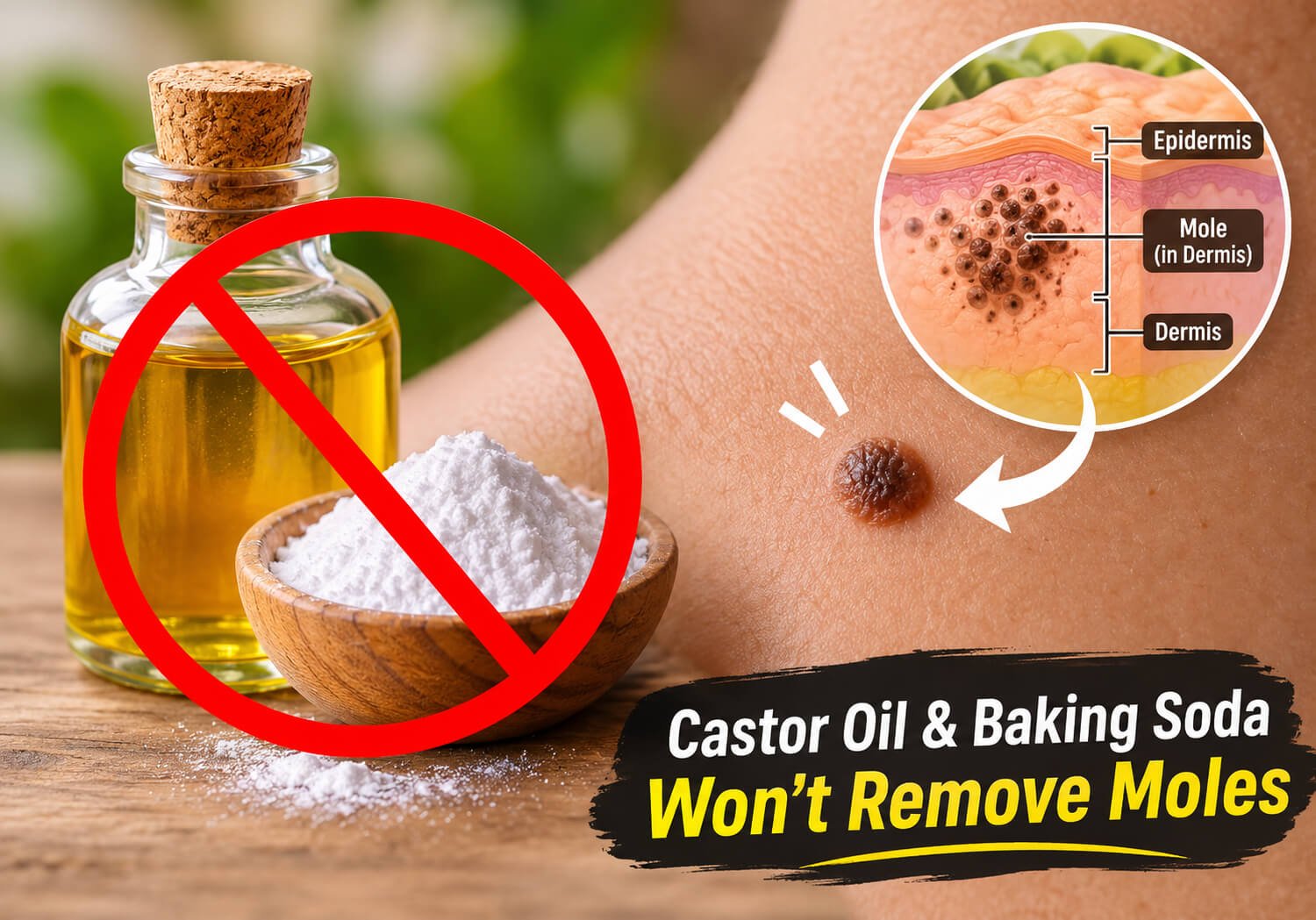
You’ve probably seen the social media posts. A thick layer of castor oil, a pinch of baking soda, and a promise that your stubborn mole will “dissolve” in a week or two. The idea is tempting—no doctor’s appointment, no needle, no scar. But before you mix up a jar in your kitchen, here’s the honest truth: there is no peer-reviewed scientific evidence that castor oil and baking soda can remove a mole from your skin. Moles live in the dermis and epidermis, made of clusters of pigment-producing cells called melanocytes. No over-the-counter household product penetrates deep enough to dissolve those cells without also damaging healthy tissue around them.
This article walks you through what castor oil and baking soda actually do to skin, why the mole-removal claim doesn’t hold up, what risks a home application carries, and what a dermatologist would actually recommend if you want a mole gone safely. If you’ve ever wondered whether this DIY method is worth trying, you’ll have a clear, evidence-based answer by the end.
Quick Answer
Castor oil and baking soda do not remove moles. No clinical trial or peer-reviewed study supports this home remedy. Moles are clusters of melanocytes in the dermis that cannot be dissolved by topical household products. Applying baking soda to a mole risks chemical burns, scarring, and infection. See a board-certified dermatologist for safe mole evaluation and removal.
What Are Moles, and Why Can’t You “Dissolve” Them at Home?
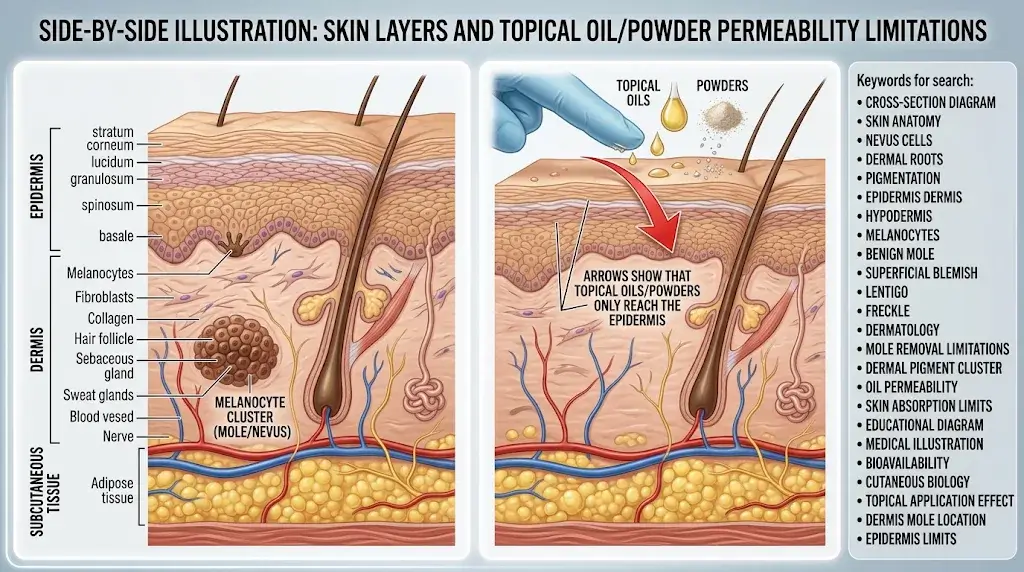
A mole (medically called a benign nevus) is a small cluster of melanocytes—cells that produce the pigment melanin—grouped together in the epidermis or upper dermis. Most people carry 10 to 40 moles, and the majority are harmless Mayo Clinic – Moles: When to Worry .
Here’s the structural problem with any topical “removal” method:
- The epidermis (outermost layer) is roughly 0.05–0.1 mm thick and constantly renews.
- The dermis (the layer beneath) is 1–4 mm thick and contains collagen, blood vessels, nerves, and—critically—the melanocyte clusters that form moles.
- A mole’s pigment cells sit within the dermis or at the junction between the dermis and epidermis.
Castor oil is a lipid-rich emollient whose active component, ricinoleic acid, sits on the surface of the skin and helps trap moisture. It does not penetrate to the dermal layer where melanocytes reside. Baking soda (sodium bicarbonate) is a mild alkaline compound with a pH around 8–9. On skin, it can disrupt the natural acidic mantle (pH ~4.5–5.5), but it does not have the chemical capacity to break down melanin-producing cells deep in the dermis PubMed – Ricinoleic acid and skin barrier function .
In short, the two ingredients work on the surface of the skin. Moles live beneath it. The mismatch is why the method simply cannot work the way the viral posts suggest.
What the Research (and the Lack of It) Tells Us
I searched PubMed, the NIH National Library of Medicine, and the CDC’s skin-cancer resources for any clinical trial, case series, or controlled study testing castor oil, baking soda, or the combination for mole removal. None exist.
- No randomized controlled trial has evaluated castor oil as a mole-removal agent.
- No peer-reviewed case report documents a mole “dissolving” after topical sodium bicarbonate application.
- The National Cancer Institute’s patient information on skin cancer lists excisional biopsy, shave excision, curettage, cryotherapy, and laser treatment as evidence-based removal methods—none of which involve kitchen ingredients National Cancer Institute – Skin Cancer Treatment .
What the research does tell us about the two ingredients individually:
| Ingredient | What it actually does to skin | Does it affect melanocytes in the dermis? |
| Castor oil (ricinoleic acid) | Occlusive emollient; may reduce transepidermal water loss; mild anti-inflammatory properties on the surface | No evidence of dermal penetration to melanocyte depth |
| Baking soda (sodium bicarbonate) | Mild alkaline; can disrupt skin’s acid mantle; used in some antacid formulations | No evidence of melanocyte dissolution; high-concentration contact can cause irritant contact dermatitis or chemical burns |
The absence of evidence is not the same as evidence of absence, but in a medical context, a treatment with zero published clinical data should not be applied to a skin lesion that could, in rare cases, be melanoma. That’s the core risk.
Why the “Mole Dissolution” Claim Spreads
Social media algorithms reward simple, dramatic before-and-after photos. A few factors make this particular myth sticky:
- Confirmation bias. If a mole’s surface scabs, peels, or lightens after a week of baking-soda application, the person interprets it as the mole “going away.” In reality, they’ve irritated or mildly burned the epidermis above the mole.
- Anecdotal framing. “It worked for me” is not a controlled experiment. The mole may have been a superficial seborrheic keratosis or a small tag that was already in the process of resolving.
- No follow-up photos. Most viral posts show one “after” image taken at a convenient angle, with no dermatologist confirmation that the lesion is truly gone.
What Actually Happens If You Apply Baking Soda to a Mole
This is the part I want to be very clear about, because the risk is real and not hypothetical.
- pH disruption. Baking soda at a 1:1 paste concentration raises the local skin pH well above the natural 4.5–5.5 range. Prolonged contact (hours or days, as the “remedy” instructs) can cause irritant contact dermatitis—redness, stinging, peeling, and in sensitive individuals, a shallow chemical burn.
- Occlusion + alkalinity. Layering castor oil over the baking-soda paste traps the alkaline compound against the skin for extended periods, increasing the time the barrier is exposed to a hostile pH. This combination raises the risk of a superficial chemical burn, especially on thinner skin (face, neck, eyelids).
- Infection risk. Breaking the epidermal barrier—whether by peeling, scratching the itchy paste, or a mild burn—opens a portal for bacteria. A mole site that becomes infected can scar, and scarring over a pigmented lesion makes future dermatoscopic examination harder.
- Masking a dangerous change. If the mole is actually a developing melanoma or an atypical nevus, the irritation, crusting, and color change caused by the home remedy can mimic or mask the ABCDE warning signs (Asymmetry, Border irregularity, Color variation, Diameter > 6 mm, Evolving). You may delay the dermatologist visit by weeks or months CDC – Know Your Skin / ABCDE Rule .
Bottom line: The most likely outcome of applying castor oil and baking soda to a mole is an irritated, red, peeling patch of skin with the mole still fully intact underneath. The less likely but more dangerous outcome is a chemical burn, secondary infection, or a delayed melanoma diagnosis.
Safe, Evidence-Based Mole Removal Options
If a mole bothers you cosmetically, is rubbing against clothing, or is changing in appearance, a board-certified dermatologist has several well-studied options:
| Method | How it works | Typical use | Downtime |
| Shave excision | A sterile blade shaves the mole flush with the skin | Benign, raised moles on the back, chest, scalp | 1–2 weeks; small scab |
| Punch excision | A small cylindrical tool removes the mole and a thin ring of surrounding skin | Moles with dermal component; when a full biopsy is needed | 1–2 weeks; small linear scar |
| Excisional biopsy | The mole and a margin of normal skin are cut out and sent to a lab | Suspicious or atypical lesions; any lesion where melanoma cannot be ruled out | 2–3 weeks; small sutured scar |
| Cryotherapy (liquid nitrogen) | Freezes the lesion; tissue sloughs off over 1–2 weeks | Very small, clearly benign keratoses or tags | 1–2 weeks; blister, then peel |
| Laser / electrosurgery | Targeted energy destroys pigment cells or tissue | Superficial pigmented lesions; cosmetic refinement | A few days to 1 week |
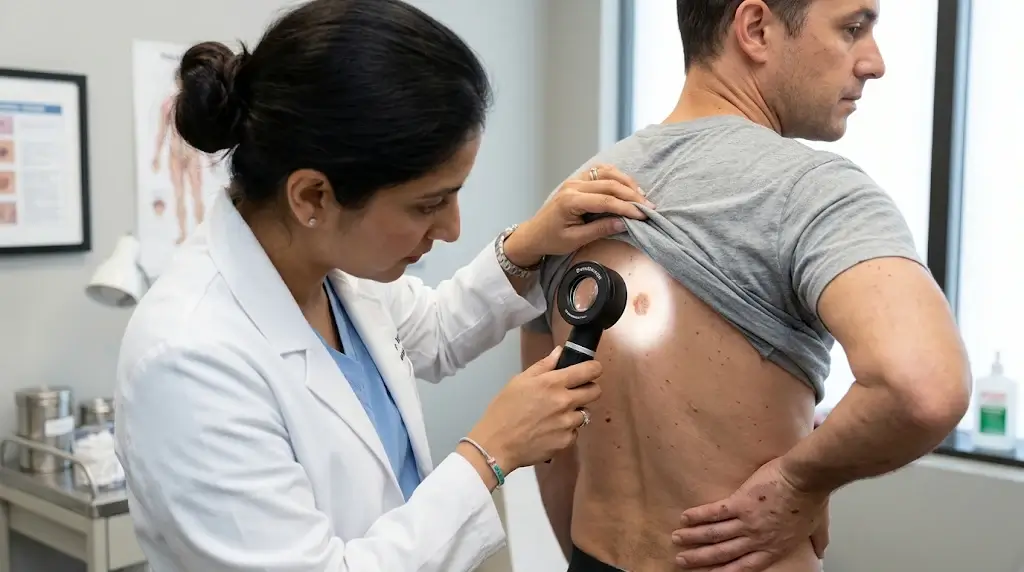
A dermatologist will first examine the mole with a dermatoscope (a magnifying lens with polarized light) and, if anything looks atypical, perform a biopsy and send the tissue for histopathology before any removal is finalized. This step is non-negotiable for safety Mayo Clinic – Skin Biopsy .
The ABCDE Rule: When to See a Doctor Urgently
Before you consider any home treatment, check every mole against the ABCDE checklist, which the American Academy of Dermatology and the CDC recommend for self-skin exams:
- A – Asymmetry: One half doesn’t match the other.
- B – Border: Edges are ragged, blurred, or irregular.
- C – Color: Multiple shades of brown, black, tan, red, white, or blue.
- D – Diameter: Larger than 6 mm (about the size of a pencil eraser), though melanomas can be smaller.
- E – Evolving: The mole has changed in size, shape, color, or started to itch, bleed, or crust.
If a mole hits even one of these flags, stop any home remedy immediately and book a dermatologist appointment. Early detection of melanoma is linked to significantly higher survival rates; the 5-year relative survival rate for melanoma caught at the local stage is approximately 99%, compared with about 34% for distant-stage disease American Cancer Society – Melanoma Statistics .
Coach’s Tip
Think of your skin the way you’d think of a joint you’re training. You don’t load a shoulder with a 200-lb (91-kg) press the first day, and you don’t apply an untested alkaline paste to a pigmented lesion you haven’t had examined. The “progressive overload” principle applies to skin care too: get a professional baseline first, then decide on a plan.
If You Still Want to Try a Gentle, Low-Risk Topical Approach (With Caveats)
I’m not going to tell you this will remove the mole. It won’t. But if the mole has been cleared as benign by a dermatologist and you simply want to keep the surrounding skin healthy while you wait for a professional removal appointment, here’s a low-risk routine:
- Cleanse the area with a mild, fragrance-free cleanser and pat dry.
- Apply a thin layer of pure, cold-pressed castor oil (about the size of a grain of rice) to the skin around the mole, not directly on it. Castor oil’s occlusive properties can help keep the area moisturized and reduce the “rough” feeling of a raised mole PubMed – Castor oil and skin hydration .
- Skip the baking soda entirely. There is no scenario in which I’d recommend pressing a sodium bicarbonate paste onto a pigmented skin lesion for hours. The risk-to-benefit ratio is unfavorable.
- Re-evaluate the mole every 4–6 weeks with a well-lit mirror. Take a photo the same way each time (same distance, same lighting) so you can spot subtle changes.
- Schedule the dermatologist visit if you want it removed. Most insurance plans cover a mole biopsy if the doctor deems it medically necessary; purely cosmetic removal is typically out-of-pocket.
Common Mistake
People apply a thick baking-soda paste, cover it with a bandage, and leave it on overnight. This creates a warm, alkaline, occluded environment that is a recipe for irritant contact dermatitis and, in worst cases, a superficial chemical burn. If you’ve already done this and the area is red, stinging, or blistering, rinse with cool water, apply a plain petroleum-jelly barrier, and call your primary-care doctor or a dermatologist. Do not reapply.
What to Do Instead of a Home Remedy: A Practical Checklist
If you’ve been looking at your mole and thinking, “I wish I could just get rid of this,” here’s a step-by-step plan that keeps you safe:
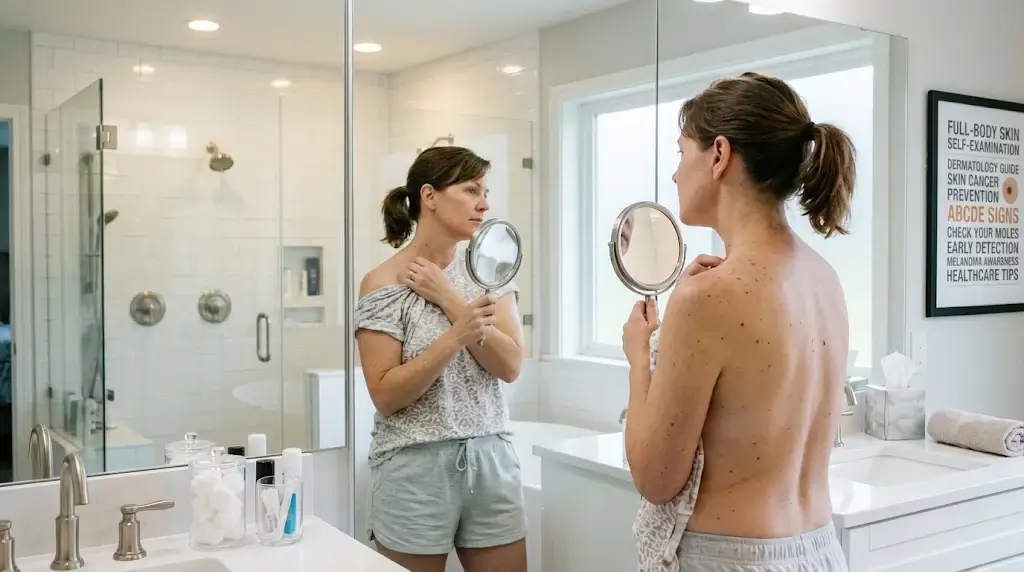
- Do a full-body self-skin exam in front of a mirror (use a hand mirror for your back and scalp). Note every mole’s size, color, and location. The CDC recommends checking your skin monthly CDC – Skin Self-Exams .
- Flag any mole that meets one or more ABCDE criteria.
- Book a dermatologist appointment. Bring your photo log. If you can’t get in quickly, your primary-care provider can perform a basic visual exam and refer you.
- Ask about a dermatoscopic exam. This is a quick, painless, non-invasive magnification that helps the doctor see pigment patterns invisible to the naked eye.
- If the mole is cleared as benign and you want it removed for cosmetic reasons, discuss shave excision, laser, or cryotherapy. Ask about expected scarring, downtime, and cost.
- If the mole is atypical or suspicious, the doctor will likely perform a biopsy. The tissue goes to a pathologist. You’ll get results in 1–2 weeks.
- Follow up as directed. If a melanoma is found, the treatment plan (wider excision, sentinel lymph node biopsy, possible immunotherapy) is very different from a simple cosmetic shave.
Can Castor Oil or Baking Soda Help With Other Skin Concerns?
To be fair, both ingredients have legitimate, well-documented uses in skincare—just not mole removal:
- Castor oil is a popular occlusive for dry, cracked skin, cuticles, and lips. Its ricinoleic acid content has shown mild anti-inflammatory and antimicrobial activity in lab (in vitro) studies, which is why it appears in some over-the-counter lip balms and after-shave products PubMed – Ricinoleic acid antimicrobial properties .
- Baking soda is used in very dilute concentrations (a teaspoon in a full bath) as a mild pH buffer for people with certain rashes, and in dentistry as a mild abrasive. It is not a treatment for pigmented lesions, warts, or growths.
If you’re dealing with a wart (caused by HPV), a skin tag, or a seborrheic keratosis, the evidence-based treatments are different from mole removal and still involve a clinician (salicylic acid for warts, cryotherapy or shave for tags, curettage for keratoses). None of these respond to castor oil and baking soda either.
Who Should Absolutely Avoid Home “Remedies” on a Mole
Some people are at higher risk for skin cancer or have skin conditions that make any topical irritant more dangerous:
- Fair skin, light eyes, freckles, or a history of sunburns – higher baseline melanoma risk.
- A personal or family history of melanoma – any new or changing mole warrants professional evaluation.
- Immunosuppression (organ transplant, chemotherapy, long-term steroids) – skin lesions can behave differently and heal more slowly.
- Children and adolescents – skin is thinner, and a chemical burn on a child’s face is harder to manage.
- People on blood thinners or with a bleeding disorder – any skin breakage from a home remedy can lead to prolonged bleeding.
- Pregnant or postpartum individuals – hormonal changes can cause moles to darken or grow; a dermatologist can distinguish normal pregnancy-related changes from something that needs a biopsy.
If any of these apply, do not apply baking soda, castor oil, or any other home remedy to a mole without a doctor’s explicit go-ahead. Check with your primary-care provider or a dermatologist first.
(FAQ)Frequently Asked Questions
Does castor oil actually remove moles?
No. Castor oil is a surface-level emollient. It moisturizes the epidermis but does not penetrate to the dermal layer where a mole’s melanocytes reside. No clinical study supports its use for mole removal. If you want a mole removed, see a dermatologist for a shave excision, laser, or biopsy.
Can baking soda dissolve a mole on your skin?
No. Baking soda (sodium bicarbonate) is a mild alkaline compound. Applied to skin, it can disrupt the acid mantle and cause irritation or a shallow chemical burn, but it does not dissolve melanocytes or melanin in the dermis. Using it on a mole risks scarring and can mask warning signs of melanoma.
Is it safe to put baking soda on a mole?
It is not recommended. Prolonged contact with a baking-soda paste can cause irritant contact dermatitis, redness, peeling, or a superficial chemical burn. More importantly, the resulting crusting and color change can make it harder for a dermatologist to evaluate the mole properly. Avoid applying it.
How long does it take for castor oil to work on moles?
It won’t work on moles at any timeframe. Castor oil’s role in skincare is as an occlusive moisturizer. If you’ve been applying it to a mole for weeks and see no change, that’s expected—the mole is still there. Schedule a dermatologist visit if you want it removed.
What happens if you put baking soda on your face?
A brief, dilute application (like a teaspoon in a bath) is generally tolerated. A thick paste left on the face for hours can strip the acid mantle, cause stinging, redness, and peeling, and in sensitive skin, a mild chemical burn. It does not treat moles, warts, or pigmented lesions.
Can you remove a mole without a doctor?
You can remove a superficial skin tag with a sterile, over-the-counter method under a pharmacist’s guidance, but you should not remove a pigmented mole at home. A mole may be benign, but only a dermatologist with a dermatoscope and, if needed, a biopsy can confirm that. Home removal risks infection, scarring, and missing a melanoma.
The Bottom Line
Castor oil and baking soda for mole removal is a myth with no scientific backing. The ingredients work on the surface of the skin; moles live beneath it. The best-case outcome of the home remedy is nothing happening. The worst-case outcome is a chemical burn, a secondary infection, a scar that complicates future skin exams, or—most critically—a delayed diagnosis of melanoma because the irritation masked the mole’s evolving appearance.
You don’t need a viral TikTok recipe to take care of your skin. You need a well-lit mirror, a monthly self-skin exam, and a dermatologist in your corner when something looks off. If a mole is bugging you, the most effective “removal” plan is a 15-minute dermatoscope exam and, if it’s cleared as benign, a quick in-office shave or laser session. It’s cheaper, safer, and actually works.
Treat your skin with the same respect you’d treat a joint you’re training: get a professional assessment before you load it, progress gradually, and don’t skip the check-up because a kitchen ingredient promised a shortcut.