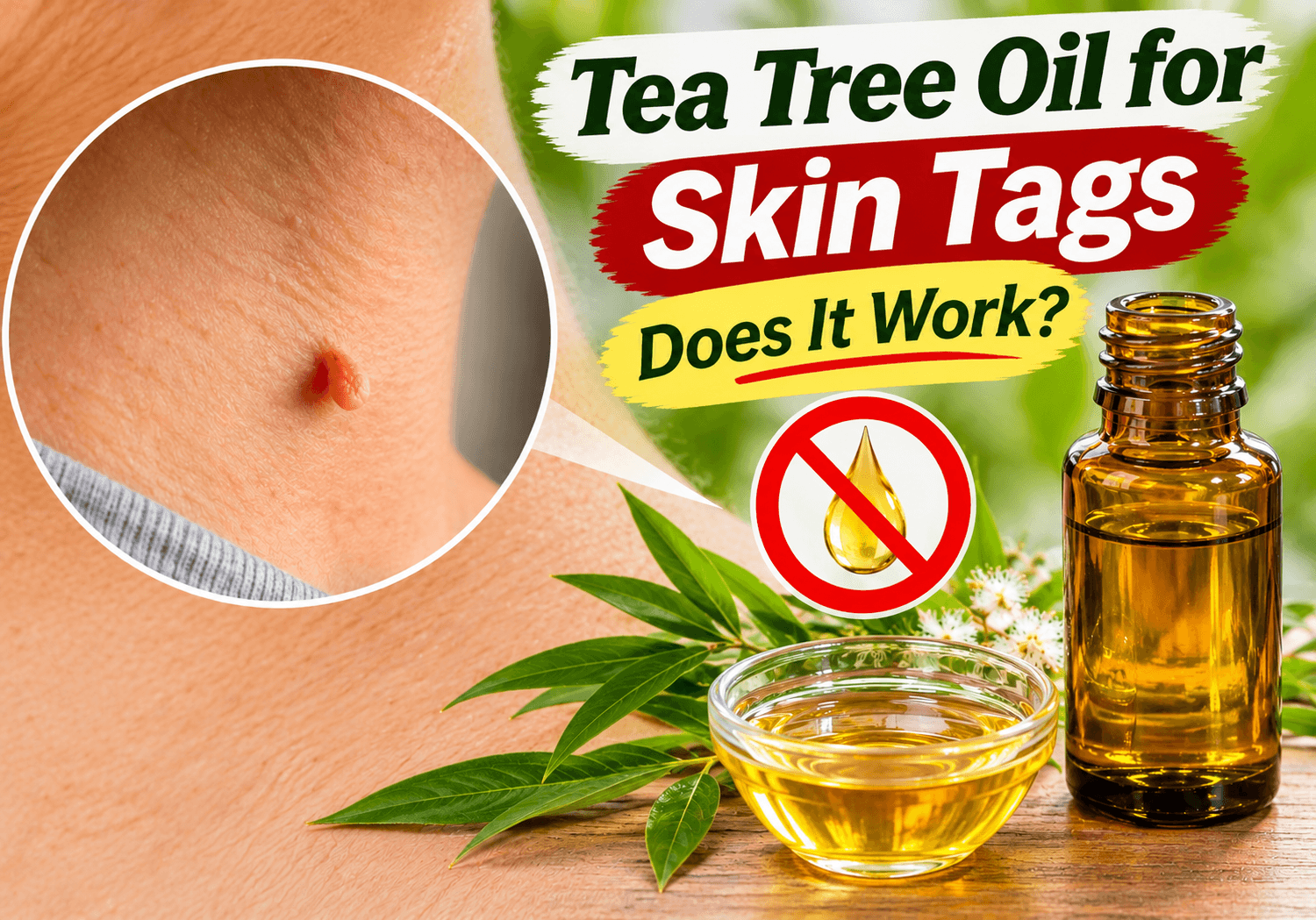
You notice a small, soft bump hanging from your neck, armpit, or under your breast. A quick search brings up a flood of blog posts claiming a few drops of tea tree oil will dissolve it overnight. Before you start dabbing essential oil on your skin, you deserve a straight answer backed by what the medical literature actually says.
This article breaks down the science behind tea tree oil (Melaleuca alternifolia), what it can do for your skin, why it is unlikely to remove a skin tag (acrochordon), and the proven medical options your dermatologist can offer. You’ll also get safety guidance so you don’t irritate or worsen the area while experimenting at home.
Quick Answer
No. There is no clinical evidence that tea tree oil removes or shrinks skin tags. Tea tree oil has documented antimicrobial and anti-inflammatory properties, but skin tags are structural growths of skin and connective tissue that require physical removal. Applying tea tree oil may cause irritation or allergic contact dermatitis without resolving the tag. See a dermatologist for proven treatments like cryotherapy or surgical excision.
What the Research Actually Says About Tea Tree Oil
Tea tree oil is extracted from the leaves of Melaleuca alternifolia, a shrub native to southeastern Australia. Its primary active compound, terpinen-4-ol, gives the oil well-documented antimicrobial, antifungal, and anti-inflammatory properties. Multiple peer-reviewed studies have confirmed its effectiveness against bacteria like Staphylococcus aureus and fungi like Candida species, according to research published in The Journal of Antimicrobial Chemotherapy.
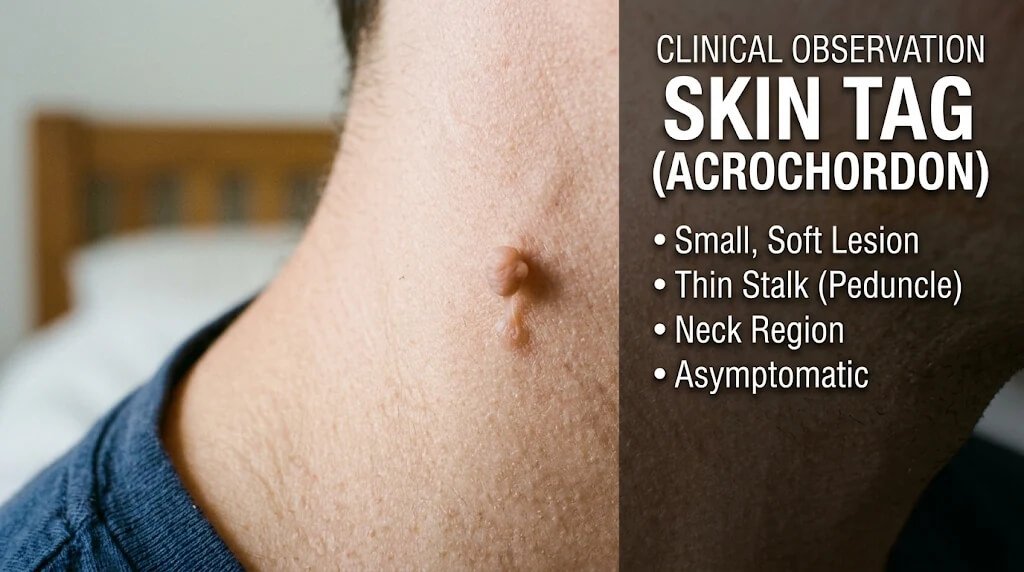
That said, “antimicrobial” and “removes a structural skin growth” are two very different claims. A skin tag is a small pedunculated (stalked) overgrowth of epidermis, collagen, and tiny blood vessels. Because the tag is made of your own tissue, an antiseptic oil has no mechanism to dissolve or shrink it.
A systematic review of topical treatments for benign skin lesions, indexed in PubMed, found no randomized controlled trials testing tea tree oil specifically for acrochordon removal. The Mayo Clinic and Cleveland Clinic both list medical procedures—cryotherapy, electrocautery, surgical excision, and ligation—as the standard removal methods. Neither lists essential oils as a treatment.
Bottom line: The evidence does not support tea tree oil as an effective treatment for skin tags. It is a useful antiseptic for minor cuts, acne-prone skin, or fungal spots, but it will not make a tag disappear.
What Tea Tree Oil Can Do for Skin
To be fair, tea tree oil is not useless in a skincare context. Here’s where the evidence supports its use:
- Acne management: A 2000 RCT published in the International Journal of Dermatology found 5% tea tree oil gel reduced acne lesion count compared to a placebo, though it worked more slowly than 5% benzoyl peroxide.
- Antifungal support: Research in Mycoses confirms activity against Candida and Trichophyton species.
- Minor wound antisepsis: Small studies support its role as a gentle antiseptic for superficial cuts.
None of these applications involve dissolving a structural tissue growth. The mechanism simply does not apply to acrochordons.
Why Skin Tags Form (and Why Oil Won’t Fix Them)
Understanding the biology helps explain why no topical oil will work. Skin tags develop when excess collagen fibers and tiny blood vessels tangle together beneath the epidermis. Common triggers include:
- Friction from skin rubbing against skin or clothing
- Genetics (if your parents have them, you likely will too)
- Insulin resistance or type 2 diabetes
- Hormonal shifts during pregnancy
- Weight fluctuations that create more skin folds
The American Academy of Dermatology notes that skin tags are benign and do not turn into cancer. They are a structural issue, not an infectious one. That distinction is critical: you cannot “kill” a tag with an antiseptic because it is not alive in the way bacteria or fungi are. It is your own tissue in a slightly disorganized arrangement.
Coach’s Tip: Think of a skin tag like a small, soft loop of rope tied to your shirt. Pouring antiseptic on the rope won’t untie the knot. You need to physically cut or tie it off. That’s exactly what a dermatologist does with cryotherapy (freezing), electrocautery (burning), or a small scissors excision.
Can Tea Tree Oil Make Skin Tags Worse?
This is the part that concerns me most when clients ask about dabbing essential oils on sensitive areas. Tea tree oil is a known sensitizer. The Contact Dermatitis Clinic at Johns Hopkins documents cases of allergic contact dermatitis from undiluted tea tree oil, particularly on the face, neck, and underarms—exactly where skin tags commonly appear.
Risk factors for a bad reaction:
- Applying undiluted (100%) tea tree oil directly to skin
- Using it on already-irritated, broken, or thin skin
- Repeated daily application (sensitization builds over days to weeks)
- Combining it with other essential oils or carrier oils that compound irritation
If you do get a reaction, you may see redness, swelling, blistering, or a spreading rash around the tag. In that case, stop use immediately, rinse the area with cool water and mild soap, and see a doctor if the irritation doesn’t improve within 48 hours.
Common Mistake: People apply full-strength tea tree oil to a skin tag every night for “weeks” hoping it will shrink. What actually happens is the surrounding skin becomes inflamed, the tag may look redder and more swollen (making it seem worse), and the person develops a patch of contact dermatitis that takes weeks to heal. The tag is still there. Now you have a rash on top of it.
Proven Medical Removal Options
If you want the tag gone, here are the evidence-based methods a board-certified dermatologist or primary care physician can perform. Most are quick, low-cost, and done in-office.
| Method | How It Works | Typical Downtime | Best For |
| Cryotherapy | Liquid nitrogen freezes the tag tissue; it sloughs off in 1–2 weeks | 1–2 weeks for tag to fall off | Small tags (< 5 mm / 0.2 in) |
| Electrocautery | A fine probe delivers heat to destroy the tag at its base | 3–7 days; small scab forms | Small to medium tags |
| Surgical excision | Doctor clips the tag off with sterile scissors after local anesthetic | 1–3 days; tiny scab | Larger tags, tags on stalks |
| Ligation | A suture or thread is tied around the base, cutting off blood supply; tag falls off in 7–14 days | 1–2 weeks | Small, pedunculated tags |
| Dermabrasion / laser | Ablates the tag tissue; more precise for flat or broad-based tags | 3–10 days | Flat tags, cosmetic areas |
The Cleveland Clinic notes that all of these methods have high success rates and low complication risk when performed by a trained provider. Most insurance plans cover removal if the tag is causing friction, bleeding, or diagnostic concern.
What to Expect at the Appointment
- Duration: 5–15 minutes in the office.
- Pain: Minimal. Local anesthetic (like lidocaine) is used for excision; cryo and cautery cause a brief sting.
- Aftercare: Keep the area clean and dry. A small bandage may be applied. Avoid picking at the scab.
- Cost: Typically 100–300 per tag if uninsured; often covered if medically indicated. [VERIFY exact pricing varies by provider and region.]
If You Still Want to Try a Topical Approach (Safety First)
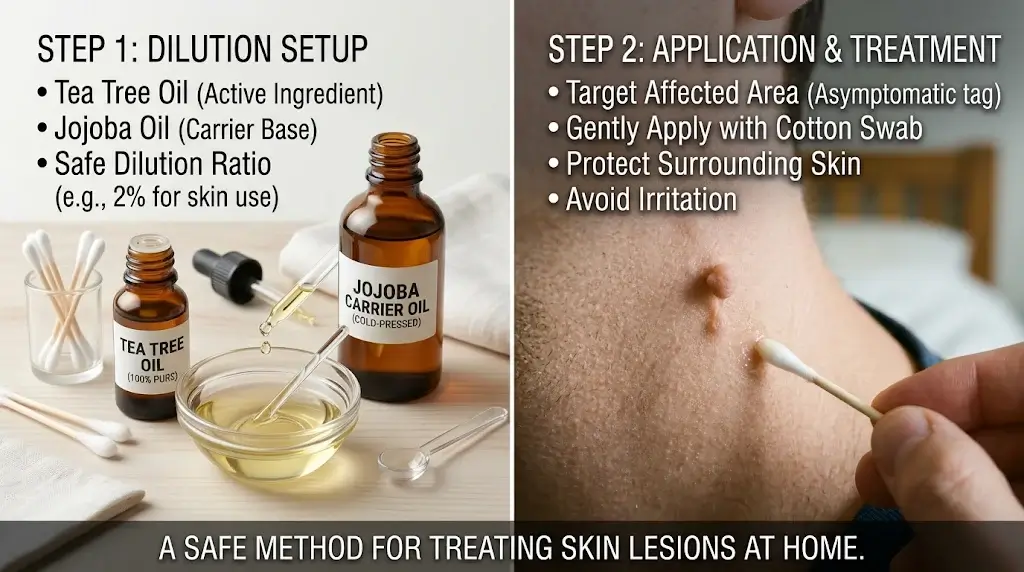
I’ll be direct: I do not recommend tea tree oil for skin tag removal because it will not work and carries irritation risk. However, if you have a small, bothersome tag and want to try a low-risk topical while scheduling a dermatologist visit, here is how to minimize harm:
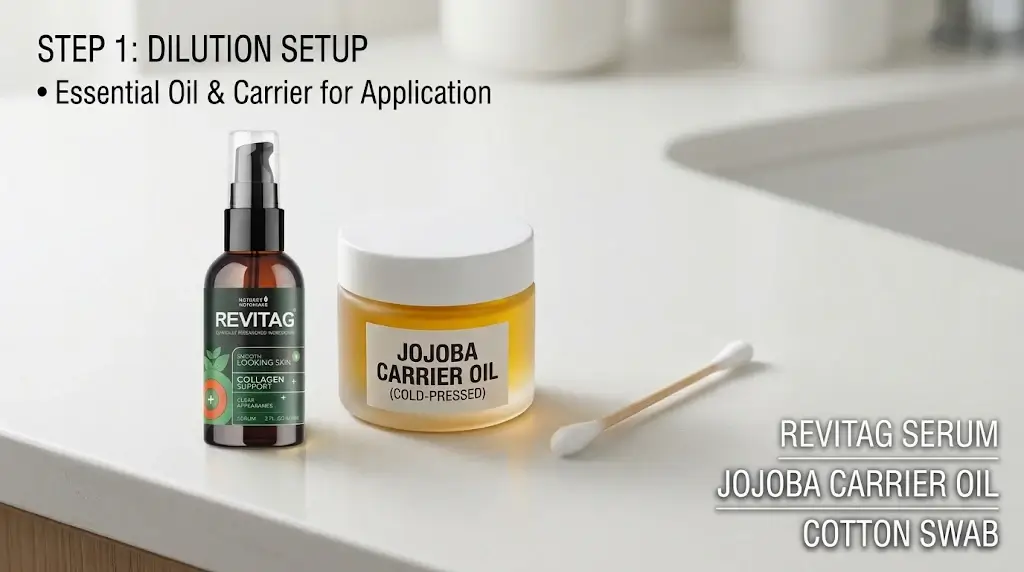
- Dilute. Mix 1–2 drops of 100% tea tree oil with 1 teaspoon (5 mL) of a carrier oil (jojoba, fractionated coconut, or sweet almond). This brings the concentration to roughly 2–4%.
- Patch test first. Apply a tiny amount to the inside of your forearm. Wait 24 hours. If you see redness, itching, or swelling, do not use it near the tag.
- Apply sparingly. Use a clean cotton swab to dab the diluted oil on the tag once daily. Do not rub.
- Limit duration. Give it 10–14 days maximum. If the tag has not changed size, shape, or color, stop.
- Watch for warning signs. Increasing redness, swelling, blistering, or a spreading rash means stop and see a doctor.
This protocol is about skin safety, not about expecting the tag to disappear. Set your expectations correctly: the tag will almost certainly still be there after two weeks.
Tea Tree Oil vs. Other “Home Remedies” for Skin Tags
You’ll often see tea tree oil grouped with apple cider vinegar, garlic, or castor oil in “natural removal” articles. Here’s a quick reality check:
| Remedy | Claimed Mechanism | Evidence for Tag Removal | Main Risk |
| Tea tree oil | Antiseptic / “dries out” the tag | None (no RCTs) | Contact dermatitis |
| Apple cider vinegar | Acetic acid “burns” the tissue | Anecdotal only | Chemical burn, scarring, pain |
| Raw garlic | Allicin “kills” the tissue | None | Severe chemical burn, blistering |
| Castor oil | “Softens” the tag | None | No effect; possible clogged pores |
| Tying with dental floss | Cuts blood supply (DIY ligation) | Mimics medical ligation | Infection, incomplete removal, bleeding |
The Harvard Health Publishing team cautions against applying corrosive substances (vinegar, garlic) to skin, as they can cause full-thickness chemical burns that leave worse scarring than a simple in-office removal would.
My recommendation as a coach who values evidence over anecdote: skip the kitchen-ingredient experiments. A 10-minute visit to a dermatologist is faster, safer, and actually resolves the problem.
Who Should See a Doctor Before Trying Any Topical Treatment
Please check with a doctor or dermatologist before applying any essential oil or home remedy if:
- The tag is growing rapidly, changing color, bleeding, or is larger than 1 cm (0.4 in)
- You have diabetes or impaired wound healing
- You are on blood thinners (warfarin, apixaban, clopidogrel)
- The tag is in a sensitive area (eyelid, genital region, inside the ear)
- You are pregnant or breastfeeding
- You have a history of eczema, psoriasis, or severe contact allergies
- You are unsure whether the growth is actually a skin tag (it could be a seborrheic keratosis, skin fibroma, or, rarely, a melanoma)
A dermatologist can perform a quick visual exam or, if needed, a small skin biopsy to confirm the diagnosis before any treatment. This is especially important for any pigmented, irregular, or changing lesion.
Supporting Overall Skin Health
While no oil will remove a tag, keeping your skin barrier healthy can reduce friction-related irritation around existing tags and lower the chance of new ones forming in fold areas. A few evidence-based habits:
- Moisturize daily with a fragrance-free, ceramide-based moisturizer to maintain the skin barrier.
- Manage friction: Wear smooth, moisture-wicking fabrics under areas where tags rub (neck, underarms, bra line).
- Support skin integrity from within: Omega-3 fatty acids (EPA and DHA) have been linked to reduced skin inflammation and improved hydration in clinical studies, according to research indexed in PubMed. If you’re not eating fatty fish twice a week, a quality fish oil supplement may help. You can read more about this in our guide on omega-3 fatty acids for skin hydration and inflammation.
- Control blood sugar: Insulin resistance is a known risk factor for new skin tags. Regular movement, adequate protein, and fiber-rich meals support stable glucose levels.
- Protect from sun: UV damage weakens the skin barrier over time. Use SPF 30+ daily on exposed areas.
These steps won’t make an existing tag vanish, but they create a healthier environment for your skin and may reduce the rate of new tag formation.
(FAQ)
Can tea tree oil actually remove skin tags?
No. There are no clinical trials showing tea tree oil removes or shrinks skin tags. Skin tags are structural tissue growths, not infections, so an antiseptic oil has no mechanism to dissolve them. Proven removal requires a medical procedure like cryotherapy, electrocautery, or surgical excision performed by a dermatologist.
How long would tea tree oil take to work on a skin tag?
It will not work, regardless of duration. If you apply diluted tea tree oil for 10–14 days and the tag has not changed, stop. Prolonged application increases the risk of contact dermatitis without any benefit to the tag itself.
Is tea tree oil safe to use on skin tags?
Diluted tea tree oil (2–4% in a carrier oil) is generally safe for most people on intact skin. However, it is a known sensitizer. If you have sensitive skin, eczema, or a history of allergic reactions to essential oils, skip it entirely. Always patch-test on your forearm first.
What is the best essential oil for skin tags?
No essential oil has been proven to remove skin tags. If you want a soothing, low-irritation option for the surrounding skin while you wait for a dermatologist appointment, a highly diluted (under 2%) chamomile or lavender oil in a carrier is gentler than tea tree oil. But again, none will remove the tag.
Can I use tea tree oil on skin tags on my neck or underarms?
These areas have thinner, more sensitive skin and are higher-risk for irritation and allergic reaction. If you choose to try a diluted application, use the lowest concentration (1 drop in 1 tsp carrier oil), apply once daily, and stop immediately if you notice redness or itching. A dermatologist visit is the safer route for these locations.
Does tea tree oil shrink skin tags or make them fall off?
No. There is no evidence that tea tree oil causes a skin tag to shrink, dry up, or detach. The tag’s blood supply and structural tissue are not affected by topical antiseptic compounds. Only physical removal methods (freezing, cutting, cauterizing, or ligating) will eliminate it.
Conclusion: Skip the Oil, Book the Appointment
Tea tree oil for skin tags does not work. The research is clear: tea tree oil is a useful antiseptic and anti-inflammatory for minor skin issues like acne or superficial fungal spots, but it has no demonstrated ability to remove a structural growth like an acrochordon. Relying on it wastes time, risks a patchy rash, and leaves the tag exactly where it started.
The good news is that getting a skin tag removed is one of the simplest, most affordable dermatology procedures available. A 10-minute office visit, a quick freeze or snip, and a small scab that heals in a week. You walk in with the tag, you walk out without it. No two-week waiting game, no irritation, no guessing.
If you’re dealing with multiple tags, a tag that’s changing, or any growth you’re unsure about, make that dermatologist appointment this week. Bring a list of questions. Ask whether the removal is covered by your insurance. And leave the essential oil in the bathroom cabinet where it belongs—next to the acne gel, not on your neck.