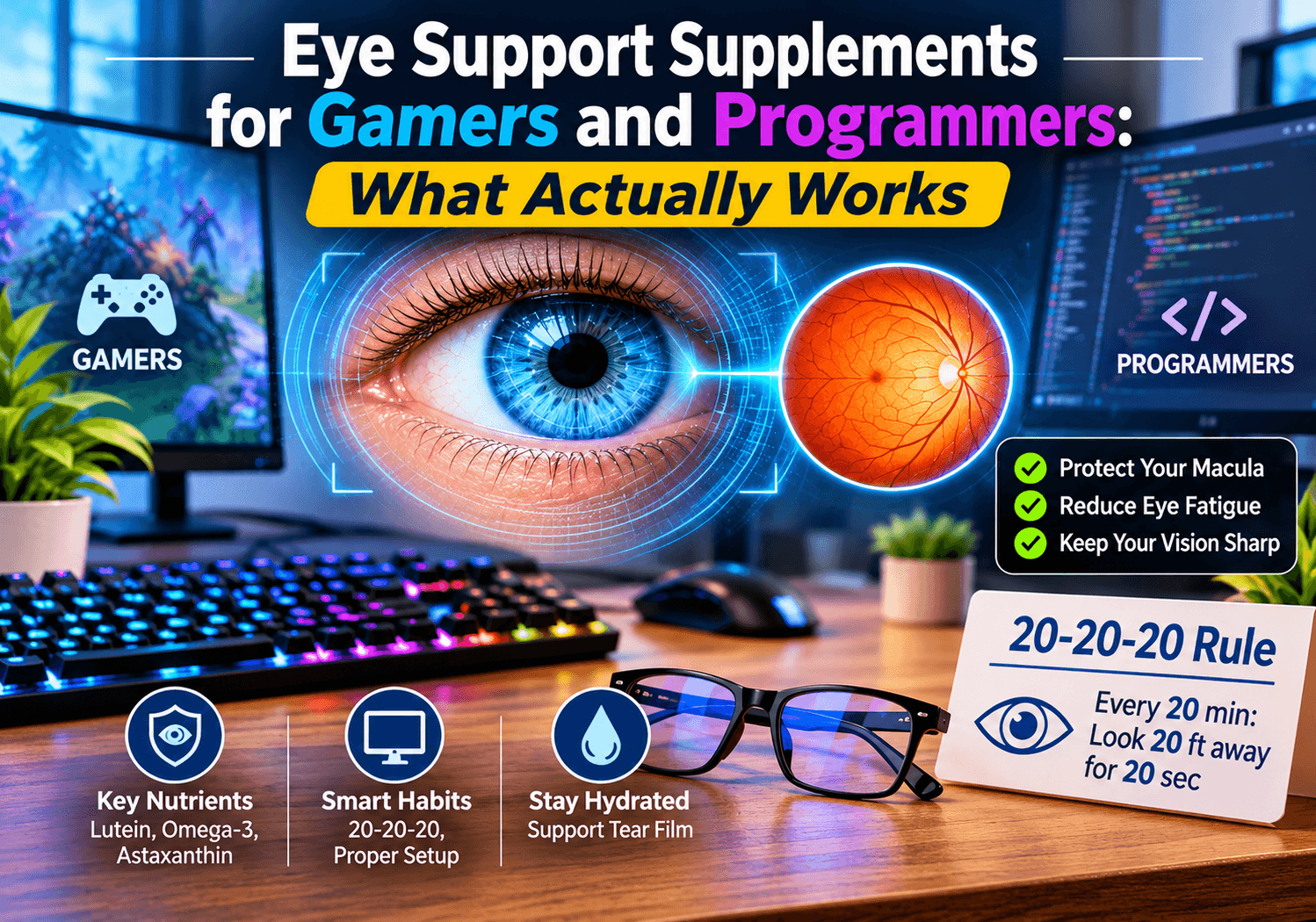
You stare at a monitor for eight, ten, or twelve hours a day. Your eyes burn by 3 p.m. Your vision blurs during long coding sprints or ranked matches. You blink less than you realize, your tear film thins, and the screen starts to feel like sandpaper.
Eye support supplements for gamers and programmers target the specific stressors of prolonged screen time: oxidative load on the retina, reduced blink rate, and the constant demand on your macula to process fine detail at close range. The good news? A handful of well-studied nutrients can help your eyes handle that daily workload.
This guide breaks down which supplements have real evidence behind them, what doses to look for, and how to pair them with simple habits that actually reduce screen fatigue. No hype, no miracle pills. Just practical, coach-level guidance you can act on this week.
Quick Answer: The most evidence-backed eye support supplements for gamers and programmers are lutein (10–20 mg), zeaxanthin (2–4 mg), omega-3 fatty acids (1,000–2,000 mg combined EPA/DHA), and astaxanthin (4–12 mg). These nutrients support macular pigment density, tear film quality, and retinal antioxidant defense. Pair them with the 20-20-20 rule and proper monitor setup for the best results.
Why Screen Time Strains Your Eyes (and Why Supplements Can Help)
Your eyes were not designed to lock onto a glowing rectangle 20 inches (51 cm) away for ten hours straight. When you stare at a monitor, three things happen simultaneously:
- Your blink rate drops by 50–60%. Normal blinking is about 15–20 times per minute. During focused screen work, it can fall to 5–7. That means your tear film evaporates faster than it renews, leading to dryness and irritation.
- Your ciliary muscle stays contracted. Focusing at close range keeps the lens in a fixed, accommodated state. Over hours, that sustained tension contributes to the “tired eye” feeling.
- Your retina processes a constant flood of blue-violet light (400–495 nm). While the evidence that blue light from screens causes permanent retinal damage in healthy adults is still limited, the cumulative oxidative stress on retinal cells is a real physiological load.
The National Eye Institute, part of the NIH, notes that the macula—the small area at the center of your retina responsible for sharp, detailed vision—accumulates two carotenoid pigments (lutein and zeaxanthin) that act as a natural “sunglass filter” for incoming light and as antioxidants for retinal cells. When you’re screen-heavy, those pigments work overtime. Supplementing them can help maintain macular pigment density, which research links to better visual performance under high-contrast, close-range tasks.

The Key Eye Support Supplements, Ranked by Evidence
Not every “eye vitamin” on the shelf is created equal. Here are the nutrients with the strongest research backing for people who live on a screen.
1. Lutein and Zeaxanthin (The Macula’s Best Friends)
What they do: These two carotenoids are the only dietary pigments that concentrate in the macula. They filter high-energy blue light before it reaches the photoreceptors and neutralize free radicals generated by light exposure.
The evidence: The landmark AREDS2 study, published in JAMA (Liu et al., 2013), tested whether adding 10 mg lutein and 2 mg zeaxanthin to a multivitamin formula slowed progression of age-related macular degeneration. While the primary endpoint was not met for all participants, the study confirmed safety at those doses and showed a trend toward reduced progression in the lowest macular pigment groups. Multiple smaller trials in healthy adults have shown that 10–20 mg of lutein per day for 8–12 weeks increases measured macular pigment optical density (MPOD), a marker of retinal carotenoid loading.
Dose to look for: 10–20 mg lutein + 2–4 mg zeaxanthin daily. The “2:1” ratio (lutein to zeaxanthin) mirrors what’s found in leafy greens and egg yolks.
Best sources in a supplement: Marigold extract (Tagetes erecta) is the standard delivery form. Look for “lutein from marigold” on the label.
Food sources (for reference): Cooked spinach, kale, corn, egg yolks, and orange peppers.
2. Omega-3 Fatty Acids (DHA and EPA) for Tear Film Quality
What they do: DHA is a structural component of the retinal cell membranes. EPA and DHA also support the meibomian glands in your eyelids, which secrete the oily layer of your tear film. A healthy oil layer slows tear evaporation—exactly what you need when your blink rate drops during a coding session.
The evidence: Several clinical trials published in PubMed-indexed ophthalmology journals have shown that omega-3 supplementation (typically 1,000–2,000 mg combined EPA/DHA per day) can improve tear break-up time and reduce self-reported dryness in people with mild to moderate dry eye. The effect is modest but consistent, and it makes the most sense for people who already notice their eyes getting dry after long screen sessions.
Dose to look for: 1,000–2,000 mg combined EPA + DHA per day. If you eat fatty fish (salmon, mackerel, sardines) twice a week, you may already be close to this.
Best sources in a supplement: Fish oil, algal oil (for DHA specifically, and a good vegan option), or a combined EPA/DHA capsule.
Practical note: If you’re already taking an omega-3 for joint or heart support, you likely don’t need a separate “eye” omega-3. Just make sure the label lists EPA and DHA amounts. You can learn more about how omega-3s support overall tissue hydration and reduce low-grade inflammation in our guide on omega-3 fatty acids for skin hydration and inflammation.
3. Astaxanthin (The Antioxidant Workhorse)
What they do: Astaxanthin is a carotenoid found in salmon, shrimp, and algae. It has an exceptionally long molecular structure that lets it span the entire cell membrane, offering antioxidant protection on both the inner and outer surfaces. For the retina, that means it can help neutralize the reactive oxygen species generated by prolonged light exposure.
The evidence: A small number of clinical trials (mostly in Japanese and Asian populations) have reported that 4–12 mg of astaxanthin per day for 4–12 weeks reduced self-reported eye fatigue and improved accommodation flexibility (the eye’s ability to shift focus between near and far). Sample sizes have been small (30–80 participants), so treat the data as promising but not definitive.
Dose to look for: 4–12 mg per day. Most studies used 6 mg.
Best sources in a supplement: Haematococcus pluvialis microalgae extract.
Food sources (realistic? Not really): You’d need to eat a large serving of wild salmon daily to get meaningful astaxanthin. A supplement is the practical route.
4. Vitamin A (Retinol and Beta-Carotene)
What they do: Vitamin A is essential for the production of rhodopsin, the light-sensitive pigment in your rod cells. It also supports the health of the corneal and conjunctival epithelium—the surface tissues that get dry and irritated from reduced blinking.
The evidence: Vitamin A deficiency causes well-documented eye problems, including night blindness and corneal dryness. In developed countries, true deficiency is rare in adults who eat a varied diet. However, if your diet is low in animal products, eggs, and orange vegetables, a modest supplement can help maintain adequate levels.
Dose to look for: 700–900 mcg RAE (retinol activity equivalents) per day for adults. This is roughly what’s in a standard multivitamin. Avoid megadoses of preformed vitamin A (retinol) above 3,000 mcg RAE without medical supervision.
Best sources in a supplement: A quality multivitamin usually covers this. If you want a standalone, look for a blend of retinol and beta-carotene.
5. Vitamin C and Vitamin E (Antioxidant Support)
What they do: These two vitamins work synergistically to protect retinal and lens cells from oxidative damage. Vitamin C is water-soluble and concentrated in the aqueous humor (the fluid in the front of your eye). Vitamin E is fat-soluble and protects the lipid-rich cell membranes of the retina.
The evidence: The AREDS2 formula included 500 mg vitamin C and 400 IU vitamin E as part of the antioxidant package. While the formula was designed for macular degeneration, the underlying mechanism—reducing oxidative stress in retinal tissue—is the same one you want to support during long screen sessions.
Dose to look for: 500 mg vitamin C + 400 IU (13.5 mg) vitamin E daily, either in a multivitamin or as part of an eye-support formula.
6. Zinc
What they do: Zinc is a cofactor for over 300 enzymes, including those involved in retinal metabolism and the transport of vitamin A from the liver to the eye. Low zinc status has been associated with increased risk of macular degeneration in observational studies.
Dose to look for: 15–30 mg elemental zinc per day. More than that can interfere with copper absorption, so don’t go overboard.
Best sources in a supplement: Zinc picolinate or zinc citrate are well-absorbed forms.
7. Bilberry Extract (Honorable Mention)
What it does: Bilberry (Vaccinium myrtillus) is a European berry whose anthocyanin pigments have been studied for their ability to support microcirculation in the retina and improve dark adaptation (the time it takes your eyes to adjust to dim light).
The evidence: The research base is thinner than for lutein or omega-3s. A few small trials reported modest improvements in night vision and reduced eye fatigue, but the studies are old and methodologically limited. It’s a reasonable add-on, not a cornerstone.
Dose to look for: 160–320 mg of standardized bilberry extract (25% anthocyanins) per day.
Supplement Comparison Table at a Glance
| Supplement | Typical Dose | Primary Eye Benefit | Evidence Strength | Best For |
| Lutein + Zeaxanthin | 10–20 mg + 2–4 mg | Macular pigment density, blue-light filtering | Strong (AREDS2, MPOD trials) | Everyone on a screen 6+ hrs/day |
| Omega-3 (EPA/DHA) | 1,000–2,000 mg | Tear film quality, retinal cell structure | Moderate (multiple RCTs) | People with dry-eye symptoms |
| Astaxanthin | 4–12 mg | Antioxidant protection, accommodation | Moderate (small RCTs) | Gamers in long competitive sessions |
| Vitamin A | 700–900 mcg RAE | Corneal health, night vision | Strong (deficiency data) | Plant-based eaters, low-egg diets |
| Vitamin C + E | 500 mg + 400 IU | Antioxidant defense in retina/lens | Moderate (AREDS2 component) | General retinal antioxidant support |
| Zinc | 15–30 mg | Retinal metabolism, vitamin A transport | Moderate (observational) | Those not getting enough from diet |
| Bilberry extract | 160–320 mg | Microcirculation, dark adaptation | Weak to moderate | Optional add-on |
How to Build Your Daily Eye-Support Routine
You don’t need seven separate bottles. Here’s a practical, no-fuss approach:
Option A – The “One Bottle” Route
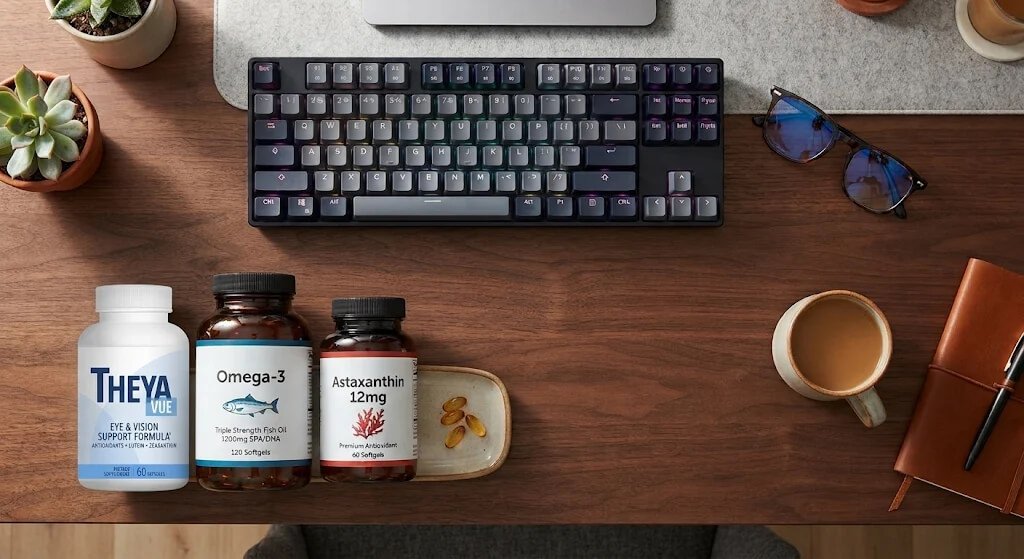
Pick a single eye-support formula that combines lutein, zeaxanthin, vitamin C, vitamin E, zinc, and a small amount of astaxanthin. Take it with a meal that contains some fat (helps absorption of the fat-soluble nutrients). Then add a standalone omega-3 if you’re not eating fatty fish regularly.
Option B – The “Two-Bottle” Route
- Bottle 1: Lutein/zeaxanthin + astaxanthin + vitamin C/E + zinc (an eye-specific formula)
- Bottle 2: Omega-3 (1,000–2,000 mg EPA/DHA)
Timing tip: Take your supplements with your largest meal of the day, ideally lunch. Fat-soluble nutrients (lutein, zeaxanthin, astaxanthin, vitamin E, DHA) absorb better alongside dietary fat.
How long before you notice a difference? Macular pigment loading takes about 8–12 weeks of consistent daily intake. Tear film improvements from omega-3s may be noticeable in 4–6 weeks. Don’t expect overnight changes. This is a maintenance strategy, not a fix-it-fast pill.
Coach’s Tip: If you’re a competitive gamer or a developer in a crunch, your eyes are working as hard as your hands. Think of eye supplements the same way you’d think of a pre-workout for your muscles. They don’t replace the fundamentals (sleep, hydration, breaks), but they give your retinal tissue the raw materials it needs to recover between sessions. Consistency matters more than a single “super dose.”
Beyond the Bottle: The Non-Negotiable Screen Habits
Supplements are a supporting cast. The lead roles go to these habits, which cost nothing and have the biggest impact on how your eyes feel by 5 p.m.:
The 20-20-20 Rule
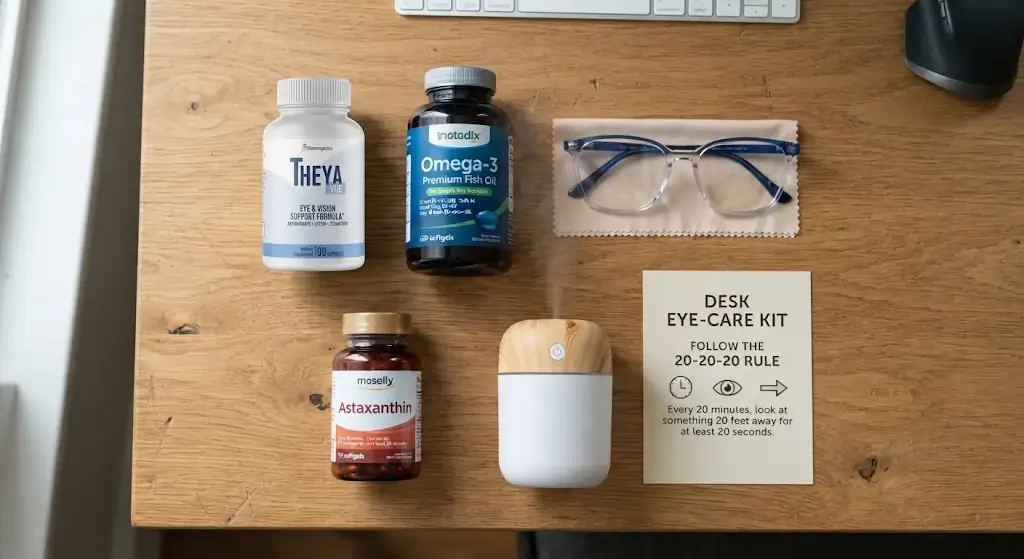
Every 20 minutes, look at something at least 20 feet (6 m) away for 20 seconds. This relaxes the ciliary muscle and gives your accommodation system a break. Set a phone timer if you need a nudge. During a long coding session, use it as a natural checkpoint: finish the function, look out the window, come back.
Blink Consciously
When you notice your eyes starting to sting, do 10 slow, full blinks in a row. Not half-blinks. Squeeze the lids shut for a second, then open. This re-spreads the tear film across the cornea.
Palming (Easier Version)
Rub your palms together for 10 seconds to warm them. Close your eyes and rest your palms over your closed lids, fingers over your brows. Don’t press on the eyeballs. Breathe slowly for 30–60 seconds. This reduces ciliary muscle tension and gives your visual cortex a brief rest.
Palming + Neck Release (Harder/Progression Version)
After the 60-second palm, gently tilt your head to the right, drop your right ear toward your shoulder, and hold for 15 seconds. Repeat on the left. Then do 10 slow chin tucks (pull your chin straight back, like making a “double chin,” hold 3 seconds, release). Tension in your upper traps and neck often compounds the feeling of eye fatigue.
Monitor Setup
- Distance: 20–28 inches (51–71 cm) from your eyes to the screen.
- Height: The top of the screen should be at or slightly below eye level so you look slightly downward.
- Brightness: Match your room’s ambient light. If your room is dim, dim the screen. If it’s bright, brighten it.
- Color temperature: Shift toward warmer (lower color temperature, around 4,000–5,000 K) in the evening. Many monitors and operating systems have a “night mode” or “f-lux” equivalent.
- Text size: If you’re coding, increase your font size so you’re not squinting at 10-point text.
Hydration and Environment
Drink water regularly. A dry room (especially with air conditioning or a heater running) accelerates tear evaporation. A small desk humidifier can help if you’re in a dry climate or a heated office in winter.
Safety Notes and Who Should Talk to a Doctor First
- Supplements are not a substitute for an eye exam. If you notice persistent blurriness, double vision, flashes of light, a “curtain” over your vision, or sudden changes in color perception, see an optometrist or ophthalmologist. These can be signs of retinal issues that no supplement will fix.
- Pregnant or breastfeeding? Check with your doctor before taking any new supplement, especially high-dose vitamin A (preformed retinol) or zinc.
- Taking blood thinners or other medications? Omega-3s at higher doses (above 3,000 mg EPA/DHA) can have a mild blood-thinning effect. Talk to your pharmacist or doctor if you’re on warfarin, aspirin, or other anticoagulants.
- Selenium and zinc interactions: If you’re taking a zinc supplement, make sure you’re not also loading up on selenium or copper from other sources without guidance.
- Allergies: If you’re allergic to shellfish, choose an algal oil source for omega-3s and verify that your astaxanthin source (Haematococcus pluvialis) is free of shellfish-derived ingredients.
Common Mistake: Buying a “vision formula” with 30 different ingredients at 1–2 mg each, hoping the breadth covers everything. You end up with sub-therapeutic doses of the nutrients that actually matter (lutein, DHA, astaxanthin) and a pile of filler. Read the label. Look for the specific milligram amounts of lutein, zeaxanthin, EPA, DHA, and astaxanthin. If those numbers aren’t printed, put the bottle back.
FAQ: Eye Support Supplements for Gamers and Programmers
Do lutein supplements actually help with screen fatigue?
Research suggests that 10–20 mg of lutein daily for 8–12 weeks increases macular pigment density, which is associated with better contrast sensitivity and reduced glare sensitivity. Whether that translates to a noticeable reduction in “tired eyes” after a 10-hour session is individual. The evidence supports the mechanism; the subjective experience varies.
Can omega-3 reduce dry eyes from staring at screens?
Yes, modestly. Clinical trials show that 1,000–2,000 mg of combined EPA and DHA per day can improve tear break-up time and reduce dryness symptoms in people with mild dry eye. It works best alongside the 20-20-20 rule and conscious blinking. It won’t replace preservative-free eye drops if your dryness is severe.
How much astaxanthin should I take for eye health?
Most clinical trials used 4–12 mg per day, with 6 mg being the most common dose. Start at 4 mg and see how you feel. Take it with a meal containing fat. There’s no strong evidence that 20 mg is better than 6 mg for eye-specific outcomes.
Are eye supplements better than blue-light-blocking glasses?
They do different jobs. Blue-light glasses filter a portion of the 400–495 nm spectrum reaching your retina, reducing the light load. Supplements support the internal antioxidant and structural health of the retinal and tear film tissues. If budget allows, using both is reasonable. Neither replaces proper monitor setup and regular breaks.
How long before eye supplements show results?
Macular pigment loading (lutein/zeaxanthin) takes roughly 8–12 weeks of daily dosing. Omega-3 effects on tear film may be noticeable in 4–6 weeks. Astaxanthin’s antioxidant effects build over several weeks. Consistency is key. Skipping days resets the clock.
Can I just eat more spinach and salmon instead of taking pills?
You can, and you should eat those foods. But getting 10–20 mg of lutein from food alone requires eating large portions of cooked leafy greens daily, and 1,000–2,000 mg of EPA/DHA requires two to three servings of fatty fish per week. If your diet already covers that, you may not need a supplement. If it doesn’t, a targeted supplement fills the gap.
Final Thoughts: Build the Foundation, Add the Supplements
Your eyes are the most overworked tool in your daily kit if you game, code, or design for a living. The single biggest thing you can do is take real breaks—20-20-20, palming, conscious blinking—and set up your monitor at the right distance and angle. Those habits are free and work immediately.
On top of that, a small, well-chosen supplement stack—lutein and zeaxanthin for macular pigment, omega-3s for tear film, and astaxanthin for antioxidant defense—gives your retinal tissue the raw materials it needs to recover between long sessions. You don’t need seven bottles. You need two or three good ones, taken consistently with a meal that has some fat, for at least two months before you judge the effect.
Treat your eyes the way you’d treat any other piece of high-performance equipment: maintain them daily, don’t ignore early warning signs, and get a professional check-up once or twice a year. Your vision is not something you can “push through.” Protect it, and it will keep up with your next ranked match, your next sprint, and your next 12-hour debugging session.