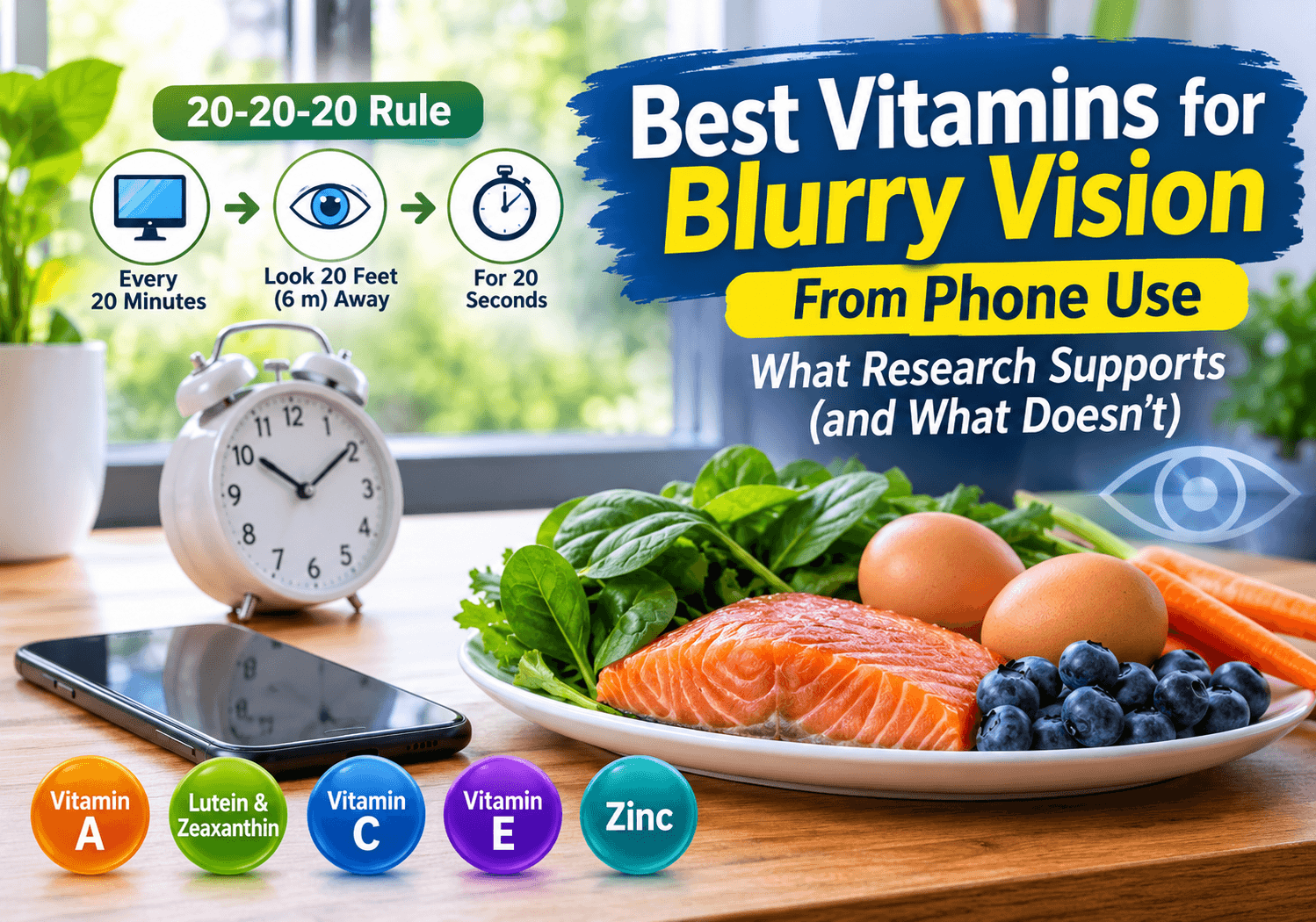
If your eyes go fuzzy after an hour of scrolling, you’ve probably wondered about the best vitamins for blurry vision from phone use. The honest coach’s answer is that no vitamin has been proven to fix it. Most phone-related blur comes from how you use your eyes, not from a nutrient gap.
That said, a few nutrients do matter for eye health. Knowing which ones, and when they help, keeps you from wasting money. It also keeps you from taking something that could backfire.
This guide covers why phones blur your vision, what the research says about each nutrient, and the habits that do the real work. For anything involving supplements, check with your doctor or eye care professional first.
Quick Answer: No vitamin has been proven to fix blurry vision from phone use, which usually comes from eye strain and dryness. Vitamin A, lutein, zeaxanthin, vitamin C, vitamin E, and zinc are linked to eye health, mainly in deficiency or macular degeneration. Rest breaks, blinking, and an eye exam matter more. Ask your doctor before supplementing.
Why Phones Blur Your Vision in the First Place
Before choosing a vitamin, you need to know what you’re treating. Three things usually cause screen blur, and none of them is a vitamin shortage.
Digital Eye Strain
Digital eye strain, also called computer vision syndrome, is a group of symptoms from long phone, tablet, and computer use. UT Medicine lists blurry vision, dry eyes, headaches, and light sensitivity among the most common. It happens when the eyes focus hard on a close task for a long time.
The American Academy of Ophthalmology (AAO) says screen use has not been shown to cause permanent eye damage. As relayed by Brown University Health, symptoms come from how we use our devices. [VERIFY: swap in the direct AAO page if you can confirm the URL.]
Dry Eye From Reduced Blinking
When you stare at a screen, you tend to blink less. UT Medicine notes that less blinking can lead to dry eye symptoms. A dry tear film scatters light, and that can make text look smeary until you blink.
That’s why blur that clears with a few deliberate blinks is a classic sign of dryness, not a vitamin problem.
Focusing Fatigue and Uncorrected Vision
Holding your focus at a close distance works the eye’s focusing muscles for long stretches. Uncorrected or under-corrected vision problems are a major cause of eye strain. Even minor ones can affect comfort on digital devices, according to UT Medicine.
If your prescription is out of date, no supplement will sharpen the picture.
What About Blue Light?
Blue light gets blamed a lot. The AAO’s position, as summarized by Brown University Health, is that blue light from devices does not cause eye strain or eye disease. There’s also no evidence that blue-blocking glasses reduce strain symptoms.
Blue light can still affect sleep if you use screens close to bedtime. We’ll come back to that later.
The Best Vitamins for Blurry Vision From Phone Use: What the Evidence Shows
Here’s where the research actually stands. The key point is that most eye-nutrient studies looked at age-related macular degeneration (AMD) or true deficiency, not phone-related blur.
| Nutrient | What research shows | Strength of evidence for phone blur | Main caution |
| Vitamin A | Essential for normal vision; deficiency causes night blindness | Not studied for screen blur; helps only if deficient | Too much preformed vitamin A can blur vision |
| Lutein + zeaxanthin | Studied in AMD (AREDS2) | No direct evidence for screen strain | Ask an eye doctor before starting |
| Vitamins C and E, zinc, copper | AREDS formula slowed AMD progression in at-risk people | No direct evidence for screen strain | Vitamin E and medication interactions; high zinc dose |
| Omega-3 (EPA/DHA) | DREAM trial: no better than placebo for dry eye | Weak/none | Cost; no proven benefit for dry eye |
| Vitamin B12 and others | [VERIFY: no source reviewed] | Unknown | Test before supplementing |
Vitamin A: Essential, but Only If You’re Low
Vitamin A is required for normal vision. The NIH Office of Dietary Supplements says it’s important for normal vision, the immune system, and reproduction. MedlinePlus adds that a lack of it can cause reversible night blindness and, in severe cases, permanent corneal damage called xerophthalmia.
Here’s the catch for phone users. Vitamin A deficiency is rare in the United States because most people get enough from food, according to NIH. So if you eat a normal mixed diet, a vitamin A pill is unlikely to sharpen your screen vision.
Worse, getting too much preformed vitamin A from supplements can cause severe headache and blurred vision, as well as nausea and dizziness. The adult upper limit for preformed vitamin A is 3,000 mcg per day from all sources, per the same NIH fact sheet [VERIFY: confirm the figure against the current table].
Common Mistake: Taking a high-dose vitamin A supplement “for my eyes” when blur is just screen strain. More isn’t better here, and excess can cause the very symptom you’re trying to fix.
Lutein and Zeaxanthin: Promising for Macular Health, Unproven for Screens
Lutein and zeaxanthin are carotenoids found in leafy greens. They are major components of the macular pigment, according to a review of the AREDS2 findings [VERIFY: confirm author, journal, and year].
The big test was the AREDS2 trial. It enrolled 4,203 people aged 50 to 85 and tested 10 mg of lutein plus 2 mg of zeaxanthin, among other combinations, per the JAMA study abstract on PubMed. Participants were at risk for advanced AMD.
The results were nuanced. The National Eye Institute (NEI) reports that adding lutein and zeaxanthin had no additional overall effect on advanced AMD risk. People with low dietary intake who took them had a 26% lower risk, though.
Notice what’s missing: no one tested these for phone-related blur. They’re a macular-health story, not a screen-fatigue fix.
Vitamins C and E, Zinc, and Copper: The AREDS Formula
The original AREDS trial tested a formula of vitamin C, vitamin E, beta-carotene, and zinc. It reduced the 5-year likelihood of advanced AMD by an estimated 25% in at-risk individuals, according to a published review.
The doses are not casual. The NEI’s AREDS2 formula lists 500 mg vitamin C, 400 IU vitamin E, 80 mg zinc, 2 mg copper, 10 mg lutein, and 2 mg zeaxanthin. Copper is included to prevent zinc-related copper deficiency, and the original beta-carotene version is not recommended for current or former smokers.
This formula is for people with intermediate or advanced AMD, and a doctor should recommend it. It is not a general screen-time supplement. Our guide on which vitamins support metabolism when you’re deficient explains why testing for a gap beats guessing.
Omega-3: Popular, but the Best Trial Was Disappointing
Fish oil is often recommended for dry eyes. The NIH-funded DREAM trial tested it properly. The NEI reported that 3 grams daily of omega-3 (2,000 mg EPA and 1,000 mg DHA) was no better than placebo for dry eye symptoms.
That trial enrolled 535 people with moderate to severe dry eye. It didn’t study phone users specifically. Still, it’s a good reminder that popular advice doesn’t always hold up.
Omega-3s from food remain a healthy choice overall. If you want to read more on the nutrient, see our guide to omega-3 fatty acids and inflammation.
B12 and Everything Else
You’ll see many other nutrients marketed for “screen eyes.” I did not find high-quality trial evidence for them in the sources reviewed for this article [VERIFY: check PubMed before adding any claim]. If a doctor finds a deficiency, such as low B12, treating it is a different matter. Our vitamin B12 overview covers what that nutrient does in the body.
Food First: Eating for Eye Health
If you want to give your eyes the raw materials, food is the safer route. The sources reviewed point to these:
- Vitamin A (preformed): eggs, dairy, fish, and fortified cereals, per NIH.
- Provitamin A (beta-carotene): broccoli, spinach, and dark green leafy vegetables, per MedlinePlus.
- Lutein and zeaxanthin: spinach, kale, and collard greens, as illustrated in NEI AREDS2 materials [VERIFY: confirm food list on an NEI page].
- Omega-3s: fatty fish such as salmon.
A simple coach’s plan: put one leafy green and one egg or fish serving on your plate most days. That’s a practical target, not a medical prescription. For a broader view of reading ingredient labels, our guide to evaluating supplement ingredients walks through what to look for.

How to Apply It: A Coach’s Screen-Break Routine
Here’s the part that actually changes how your eyes feel. Think of it as training your eyes to recover, the same way you’d program rest between sets.
The 20-20-20 Rule (The Core Habit)
Every 20 minutes of screen time, look at something about 20 feet (6 m) away for at least 20 seconds. The AAO recommends this approach, according to Brown University Health. UT Medicine’s ophthalmologist calls frequent breaks the most efficient way to limit symptoms.
One caution: research on the rule itself is thin. Any regular break from close work is likely helpful.
Step-by-Step Eye Reset
- Set a repeating timer for 20 minutes. This is your “set.”
- Look far. Find a window or wall at least 20 feet (6 m) away. Hold for 20 seconds.
- Blink on purpose. Do 10 slow, full blinks, closing the lids gently and completely.
- Reset your posture. Roll your shoulders back and drop your chin slightly.
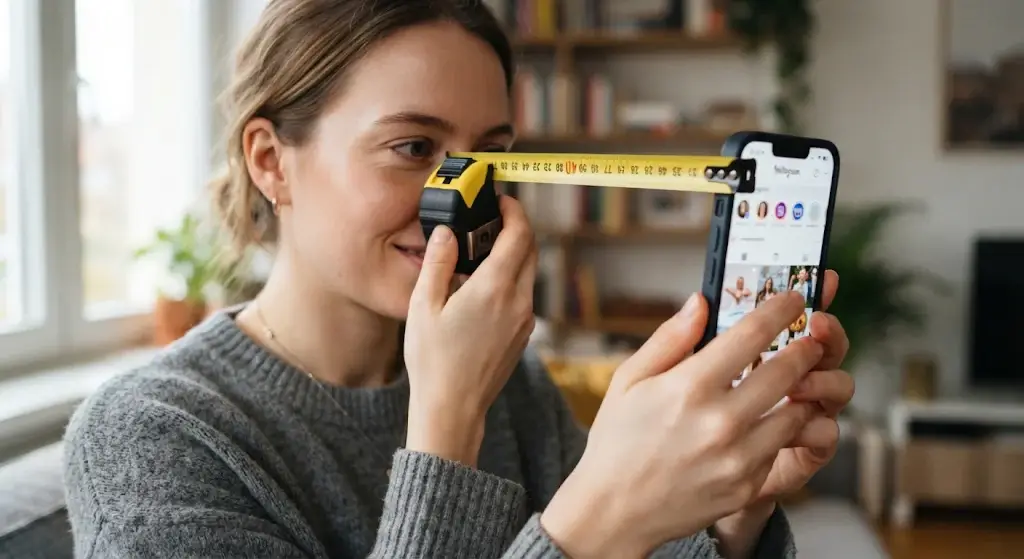
- Check your distance. Hold your phone about 20 to 28 inches (51 to 71 cm) from your eyes and 4 to 5 inches (10 to 13 cm) below eye level, per UT Medicine.
Coach’s Tip: Tie the break to something you already do. Every time you finish a text thread, a video, or a notification, look up and blink. Habits stick when they have an anchor.
Easier and Harder Versions
| Level | What to do | Frequency |
| Easier (regression) | Look away for 10 seconds and blink 5 times | Every 30 minutes |
| Standard | 20 seconds at 20 feet (6 m) plus 10 slow blinks | Every 20 minutes |
| Harder (progression) | Standard break plus 1 minute with eyes closed and a hand-free stretch | Every 20 minutes, plus a 15-minute rest after 2 hours of continuous use |
The 15-minute rest after two hours comes from UT Medicine’s guidance.
Set Up Your Environment
- Reduce glare and dim harsh lighting near the screen.
- Raise your text size so you aren’t squinting.
- Consider lubricating eye drops if your eyes feel dry. Ask an eye doctor which kind suits you.
- If you wear contacts and feel strain, ask your eye doctor whether glasses might be more comfortable for long sessions.

When Blurry Vision Isn’t About Your Phone
Sometimes blur has nothing to do with screens. UT Medicine recommends a comprehensive eye exam if symptoms worsen, because an exam can detect an uncorrected refractive error.
Get checked promptly if you notice any of the following:
- Blur that doesn’t improve after rest and blinking
- Blur in one eye only
- Sudden vision changes, flashes of light, or new floaters
- Eye pain or redness
- Double vision
I’m describing common-sense warning signs here, not diagnosing anything. If any of these show up, call an eye care professional rather than reaching for a supplement. [VERIFY: add a link to an AAO or NEI page on warning signs.]
Safety Notes Before You Buy Any Supplement
Supplements can interact with medications and with each other. A few specifics from the sources:
- Vitamin A: Too much preformed vitamin A can cause blurred vision, headache, nausea, dizziness, and in severe cases worse. NIH also warns that high-dose preformed vitamin A should be avoided during pregnancy or if you might be pregnant.
- Medication interactions: The weight-loss drug orlistat can lower vitamin A absorption, per NIH. Tell your pharmacist about everything you take.
- Beta-carotene and smoking: High-dose beta-carotene supplements are linked to higher lung cancer risk in current and former smokers. The NEI says the original AREDS formula isn’t recommended for them.
- Vitamin E: It can interact with blood thinners and some other medicines, according to the NEI.
- Zinc: The AREDS formula uses a high dose, and copper is added to prevent zinc-related copper deficiency.
How to Choose a Supplement If Your Doctor Recommends One
Say your eye doctor finds a reason to supplement. Here’s a buyer’s checklist to follow:
- Match the formula to the diagnosis. The AREDS2 formula is for AMD. It isn’t a general-purpose screen supplement.
- Check the doses against the research. The NEI lists exact amounts for AREDS2.
- Ask about your medications and health history. Smoking, pregnancy, blood thinners, and orlistat all change the answer.
- Look for third-party testing. Seals from independent labs can confirm what’s in the bottle [VERIFY: add a source for third-party testing].
- Skip megadoses. Excess vitamin A can blur vision.
The NEI notes it doesn’t produce the supplements and can’t comment on specific brands. That’s your cue to rely on your doctor, not on marketing. When evaluating the best vitamins for blurry vision from phone use, the best choice for most people is food plus better screen habits, with a supplement only when a professional says so.
Related Tips: Sleep and Screens
Late-night scrolling can interfere with rest, and tired eyes feel worse. Blue light can increase alertness, so using screens close to bedtime may make it harder to fall asleep. Our guide on how sleep affects metabolism shows why recovery matters beyond your eyes.
Another carotenoid you’ll see marketed is astaxanthin. We cover it in our astaxanthin supplement guide, though its focus is skin, not eyesight. I don’t make eye-health claims for it here.
Frequently Asked Questions
Can vitamins fix blurry vision from phone use?
Usually not. Blurry vision from phones most often reflects eye strain, dryness, or an outdated prescription, and no vitamin has been shown to correct those. Vitamins help mainly when a true deficiency exists. Breaks, blinking, and an eye exam are the first steps, and a doctor can advise on supplements.
Is vitamin A good for eyesight?
Vitamin A is essential for normal vision, and deficiency can cause night blindness. Deficiency is rare in the United States, though. Too much preformed vitamin A can itself cause blurred vision, per NIH. Check with a doctor before taking a supplement.
Do lutein supplements help with screen use?
Lutein and zeaxanthin were studied for age-related macular degeneration, not phone strain. In AREDS2, people with low dietary intake who took them had a 26% lower risk of advanced AMD. Nothing shows they fix screen-related blur, so ask your eye doctor first.
Does fish oil help dry eyes from screens?
A large NIH-funded trial found that 3 grams of omega-3 daily was no better than placebo for moderate to severe dry eye. It didn’t study phone use specifically. Eating fish is still a healthy habit, but supplements shouldn’t replace breaks and blinking.
How long does blurry vision from phone use last?
Digital eye strain symptoms are usually temporary and ease with rest. If blur lingers after breaks or keeps returning, schedule an eye exam to check for uncorrected vision problems. Sudden blur, eye pain, flashes, or vision loss need prompt medical attention.
Do blue light glasses help?
The AAO says blue light from screens hasn’t been shown to cause eye strain or eye disease. Brown University Health adds there’s no evidence the glasses reduce strain symptoms. Breaks, good lighting, and a comfortable viewing distance are better first steps.
Conclusion
The best vitamins for blurry vision from phone use are, frankly, the ones you probably already get from a varied diet. Vitamin A, lutein, zeaxanthin, vitamins C and E, and zinc all play roles in eye health. The strongest evidence is for macular degeneration and true deficiency, not for screen-related blur.
For most people, the real fix is training your habits: take 20-20-20 breaks, blink fully, hold your phone at a good distance, and keep your prescription current. If blur persists, see an eye care professional instead of guessing with supplements.
Start with one change today. Set a 20-minute timer, look across the room, and blink slowly ten times. Do that consistently and your eyes will tell you what’s working.