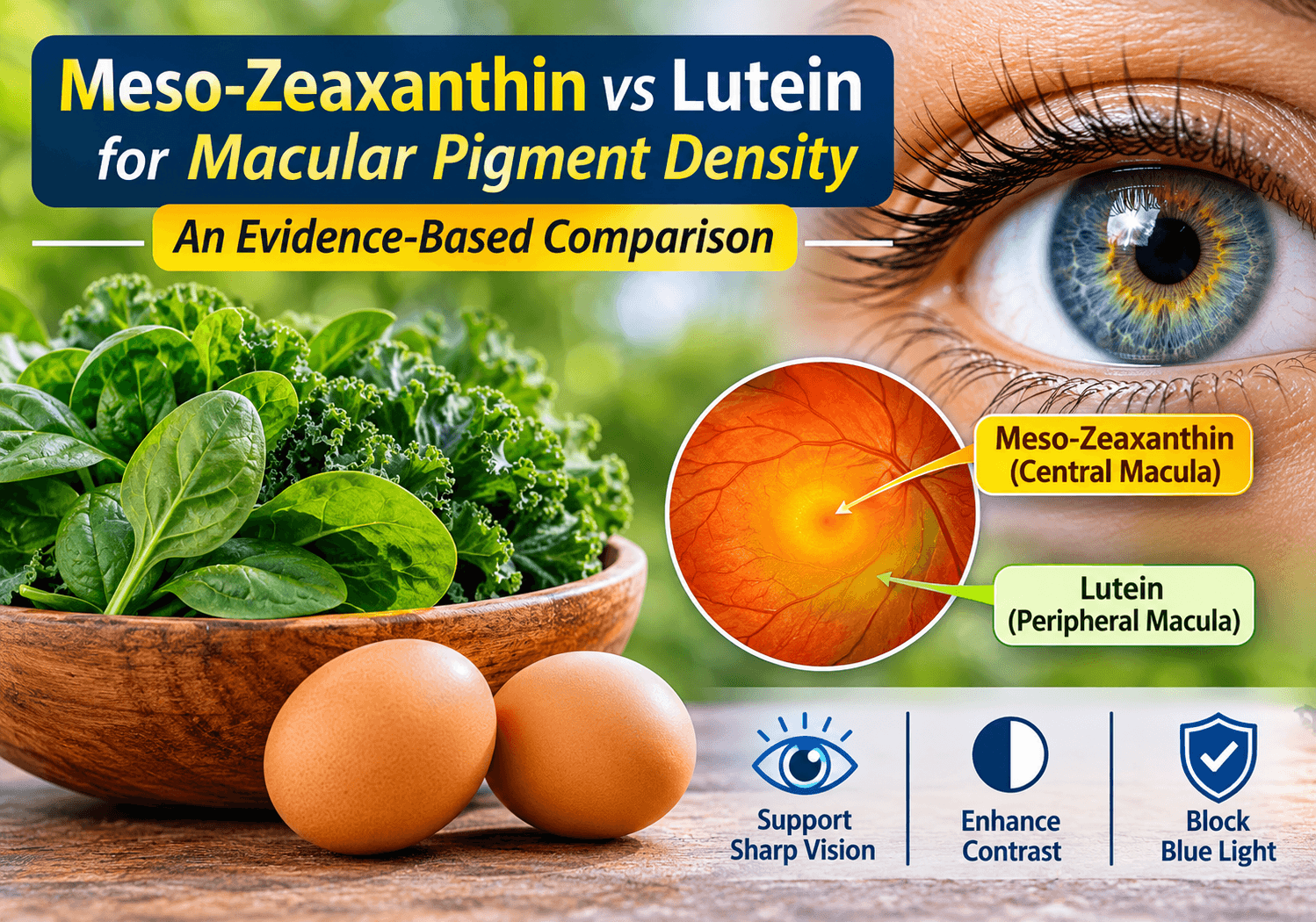
As a strength and conditioning coach working with active adults, seniors, and competitive pickleball players, I often emphasize that fitness is not just about muscle and cardio. Sharp, resilient vision is a critical component of athletic performance and daily independence. When clients ask about protecting their eyes from blue light and age-related decline, the conversation inevitably turns to carotenoids. Specifically, the debate of meso-zeaxanthin vs lutein for macular pigment density is one of the most important nutritional discussions you can have for long-term eye health.
Both compounds are powerful antioxidants, but they behave differently in the retina. Understanding their unique roles will help you choose the right strategy to protect your central vision, improve contrast sensitivity, and maintain peak visual performance on the court or in daily life.
Quick Answer
When comparing meso-zeaxanthin vs lutein for macular pigment density, both are essential, but they serve different zones of the retina. Lutein is primarily found in the peripheral macula and is easier to obtain from diet. Meso-zeaxanthin is concentrated directly in the center of the macula, where it provides the strongest protection against blue light and oxidative stress. For optimal macular pigment optical density (MPOD), research suggests a combined supplement featuring a 10:2:1 ratio of lutein, meso-zeaxanthin, and zeaxanthin is most effective.
Side-by-Side Comparison: Meso-Zeaxanthin vs Lutein
Before diving into the deep science, it is helpful to see how these two carotenoids stack up against each other across key categories.
| Feature | Lutein | Meso-Zeaxanthin |
| Primary Retinal Location | Peripheral macula | Central macula (fovea) |
| Main Function | Filters blue light, general antioxidant support | Peak blue light filtration, protects central visual acuity |
| Dietary Availability | High (kale, spinach, eggs, corn) | Very low (rare in most foods, trace amounts in some seafood) |
| Impact on MPOD | Increases peripheral macular pigment density | Directly increases central macular pigment density |
| Typical Supplement Dose | 10 mg to 20 mg daily | 2 mg to 10 mg daily (often paired with lutein) |
| Best For | General eye health, dietary baseline support | Targeted MPOD enhancement, athletes, seniors |
What Are Lutein and Meso-Zeaxanthin? The Science of Carotenoids
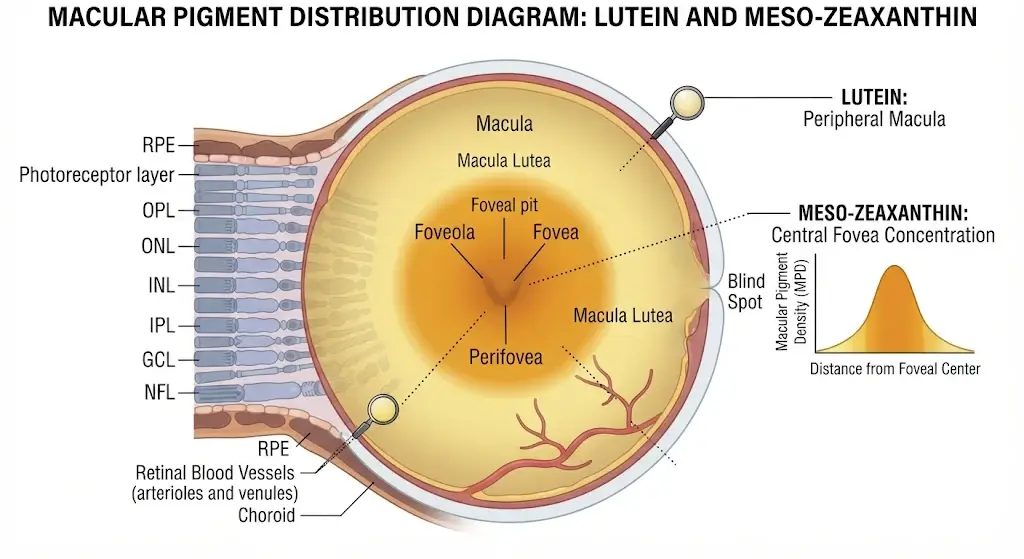
To understand the difference between meso-zeaxanthin vs lutein for macular pigment density, we must first look at the anatomy of the eye. The macula is a small, highly sensitive area near the center of the retina responsible for sharp, detailed central vision. This is the vision you use when reading a book held 14 inches (35 cm) from your face, recognizing a friend’s face across a room, or tracking a 2.9-inch (7.4 cm) pickleball moving at 30 miles per hour (48 km/h).
The macula gets its yellow color from a dense accumulation of three specific carotenoids: lutein, zeaxanthin, and meso-zeaxanthin. These compounds are not produced by the human body; they must be acquired through diet or supplementation.
Lutein is the most abundant carotenoid in the human diet. It is readily found in dark leafy greens like kale and spinach. Once absorbed, lutein is transported to the eye, where it predominantly settles in the outer, peripheral regions of the macula.
Meso-zeaxanthin, on the other hand, is a unique isomer of zeaxanthin. It is rarely found in significant quantities in the standard Western diet. Research indicates that the human body may convert some dietary lutein into meso-zeaxanthin directly within the retina, but this conversion process can become less efficient with age or genetic variation. Meso-zeaxanthin is uniquely positioned right in the center of the fovea, the very epicenter of your sharpest vision, acting as the primary shield against high-energy blue light and oxidative stress.
How They Impact Macular Pigment Optical Density (MPOD)
Macular Pigment Optical Density (MPOD) is the clinical measurement of how thick and protective your macular pigment is. Think of MPOD like sunscreen for the back of your eye. A higher MPOD means better protection against phototoxic damage and a lower risk of age-related macular degeneration (AMD).
When evaluating meso-zeaxanthin vs lutein for macular pigment density, clinical trials show that both are effective, but their spatial impact differs. A landmark study published in Nutrients demonstrated that supplementation with lutein, zeaxanthin, and meso-zeaxanthin significantly increases overall MPOD, but the addition of meso-zeaxanthin is specifically required to build pigment in the central macula.
The Central Retinal Enrichment Supplementation Trials (CREST) provided compelling evidence on this topic. In this double-blind, placebo-controlled trial, participants who received a specific three-carotenoid formula saw significant improvements in their central MPOD compared to those who only received lutein and zeaxanthin. This happens because meso-zeaxanthin is the exact molecular shape needed to pack tightly into the center of the fovea, whereas lutein molecules are slightly different and tend to populate the surrounding areas.
Therefore, if your goal is to maximize central MPOD, relying on lutein alone may leave the very center of your vision under-protected.
Visual Performance: Contrast Sensitivity and Glare Recovery
Why does MPOD matter to a strength coach or an active adult? Because vision dictates movement quality and safety. Two critical aspects of visual performance are contrast sensitivity and glare recovery.
Contrast sensitivity is your ability to distinguish an object from its background. Imagine trying to track a yellow pickleball against a bright, cloudless sky, or reading road signs while driving toward a setting sun. Higher MPOD acts as an internal pair of yellow-tinted sunglasses, filtering out scattered blue light and sharpening edges. Research confirms that enrichment of macular pigment enhances contrast sensitivity in subjects free of retinal disease.
Glare recovery is the time it takes for your eyes to adjust after being exposed to a bright flash of light. A higher density of macular carotenoids has been directly linked to faster glare recovery times, which is vital for athletes transitioning from bright outdoor courts to shaded areas, or for seniors driving at night facing oncoming headlights.
While lutein provides a solid foundation for overall visual health, the addition of meso-zeaxanthin is what truly optimizes these high-performance visual metrics by fortifying the central fovea.
Coach’s Tip: Maximize Absorption with Dietary Fat
Carotenoids are fat-soluble nutrients. Taking your lutein or meso-zeaxanthin supplement on an empty stomach with just water will result in poor absorption. Always take your eye health supplements with a meal containing at least 10 to 15 grams of healthy fat. Examples include two whole eggs, half an avocado, or a tablespoon of olive oil. This simple habit can increase carotenoid bioavailability by up to threefold.
Common Mistake: Expecting Overnight Results
A frequent error I see is clients stopping a supplement after three weeks because they “don’t feel any different.” Macular pigment optical density builds slowly. Peer-reviewed clinical data shows it takes a minimum of 3 to 6 months of consistent, daily supplementation to see measurable, clinically significant improvements in MPOD and contrast sensitivity. Consistency is your most powerful tool.
Dietary Sources vs. Supplementation
Can you get enough of these nutrients from food alone? For lutein, the answer is often yes, if you are deliberate. A single cup of cooked kale contains approximately 23 mg of lutein, easily meeting the baseline daily requirement. Other excellent sources include spinach, collard greens, peas, and egg yolks.
However, meso-zeaxanthin presents a dietary challenge. It is not present in meaningful amounts in common fruits and vegetables. Trace amounts can be found in certain types of seafood, like salmon and trout, or in the skin of some fruits, but not nearly enough to therapeutically raise central MPOD.
This dietary reality is why the debate of meso-zeaxanthin vs lutein for macular pigment density often leans toward supplementation for meso-zeaxanthin. While a diet rich in leafy greens is non-negotiable for foundational health, targeted supplementation is the only reliable way to ensure adequate meso-zeaxanthin levels, especially for individuals over 40 whose natural conversion of lutein to meso-zeaxanthin may be declining. For broader metabolic and antioxidant support, many active adults also pair their eye health regimen with other targeted nutrients, such as an astaxanthin supplement for anti-aging or omega-3 fatty acids for inflammation.

When to Choose Lutein
Lutein is the ideal starting point for certain individuals. You should prioritize a high-quality lutein supplement (or focus heavily on dietary sources) if:
- You are under 40 and generally healthy: Your body’s natural conversion processes are likely still efficient, and a strong dietary baseline of lutein may be sufficient to maintain healthy peripheral MPOD.
- Your primary goal is general preventative health: If you have no family history of macular issues and simply want a nutritional insurance policy, lutein is widely studied, highly safe, and cost-effective.
- You are on a strict budget: Lutein-only or lutein-zeaxanthin supplements are generally less expensive than formulas that include synthesized meso-zeaxanthin.
When to Choose Meso-Zeaxanthin (or a Combination)
Given the evidence, when does meso-zeaxanthin become the necessary choice? You should actively seek out a supplement containing meso-zeaxanthin if:
- You are over 50: The natural enzymatic conversion of lutein to meso-zeaxanthin in the retina tends to slow down with age, making direct supplementation highly valuable.
- You are an athlete or highly active: If you play tennis, pickleball, golf, or cycle, your demand for high contrast sensitivity and rapid glare recovery is elevated. The CREST trial specifically noted visual performance benefits in active populations using the three-carotenoid formula.
- You have a family history of AMD: If macular degeneration runs in your family, maximizing central MPOD is a proactive, evidence-based strategy. The AREDS2 formula established the importance of these carotenoids, and modern formulations often build on this by adding meso-zeaxanthin to achieve the optimal 10:2:1 ratio (10 mg lutein, 2 mg meso-zeaxanthin, 1 mg zeaxanthin).
- You spend extensive time in front of screens: While blue light from screens is far less intense than sunlight, cumulative exposure contributes to digital eye strain. Central macular protection is beneficial for heavy computer users.
Supporting your body’s natural processes is a holistic endeavor. Just as you might explore ways to increase metabolism naturally after 40 or ensure you have the right vitamins to support metabolism when deficient, protecting your vision requires targeted, age-appropriate nutritional strategies.
Cost Comparison and Value
When evaluating meso-zeaxanthin vs lutein for macular pigment density, cost is a practical factor.
- Lutein-Only Supplements: Typically range from $10 to $20 per month. They offer excellent value for basic maintenance but lack the central macular targeting of meso-zeaxanthin.
- Lutein + Zeaxanthin (e.g., standard AREDS2 style): Usually cost between $15 and $30 per month. This is a solid middle ground for general senior health.
- Three-Carotenoid Formulas (Lutein, Meso-Zeaxanthin, Zeaxanthin): These premium formulas, often utilizing patented raw materials like MacuHealth, typically range from $40 to $60 per month.
While the three-carotenoid option is more expensive, the clinical value for active adults and seniors seeking to actively increase their central MPOD, rather than just maintain it, justifies the investment. Consider it an investment in your independence and athletic longevity.
Practical Application: Your Daily Vision Support Routine
As a coach, I do not just prescribe supplements; I prescribe habits. Here is a practical, progressive routine to support your macular pigment density and overall visual health.
Phase 1: The Regression (Foundation)
Best for: Beginners, those on a budget, or individuals under 40.
- Dietary Baseline: Consume at least two servings of dark leafy greens (spinach, kale, Swiss chard) daily.
- Egg Integration: Eat 1–2 whole eggs per day. The fat in the yolk dramatically improves the absorption of the lutein naturally present in the egg
pmc.ncbi.nlm.nih.gov
. - The 20-20-20 Rule: Every 20 minutes, look at an object 20 feet (6 meters) away for 20 seconds to reduce digital eye strain.
- Basic Supplementation: A standard 10 mg lutein + 2 mg zeaxanthin capsule taken with breakfast.
Phase 2: The Progression (Optimization)
- Advanced Supplementation: Upgrade to a clinically validated 10:2:1 ratio supplement (10 mg lutein, 2 mg meso-zeaxanthin, 1 mg zeaxanthin). Take it daily with your largest meal containing healthy fats.
- Synergistic Nutrients: Ensure you are also getting adequate nutrients that support normal energy and overall cellular health, as oxidative stress affects the entire body, including the eyes. Some individuals also benefit from exploring supplements that improve metabolic health to support systemic circulation, which delivers these carotenoids to the retina.
- Active Visual Drills: Spend 5 minutes a day practicing dynamic visual tracking. Toss a tennis ball against a wall from 10 feet (3 meters) away, keeping your head still and tracking the ball purely with your eyes. This trains the neural pathways connected to your central macula.
- UV Protection: Always wear 100% UV-blocking sunglasses when outdoors for more than 15 minutes, regardless of cloud cover.

Frequently Asked Questions (FAQ)
What is the main difference between meso-zeaxanthin and lutein?
The primary difference lies in their location within the retina. Lutein is mostly found in the peripheral areas of the macula, while meso-zeaxanthin is highly concentrated in the very center of the macula (the fovea), providing targeted protection for your sharpest central vision.
Does meso-zeaxanthin increase macular pigment density better than lutein?
Neither is strictly “better”; they are complementary. Lutein builds the peripheral foundation, but research shows that meso-zeaxanthin is uniquely required to significantly increase pigment density in the central fovea, making a combination of both the most effective approach.
How much lutein and meso-zeaxanthin should I take daily?
Clinical trials, including the CREST study, frequently use a ratio of 10 mg of lutein, 2 mg of meso-zeaxanthin, and 1 mg of zeaxanthin daily. This 10:2:1 ratio is widely considered the gold standard for safely and effectively increasing MPOD over time.
Can meso-zeaxanthin improve vision in pickleball players?
Yes, indirectly. By increasing macular pigment optical density, meso-zeaxanthin helps filter scattered blue light. This enhances contrast sensitivity and speeds up glare recovery, which are critical skills for tracking a fast-moving ball against bright outdoor backgrounds.
Is meso-zeaxanthin safe for long-term use?
Yes. Extensive clinical trials, including the AREDS2 and CREST studies, have demonstrated that long-term supplementation with lutein, zeaxanthin, and meso-zeaxanthin is safe and well-tolerated, with no serious adverse effects reported in healthy populations.
Can I get meso-zeaxanthin from my diet?
It is very difficult. Unlike lutein, which is abundant in leafy greens, meso-zeaxanthin is rarely found in significant quantities in common foods. While the body can convert some lutein to meso-zeaxanthin, direct supplementation is the most reliable way to ensure adequate levels, especially as we age.
Conclusion
The debate of meso-zeaxanthin vs lutein for macular pigment density is not about choosing a winner, but rather understanding how these two powerful carotenoids work as a team. Lutein provides the essential, diet-friendly foundation for your peripheral macula. Meso-zeaxanthin delivers the specialized, central protection your fovea needs to maintain sharp visual acuity, contrast sensitivity, and glare recovery.
Whether you’re chasing a personal record or protecting your independence, a combined supplement built on the clinically proven 10:2:1 ratio is your smartest, evidence-based move. Pair this with a nutrient-dense diet, consistent habits, and regular eye exams, and you will be actively investing in your vision for decades to come.