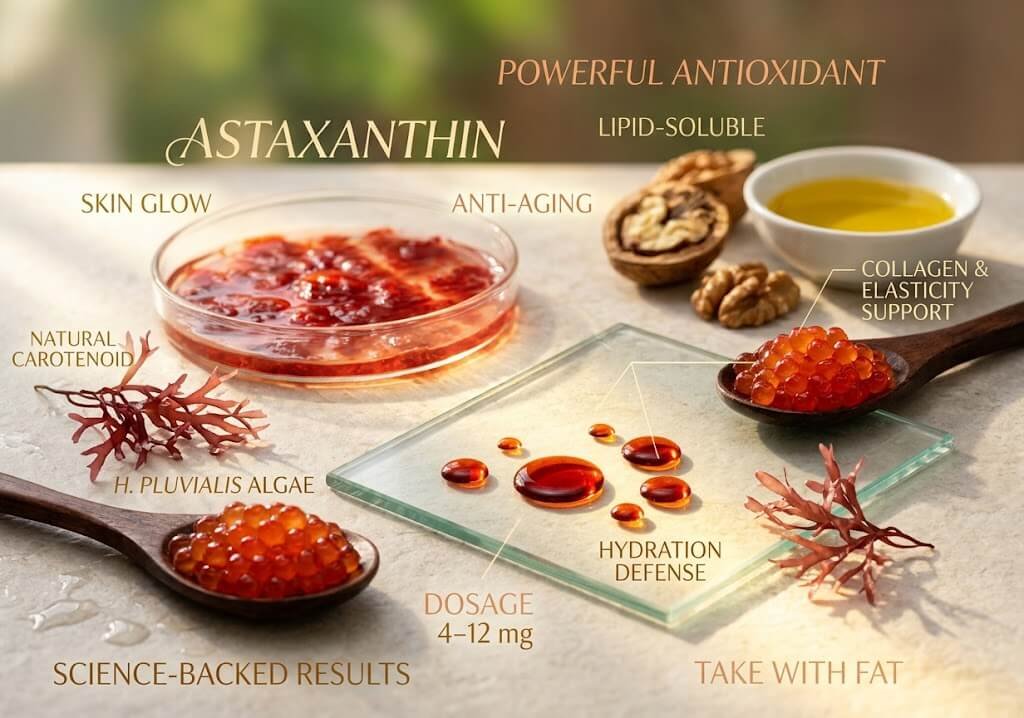
You’ve probably seen astaxanthin pop up in supplement aisles, skincare forums, and wellness blogs with bold claims about “radiant skin in 30 days.” As a strength and conditioning coach who works with clients on recovery, nutrition, and overall body composition, I get asked about supplements constantly. Astaxanthin for skin glow and anti aging is one of the more interesting ones because the underlying biochemistry is genuinely promising, yet the marketing often runs ahead of the evidence.
This guide breaks down what astaxanthin actually is, what peer-reviewed research supports, how to take it if you decide to try it, and where the claims stop being backed by data. No hype, no miracle promises—just the practical details you need to make an informed choice.
Quick Answer: Astaxanthin is a carotenoid pigment found in algae, salmon, and shrimp. Research suggests it may act as a potent antioxidant that supports skin hydration, elasticity, and protection against UV-related oxidative stress. Typical studied doses range from 4–12 mg daily, taken with a fat-containing meal. Results, if any, generally appear after 4–8 weeks of consistent use. It is not a replacement for sunscreen or a medical treatment.
What Is Astaxanthin and Where Does It Come From?
Astaxanthin is a xanthophyll-type carotenoid—a fat-soluble pigment that gives salmon, trout, shrimp, and certain algae their pink-to-red color. The primary commercial source is the freshwater microalgae Haematococcus pluvialis, which produces astaxanthin as a stress response when exposed to UV light and nutrient limitation.
Unlike water-soluble vitamins such as vitamin C, astaxanthin is lipid-soluble. That means it dissolves in fats and oils, gets absorbed in the small intestine alongside dietary fat, and accumulates in fatty tissues, including the skin. This property is why how you take it matters as much as how much you take.
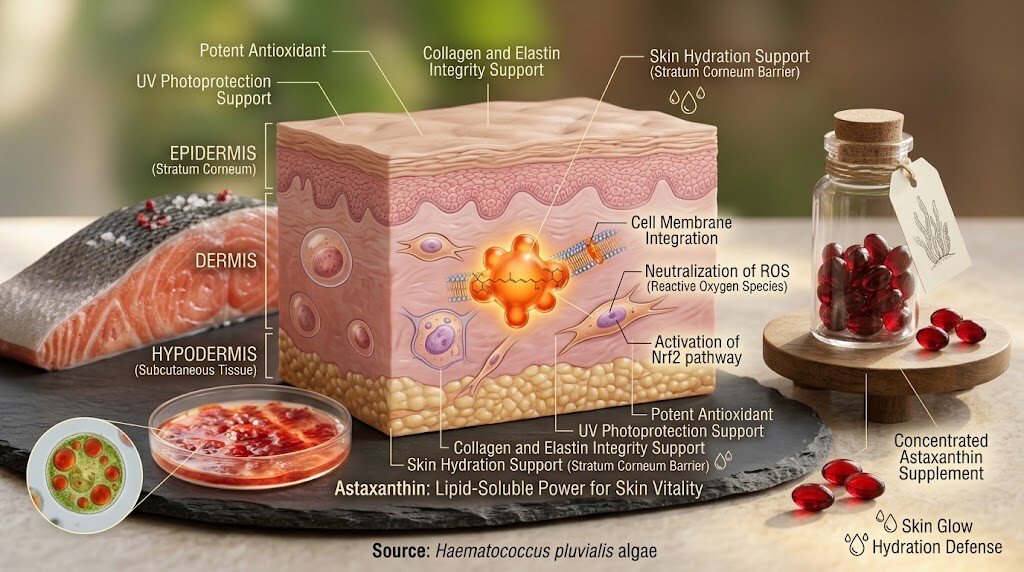
In the body, astaxanthin sits within cell membranes, particularly in the dermis (the deeper layer of skin) and the epidermis. Its molecular structure allows it to span the entire lipid bilayer of a cell membrane, which gives it a unique ability to quench free radicals on both the inside and outside of the cell simultaneously. This is a structural advantage that many other antioxidants, like vitamin C, do not share.
How Astaxanthin May Support Skin Glow and Anti Aging
The “glow” and “anti-aging” claims around astaxanthin trace back to several biological pathways. None of them are guaranteed outcomes, but the mechanisms are well-documented in peer-reviewed literature.
Antioxidant Protection Against Oxidative Stress
Every day, your skin is hit by ultraviolet (UV) radiation, pollution, and normal metabolic byproducts that generate reactive oxygen species (ROS). Excess ROS damages cell membranes, DNA, and the collagen and elastin fibers that keep skin firm and smooth. This process is called oxidative stress, and it is one of the central drivers of visible aging.
Astaxanthin has been measured in laboratory assays to have a very high ORAC (Oxygen Radical Absorbance Capacity) value—often cited as roughly 500–6,000 times that of vitamin C on a per-milligram basis in test-tube settings. In the body, the picture is more nuanced, but the carotenoid does activate the Nrf2 antioxidant pathway, a cellular signaling route that upregulates the body’s own protective enzymes, including superoxide dismutase and glutathione peroxidase.
Collagen Production and Skin Elasticity
Aging and chronic UV exposure activate enzymes called matrix metalloproteinases (MMPs), which break down dermal collagen and elastin. Several in-vitro and small human studies have observed that carotenoid supplementation, including astaxanthin, is associated with reduced MMP activity and a modest improvement in measured skin elasticity. The effect is subtle—think “slightly firmer” rather than a dramatic reversal—but it is measurable in controlled settings.
Skin Hydration and Barrier Function
One of the most consistently reported findings in small human trials is an improvement in skin hydration. Astaxanthin appears to support the lipid structure of the stratum corneum (the outermost skin layer), helping it retain water. In a handful of 8-week crossover studies, participants taking 6 mg of astaxanthin daily showed small but statistically significant increases in skin moisture compared to placebo.
UV-Related Photoprotection
This is where the marketing often overreaches. Astaxanthin does not replace sunscreen. However, research suggests it may offer a mild, internal “pre-conditioning” effect: regular carotenoid intake can reduce the severity of UV-induced erythema (sunburn redness) and lower markers of photo-damage. The CDC and dermatology guidelines are clear that broad-spectrum SPF 30+ sunscreen, protective clothing, and shade remain the primary defenses against UV damage. Astaxanthin, at best, is a small supporting layer in that strategy.
Coach’s Tip: Think of astaxanthin the way I think of a good protein shake after a hard session. It supports recovery and maintenance, but it does not replace sleep, consistent training, or, in this case, daily sunscreen. Layer it into a routine that already covers the basics.
hat the Research Says: Evidence at a Glance
I pulled together the general findings from peer-reviewed human studies and in-vitro work on astaxanthin and skin. The table below summarizes what is supported, what is preliminary, and what is not yet proven.
| Claim | Evidence Level | Key Detail |
| Potent antioxidant in cell membranes | Strong (in-vitro + animal) | Spans lipid bilayer; activates Nrf2 pathway |
| Modest improvement in skin hydration | Moderate (small human RCTs, 4–8 weeks) | 6–12 mg/day; effect size is small but measurable |
| Slight increase in skin elasticity | Moderate (small human RCTs) | Often paired with other carotenoids |
| Reduced UV-induced erythema | Preliminary (few small trials) | Not a substitute for SPF sunscreen |
| Reduced wrinkle depth | Weak / preliminary | Most data is in-vitro or animal; human data limited |
| “Visible glow in 30 days” | Not supported | No controlled trial demonstrates this timeline |
A critical note: most human studies to date have involved small sample sizes (20–60 participants), durations of 4–12 weeks, and doses of 4–12 mg per day. Larger, longer, multi-center trials are needed before strong conclusions can be drawn. The NIH National Center for Complementary and Integrative Health notes that while astaxanthin shows promise in laboratory settings, more human research is required to confirm specific skin benefits.
How to Use an Astaxanthin Supplement for Skin: A Practical Guide
If you decide to try astaxanthin, the details of how you take it matter. Here is the practical playbook.
Dosage
- Most studied range: 4–12 mg per day.
- Common supplement form: Softgel capsules containing 4 mg or 6 mg of astaxanthin in an oil base (usually olive oil, MCT oil, or fish oil).
- Start low: If you are new to carotenoid supplements, begin with 4 mg daily for the first two weeks to see how your body responds, then increase to 6–8 mg if tolerated.
- Upper limit: There is no established Upper Tolerable Intake Level (UL) for astaxanthin specifically, but doses above 12 mg/day have not been well-studied in healthy adults. Stick to the range used in published trials.
Timing and Absorption
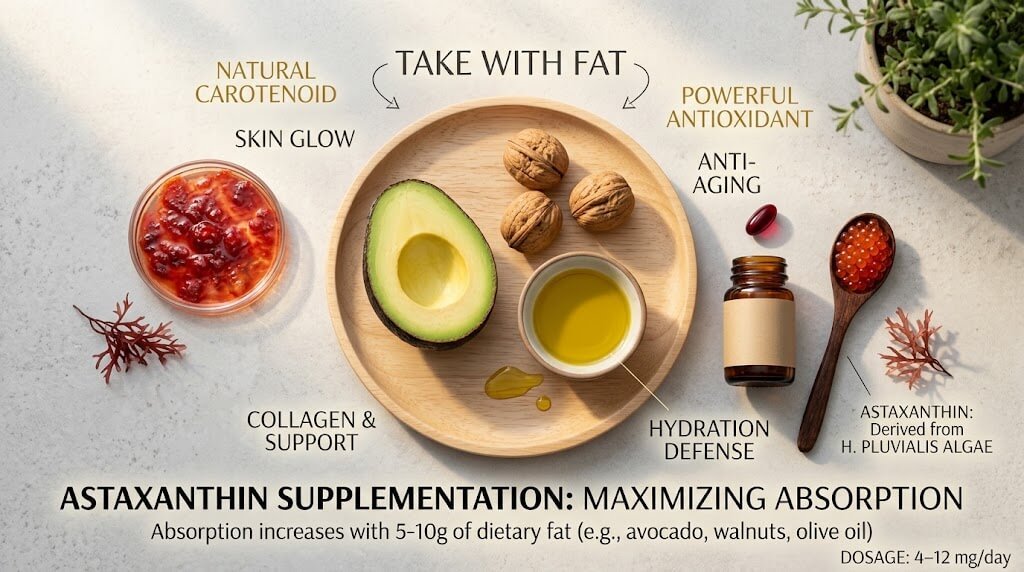
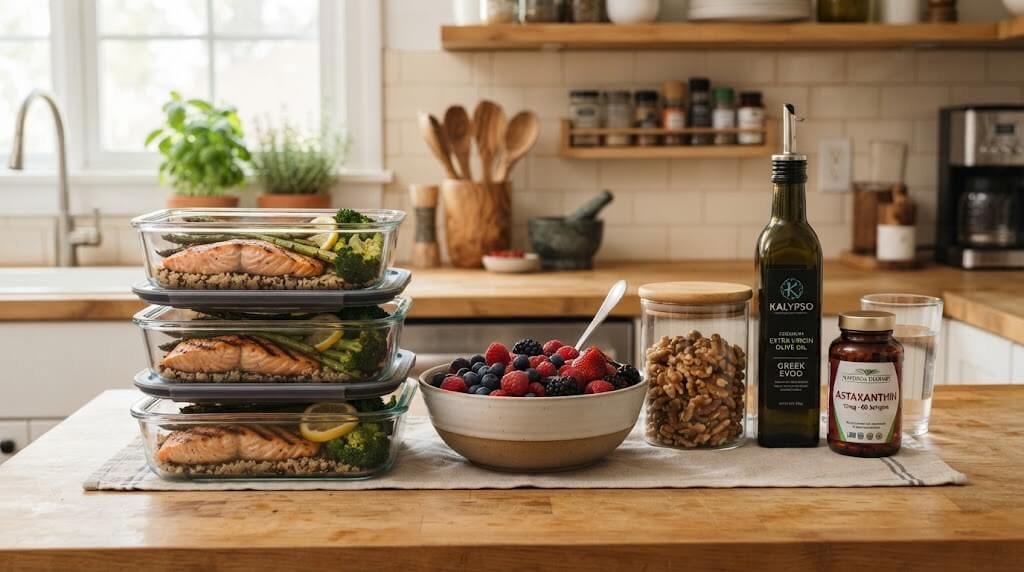
Because astaxanthin is fat-soluble, take it with a meal or snack that contains at least 5–10 g of dietary fat. Examples: a handful of walnuts (about 2 oz / 55 g), a tablespoon of olive oil drizzled over vegetables, an avocado half, or a meal that includes eggs, fatty fish, or full-fat dairy.
Taking it on an empty stomach with just water will significantly reduce absorption. This is the single most common mistake I see people make with lipid-soluble supplements.
What to Look for in a Product
When you are comparing options in the aisle or online, use this checklist:
- Source: Haematococcus pluvialis (algae-derived). Avoid products that do not state the source.
- Form: Softgel or liquid oil capsule. Powdered astaxanthin without an oil carrier is less bioavailable.
- Dosage per capsule: 4 mg or 6 mg is the standard. Be wary of “megadose” products at 20+ mg that have no supporting trial data.
- Third-party testing: Look for a seal from NSF International, USP, or ConsumerLab indicating the product was tested for purity and label accuracy.
- No unnecessary fillers: Fewer ingredients is generally better. You do not need proprietary blends or added “synergy” stacks to get the carotenoid benefit.
- Storage: Astaxanthin degrades with light and heat. Choose a product in a dark or amber bottle, and store it in a cool, dry place.
If you want a broader framework for vetting any supplement’s ingredient list, the process of checking for third-party testing, verifying dosages against published research, and screening for unnecessary additives is covered in detail in our guide on how to evaluate supplement ingredients.
A Simple Daily Routine
- Morning or midday meal (whichever contains fat): Take 1 capsule (4–6 mg) with food.
- Continue daily for at least 8 weeks before assessing any change. Carotenoids accumulate in tissue over time; a one- or two-week trial will not show a meaningful effect.
- Keep using SPF 30+ sunscreen every day, regardless of whether you take astaxanthin.
- Track your skin with weekly photos in consistent lighting if you want an objective reference point.
Astaxanthin Dosage and Timeline: What to Expect
| Week | What Is Happening in Your Body | What You May Notice |
| 1–2 | Astaxanthin begins accumulating in cell membranes; Nrf2 pathway activation starts | Nothing visible |
| 3–4 | Tissue levels build; early changes in skin hydration markers | Possibly slightly softer skin texture |
| 5–8 | Dermal carotenoid concentration increases; small improvements in elasticity and moisture may be measurable | Subtle improvement in “dewiness”; skin may look slightly more even |
| 8–12+ | Steady-state tissue levels; antioxidant enzyme activity may be elevated | Any visible change plateaus; consistency matters more than a bigger dose |
No controlled trial has demonstrated a dramatic “glow” transformation. What the data supports is a modest, gradual improvement in a few measurable skin parameters. Manage expectations accordingly.
Safety, Side Effects, and Who Should Be Cautious
Astaxanthin is generally well-tolerated at the doses studied (4–12 mg/day). The most commonly reported effects in trials are mild and include:
- Slight greenish or yellowish tint to the skin at very high, prolonged doses (a condition called carotenoderma, which is harmless and reversible)
- Mild gastrointestinal discomfort (nausea or loose stools) in a small number of participants
- No significant drug interactions have been established, but caution is warranted
Talk to your doctor or a registered dietitian before starting astaxanthin if you:
- Are pregnant or breastfeeding (insufficient safety data)
- Have a diagnosed skin condition such as eczema, psoriasis, or melasma
- Are taking blood-thinning medications (theoretical interaction with omega-3–rich formulations)
- Have a carotenoid metabolism disorder
- Are on any prescription medication and want to rule out interactions
The CDC’s guidance on sun safety reinforces that no supplement replaces external UV protection. If your goal is anti-aging, the highest-impact steps remain daily broad-spectrum sunscreen, avoiding peak UV hours, and a consistent skincare routine.
Common Mistake: Taking astaxanthin on an empty stomach and expecting results within two weeks. Without dietary fat, absorption drops substantially, and the carotenoid simply passes through. And because tissue accumulation takes 4–8 weeks, judging the supplement after 10 days is like judging a strength program after one workout. Give it the time the research actually used.
Astaxanthin as Part of a Broader Skin and Wellness Routine
No single supplement is going to transform your skin. The clients who see the best overall results are the ones who layer evidence-based habits. Here is how astaxanthin fits into a bigger picture:
- Daily SPF 30+ sunscreen (the single most effective anti-aging step for skin)
- Adequate protein intake to support collagen synthesis—aim for roughly 0.7–1.0 g per pound of body weight (1.5–2.2 g/kg) spread across meals, a principle that also supports muscle recovery during training
- Vitamin C and vitamin E in your diet (citrus, bell peppers, nuts, seeds) for complementary antioxidant support
- Omega-3 fatty acids from fatty fish (salmon, mackerel, sardines) 2–3 times per week, which support skin barrier lipids
- Consistent sleep (7–9 hours), because poor sleep is linked to elevated inflammatory markers and impaired skin repair
- Regular movement (a mix of strength training and moderate cardio) to support circulation and cellular turnover
If you are already exploring a supplement stack, it helps to understand which nutrients support normal energy metabolism at the cellular level, because the same mitochondrial and antioxidant pathways that drive energy production also influence how well your skin repairs itself. Astaxanthin is one small piece of that puzzle, not the whole picture.
For those who prefer to focus on stimulant-free supplement options that support overall wellness without jittery side effects, astaxanthin fits that profile—it is a carotenoid pigment, not a stimulant, and it does not affect heart rate or sleep architecture.
Astaxanthin vs. Other Common “Glow” Ingredients
A quick comparison to help you decide where astaxanthin sits relative to other popular options:
| Ingredient | Primary Mechanism | Typical Dose | Evidence for Skin | Time to Effect |
| Astaxanthin | Lipid-soluble antioxidant; Nrf2 activation | 4–12 mg/day | Moderate (small RCTs) | 4–8 weeks |
| Vitamin C (oral) | Water-soluble antioxidant; collagen synthesis cofactor | 500–1,000 mg/day | Moderate (larger trials) | 4–12 weeks |
| Coenzyme Q10 | Mitochondrial electron transport; antioxidant | 100–200 mg/day | Preliminary (small trials) | 6–12 weeks |
| Collagen peptides | Provides amino acids for dermal matrix | 5–15 g/day | Moderate (several RCTs) | 8–12 weeks |
| Hyaluronic acid (oral) | Skin hydration; mucopolysaccharide | 100–200 mg/day | Preliminary (small trials) | 4–8 weeks |
None of these are “better” than the others in absolute terms. They work through different pathways. Some people use two or three together. The key is consistency, realistic expectations, and not replacing sunscreen with any of them.
Frequently Asked Questions
Does astaxanthin really make your skin glow?
Research from small human trials suggests astaxanthin may modestly improve skin hydration and elasticity over 4–8 weeks, which some people describe as a subtle “glow.” However, no controlled study supports a dramatic or rapid transformation. The effect is gradual and mild, not a filter-like change.
How much astaxanthin should I take for skin benefits?
The doses used in published human studies range from 4 to 12 mg per day. Starting at 4 mg and working up to 6–8 mg is a reasonable approach. Take it with a meal containing 5–10 g of fat for proper absorption.
How long does astaxanthin take to show results on skin?
Most trials measured changes at 4, 8, or 12 weeks. Carotenoids accumulate in tissue gradually, so you should not expect visible changes before the four-week mark. Consistency over at least two months is the minimum to assess any effect.
Can astaxanthin replace sunscreen?
No. The CDC and dermatology guidelines are explicit: broad-spectrum SPF 30+ sunscreen, protective clothing, and shade are the primary defenses against UV damage. Astaxanthin, at best, offers a small supplementary layer of internal antioxidant support. It is not a sunscreen.
Is astaxanthin safe to take daily?
At 4–12 mg per day, astaxanthin has a good safety profile in short- to medium-term studies. Mild GI discomfort is the most common reported effect. If you are pregnant, nursing, on medications, or have a skin condition, check with your doctor first.
What foods contain natural astaxanthin?
The richest dietary sources are wild salmon, trout, shrimp, krill, and certain red algae. However, the amount you would get from a typical serving of salmon (about 5–6 oz / 150–170 g) is far less than a 4–6 mg supplement dose. Supplements are the practical way to reach the levels studied in trials.
Final Thoughts
Astaxanthin is not a magic pill, and anyone selling it as one is overselling. What the research does support is that this carotenoid is a genuinely interesting antioxidant that may offer modest, measurable benefits for skin hydration, elasticity, and protection against oxidative stress when taken consistently at 4–12 mg per day with dietary fat.
As a coach, I tell my clients the same thing I tell them about any supplement: it is the last 5% of the equation. The first 95% is daily sunscreen, adequate protein, consistent sleep, regular movement, and not smoking. If you want to add astaxanthin to that foundation, the evidence says it is a reasonable, low-risk option—just set your expectations at “slightly better,” not “completely different.”
Start with 4 mg, take it with lunch, give it eight weeks, and take before-and-after photos in the same lighting. If you notice a small improvement in how your skin feels and looks, great. If not, no harm done, and you still have a solid routine in place.