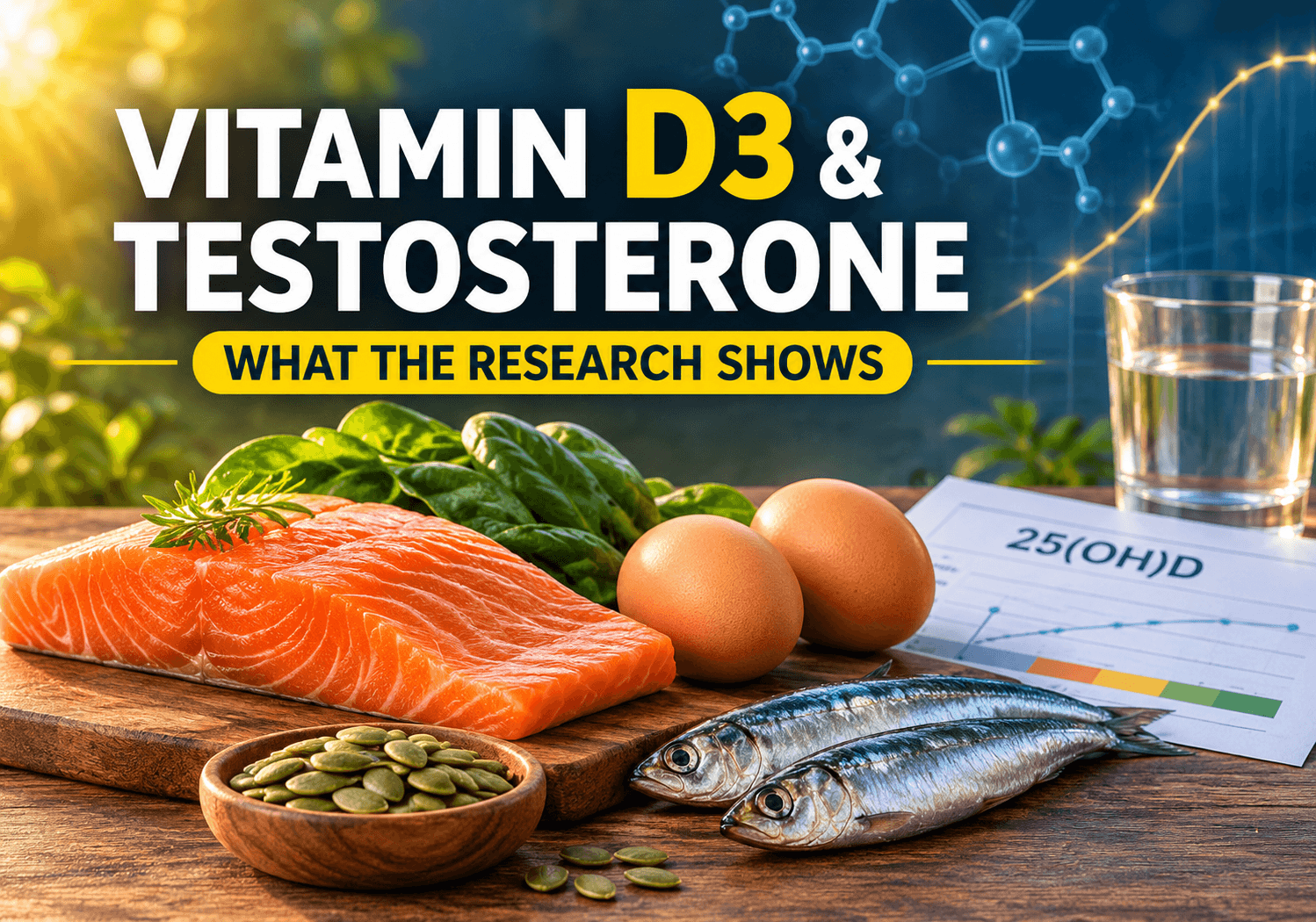
If you train hard, eat your protein, and still feel wiped out with stalled lifts, your blood work might hold the answer. Many men look into vitamin D3 and testosterone levels in men research when trying to figure out why their energy, recovery, or drive has dipped.
As a strength and conditioning coach, I see plenty of lifters spend hundreds of dollars on flashy herbal boosters while ignoring basic micronutrient gaps. Vitamin D3 isn’t a magic steroid, nor will it turn an average lifter into a heavyweight champion overnight. However, clinical studies show a clear biological link between your vitamin D status and how well your body produces and uses male sex hormones.
Quick Answer: Research shows that vitamin D3 supplementation does not act as a testosterone booster in men who already have healthy vitamin D levels. However, in men with clinical vitamin D deficiency (below 20 ng/mL), correcting that deficiency through sunlight, diet, or daily vitamin D3 supplementation may help restore low testosterone back toward normal baseline levels.
How Vitamin D3 Works in the Male Body
Most people think of vitamin D as a simple bone vitamin, yet it actually functions as a pro-hormone inside your body. When ultraviolet B (UVB) rays from sunlight hit your skin, your body converts a cholesterol compound into cholecalciferol, also known as vitamin D3. Your liver and kidneys then process this compound into its active hormonal form, calcitriol.
Scientists have discovered vitamin D receptors (VDR) and vitamin D-metabolizing enzymes inside the male reproductive tract. According to research indexed by the National Center for Biotechnology Information (NCBI), these receptors are located directly inside the testes, specifically within the Leydig cells. Leydig cells are the exact cellular factories responsible for producing roughly 95% of a man’s total testosterone.
When active vitamin D binds to these receptors, it helps regulate calcium transport and cellular signaling needed for steroidogenesis—the biological process that turns cholesterol into testosterone. Without enough vitamin D circulating in your bloodstream, those cellular factories may run below peak efficiency.
- Endocrine signaling: Vitamin D receptors sit inside the hypothalamus and pituitary gland, which send luteinizing hormone (LH) signals down to the testes.
- Enzyme regulation: Some laboratory data suggests vitamin D may influence aromatase, the enzyme that converts testosterone into estrogen, helping keep hormone ratios balanced.
- SHBG interaction: Vitamin D status appears connected to sex hormone-binding globulin (SHBG), a protein that binds to testosterone in the blood and determines how much “free” testosterone remains active for muscle and tissue repair.

What the Vitamin D3 and Testosterone Levels in Men Research Says
When you dig into vitamin D3 and testosterone levels in men research, you find two distinct types of evidence: observational studies and randomized controlled trials (RCTs). Understanding the difference between these two keeps you from falling for supplement hype.
Observational Studies: The Strong Correlation
Large population studies consistently show that men with higher blood levels of 25-hydroxyvitamin D (25(OH)D) tend to have higher total and free testosterone levels. For example, a well-known cross-sectional study published in Clinical Endocrinology examined over 2,200 men and found a clear seasonal pattern. Both vitamin D levels and testosterone levels peaked in late summer and hit their lowest points in late winter.
Men in that study who maintained sufficient vitamin D levels (above 30 ng/mL or 75 nmol/L) showed significantly higher total testosterone and lower SHBG than deficient men. Still, observational studies only prove correlation, not cause and effect. Men who spend more time outdoors exercising in the sun also tend to be leaner and more physically active, both of which naturally support higher hormone levels.
Randomized Controlled Trials: Testing Supplementation Directly
To see if taking a pill actually raises hormones, researchers run randomized controlled trials where one group takes vitamin D3 and another takes a placebo. The results split cleanly based on where the men started.
In a widely cited 12-month trial published in Hormone and Metabolic Research, researchers gave overweight, vitamin D-deficient men 3,332 IU of vitamin D3 daily while they participated in a weight loss program. By the end of the year, the supplement group raised their average vitamin D levels from roughly 12 ng/mL to 34 ng/mL. Alongside that jump, their total testosterone increased by roughly 25%, and their free testosterone rose by about 20%, whereas the placebo group saw no meaningful hormone change.
On the flip side, trials conducted on healthy men who already had normal vitamin D levels tell a very different story. Studies such as a controlled trial in the European Journal of Endocrinology found that giving extra vitamin D3 to men with sufficient baseline levels produced zero increase in total or free testosterone.
Coach’s Tip: Think of vitamin D3 like putting air in a flat tire. If your tire is down to 15 PSI, pumping it back up to 35 PSI restores your car’s speed, handling, and fuel economy. Once the tire is full, pumping in 50 PSI won’t make your car drive faster—it just creates dangerous pressure.
Summary of Key Clinical Trials on Vitamin D3 and Male Hormones
To help you compare the science at a glance, the table below breaks down major human studies examining vitamin D3 and male reproductive hormones.
| Study Reference & Year | Study Population | Daily Vitamin D3 Dose & Duration | Baseline 25(OH)D Status | Key Testosterone & Hormone Outcome |
| Wehr et al. (2010) (Clinical Endocrinology) | 2,299 men (observational cohort) | No supplement (natural sun/diet levels) | Ranged from deficient (<20 ng/mL) to sufficient (>30 ng/mL) | Men with sufficient vitamin D had significantly higher total testosterone and lower SHBG. |
| Pilz et al. (2011) (Hormone and Metabolic Research) | 54 overweight, non-diabetic men | 3,332 IU daily vs. placebo for 12 months | Deficient (~12 ng/mL / 30 nmol/L) | Significant increase in total, bioactive, and free testosterone in the D3 group; no change in placebo. |
| Heijboer et al. (2015) (Endocrine Connections) | 148 men with heart failure / low D | 2,000 IU daily vs. placebo for 6 weeks | Low/insufficient (<20 ng/mL) | Vitamin D levels rose, but 6 weeks was too short to show significant testosterone shifts. |
| Lerchbaum et al. (2017) (European Journal of Endocrinology) | 98 healthy men with normal testosterone | 20,000 IU weekly (~2,857 IU/day) for 12 weeks | Sufficient (>20–30 ng/mL at baseline) | No significant effect on total or free testosterone levels in already-healthy men. |
| Lerchbaum et al. (2019) (Journal of Clinical Endocrinology & Metabolism) | 100 men with low baseline testosterone | 20,000 IU weekly (~2,857 IU/day) for 12 weeks | Sufficient at baseline (mean ~22 ng/mL) | No significant increase in total testosterone when baseline vitamin D was not severely deficient. |
Looking across these trials reveals two crucial rules for lifters and active men:
- Baseline status dictates the response: You only see a measurable hormone bump if you start out truly deficient.
- Time matters: Short 4- to 6-week supplement runs rarely move the needle on endocrine panels. Rebuilding tissue stores and stabilizing hormone synthesis takes at least 3 to 6 months of consistent intake.
Blood Levels Explained: Deficient vs. Optimal Ranges
Before buying any supplement, you need to know your numbers. Guessing your vitamin D status based on how tired you feel is unreliable, especially since stress and poor sleep can lower male libido and mimic hormone deficiency symptoms.
Ask your doctor for a 25-hydroxyvitamin D blood test (often listed as 25(OH)D). According to the NIH Office of Dietary Supplements, medical organizations generally categorize blood results using the following thresholds:
- Severe Deficiency: Below 12 ng/mL (30 nmol/L). High risk for bone softening, muscle weakness, and disrupted endocrine signaling.
- Deficiency: 12 to 19 ng/mL (30 to 49 nmol/L). Inadequate for overall bone and metabolic health; most likely range to benefit from supplementation.
- Adequate / Sufficient: 20 to 50 ng/mL (50 to 125 nmol/L). Meets the physiological needs of most healthy adults. Many sports medicine practitioners aim for the 30 to 50 ng/mL (75 to 125 nmol/L) sweet spot for athletes.
- Potentially Excessive: Above 50 to 60 ng/mL (125 to 150 nmol/L). Increases risk of side effects without providing extra strength or hormonal benefits.

If you get your testosterone tested at the same time, schedule the blood draw between 7:00 AM and 10:00 AM after a normal night of sleep. Testosterone follows a strict circadian rhythm and drops naturally by afternoon, which can skew your baseline reading.
Why Vitamin D3 Matters for Lifters Beyond Testosterone
Even if your testosterone levels sit comfortably in the middle of the normal range, keeping your vitamin D3 dialed in directly supports how well you move weight in the gym. Strength athletes rely on vitamin D for several non-hormonal performance pathways:
- Fast-Twitch Muscle Fiber Function: Type II muscle fibers—the fibers responsible for explosive barbell pulls, sprints, and heavy presses—contain high concentrations of vitamin D receptors. Low vitamin D status is linked to reduced Type II fiber size and slower force production.
- Calcium Handling and Contraction: Vitamin D regulates how calcium enters muscle cells during a contraction. Better calcium transport translates to stronger neural drive and better muscular endurance across hard sets.
- Bone Density Under Heavy Loads: Squatting 315 lb (143 kg) or deadlifting 405 lb (184 kg) places tremendous mechanical stress on your spine, hips, and femurs. Vitamin D enables your gut to absorb dietary calcium so your skeleton adapts and hardens alongside your muscles.
- Immune Resilience: Hard training blocks temporarily dip your immune defenses. Maintaining adequate vitamin D helps regulate immune cell activity so you miss fewer workouts to seasonal colds.
Practical Action Plan: How to Optimize Vitamin D3 Safely
If your blood work confirms low vitamin D or you train indoors through long winters, follow a structured, evidence-based approach rather than megadosing random capsules.
1. Get Smart Sunlight Exposure
Direct midday sun on bare skin remains the most efficient way to generate vitamin D3. Aim for 10 to 30 minutes of sun exposure on your arms, legs, or back two to three times per week between 10:00 AM and 3:00 PM without sunscreen, then apply sun protection if staying out longer. Men with darker skin tones have more melanin, which naturally filters UVB rays and requires closer to 30–45 minutes to synthesize the same amount of vitamin D3.
2. Prioritize Vitamin D3-Rich Whole Foods
Food alone rarely fixes a deep deficiency, yet whole foods provide co-factors like healthy fats, omega-3s, and protein that support overall hormone production. Build these staples into your weekly meal prep:
- Wild-caught salmon (3.5 oz / 100 g): ~400 to 600 IU of vitamin D3.
- Canned sardines or mackerel (3.5 oz / 100 g): ~250 to 350 IU of vitamin D3.
- Whole pasture-raised eggs (2 large eggs): ~80 to 100 IU (found strictly in the yolk, so don’t toss them).
- UV-exposed mushrooms (1 cup / 70 g): ~300 to 400 IU (provides vitamin D2, which is slightly less potent than D3 but still useful).
- Fortified dairy or plant milks (1 cup / 240 mL): ~100 to 120 IU.
3. Choose the Right Supplement Form and Dose
Always choose cholecalciferol (vitamin D3) over ergocalciferol (vitamin D2). Clinical data cited by the NIH Office of Dietary Supplements confirms that vitamin D3 raises and maintains serum 25(OH)D concentrations significantly better than vitamin D2.
- Maintenance dose: 1,000 to 2,000 IU (25 to 50 mcg) daily works well for most men maintaining healthy levels during fall and winter.
- Correction dose: 2,000 to 4,000 IU (50 to 100 mcg) daily is commonly used for 8 to 12 weeks to correct mild-to-moderate deficiency under medical supervision.
- Upper safety limit: The National Academy of Medicine sets the Tolerable Upper Intake Level (UL) for adults at 4,000 IU (100 mcg) per day. Do not exceed 4,000 IU daily unless a physician prescribes a temporary high-dose protocol based on lab work.

Common Mistake: Taking your vitamin D3 capsule on an empty stomach with black coffee before morning cardio. Vitamin D3 is fat-soluble—without dietary fat, your gut absorbs only a fraction of the dose. Always swallow your softgel alongside a meal containing at least 10 to 15 grams of healthy fat, such as eggs, avocado, olive oil, or salmon.
4. Pair With Key Synergistic Nutrients
Micronutrients rarely work in isolation. If you are addressing low energy or borderline testosterone, pay attention to three supporting nutrients:
- Magnesium: Your liver and kidneys require magnesium-dependent enzymes to convert inactive vitamin D into active calcitriol. Good sources include pumpkin seeds, spinach, almonds, and black beans.
- Zinc: Like vitamin D, zinc plays a direct role in Leydig cell function and LH signaling. You can explore the research on how zinc supports healthy testosterone levels in men if your diet lacks red meat, shellfish, or legumes.
- Vitamin K2 (MK-7): Helps direct the calcium absorbed via vitamin D into your bone matrix rather than soft tissues.
Training and Lifestyle Habits That Actually Drive Testosterone
Supplements only fill nutritional gaps; they never replace the mechanical and metabolic signals that tell your body to produce anabolic hormones. If you want to maximize natural testosterone alongside healthy vitamin D levels, lock in these four training pillars.
Sample Lower-Body Strength Session for Hormonal & Neuromuscular Output
Large multi-joint barbell movements recruit massive amounts of muscle mass, triggering acute post-workout spikes in testosterone and growth hormone while improving insulin sensitivity.
| Exercise | Sets | Reps | Rest | Weight Guidance & Tempo | Form Cues |
| 1. Barbell Back Squat | 4 | 5–6 | 3 min | 75–82% 1RM (e.g., 185–225 lb / 84–102 kg for intermediate lifters); 3-sec lower, explode up | Brace core hard, push knees out over mid-foot, keep chest proud out of the hole. |
| 2. Romanian Deadlift (RDL) | 3 | 8 | 2–3 min | 65–72% of deadlift 1RM (e.g., 155–205 lb / 70–93 kg); 3-sec eccentric stretch | Push hips straight back, keep bar dragging close to thighs, stop when hamstrings reach full stretch. |
| 3. Bulgarian Split Squat | 3 | 8–10 / leg | 90 sec | Hold 30–50 lb (14–23 kg) dumbbells; smooth 2-sec descent | Keep torso slightly leaned forward, drive hard through front heel, keep back knee soft. |
| 4. Hanging Leg Raise | 3 | 10–15 | 60 sec | Bodyweight; controlled 2-sec lower without swinging | Curl pelvis upward toward ribs rather than just swinging legs at the hip. |
Easier Version (Regression): Swap the Barbell Back Squat for a Goblet Squat holding a 35–50 lb (16–23 kg) dumbbell at chest height, and perform Romanian Deadlifts with dumbbells to reduce lower-back shear while learning the hip hinge.- Harder Version (Progression): Add a 2-second pause at the bottom of each Barbell Back Squat rep using 80% 1RM, and elevate your front foot on a 2-inch (5 cm) bumper plate during Bulgarian Split Squats to increase range of motion.

Recover Like an Athlete
- Sleep 7.5 to 9 hours per night: A landmark study from the Journal of the American Medical Association (JAMA) showed that restricting healthy young men to 5 hours of sleep per night for just one week dropped daytime testosterone levels by 10% to 15%.
- Manage body fat without crash dieting: Excess adipose (fat) tissue contains high levels of the aromatase enzyme, which converts testosterone into estradiol. Losing excess weight steadily at 0.5 to 1 lb (0.23 to 0.45 kg) per week improves hormone balance, whereas extreme calorie cuts crash testosterone. For men noticing age-related shifts, understanding what causes low libido in men after 40 helps separate normal aging from fixable lifestyle habits.
- Be selective with herbal add-ons: While some men look into botanicals alongside vitamins, always check clinical data first—for instance, reviewing studies on whether ashwagandha increases testosterone and libido in men or comparing libido supplements for men against proven foundational nutrients. You can also explore vitamins and nutrients for male fertility and sperm health if reproductive goals are part of your plan.
Safety Notes and Potential Side Effects
Because vitamin D3 is fat-soluble, your body stores excess amounts in fat tissue and the liver rather than flushing them out in urine like vitamin C or B vitamins. Taking mega-doses over several months can cause vitamin D toxicity (hypervitaminosis D).
Excessive vitamin D forces your intestines to absorb too much calcium, leading to hypercalcemia (abnormally high blood calcium). Warning signs include:
- Persistent nausea, vomiting, or loss of appetite
- Excessive thirst and frequent urination
- Muscle weakness, confusion, or unusual fatigue
- Kidney stones or calcium buildup in blood vessels over time
Always speak with your doctor or healthcare provider before starting vitamin D3 supplements—especially if you have kidney disease, sarcoidosis, hyperparathyroidism, or take heart medications like digoxin or thiazide diuretics.
Frequently Asked Questions (FAQ)
Does vitamin D3 increase testosterone levels in men?
Vitamin D3 only appears to increase testosterone in men who have a clinical vitamin D deficiency (blood levels below 20 ng/mL). In deficient men, correcting vitamin D levels may help restore low testosterone back toward normal. If your vitamin D levels are already healthy, taking extra D3 will not boost testosterone.
How much vitamin D3 should a man take daily for testosterone?
For general maintenance, most men do well with 1,000 to 2,000 IU (25 to 50 mcg) of vitamin D3 daily. If a blood test shows deficiency, doctors commonly recommend 2,000 to 4,000 IU daily for 8 to 12 weeks. Avoid exceeding the 4,000 IU upper limit without medical supervision.
How long does it take for vitamin D3 to raise testosterone?
Raising blood serum 25(OH)D levels takes consistent daily intake over 8 to 12 weeks. However, downstream hormonal adjustments in total and free testosterone typically take 3 to 6 months to show up on follow-up lab work, as seen in longer clinical trials.
Can low vitamin D cause low libido and fatigue in men?
Yes, low vitamin D is frequently linked to persistent fatigue, low mood, muscle weakness, and reduced sex drive. While low vitamin D alone is rarely the sole cause of low libido, correcting a deficiency often improves daytime energy and supports healthier baseline hormone function.
What is the optimal blood level of vitamin D for male hormone health?
Medical guidelines consider serum 25(OH)D levels between 20 and 50 ng/mL (50 to 125 nmol/L) adequate for most adults. Many sports medicine physicians aim for 30 to 50 ng/mL (75 to 125 nmol/L) in active men to support optimal bone density, muscle recovery, and endocrine signaling.
What foods are high in vitamin D3 for men?
Fatty fish are the richest natural dietary sources of vitamin D3, including wild-caught salmon, mackerel, sardines, and trout. Egg yolks, beef liver, and fortified milk or orange juice also contribute smaller amounts, though sunlight and supplements remain the primary ways to fix a deficiency.
Conclusion
The current body of vitamin D3 and testosterone levels in men research gives lifters a clear, practical takeaway: vitamin D3 is an essential foundation for male hormone production, not a shortcut past hard training and recovery. If your blood levels sit below 20 ng/mL, bringing them up into the 30 to 50 ng/mL range through sensible midday sun, fatty fish, and 1,000 to 4,000 IU of daily vitamin D3 with a fat-containing meal can remove a major roadblock to healthy testosterone levels.
Start by requesting a simple 25(OH)D and morning testosterone blood panel from your doctor so you know exactly where you stand. Combine smart supplementation with heavy compound lifting, 7.5 to 9 hours of sleep, and a nutrient-dense diet to keep your strength and hormone health moving in the right direction.