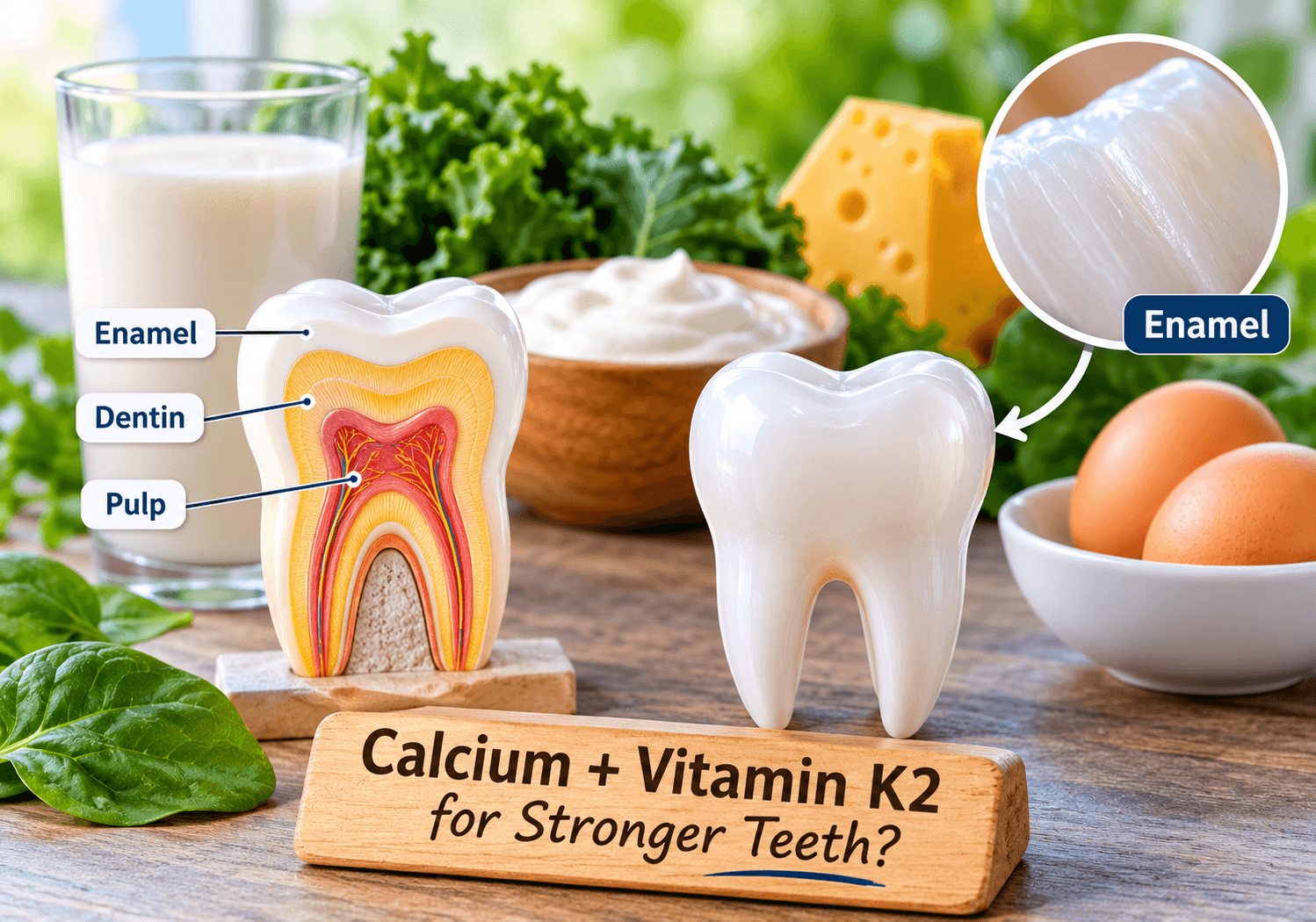
Does Calcium and Vitamin K2 Actually Strengthen Tooth Enamel? What the Research Shows
Calcium and vitamin K2 show up on supplement labels with big promises about “stronger teeth.” So does calcium and vitamin K2 actually strengthen tooth enamel, or is that mostly marketing? The honest answer has layers. Calcium is the main mineral in enamel, but swallowing more of it is not the same as adding it to your tooth surface. Vitamin K2 has an interesting theory behind it, but the proof for enamel is thin.
This guide walks through it the way a coach walks a client through any supplement question. We look at what the body actually does, what research supports, and what you can do with that information this week. By the end you will know where calcium and K2 fit, what protects enamel best, and when a supplement is worth a talk with your dentist or doctor.
Quick Answer
Not on their own. Calcium is a building block of enamel, and vitamin K supports proteins involved in bone mineralization, but no strong human evidence shows that calcium and vitamin K2 supplements strengthen tooth enamel. Fluoride, good oral hygiene, and enough calcium and vitamin D from food have far better support. Ask your dentist before adding supplements.
What Tooth Enamel Is (and Why It Isn’t Like Bone)
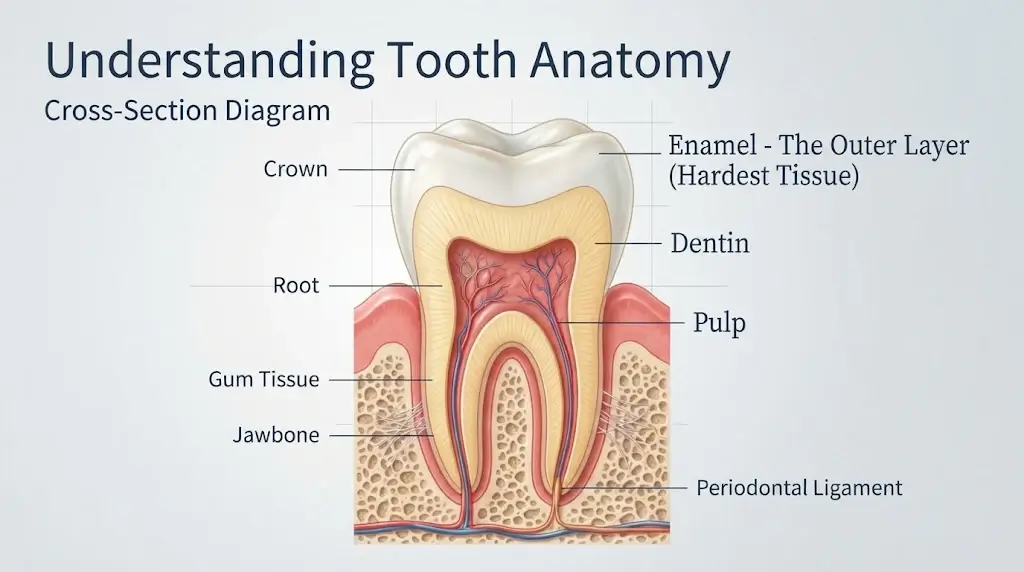
Enamel is the hard outer shell of your teeth. A research review describes mature enamel as the hardest tissue in the human body, covering the whole crown of the tooth. It is built from organic and inorganic components, and its mineral formation is controlled while the tooth is still developing.
The main mineral is calcium hydroxyapatite, a crystal made of calcium and phosphate. The NIH Office of Dietary Supplements notes that more than 99% of the body’s calcium is stored as calcium hydroxyapatite in bones and teeth. That is why people assume more calcium means stronger teeth.
Here is where the logic breaks. The same NIH fact sheet points out that, unlike teeth, bone constantly remodels, with calcium being removed and deposited all the time. It also says the body uses bone, not teeth, as its calcium reservoir to keep blood levels steady.
Think of bone as a work site where crews are always rebuilding. Enamel is more like a finished surface. You can protect it and help repair early damage, but you do not “train” it from the inside the way you train a muscle.
The Daily Tug-of-War: Demineralization and Remineralization
Decay is not a one-way slide. A review in a dental research journal explains that cavity formation is a dynamic process of alternating demineralization and remineralization. Minerals leave the enamel at some moments and return at others.
The same review says remineralization can happen naturally when calcium and phosphate from plaque and saliva are deposited into the crystal gaps of damaged enamel, creating a net mineral gain. So calcium does matter for your teeth. The question is whether the calcium that reaches the tooth surface comes from a pill.
Saliva and the products you put in your mouth are the main delivery routes for that surface calcium. Fluoride changes the equation. Dental researchers describe fluoride-driven remineralization as the cornerstone of current cavity management, and the CDC says fluoride works by stopping or even reversing the tooth decay process and keeps enamel strong.
One more detail explains why researchers keep studying calcium and phosphate at the tooth surface. A randomized in situ study notes that building one unit of fluorapatite takes ten calcium ions and six phosphate ions for every two fluoride ions, so a shortage of calcium or phosphate at the surface can limit net repair even when fluoride is present.
Coach’s Tip: Treat your mouth like a training log with two columns: minerals lost and minerals regained. Fluoride toothpaste, saliva flow, and regular dental care push the balance toward “regained.” A pill in your stomach does not directly write to that log.
How far does natural repair reach?
Not as far as you might hope. The same review reports that fluoride-mediated salivary remineralization is restricted to the outer 30 micrometers of the tooth, roughly 0.001 inch (0.003 cm). That limit is one reason dental scientists are still working on deeper repair methods.
The National Institute of Dental and Craniofacial Research (NIDCR) held a workshop on exactly this problem. Its summary says the goal is to advance tooth remineralization to help reduce cavities, which remain a common public health problem. In other words, the science of rebuilding enamel is active but unfinished.
Calcium and Enamel: What It Does and What It Doesn’t
Calcium is not the villain or the hero here. It is a required raw material, and you need enough of it. The practical question is whether taking extra calcium beyond your daily needs does anything extra for enamel.
The NIH sources we reviewed describe calcium’s job mainly in terms of bone structure, muscle and nerve function, and keeping blood calcium stable. They also say serum calcium is tightly regulated and does not fluctuate with dietary intake. We found no source in our review showing that extra swallowed calcium is delivered into finished enamel. [VERIFY with a fresh PubMed search before publishing]
Absorption matters more than the number on the label
Calcium has to be absorbed before it can go anywhere. The NIH fact sheet says vitamin D is required for active calcium absorption in the gut. It also notes that absorption from dairy and fortified foods is about 30%, and that spinach gives only about 5% while milk gives about 27% because of compounds like oxalic acid.
That means two foods with similar calcium on paper can deliver very different amounts. If you eat a lot of leafy greens for calcium, you may be getting less than the label suggests.
Food sources worth knowing
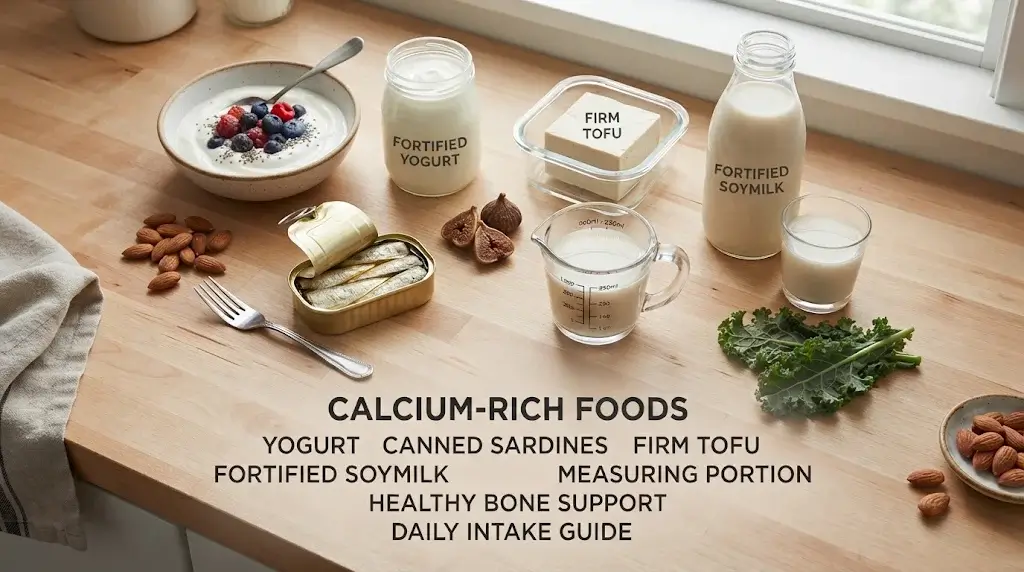
The NIH lists these approximate calcium amounts per serving. Labels vary by brand, so always check the package.
| Food | Serving | Calcium (approx.) |
| Plain low-fat yogurt | 8 oz (237 mL) | 415 mg |
| Canned sardines with bones | 3 oz (85 g) | 325 mg |
| Nonfat milk | 1 cup (237 mL) | 299 mg |
| Calcium-fortified soymilk | 1 cup (237 mL) | 299 mg |
| Firm tofu made with calcium sulfate | ½ cup (about 126 g) | 253 mg |
| Kale, cooked | 1 cup | 94 mg |
Those figures come from the NIH calcium fact sheet. If you do not eat dairy, the same source lists canned fish with bones, certain vegetables, and fortified milk substitutes as options.
Calcium supplements: forms and cautions
The two main supplement forms are calcium carbonate and calcium citrate, according to the NIH. Carbonate is cheaper and common, while citrate is easier on people with low stomach acid or absorption problems. The elemental calcium amount on the Supplement Facts panel is the number that counts.
High-dose calcium is not risk-free. Daily upper limits count calcium from food, drinks, and supplements together, so it is easy to overshoot if you stack a fortified cereal, a multivitamin, and a calcium pill. Check with your doctor about your own total.
Common Mistake: Taking a calcium pill to fix sensitive teeth, chalky white spots, or a rough patch on the enamel. Those signs call for a dental exam, not a supplement. Delaying the visit can let early damage progress.
Vitamin K2 and Teeth: The Theory, the Evidence, and the Gaps
Vitamin K is a family of compounds. The NIH explains that phylloquinone (vitamin K1) is the main dietary form and is found mainly in green leafy vegetables, while menaquinones (vitamin K2) are found in fermented foods and foods from animals. MK-4, MK-7, and MK-9 are the best-studied menaquinones.
Why K2 gets attention
Vitamin K acts as a coenzyme that helps make proteins involved in blood clotting and bone metabolism. The NIH notes that osteocalcin, a vitamin K-dependent protein in bone, may be involved in bone mineralization or turnover. That is the biological hook: if K-dependent proteins help steer calcium into hard tissue, maybe they help teeth too.
A 2015 paper in Medical Hypotheses proposed a role for vitamin K2 in dental caries through hormonal and saliva-related pathways. [VERIFY: add the PubMed link for Southward K, Med Hypotheses 2015;84(3):276-280.] The key word is hypothesis. A hypothesis is a starting point for testing, not proof that a supplement works.
What the evidence actually shows
Even for bone, where K2 is studied most, the picture is mixed. The NIH says a few studies found vitamin K supplements improved bone strength and lowered fracture chances, but other studies did not. It also says more research is needed to understand whether vitamin K supplements can help bone health or reduce osteoporosis risk.
For enamel, the evidence is thinner still. In the sources we reviewed, we found theory and biological reasoning but no randomized human trial showing that K2 supplements strengthen enamel or prevent cavities. [VERIFY: run a PubMed search for “menaquinone” AND “dental caries” AND “randomized” before publishing.]
Coach’s Tip: When a supplement’s pitch relies on “it helps calcium go to the right place,” ask one question: where is the trial that measured teeth? If the answer is a bone study, the claim about teeth is an extrapolation.
Do you even need extra K2?
Probably not for deficiency reasons. The NIH says vitamin K deficiency is very rare and most people in the United States get enough from food. Gut bacteria also make some vitamin K, though the NIH notes the amount the body absorbs from that source is unclear.
Adequate intake for adults is about 90 mcg per day for women and 120 mcg for men. [VERIFY exact values in the ODS Vitamin K table.] If you want to raise your intake, foods like eggs, cheese, and fermented foods are the usual K2 sources, and green leafy vegetables supply K1.
If you are reviewing K2 products, our guide on how to evaluate supplement ingredients walks through dose, form, and claim checks that apply to any capsule.
Who must be careful with vitamin K
Vitamin K interacts with the blood thinner warfarin (Coumadin). The NIH warns that a sudden change in vitamin K intake can cause dangerous bleeding or clots in people on warfarin, so consistency is the rule. Using antibiotics for more than a few weeks and taking the weight-loss drug orlistat can also lower vitamin K availability.
If you take any blood thinner, talk to your prescriber before starting or stopping a K2 supplement. This is not a “maybe” situation.
Evidence Check: Does Calcium and Vitamin K2 Actually Strengthen Tooth Enamel?
Here is the honest scorecard. It separates what is well supported from what is plausible but unproven.
| Factor | Role in tooth health | How strong is the support? |
| Fluoride (toothpaste, water, professional) | Promotes remineralization, stops or reverses early decay | Strongest: described as the cornerstone of cavity management (review; CDC) |
| Dietary calcium (enough, not extra) | Raw material for hydroxyapatite; needs vitamin D to absorb | Essential nutrient; benefit of extra supplemental calcium for enamel not shown in sources reviewed |
| Vitamin K2 | Supports proteins involved in bone mineralization | Hypothesis for teeth; mixed evidence even for bone |
| Vitamin D | Needed for calcium absorption; low levels linked to more cavities in children | Association in observational studies; cause and effect not proven |
| Topical calcium-phosphate products (CPP-ACP) | Deliver calcium and phosphate at the tooth surface | The calcium-phosphate technology with the most evidence in one 2010 review |
So, does calcium and vitamin K2 actually strengthen tooth enamel? Based on the sources above, calcium is necessary but supplements beyond your needs are unproven for enamel, and K2 is promising on paper but unproven for teeth. The strongest tools remain fluoride and routine dental care.
What about calcium-phosphate products you use on your teeth?
There is a difference between swallowing minerals and applying them to the tooth. A review in the Journal of Dental Research defines remineralization as supplying calcium and phosphate ions from an external source to promote deposition into crystal gaps in demineralized enamel, producing net mineral gain. Among delivery systems, it concluded the best-supported technology used casein phosphopeptides to stabilize and deliver calcium, phosphate, and fluoride.
That is a dental product used at the tooth surface, not a capsule. If you are curious about it, a dentist can tell you whether it fits your situation.
Vitamin D: The Supporting Actor Worth Checking
Vitamin D is the nutrient with a real, though limited, link to teeth. A 2023 meta-analysis in BMC Oral Health found that children with vitamin D deficiency had a 22% higher risk of dental caries than children with normal levels. The authors describe low vitamin D as a potential risk factor.
Two cautions apply. First, this was an association in observational studies, so it does not prove that vitamin D deficiency causes cavities. Second, the finding was in children, so it does not tell us what a supplement would do for an adult’s enamel.
The paper also notes that a shortage of vitamin D during tooth development can cause enamel hypoplasia, a thin or underdeveloped enamel layer that is more prone to decay. That is a development issue, which is different from strengthening mature enamel in adults.
Vitamin D also matters because of calcium absorption, as covered above. If you are working on the bigger nutrition picture, see our overview of nutrients that support metabolism and our explainer on spotting vitamin deficiencies for how testing and food-first strategies work.
How to Apply This: A Practical Plan
You do not need a cabinet full of pills to look after your enamel. Use this order of operations. It works the same way I would build a training plan: foundation first, extras last.
Step-by-step
- Brush with fluoride toothpaste every day. This is the most strongly supported habit in the research above. The CDC recommends children under 6 use a pea-sized amount of toothpaste, spit out the excess, and rinse well.
- Hit your calcium target from food first. Check the RDA for your age and sex in the NIH table. Adults 19-50 need about 1,000 mg per day, and the figure rises to 1,200 mg for women 51-70 and for everyone over 70. [VERIFY ages and amounts against the ODS Calcium table.]
- Pair calcium with vitamin D. Ask your doctor whether your vitamin D level has ever been checked, because absorption depends on it.
- Get vitamin K from food. Include leafy greens for K1 and eggs, cheese, or fermented foods for K2 if they suit your diet.
- Decide on supplements only after a conversation. Bring the product label to your dentist or doctor and ask whether you have a real gap.
- Book a dental exam for any chalky patches, rough spots, or sensitivity. Ask about professional fluoride options.
- Reassess at your next routine visit. Let your dentist tell you whether anything has changed.
A sample day that covers calcium from food
This is an example, not a prescription. Amounts come from the NIH table above and will vary by brand.
| Meal | Example | Calcium (approx.) |
| Breakfast | 8 oz (237 mL) plain low-fat yogurt with fruit | 415 mg |
| Lunch | Salad with ½ cup (about 126 g) calcium-set firm tofu | 253 mg |
| Dinner | 3 oz (85 g) canned sardines with bones on whole-grain toast | 325 mg |
| Total | about 993 mg |
If you skip dairy, swap in fortified soymilk (299 mg per cup) or fortified cereal, and check the label. Add other foods through the day and you land near the 1,000 mg adult figure without a pill.
Easier and harder versions of this plan
- Starter version: Fluoride toothpaste every day plus one calcium-rich food at lunch. Add a dental checkup if it has been a while.
- Advanced version: Track your calcium from food for a week, ask your doctor about vitamin D testing, and ask your dentist about professional fluoride options. Consider a supplement only if a gap shows up.
Choosing a Supplement If You Still Want One
Some people have real reasons to supplement, such as limited dairy intake, restricted diets, or a clinician’s advice. If that is you, a few checks help you avoid the common traps. Our guide on what to look for in a supplement covers label basics that apply to many products.
- Read the elemental calcium amount. It is on the Supplement Facts panel, and it is the number that counts toward your total.
- Know your forms. Calcium carbonate is common and inexpensive, while citrate suits people with low stomach acid, according to the NIH.
- Count everything. Multivitamins, antacids, and fortified foods all add calcium.
- Check the K2 form and dose. Look for MK-4 or MK-7 on the label and compare against your intake from food.
- Match it to your medicines. Tell your doctor and pharmacist about every supplement, especially if you take warfarin.
For a broader safety mindset, our piece on which supplements may be safe explains how to weigh benefits against risks before you buy.
Safety Notes: Who Should Check First
Check with a doctor or dentist before adding calcium or vitamin K2 supplements if any of these apply:
- You take warfarin or another blood thinner.
- You use antibiotics for more than a few weeks or take orlistat.
- You are pregnant or breastfeeding.
- You have kidney problems, a history of kidney stones, or a heart condition.
- You take several supplements or multiple prescription drugs.
- You are giving supplements to a child.
The NIH notes that the upper limits for calcium include all sources, and that some studies on calcium supplements and heart disease have conflicting results. A professional can look at your whole picture, which a general article cannot.
Related Tips for Healthier Enamel
- Think frequency and routine. The tug-of-war between mineral loss and gain happens throughout the day, so consistent habits beat one-off fixes. Ask your dentist which habits matter most for you.
- Keep saliva working. Saliva supplies calcium and phosphate to the tooth surface, so talk to your dentist if you have a dry mouth.
- Use the supplement budget on the basics. A good fluoride toothpaste, a soft brush, and a dental visit beat most capsules in cost and in evidence.
- Keep notes. Write down any sensitivity, white spots, or changes before your appointment, the same way you would log a training problem before seeing a physical therapist.
Frequently Asked Questions
Can enamel grow back with calcium?
Enamel can regain minerals in the early stages of damage through remineralization, a process involving saliva, calcium, phosphate, and fluoride. Fluoride has the best support as a helper. Once a true cavity forms, a dentist needs to treat it, and extra calcium pills are not a substitute.
Is vitamin K2 good for teeth?
Vitamin K2 supports proteins involved in bone mineralization, and some researchers have proposed a role in cavity prevention. That idea is still a hypothesis, and the sources we reviewed did not include strong human trials on enamel. Eat K2-containing foods if they suit you, and ask a professional about supplements.
How much calcium do I need for strong teeth?
The NIH sources we reviewed give no separate tooth-specific target. Adults follow the general calcium RDA, about 1,000 to 1,200 mg daily depending on age and sex, counting food and supplements together. Aim for food first, and check with your doctor before taking high-dose calcium.
Do calcium supplements whiten or harden teeth?
No source we reviewed shows that calcium pills whiten teeth or harden enamel. Fluoride toothpaste has far better support for strengthening enamel. White or chalky spots deserve a dental exam rather than a supplement, so book a visit instead of guessing.
Can I take calcium and vitamin K2 together?
Many products combine them, and the NIH notes some vitamin K supplements also contain calcium, magnesium, or vitamin D. Combining is not automatically unsafe, but it matters if you take warfarin, long-term antibiotics, or other medicines. Check with your doctor or pharmacist before starting any combination.
What actually protects enamel best?
Fluoride has the strongest backing: the CDC says it can stop or even reverse early tooth decay and keeps enamel strong. Pair daily fluoride toothpaste with regular dental visits and enough calcium and vitamin D from food. Supplements are optional extras, not substitutes for these basics.
Conclusion: So, Does Calcium and Vitamin K2 Actually Strengthen Tooth Enamel?
Here is the bottom line. Calcium is a key ingredient of enamel, but the research we reviewed does not show that extra calcium pills strengthen it, and vitamin K2 for teeth remains an interesting hypothesis without strong human trials. So when someone asks whether calcium and vitamin K2 actually strengthen tooth enamel, the evidence-based answer is “not proven, and not the best place to start.”
Put your effort where the evidence is strongest. Use fluoride toothpaste daily, get calcium and vitamin D from food, see your dentist, and treat supplements as a conversation rather than a shortcut. That order of priorities will protect your teeth better than any capsule.