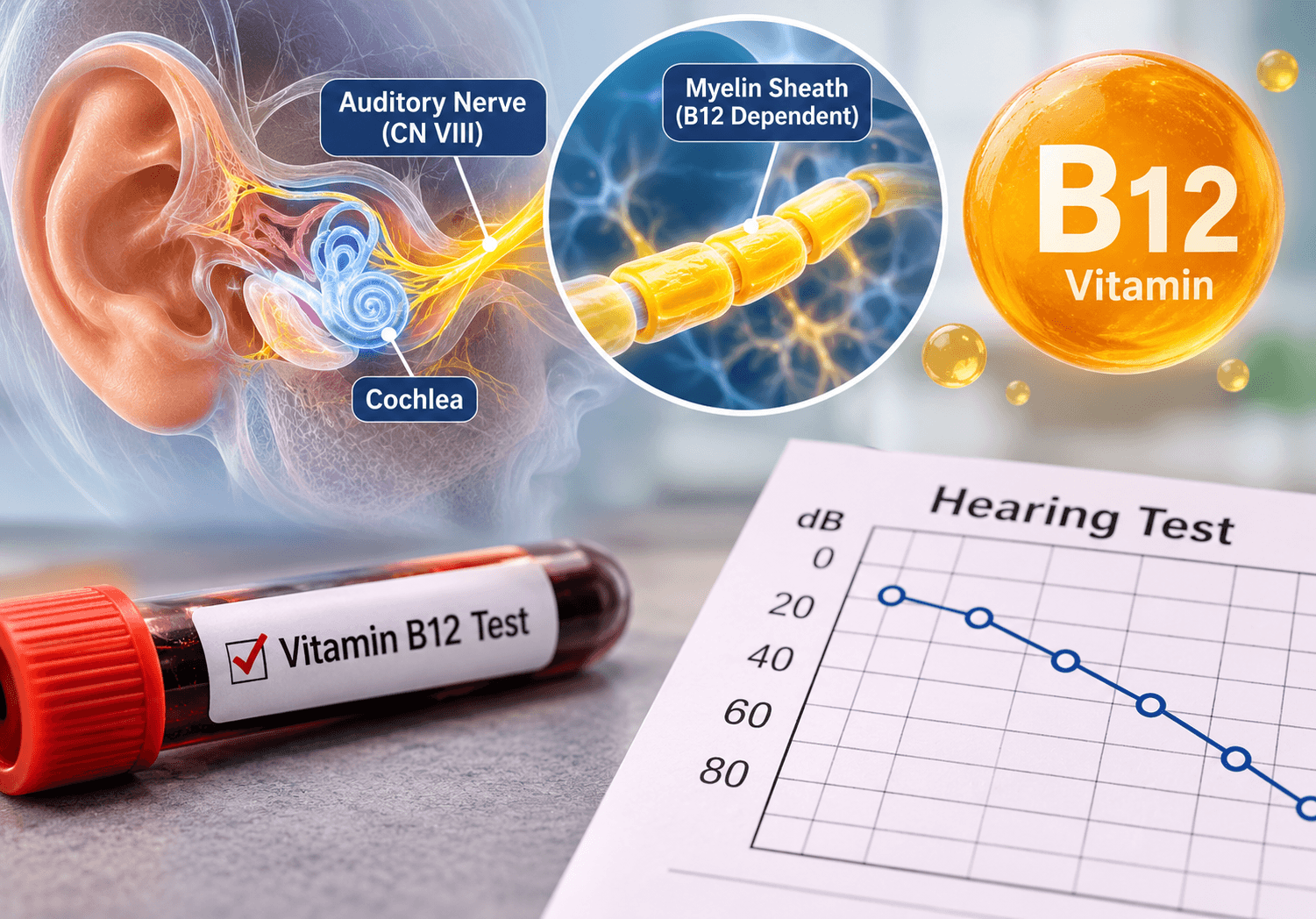
You notice the TV sounds a little muffled. Your friend’s voice fades in crowded rooms. A faint ringing hums in one ear at night. You chalk it up to age or too many loud concerts. But what if a simple blood test could reveal a nutritional gap behind those changes? The question of whether can vitamin B12 deficiency affect hearing is one more people are asking as they look for reversible causes of auditory decline.
Vitamin B12 (cobalamin) is a water-soluble B-complex vitamin your body cannot make on its own. You get it from animal-based foods or supplements. It plays a critical role in maintaining the myelin sheath—the protective coating around your nerves—and supporting red blood cell production. Because the auditory nerve and the delicate hair cells of the inner ear depend on healthy nerve function, a significant B12 shortfall may contribute to hearing changes, though the direct evidence is still developing.
This article breaks down what the research actually shows, who is at risk, how to get tested, and what practical steps you can take. I’ve coached athletes and everyday clients for years, and one thing I’ve learned is that nutrition gaps often show up as “mystery” symptoms before anyone connects the dots. Let’s connect them.
Quick Answer:
Can vitamin B12 deficiency affect hearing? Research suggests that severe, prolonged B12 deficiency may contribute to auditory symptoms such as muffled hearing, tinnitus, and difficulty with sound discrimination, likely through damage to the myelin sheath of the auditory nerve. However, B12 deficiency is not a well-established primary cause of hearing loss. If you notice hearing changes, a simple blood test can rule out low B12 as a contributing factor.
What Vitamin B12 Does in Your Body (and Why It Matters for Nerves)
Vitamin B12 works hand-in-hand with folate (B9) in a process called methylation. This process builds and repairs your DNA, produces red blood cells, and—critically for this topic—maintains the myelin sheath that insulates every nerve in your body, including the vestibulocochlear nerve (cranial nerve VIII) that carries sound signals from your inner ear to your brain.
Without adequate B12, myelin breaks down. The result is a condition called demyelination, where nerve signals slow down or misfire. You may have seen this discussed in the context of peripheral neuropathy—tingling or numbness in the hands and feet. The same mechanism, in theory, can affect any nerve, including the ones serving your cochlea and auditory pathway.
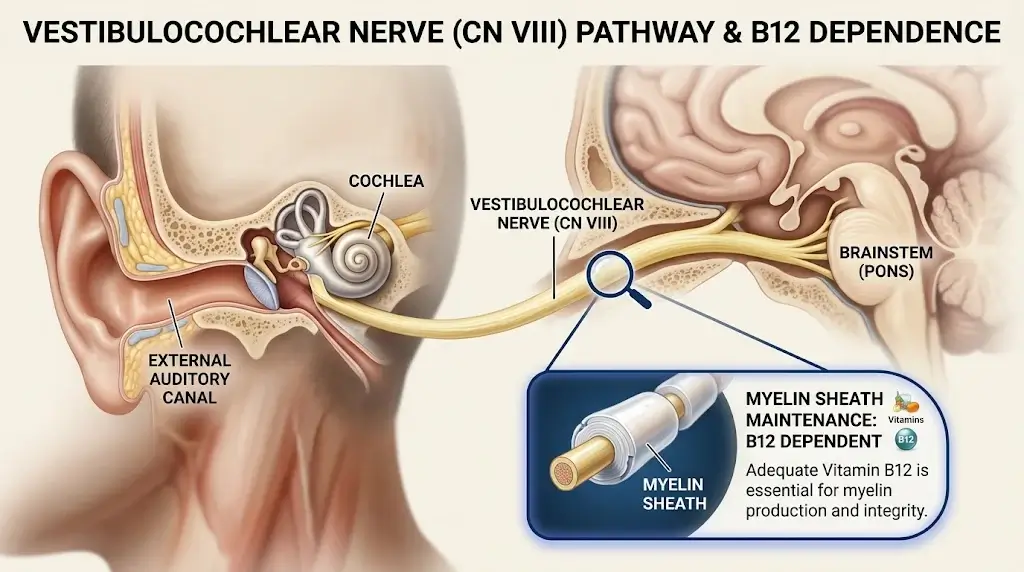
The inner ear is especially vulnerable. The cochlea contains thousands of tiny hair cells that convert sound vibrations into electrical signals. Those signals travel along the auditory nerve to the brain. If the myelin around that nerve degrades, the signal gets distorted—much like a frayed electrical wire. The brain then receives a garbled version of what you’re actually hearing.
It’s also worth noting that B12 deficiency can lower red blood cell count, leading to megaloblastic anemia. Fewer red blood cells mean less oxygen delivered to every tissue, including the metabolically active hair cells of the cochlea. Chronic under-oxygenation (hypoxia) is a recognized stressor for inner-ear cells.
The Connection Between B12 Deficiency and Hearing: What the Evidence Actually Shows
Here’s where I want to be straight with you, the way I’d be with a client in my gym: the evidence linking B12 deficiency directly to hearing loss is suggestive but not yet definitive.
What we know with confidence:
- Severe B12 deficiency causes neurological damage, including peripheral neuropathy, optic nerve changes, and cognitive decline, according to Mayo Clinic’s overview of vitamin B12 deficiency.
- The auditory nerve is a peripheral nerve. It is subject to the same demyelination risk as any other.
- B12 is involved in the methylation cycle that repairs and maintains nerve tissue, as described by the National Institutes of Health Office of Dietary Supplements.
What the research is still exploring:
- A small number of case reports in the literature describe patients with confirmed B12 deficiency who presented with sensorineural hearing loss or tinnitus that partially improved after B12 repletion. These are individual case reports, not large controlled trials.
- A 2019 review in the Journal of Laryngology & Otology noted that nutritional deficiencies, including B12, folate, and iron, have been proposed as modifiable risk factors for sensorineural hearing loss, but called for larger prospective studies to confirm causation [VERIFY – confirm exact journal and year before publishing].
- The Centers for Disease Control and Prevention lists B12 as essential for neurological function but does not specifically enumerate hearing loss as a recognized symptom of deficiency.
The honest bottom line: A B12 deficiency is unlikely to be the sole cause of your hearing loss. But if you’re deficient and you’re also exposed to other risk factors—noise, aging, certain medications, or vascular issues—low B12 could be a contributing thread in a larger picture. Ruling it out with a blood test is a low-cost, low-effort step that removes a variable.
Hearing Symptoms That May Be Linked to Low B12
Not every hearing complaint is B12-related. But if you’re in a group at risk for deficiency (more on that below) and you notice any of the following, it’s worth mentioning to your doctor alongside a B12 request:
- Muffled or “underwater” hearing, especially in one ear
- Difficulty distinguishing consonants (s, t, f, th) in noisy environments
- New or worsening tinnitus—a ringing, buzzing, or humming that wasn’t there before
- Reduced sound localization—trouble telling where a sound is coming from
- Balance issues or mild dizziness (the vestibular portion of CN VIII is also B12-dependent)
- Fatigue, brain fog, or tingling in the hands and feet alongside the auditory symptoms (these are classic B12 deficiency signs)
Coach’s Tip:
If you’re already in the gym or doing daily activities and you notice you’re turning up the music, asking people to repeat themselves more often, or feeling “off-balance” on uneven terrain, jot it down. Bring that note to your next medical appointment. Doctors respond better to specific observations than to “I think my hearing might be a little off.”
A simple table can help you track what you’re noticing:
| Symptom | Onset (gradual / sudden) | One ear or both? | Worse in noise? | Other B12 signs present? |
| Muffled hearing | ||||
| Tinnitus (ringing) | ||||
| Word discrimination difficulty | ||||
| Balance / dizziness | ||||
| Hand/foot tingling | ||||
| Fatigue or brain fog |
Fill this out over a week or two. It gives your doctor or audiologist a concrete pattern to work with.

Who Is at Risk for B12 Deficiency?
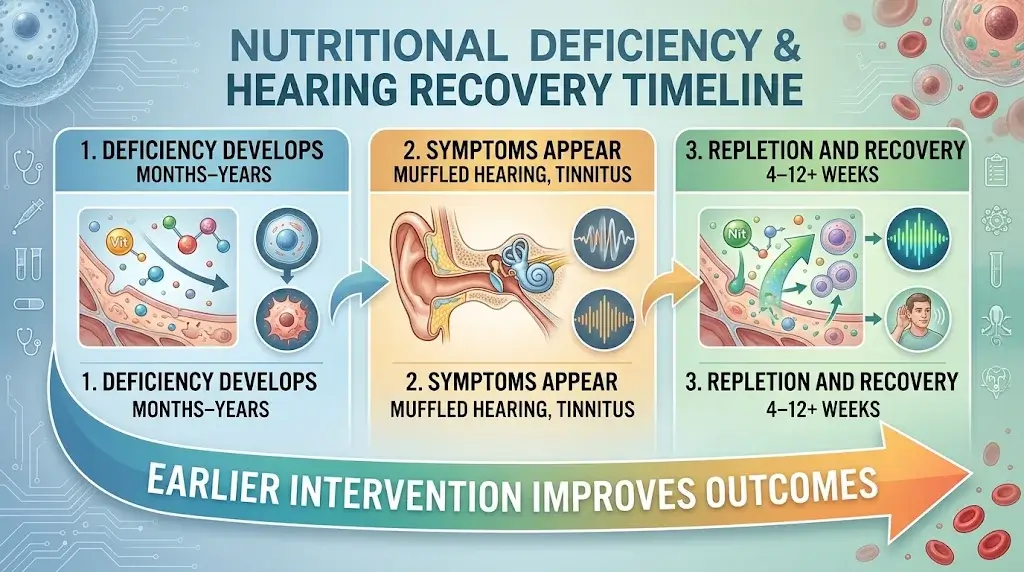
You don’t have to be vegan to be low in B12. Several common factors can deplete your stores, and the deficiency often develops slowly over months or years because your liver can hold a reserve of B12 for roughly two to five years.
Dietary factors:
- Strict vegan or long-term vegetarian diets without fortified foods or supplements
- Very low intake of meat, fish, eggs, and dairy
- Calorie-restricted diets that eliminate animal products
Medication-related:
- Long-term use of proton pump inhibitors (omeprazole, lansoprazole) or H2 blockers, which reduce stomach acid needed to release B12 from food
- Metformin (common for type 2 diabetes), which can impair B12 absorption in the gut
- Certain antibiotics used over extended periods
Gastrointestinal conditions:
- Pernicious anemia (autoimmune destruction of intrinsic factor)
- Crohn’s disease or celiac disease affecting the terminal ileum, where B12 is absorbed
- Prior gastric bypass or bariatric surgery
- Atrophic gastritis, especially in adults over 60
Other factors:
- Heavy alcohol use
- Pregnancy and breastfeeding (increased demand)
- Advanced age (reduced stomach acid production)
If you fit one or more of these categories and you’re also noticing hearing changes, the case for a B12 blood test gets stronger.
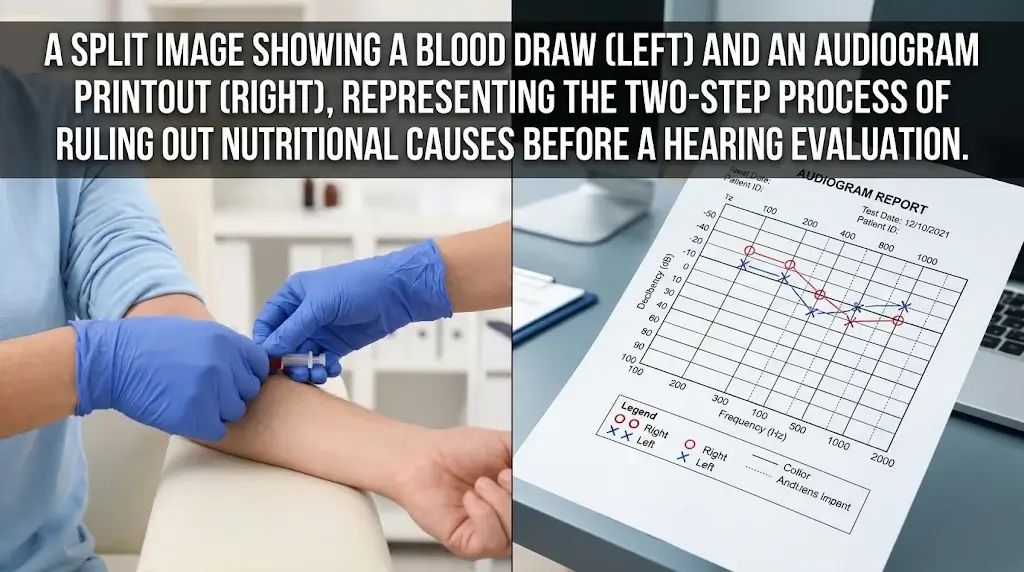
How to Get Tested: What to Ask Your Doctor
You don’t need a specialist to start this conversation. Your primary care physician can order the relevant labs. Here’s what to request and what to expect:
The tests:
- Serum vitamin B12 level – The standard screening test. Normal range is typically 200–900 pg/mL, though some labs flag anything under 300 pg/mL as “low-normal” and worth watching.
- Methylmalonic acid (MMA) and homocysteine – These metabolites rise when B12 is functionally deficient, even if the serum level looks borderline. They give a more sensitive picture.
- Complete blood count (CBC) with differential – Checks for megaloblastic anemia (enlarged red blood cells), a hallmark of significant B12 deficiency.
- Folate (B9) level – Because B12 and folate work together, a folate issue can mimic or compound B12 symptoms.
Practical steps:
- Call your doctor’s office and say: “I’d like to check my B12, MMA, homocysteine, folate, and CBC. I’ve been noticing some hearing changes and I want to rule out a nutritional factor.”
- If your doctor orders only a serum B12 and the result is “normal” (say, 320 pg/mL) but you still have neurological or auditory symptoms, ask for the MMA and homocysteine. Functional deficiency can exist at “normal” serum levels.
- Bring your symptom-tracking table from the section above.
- If B12 is confirmed low, your doctor will discuss repletion: oral supplements (typically 1,000–2,000 mcg of cyanocobalamin or methylcobalamin daily) or intramuscular B12 injections (1,000 mcg weekly for several weeks, then monthly maintenance). The choice depends on how low your level is and whether your absorption is impaired.
Common Mistake:
Waiting for a “definitive” hearing diagnosis before checking basic bloodwork. Hearing loss workups can take weeks or months to schedule. A B12 panel is a 30–80 blood draw you can get done in a week. If it’s the cause or a contributing factor, you’re already in treatment before the audiologist even sees you. Don’t let a long specialty queue delay a simple, reversible fix.
Can B12-Related Hearing Changes Be Reversed?
This is the question everyone asks, and I’ll give you the most honest answer I can: it depends on how long the deficiency has been going on and how much nerve damage has occurred.
- Early, mild changes (slight muffled hearing, new mild tinnitus, subtle word-discrimination difficulty) have a better chance of partial or full recovery once B12 levels are restored. The myelin sheath can regenerate, and nerve conduction can improve. In the case reports in the literature, improvement was often noted within 4 to 12 weeks of repletion, though some patients reported gradual changes over several months.
- Long-standing, severe deficiency with established demyelination or hair-cell damage is harder to reverse. The cochlear hair cells, once lost, do not regenerate in humans. So if the damage has progressed to the hair cells rather than just the nerve insulation, recovery may be incomplete.
- Tinnitus is the trickiest symptom. Even when hearing thresholds improve, the ringing can persist for weeks or longer as the auditory system recalibrates.
The key word is time. The sooner you identify and correct a B12 deficiency, the better the odds of meaningful improvement. This is the same principle I use with clients who’ve been training with poor form for months—the longer the bad pattern is in place, the more work it takes to retrain.
Practical Steps: What to Do If You Suspect Low B12
You don’t need to panic. You need a plan. Here’s a straightforward sequence:
- Track your symptoms for 7–10 days. Use the table above. Note when the muffled hearing or tinnitus is worst (morning, evening, after loud environments), whether it’s one ear or both, and any other signs like fatigue, tingling, or balance issues.
- Review your diet and medications. Are you vegan? On metformin or a PPI? Have you had GI surgery? Jot this down.
- Call your primary care doctor. Request the B12 panel (serum B12, MMA, homocysteine, folate, CBC). Mention your hearing symptoms specifically.
- Get the bloodwork done. Fasting is not required for a B12 test. You can go in the morning and be back at work by noon.
- Follow up on results within 1–2 weeks. If levels are low or borderline, discuss a repletion plan. If they’re solidly normal, ask your doctor whether a referral to an audiologist for a full hearing evaluation (pure-tone audiometry, speech-in-noise testing, and possibly tympanometry) makes sense to rule out other causes.
- If B12 is low, start repletion as directed. Oral supplements are effective for most people. Injections are preferred when absorption is the problem (pernicious anemia, post-surgical, metformin use).
- Recheck levels in 6–8 weeks to confirm they’ve normalized.
- Reassess your hearing symptoms after 8–12 weeks of repletion. If they’ve improved, great. If they haven’t changed, push for the audiology workup to look for other causes (noise damage, presbycusis, ototoxic medications, vascular issues).
This sequence takes about two to three months from first notice to a clear answer. It’s not fast, but it’s methodical, and it rules out a reversible cause before you invest in hearing aids or other interventions.
Safety Notes and When to See a Doctor Promptly
I’m a strength and conditioning coach, not a physician, and I want to be clear about that. The information here is educational. You should make treatment decisions with a qualified healthcare provider.
See a doctor or ENT specialist promptly if you experience:
- Sudden hearing loss in one or both ears (over hours to a few days). This is a medical emergency that requires treatment within 72 hours for the best chance of recovery, per Cleveland Clinic’s guidance on sudden sensorineural hearing loss.
- Hearing loss accompanied by severe dizziness, facial weakness, or a rash behind the ear (possible Ramsay Hunt syndrome).
- Progressive hearing decline over weeks rather than months.
- Neurological symptoms beyond hearing: confusion, difficulty walking, memory changes, or severe tingling/numbness.
General safety notes:
- B12 supplements (oral or injectable) are considered safe at typical repletion doses. There is no established upper tolerable limit for B12 because excess is excreted in urine. However, if you’re already on a B12 injection protocol, don’t stack it with high-dose oral B12 without your doctor’s guidance.
- Do not self-diagnose hearing loss as “just B12” and skip an audiology evaluation. B12 deficiency is one of many possible contributors. A full hearing workup is still important.
- If you’re pregnant, postpartum, or managing a chronic condition, check with your doctor before starting any new supplement, even B12.
This article is for general information and is not a substitute for advice from a doctor or physical therapist.
Related Tips for Protecting Your Hearing (Beyond B12)
While you’re working the B12 angle, it’s smart to shore up the other modifiable risk factors for hearing health. Here are practical, evidence-based habits:
- Manage noise exposure. The World Health Organization recommends keeping personal audio devices below 80 dB and limiting exposure to loud environments (concerts, power tools, construction) to under 85 dB for 8 hours. Use earplugs or earmuffs at events above 100 dB.
- Review your medications. Some antibiotics (aminoglycosides like gentamicin), high-dose aspirin, certain chemotherapy agents, and loop diuretics are ototoxic. If you’re on any of these, ask your pharmacist or doctor whether they carry hearing risk.
- Control vascular risk factors. High blood pressure, high cholesterol, and smoking reduce blood flow to the inner ear. Regular cardiovascular exercise, a balanced diet, and not smoking all support cochlear blood supply. As a coach, I tell clients: the same habits that protect your heart protect your ears.
- Keep up with your B-complex nutrition. B12 works alongside B9 (folate), B6, and other B vitamins. A varied diet with eggs, lean meats, fish, and dairy covers most needs. If you’re vegan or on a restricted diet, a B-complex supplement or a dedicated B12 supplement (25–100 mcg daily for maintenance) is a reasonable insurance policy. You can read more about which nutrients support normal energy and metabolic function in our guide to nutrients that support energy metabolism.
- Get a baseline audiogram. If you’re over 40, consider a hearing test every 1–2 years, or sooner if you work in a noisy environment. A baseline makes it easier to spot changes.
- Stay hydrated and manage stress. Chronic dehydration and elevated cortisol can affect microcirculation in the inner ear. These are small levers, but they add up.
If you’re already working on your overall nutrition and energy, you might find our article on how to increase energy and stamina naturally a useful companion, since B12 plays a role in both energy production and nerve health.
FAQ
Can low vitamin B12 cause hearing loss?
Research suggests that severe, prolonged B12 deficiency may contribute to hearing changes through demyelination of the auditory nerve and reduced oxygen delivery to cochlear hair cells. However, B12 deficiency is not a well-established primary cause of hearing loss. It is more likely a contributing factor alongside noise, aging, or vascular issues. A blood test can rule it in or out.
Does B12 deficiency cause tinnitus?
A small number of case reports describe new-onset or worsening tinnitus in patients with confirmed B12 deficiency, with partial improvement after repletion. Tinnitus has many causes, so B12 is one of several nutritional and neurological factors to check. If tinnitus is new or changing, see an ENT or audiologist.
Can B12 supplements improve hearing?
If your hearing changes are linked to a confirmed B12 deficiency, restoring your B12 levels through oral supplements or injections may lead to partial or full improvement, especially if the damage is limited to nerve myelin rather than hair cells. If your B12 level is normal, adding more B12 is unlikely to change your hearing.
What B12 level is too low to affect hearing?
There is no single “hearing threshold” for B12. Serum levels below 200 pg/mL are generally considered deficient. Levels between 200–300 pg/mL are “low-normal” and can still cause functional deficiency, especially if MMA and homocysteine are elevated. Your doctor will interpret your full panel.
Is hearing loss from B12 deficiency reversible?
Early, mild changes have a good chance of improving once B12 is replenished, often within 4–12 weeks. Long-standing deficiency with hair-cell damage is harder to reverse because cochlear hair cells do not regenerate in humans. The sooner you address the deficiency, the better the outlook.
How long does it take for B12 to affect hearing?
B12 stores in the liver can last 2–5 years, so a deficiency-related hearing change typically develops over months to years, not days or weeks. Sudden hearing loss is almost never caused by B12 deficiency alone and should be evaluated urgently for other causes.
Conclusion: A Simple Blood Test Can Rule Out a Reversible Factor
So, can vitamin B12 deficiency affect hearing? The evidence points to yes, it can be a contributing factor, particularly in cases of severe or long-standing deficiency where the auditory nerve’s myelin sheath is compromised. It is not the most common cause of hearing loss, but it is one of the most reversible nutritional factors you can check, and the test is a simple, inexpensive blood draw.
If you’ve been noticing muffled hearing, new tinnitus, or difficulty following conversations—and you fit any of the risk categories for low B12 (vegan diet, metformin use, GI issues, age over 60)—make the call to your doctor. Ask for the B12 panel. Bring your symptom notes. And while you’re at it, schedule that baseline audiogram if you haven’t had one in a couple of years.
You don’t have to figure this out alone, and you don’t have to wait for the symptoms to get worse. A 10-minute phone call and a 15-minute blood draw can take a reversible nutritional factor off the table and give you a clearer path forward.
And if the B12 comes back normal? No harm done. You’ve ruled out one variable, and you can focus the investigation on noise history, vascular health, medications, or age-related changes with your audiologist. Either way, you’re ahead of where you were last week.
That’s the approach I take with every client: eliminate the easy fixes first, then work up from there. Your hearing deserves the same methodical attention.