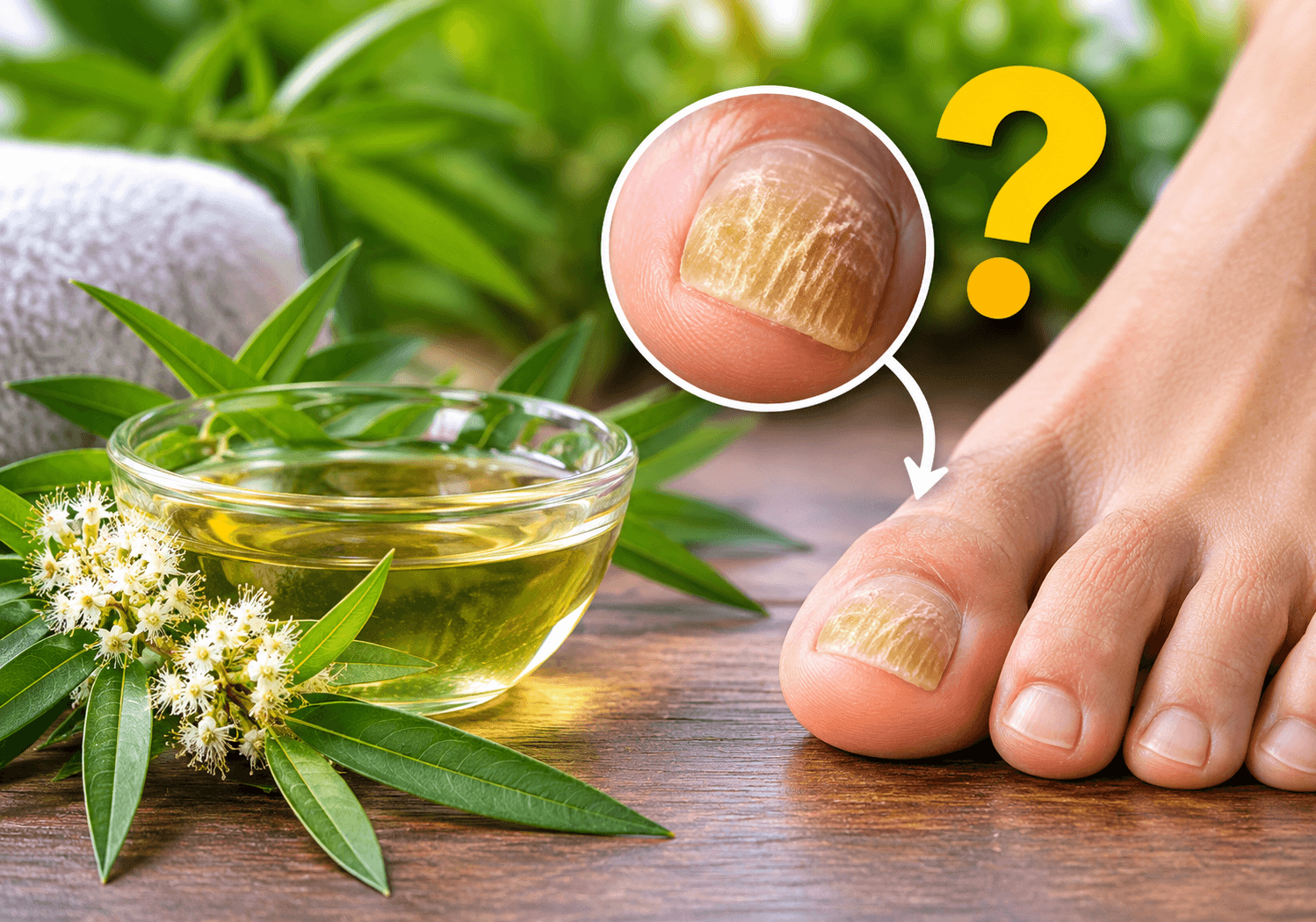
Does tea tree oil help with toenail fungus? It might help a little in some people, but the research is thin, and nobody has shown it works as well as prescription treatment. That matters if your nail is thick, yellow, and crumbly and you’re deciding what to put on it.
Athletes have extra reason to care. Sweaty shoes, shared showers, and long training weeks are part of gym and running life. This guide covers what the trials found, how tea tree oil compares with treatments doctors use, how to use it more safely if you try it, and how to lower your odds of getting fungus again.
Quick Answer: Probably not enough to rely on. Only a few small trials have tested tea tree oil on toenail fungus, and health agencies say the research is too limited to draw firm conclusions. Pure tea tree oil may help some people a little, but prescription antifungals have stronger support. See a doctor before treating.
Check with your doctor or podiatrist before starting any treatment for a nail infection. This matters most if you have diabetes, a weakened immune system, pain, or redness around the nail.
What Toenail Fungus Is and Why It’s So Hard to Treat
Toenail fungus is called onychomycosis. The CDC says it may affect up to 14% of the general population, and toenails are hit more often than fingernails. The nail can turn discolored, thick, fragile, or cracked, and it may separate from the nail bed.
Most cases are not serious, but some people have pain or just hate how the nail looks. The infection usually starts when tiny cracks in the nail or nearby skin let fungi from the environment get in.
Who gets it
The CDC says older adults and people with diabetes are especially at risk. It also notes that people with fungal toenail infections often have a fungal skin infection on the foot, particularly between the toes. That is the athlete’s foot connection.

Why nails fight back
A nail is a hard plate, and the fungus sits under and inside it. A review in PLOS Pathogens explains that dermatophytes cause most superficial fungal infections, with Trichophyton rubrum the most common cause of nail infection. The same review says thickened nails, widespread involvement of the whole nail, and disease along the nail’s side edge predict a poorer response to topical treatment.
That helps explain why any paint-on or rub-on product has a tough job. It also sets the bar for judging tea tree oil: a remedy has to do something about a fungus that’s protected by the nail itself.
Why timing is slow
The infection clears only when a new, uninfected nail grows in. MedlinePlus says that can take up to a year even if treatment works. It also says medicines clear the fungus in about half of the people who try them, and the fungus may come back afterward.
Does Tea Tree Oil Help With Toenail Fungus? What the Trials Found
Tea tree oil comes from the leaves of Melaleuca alternifolia, an Australian plant. The National Center for Complementary and Integrative Health (NCCIH) says it is promoted for external use on toenail fungus, among other conditions. It also says only a few studies have looked at fungal nails, and both the amount and the quality of that research are too limited for conclusions.
Let’s look at the main human trials behind that statement.
The 1994 trial: pure tea tree oil vs. clotrimazole
This is the study most often cited. A randomized, double-blind trial enrolled 117 people with culture-proven distal subungual onychomycosis. They applied either 100% tea tree oil or 1% clotrimazole solution twice a day for six months. Care took place at two primary care and residency centers and one podiatrist’s office.
A later review’s data table reports what happened. Mycologic cure (the fungus no longer grew in a lab test) was 18% with tea tree oil and 11% with clotrimazole. Clinical assessment was about 60% in the oil group and 61% in the clotrimazole group. The difference between treatments was not statistically significant, and redness and irritation affected 7.8% of the oil group.
Here is how I’d read that, as a coach rather than a researcher:
- Equal is not the same as good. Tea tree oil did about as well as another topical antifungal, not as well as the oral pills the CDC calls the usual best option.
- Most people were not cured. An 18% lab cure rate means the majority still had fungus after six months of twice-daily use.
- It was a long commitment. Six months of twice-daily application is a real routine, not a weekend experiment.
The 1999 trial: oil mixed with another antifungal
A randomized, double-blind, placebo-controlled study tested a cream containing 2% butenafine and 5% tea tree oil on toenail onychomycosis. The abstract reports that no relapse occurred in cured patients, and no improvement appeared in placebo participants.
The catch is that butenafine is itself an antifungal. Because the cream combined two active ingredients, we can’t tell how much, if any, of the benefit came from the oil.
What reviews and health agencies conclude
A systematic review in Skin Appendage Disorders searched PubMed, Embase, and the Cochrane Library for complementary and alternative treatments for onychomycosis. It found 17 articles, and only five of them studied tea tree oil.
Mayo Clinic says research hasn’t shown tea tree oil to be effective for toenail fungus. It adds that one small study found pure tea tree oil helped a small number of users, and that studies using lower concentrations didn’t find a benefit. It also notes that products vary in how they’re made and how much oil they contain, so results can differ.
The evidence at a glance
| Source | Design | What was tested | What it showed | Main limit |
| Buck et al., 1994 | Randomized, double-blind, 117 people | 100% tea tree oil vs. 1% clotrimazole, twice daily for 6 months | Similar results in both groups; lab cure reported as 18% vs. 11% | Small; comparator was another topical product |
| Syed et al., 1999 | Randomized, double-blind, placebo-controlled | 5% tea tree oil plus 2% butenafine cream | No improvement in placebo group; no relapse in cured patients | Can’t separate oil from butenafine |
| Systematic review | Database search | Complementary therapies for nail fungus | 17 articles found, 5 on tea tree oil | Few studies to pool |
| NCCIH / Mayo Clinic | Agency summaries | All available research | Evidence too limited for firm conclusions | Based on the same small studies |
Does Tea Tree Oil Help With Toenail Fungus as Well as Prescription Treatment?
No evidence says it does. The CDC says fungal nail infections typically don’t go away on their own, and the best treatment is usually prescription antifungal pills. In severe cases, a healthcare professional might remove the nail.
That doesn’t make tea tree oil useless or dangerous by default. It means it sits in a different tier: possible mild help for some people, unproven as a cure, and not a replacement for a doctor’s plan.

Why a diagnosis comes first
Not every thick, discolored nail is fungus. The CDC notes that other conditions can look like fungal nail infections, and the CDC’s clinical guidance recommends testing so treatment can be matched to the cause. If you treat a nail problem that isn’t fungus for months, you lose time and may miss the real issue.
Why waiting costs you
The CDC says treatment is most successful when started early. That’s the practical downside of a slow home remedy: if it doesn’t work, you’ve spent months while the infection stayed put.
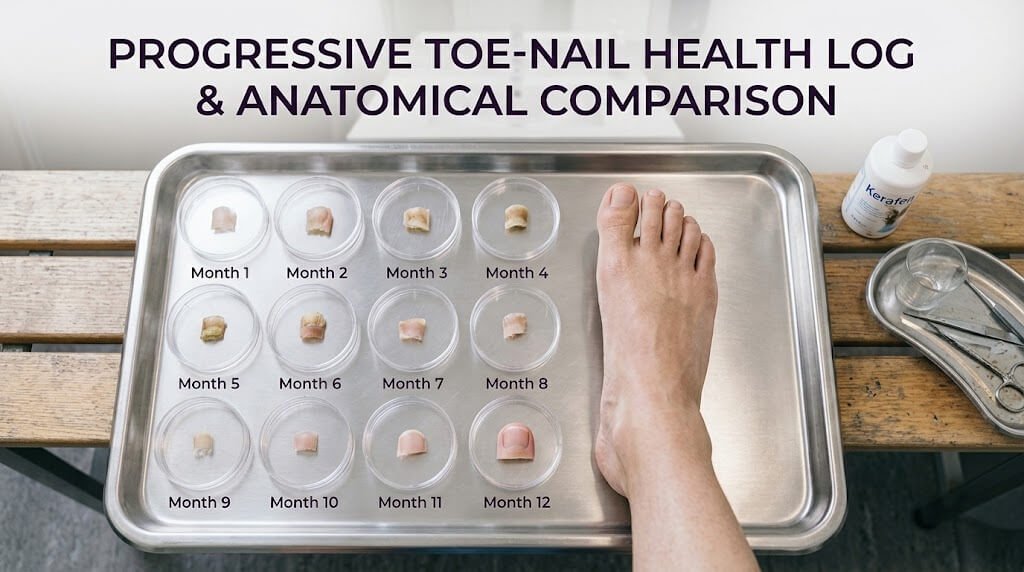
Coach’s Tip: Take a clear photo of the nail in the same light every month. It’s the easiest way to judge whether anything is changing, because a new nail grows in so slowly that you can’t judge progress by looking at it day to day. Bring the photos to your appointment.
How to Apply This: A Cautious Approach
If you’ve talked with your doctor and still want to try tea tree oil, here is a sensible way to approach it. Think of this as a plan to discuss with your clinician, not a prescription.
- Get the nail looked at first. A diagnosis tells you whether fungus is even the problem.
- Ask whether tea tree oil can be used alongside any prescribed treatment. Mayo Clinic’s current guidance says it isn’t known to cause interactions with medicines or supplements, but your clinician knows your full picture.
- Choose a product labeled as Melaleuca alternifolia oil, and read the concentration. The trials used 100% oil alone or 5% oil in a cream, and results can vary by product.
- Use it on the skin only. NCCIH says tea tree oil should not be swallowed. Swallowing it can cause serious symptoms such as confusion, unsteadiness, inability to walk, and coma.
- Watch your skin. Mayo Clinic lists itching, stinging, burning, redness, and allergic rash as possible reactions. Stop if you notice any.
- Set a realistic timeline. The 1994 trial lasted six months, and MedlinePlus says a new clear nail can take up to a year.
- Check in with your clinician. Don’t wait a full year to find out it isn’t working.
Common Mistake: Switching products every few weeks. Rotating through remedies makes it impossible to tell what is working and keeps you from ever giving any treatment a fair test. Pick one plan with your clinician and stick with it long enough to judge it.
Easier and stricter versions of the routine
Anyone can follow the basic version. The stricter version is for people who’ve decided, with their clinician, to run a full trial.
| Basic routine | Stricter routine | |
| Foot care | Wash and fully dry feet daily | Same, plus dry between toes after every shower |
| Nail care | Keep nails trimmed | Trim, and file the thickened nail as your clinician advises |
| Treatment | Whatever your doctor recommends | Same, applied consistently on a set schedule |
| Tracking | Look at the nail occasionally | Monthly dated photo |
| Follow-up | See your doctor if nothing changes | Scheduled check-ins with your clinician |
Safety Notes: Who Should Be Careful
Tea tree oil is natural, but that doesn’t make it harmless. Here are the main risks.
- Skin reactions. Mayo Clinic says to avoid tea tree oil if you have eczema or very sensitive skin, because it can irritate the skin.
- Swallowing. NCCIH warns against taking it by mouth, and Mayo Clinic describes it as toxic when swallowed. Keep the bottle away from children and pets.
- Diabetes. The CDC says fungal nail infections are more common in people with diabetes, and that a bacterial infection on top of a fungal one is also more common. If you have diabetes, get the nail examined before trying home remedies.
- Pregnancy and breastfeeding. NCCIH says topical tea tree oil products may be safe during pregnancy and breastfeeding. Ask your doctor anyway, since this is general guidance rather than advice for you.
When to see a doctor sooner
MedlinePlus advises contacting your provider if fungal nail infections don’t go away, or if the surrounding skin becomes painful, red, or drains pus. Don’t try to manage those on your own.
Preventing Toenail Fungus: A Coach’s Checklist for Gym-Goers and Runners
Prevention matters because treatment is slow and the fungus can return. MedlinePlus lists good general hygiene as the foundation: keep skin clean and dry, take proper care of your nails, and don’t share manicure or pedicure tools.
Here is how that translates to training life.
- Dry your feet fully after every workout. Pay attention to the skin between your toes, since the CDC links toenail infections with fungal skin infections there.
- Treat athlete’s foot early. If you notice itching, peeling, or cracking between your toes, deal with it before it reaches the nail.
- Change out of sweaty socks and shoes soon after you finish. After a long run, say 6 miles (9.7 km), don’t sit around in damp gear.
- Wear sandals in shared showers and locker rooms. The CDC says the fungi involved live in the environment, so a barrier between your feet and wet floors is a sensible habit.
- Keep your own nail tools. Don’t share clippers, files, or pedicure instruments.
- Mind small cracks and injuries. The CDC says small cracks in the nail or surrounding skin let fungi in, so protect your toes in the gym and on the trail.


A Sample Plan for the First Three Months
This is a suggested way to organize your approach with your clinician, not medical treatment.
Week 1: Get answers. See a doctor or podiatrist and ask about testing the nail. Take a baseline photo and start the basic foot-care habits above.
Weeks 2-4: Start the plan you and your clinician chose. Whether it’s prescription treatment, tea tree oil, or both, apply it consistently. Note any skin reactions.
Monthly: Photo and check. Take the same photo in the same light, and record any irritation or changes.
Month 3: Reassess. Bring your photos to your clinician. Remember that nails grow slowly, so the question isn’t whether the old nail looks perfect but whether healthy-looking nail is growing in from the base.
Beyond month 3: Keep going or change course. Given that clearing can take up to a year, your clinician can help you decide whether to continue, adjust, or switch approaches.
Frequently Asked Questions
Does tea tree oil cure toenail fungus?
There is no strong evidence that it does. In a 1994 trial of 117 people, pure tea tree oil produced a lab-confirmed cure in a minority of users after six months. Health agencies describe the research as too limited for firm conclusions, so it should not replace prescription care.
How long does tea tree oil take to work on toenail fungus?
No one can promise a timeline. Toenail infections clear only when a new, healthy nail grows in, and that can take up to a year even when treatment works, according to MedlinePlus. The 1994 trial applied oil twice daily for six months, so expect a long commitment, not a quick fix.
Can tea tree oil make toenail fungus worse?
Tea tree oil can irritate the skin around the nail. Mayo Clinic lists itching, stinging, burning, redness, and allergic rash as possible effects, and a review table of the 1994 trial reported irritation in about 8% of the oil group. The bigger risk is delay: CDC says treatment works best when started early.
Is tea tree oil safe to use if I have diabetes?
Ask your doctor first. CDC notes that people with diabetes are at higher risk for fungal nail infections and for a bacterial infection developing on top of one. A skin reaction could complicate things, so a clinician should examine the nail and guide the treatment plan.
Will toenail fungus go away on its own?
Usually not. CDC says fungal nail infections typically don’t go away on their own, and treatment is most successful when started early. Prescription antifungal pills taken by mouth are usually the best option, and a clinician can confirm the diagnosis first, since other conditions can look similar.
How can athletes prevent toenail fungus?
Keep your feet clean and dry, take care of your nails, and don’t share pedicure or manicure tools, as MedlinePlus advises. Treat athlete’s foot early, since CDC links toenail infections with fungal skin infections on the foot. Wearing sandals in shared showers is a sensible extra step.
Bottom Line: Does Tea Tree Oil Help With Toenail Fungus?
So, does tea tree oil help with toenail fungus? The best honest summary is “maybe a little, but not proven.” The few human trials are small, one of them can’t separate the oil from another antifungal, and agencies like NCCIH and Mayo Clinic say the evidence isn’t strong enough to recommend it as a cure.
If you want to try it, do it with your doctor’s knowledge, use it only on the skin, watch for irritation, and give it a fair, tracked trial. If you have diabetes, pain, or signs of infection, skip the experiment and get the nail examined. Then protect your feet with the drying, nail-care, and locker-room habits above so you’re not back here next season.