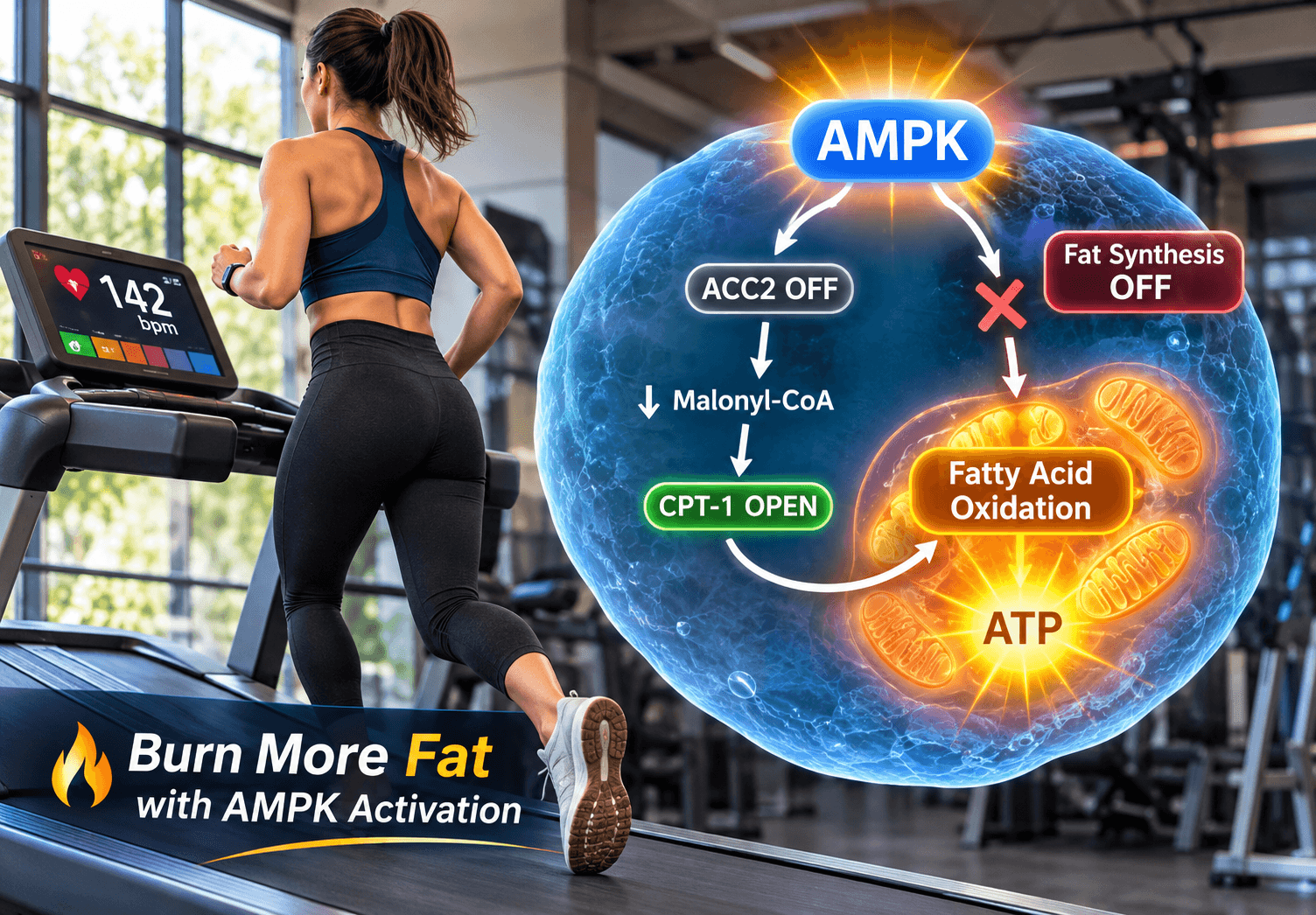
Most people trying to lose fat think only about calories in and calories out. That math matters, but your cells run their own accounting system, and one enzyme sits at the center of it. That enzyme is AMP-activated protein kinase, or AMPK. So, how does AMPK activation influence fat oxidation pathways? When AMPK turns on, it flips your muscle cells from “store fat” mode to “burn fat” mode: it removes the brake that blocks fat entry into the mitochondria, switches off fat synthesis, and builds more fat-burning machinery over time. This guide explains the science in plain English, then shows you exactly how to train, eat, and recover to activate it.

Quick Answer
AMPK is your cells’ energy sensor. When it detects low energy (rising AMP, falling ATP), it phosphorylates and inactivates ACC2, lowering malonyl-CoA and releasing CPT-1’s brake on mitochondrial fat entry. That drives fatty acids into beta-oxidation, turns off fat and cholesterol synthesis, and, with repeated activation, builds more mitochondria so your body oxidizes more fat at rest and during exercise.
What AMPK Actually Is (and Why It Matters for Fat Loss)
AMP-activated protein kinase (AMPK) is a protein found in virtually every cell in your body. Think of it as a fuel gauge. When your cells’ energy charge drops, meaning ATP (the energy currency) falls relative to AMP, AMPK switches on. Once active, it does two things at once: it turns on ATP-generating, catabolic processes like glucose uptake and fatty acid oxidation, and it turns off ATP-consuming processes like making new fat, protein, and triglycerides [1].
Researchers call AMPK a “metabolic master switch” for this reason. It senses cellular energy charge and flips metabolism from storage mode into fuel-burning mode [2]. As one widely cited review puts it, AMPK is “a crucial cellular energy sensor” that promotes ATP production while conserving ATP by switching off biosynthetic pathways, and it regulates energy balance at the whole-body level too [3].
Why should you care? Because in skeletal muscle, AMPK has “emerged as a key kinase driving lipid oxidation,” and that function has important implications for exercise adaptations as well as the metabolic defects linked to obesity [4]. In practical coaching terms: if your goal is better fat oxidation, more mitochondrial density, and improved insulin sensitivity, AMPK is the signaling pathway you are training, whether you know it or not.
The AMPK Fat Oxidation Pathway, Step by Step
Here is the core mechanism, minus the biochemistry-degree requirement. It works like a series of switches.
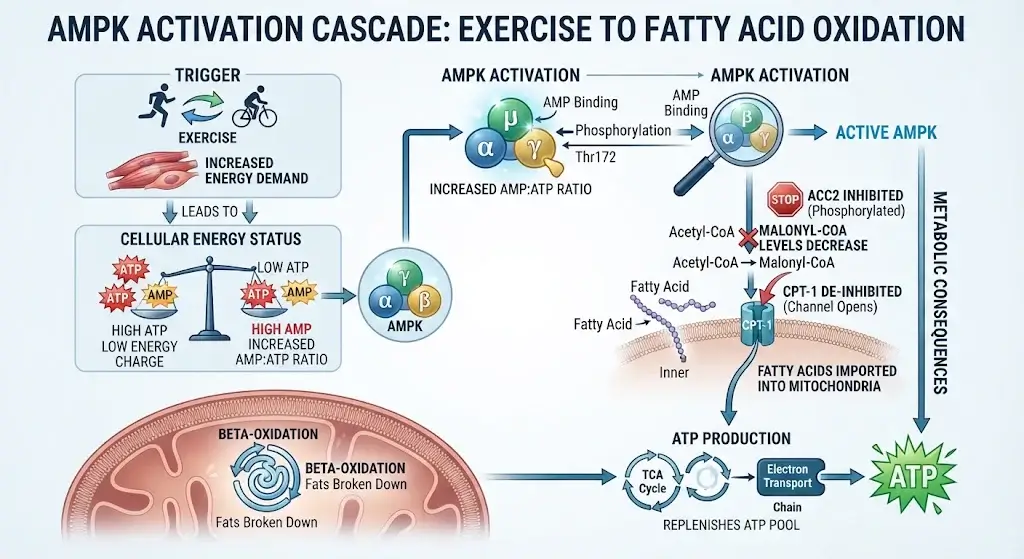
Step 1: Energy stress activates AMPK. During muscle contraction, ATP gets used up fast. AMP rises, ATP falls, and that rising AMP-to-ATP ratio allosterically activates AMPK and its upstream kinase [5]. The LKB1-to-AMPK cascade is switched on by metabolic stresses that either inhibit ATP production or accelerate ATP consumption, such as muscle contraction [6].
Step 2: AMPK phosphorylates and disables ACC. Activated AMPK phosphorylates acetyl-CoA carboxylase (ACC) and shuts it down. ACC is the enzyme that makes malonyl-CoA. In muscle, exercise or electrical stimulation drops malonyl-CoA levels sharply, and AMPK activation with simultaneous ACC inactivation is one of the primary events controlling malonyl-CoA and, therefore, fat oxidation during exercise [7]. In one classic rat study, running on a treadmill produced a 2.4-fold activation of AMPK with a marked drop in ACC activity [7]. In humans, a 30-second cycling sprint raised AMPK activity roughly two- to threefold and ACC phosphorylation about 8.5-fold [8].
Step 3: Malonyl-CoA falls, releasing CPT-1’s brake. Malonyl-CoA is a potent inhibitor of carnitine palmitoyltransferase I (CPT-1), the transporter that carries long-chain fatty acids into the mitochondria where they are burned [9]. When malonyl-CoA drops, that brake is released. In perfused rat hindlimbs, activating AMPK with AICAR (a research compound) produced a 2.8-fold increase in fatty acid oxidation alongside ACC inactivation and reduced malonyl-CoA [10].
Step 4: Fatty acids enter the mitochondria and undergo beta-oxidation. With CPT-1 gate now open, fatty acids stream into the mitochondrial matrix and get chopped into acetyl-CoA units through beta-oxidation, feeding the TCA (Krebs) cycle and the electron transport chain to produce ATP.
Step 5: Fat synthesis gets switched off simultaneously. AMPK doesn’t just speed up fat burning; it blocks fat making. Activation of AMPK by cellular stress or exercise switches on fatty acid oxidation (via phosphorylation of ACC-2) while switching off fatty acid synthesis (via phosphorylation of ACC-1) [2]. AMPK activation increases the ratio of fatty acids partitioned to oxidation rather than to triglyceride (fat) esterification [11].
Step 6: More fatty acid transporters get recruited. AMPK may also regulate fatty acid transport into the cell and into the mitochondria through the fatty acid transporter FAT/CD36 [12]. Mice lacking muscle AMPK show reduced CD36 and FABPpm protein and impaired fatty acid transport during exercise, with a higher respiratory exchange ratio (RER), meaning they burned relatively more carbohydrate and less fat [13].
Coach’s Tip: If you remember only one thing, remember this: AMPK doesn’t burn fat directly. It removes the “gatekeeper” (malonyl-CoA) that was blocking your mitochondria’s fat door. Your actual fat burning still depends on energy demand, which is why training volume and consistency matter as much as intensity.

What Turns On AMPK (and What Turns It Off)
AMPK responds to almost anything that drains cellular energy. The strongest activator, by a wide margin, is exercise.
Exercise is the most powerful physiological activator of AMPK [1]. It activates in skeletal muscle, and in rodents also in adipose tissue and liver, whenever events raise the AMP/ATP ratio [1]. In practice, that means moderate-to-hard aerobic work, intervals, and any sustained muscle contraction.
Low energy availability (caloric deficit). Fasting, caloric restriction, and low glycogen all raise AMP/ATP and nudge AMPK on. This is partly why diets high in fiber and protein, which blunt big insulin spikes, tend to support fat oxidation better than constant snacking on refined carbs. The effect is modest on its own, but it compounds with exercise.
Cold exposure, caffeine, and some botanicals. Caffeine, cold exposure, and certain plant compounds have all been shown to raise AMPK activity, though the effects in humans are generally smaller and shorter-lived than those from exercise. Berberine, a plant alkaloid, increased AMPK activity in fat and muscle cells, improved glucose tolerance, and reduced body weight in diabetic and obese mouse models without reducing food intake [14]. Green tea catechins, curcumin, and omega-3 fatty acids have also been studied for AMPK-related effects, but human evidence is mixed and doses used in cell studies rarely translate to a cup of tea or a standard capsule.
What turns AMPK off? Refeeding, high insulin, ample glucose and glycogen, and plenty of ATP. In plain terms: a big carb-heavy meal with low activity levels is the opposite of an AMPK-activating state. That is not a reason to skip carbs; it is a reason to time them around training.
How AMPK Changes Your Muscle’s Fat-Burning Capacity Over Time
Acute AMPK activation lasts minutes to hours. The real payoff comes from repeated activation, which reshapes your muscle over weeks and months. Here is what the research shows:
- More mitochondria. Chronic AMPK activation in rat muscle raised NRF-1 binding activity roughly eightfold, increased cytochrome c content, and more than doubled mitochondrial density [15]. In a separate mouse model, AMPK was shown to be a critical regulator initiating mitochondrial biogenesis [16].
- Higher oxidative enzymes. AMPK turns up PGC-1alpha and the enzymes of beta-oxidation and the TCA cycle, which raises your muscle’s ceiling for fat oxidation [17].
- Better fat transport. FAT/CD36 and FABPpm, the proteins that move fatty acids across membranes, go up with repeated training, increasing fatty acid delivery to the mitochondria [18].
- Improved insulin sensitivity. Repeated AMPK activation improves insulin-sensitive fatty acid uptake and oxidation, partly through changes in proteins linked to insulin signaling [19].
The AMPK-and-mitochondria connection is now considered central to exercise adaptation. AMPK is described as a master regulator that senses energy state, promotes glucose and fatty acid utilization, and mediates beneficial cellular adaptations across many tissues [21]. A newer review in Frontiers in Physiology frames the same idea: AMPK acts as an energy sensor and signaling regulator driving exercise-induced skeletal muscle adaptation [22].
Common Mistake: Chasing AMPK activation through supplements while ignoring the training stimulus that actually drives it. AMPK responds to repeated energy stress. No pill, powder, or tea replaces the signal your muscles send when they work hard enough to need more ATP.
How to Train to Activate AMPK and Burn More Fat
Now for the practical part. If you want to reliably turn on AMPK, three levers matter most: intensity, duration, and consistency.
Lever 1: Exercise at the Right Intensity
Fat oxidation peaks at a moderate intensity and drops off when you go harder, because high intensity forces your muscles to rely more on carbohydrate. In a landmark study of 300 healthy men and women, maximal fat oxidation averaged 7.8 mg per kg of fat-free mass per minute and occurred around 48 percent of VO2max, roughly 62 percent of maximum heart rate [23].
Here’s a practical way to find your own fat-burning zone without a lab:
- Estimate your maximum heart rate as 220 minus your age (a rough field estimate, not a lab measure).
- Multiply that by 0.60 to 0.65. That’s your approximate fatmax heart rate.
- Do your zone 2 cardio at that effort. You should be able to speak in full sentences but feel noticeably breathless if you tried to sing.
Table
| Training zone | Intensity feel | Heart rate guide | Fat oxidation effect |
| Zone 1 (recovery) | Very easy, conversational | 50-60% of max HR | Low absolute fat burn, good for recovery days |
| Zone 2 (fatmax) | Comfortably hard, can talk in sentences | 60-70% of max HR | Peak fat oxidation rate, best for building aerobic base |
| Zone 3 (tempo) | Harder, short phrases only | 70-80% of max HR | Moderate fat burn, higher total calorie burn |
| Zone 4+ (threshold/VO2) | Very hard, no talking | 80-95% of max HR | Low fat oxidation percentage, high total calorie burn, strong AMPK signal |
Note: the exact percentage where fat oxidation peaks varies by person. Fitness level, sex, and training history all shift it. Trained individuals tend to hit their fatmax at a higher percentage of VO2max than untrained ones [24]. Women, on average, oxidize a higher proportion of fat than men at the same relative intensity, especially at lower exercise intensities [25]. Men in one study shifted to carbohydrate dominance at a lower relative intensity than women [23].
Lever 2: Add Interval Work to Raise Your Ceiling
Steady zone 2 work builds your aerobic base, but intervals push AMPK activation harder and raise your ceiling for both fat and carbohydrate oxidation. In one study of untrained women, just seven high-intensity aerobic interval sessions over two weeks (10 x 4 minutes at about 90 percent of VO2peak, with 2 minutes rest between) increased whole-body fat oxidation during a 60-minute moderate ride by 36 percent, alongside a 32 percent rise in the beta-oxidation enzyme beta-HAD and a 20 percent rise in citrate synthase [26].
A 2022 systematic review and meta-analysis in the British Journal of Sports Medicine found that both HIIT and sprint interval training improve fat oxidation during exercise, with larger effects expected for longer training programs and for people with overweight or obesity [27].
A simple weekly structure that works for most clients:
- 2-3 sessions of zone 2 cardio (30-60 minutes each) at your fatmax heart rate. Brisk walking uphill, easy jogging, cycling, rowing, or elliptical all count.
- 1-2 interval sessions (for example, 4-6 rounds of 3 minutes hard / 3 minutes easy, or 10 x 1 minute hard / 2 minutes easy). Hard means about an 8 out of 10 effort.
- 2 full-body strength sessions per week, which preserve muscle mass and improve insulin sensitivity, both of which support healthy fat oxidation long term.
This lines up with the CDC physical activity guidelines, which recommend at least 150 minutes of moderate-intensity aerobic activity per week plus muscle-strengthening activity on two or more days [28]. For most people chasing fat loss, aiming toward 200-300 minutes per week gives more room for fat oxidation adaptations, but the 150-minute floor is where health benefits start [29].
Lever 3: Be Consistent
AMPK adaptations are cumulative. Each training session raises AMPK activity for a few hours; repeated sessions over weeks change your muscle’s actual machinery. Skipping weeks resets the clock. A moderate plan followed for six months beats a perfect plan followed for three weeks.

A Sample AMPK-Driven Fat Oxidation Workout
Here’s a 45-minute session designed to hit both the moderate-intensity fatmax window and the higher-intensity interval stimulus, using a rowing machine, treadmill, or stationary bike.
Table
| Segment | Duration | Intensity | Purpose |
| Warm-up | 5 minutes | Easy (zone 1) | Gradually raises heart rate and muscle temperature |
| Zone 2 block | 20 minutes | Moderate (zone 2, fatmax zone) | Sustained fat oxidation at peak fatmax |
| Interval block | 10 minutes | Hard (zone 4) then easy recovery | Strong AMPK activation and mitochondrial stimulus |
| Zone 2 flush | 5 minutes | Moderate (zone 2) | Extends time in fat oxidation while clearing metabolites |
| Cool-down | 5 minutes | Easy (zone 1) | Returns heart rate and breathing toward resting levels |
Easier version (regression): Replace the 10-minute interval block with 5 minutes of zone 2, and shorten the first zone 2 block to 15 minutes. Total session drops to 35 minutes.
Harder version (progression): Extend the interval block to 6 rounds of 2 minutes hard / 1 minute easy (18 minutes total), and lengthen the opening zone 2 block to 25 minutes. Total session becomes about 60 minutes.
Coach’s Tip: The most common mistake I see with “fat burning” training is going too hard on the easy days and too easy on the hard days. If your zone 2 session leaves you gasping, you are training in the wrong zone. If your interval session feels comfortable, you are not getting the AMPK signal you came for.
How AMPK Interacts With Fasted Training and Low-Carb Days
Exercising in a fasted or low-glycogen state raises the AMP/ATP ratio faster, which can nudge AMPK activation along slightly sooner. However, the total fat you burn over 24 hours depends more on total energy expenditure and total energy intake than on whether you trained fasted or fed. For fat loss, a modest caloric deficit remains the primary driver; the AMPK pathway is the cellular mechanism that helps your muscle oxidize that fat efficiently once the deficit is in place.
If you take metformin, have diabetes, or train in a fasted state regularly, check with your doctor first, especially if you use glucose-lowering medication.
Natural Ways to Support AMPK Activity
Beyond exercise, a few evidence-based lifestyle factors nudge AMPK in the right direction:
- Adequate sleep. Poor sleep dysregulates metabolic hormones and tends to reduce spontaneous activity and insulin sensitivity the next day, which works against the fat oxidation you are training for. The connection between sleep and metabolism is well established and worth reading in depth.
- Caloric deficit done gently. Crash dieting suppresses AMPK signaling over time because it reduces training quality and lean mass. A deficit of 300-500 calories per day, paired with consistent training, works better for fat oxidation than an aggressive one.
- Fiber and protein at each meal. Both support satiety and stable blood glucose, keeping insulin from staying chronically elevated. Insulin and AMPK act in opposite directions on fat metabolism, so keeping insulin from spiking between meals leaves AMPK more room to do its job.
- Regular movement throughout the day. Short walks after meals, standing breaks, and general daily activity all contribute small AMPK nudges that add up. Breaking up sitting time matters more than most people realize.
- Compounds under study. Berberine is the most researched botanical AMPK activator. It reduced body weight and improved insulin action in high-fat-fed rats, partly through AMPK stimulation [14]. However, human trials are smaller and less consistent than animal work, and berberine can interact with medications. If you’re considering any supplement, including berberine or green tea extract, check with your doctor or pharmacist first, especially if you take prescription medication.
Who Should Be Careful With AMPK-Targeted Training
This pathway is central to metabolic health, but a few groups need a tailored approach:
- People with type 1 or type 2 diabetes on insulin or sulfonylureas. Combining fasting exercise, low-carb eating, and intense training can cause hypoglycemia. Medical supervision is essential.
- Anyone with a history of eating disorders. Chasing metabolic pathways through extreme fasting or overtraining can be triggering and harmful.
- Pregnant or postpartum readers. Energy needs and hormone profiles change significantly; consult an obstetric provider before starting interval training or fasting protocols.
- Anyone with heart disease, uncontrolled hypertension, or recent surgery. Get clearance from your doctor before high-intensity interval work.
This article is for general information and is not a substitute for advice from a doctor or physical therapist.
FAQ: AMPK Activation and Fat Oxidation
How long do I need to exercise to activate AMPK?
AMPK activation begins within minutes of sustained muscle contraction and rises with intensity. A 30-second sprint already increases AMPK activity in human muscle [8]. For meaningful fat oxidation and adaptation, aim for 20-40 minutes of zone 2 work or 1-2 interval sessions per week, repeated over weeks.
Does AMPK burn fat or store it?
AMPK is firmly on the “burn” side of the ledger. It activates fatty acid oxidation through the ACC2-malonyl-CoA-CPT-1 axis while simultaneously inhibiting fat and cholesterol synthesis through ACC1 [2]. AMPK activation increases the fraction of fatty acids routed to oxidation rather than storage as triglyceride [11].
Is fasted cardio better for AMPK activation?
Fasted exercise may raise AMP/ATP slightly faster, but the difference in total daily fat loss is negligible. Adherence, total training volume, and overall caloric balance matter far more than the fed or fasted state. Choose the option you can sustain.
Does lifting weights activate AMPK?
Yes, especially with higher-rep sets, shorter rest periods, or compound movements that create a significant metabolic demand. Moderate-intensity resistance training still activates AMPK, though the effect is smaller than during high-intensity aerobic exercise at the same session length.
Can you activate AMPK without exercise?
Mildly, through caloric deficit, fasting, cold exposure, or compounds like berberine or caffeine. But exercise remains the most powerful physiological activator of AMPK, and the adaptations you want, including mitochondrial biogenesis and improved fat oxidation, depend on repeated exercise-induced activation [1].
Do AMPK-activating supplements actually work?
Animal data are encouraging for berberine and some botanicals, but human evidence is thinner and doses, formulations, and study durations vary widely. If you take medication, especially for blood sugar or blood pressure, check with your doctor before adding any supplement. No supplement replaces the training signal.

Conclusion: Train the Pathway, Not Just the Calories
So, how does AMPK activation influence fat oxidation pathways? It works like a cellular switchboard operator. When energy runs low, AMPK shuts down ACC, drops malonyl-CoA, opens CPT-1, and lets fatty acids flood into your mitochondria for beta-oxidation. At the same time, it turns off fat synthesis, builds more mitochondria over weeks, and improves your muscle’s insulin sensitivity.
The practical takeaway for anyone chasing fat loss or metabolic health: consistent zone 2 cardio in your fatmax zone, one or two interval sessions per week, and two full-body strength sessions create the repeated AMPK activation that reshapes your metabolism. Pair it with a modest caloric deficit, enough protein and fiber to keep insulin between meals in a healthy range, and adequate sleep to support recovery, and you give this pathway every chance to work in your favor.
You do not need to memorize the enzyme names. You need to show up, train at the right intensities, and let the biology do its job over weeks and months, not days.