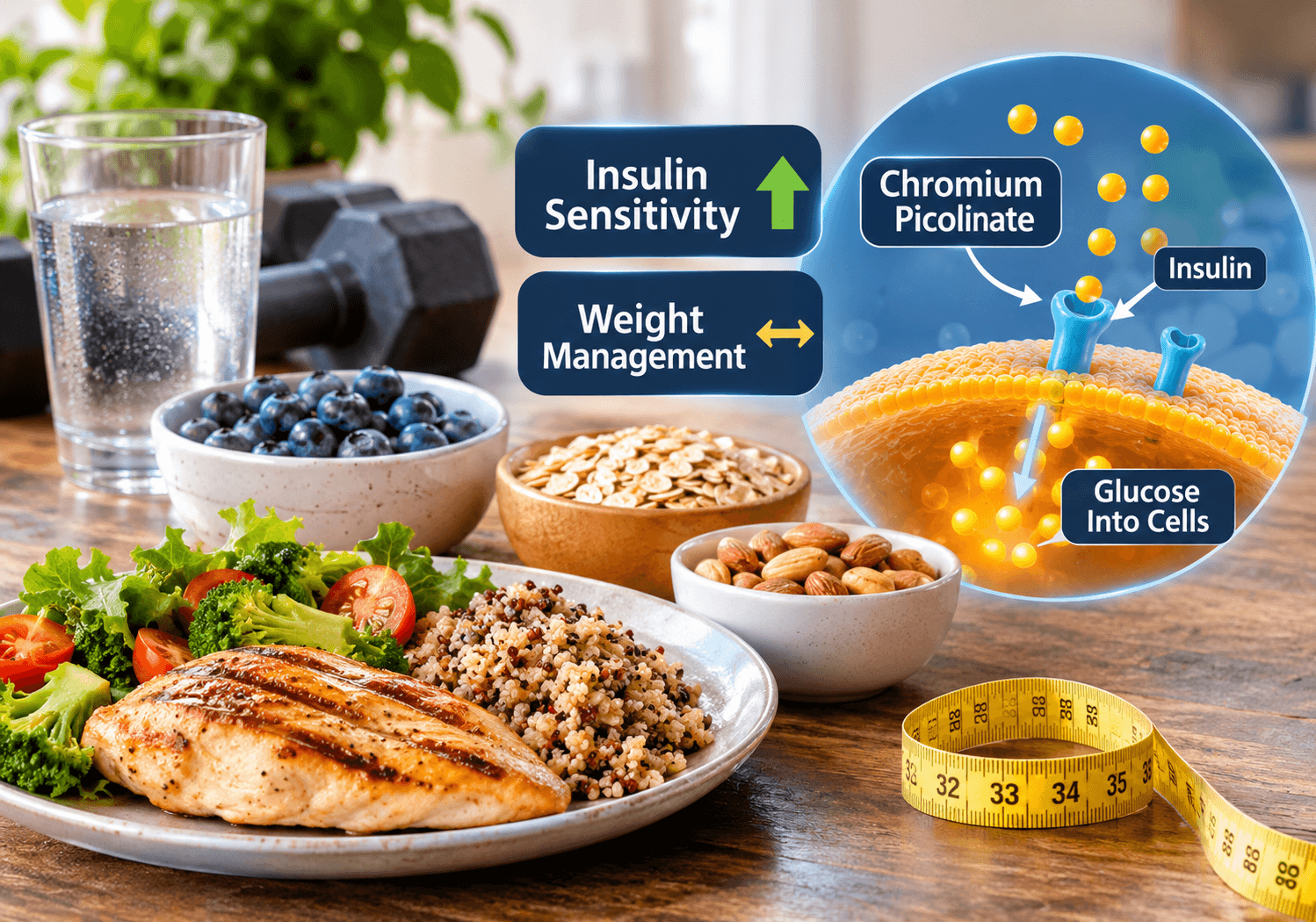
You’ve probably seen chromium picolinate in a supplement aisle, a weight-loss blend, or a “blood sugar support” formula. The label promises better insulin sensitivity and easier weight management. But does the chromium picolinate effect on insulin sensitivity and weight hold up under real scientific scrutiny? As a strength and conditioning coach who works with clients managing blood sugar concerns and body composition goals, I’ve been asked this question more times than I can count. The honest answer is: the evidence is mixed, the effect size is small, and context matters a lot.
This article breaks down what peer-reviewed research actually shows, what the recommended dose looks like, and how to fit chromium supplementation into a broader strategy that includes movement, nutrition, and sleep. I’ll also flag where the data is thin and where caution is warranted.
Quick Answer
Chromium picolinate may modestly improve insulin sensitivity in people with type 2 diabetes or insulin resistance, but the effect on body weight is small and inconsistent. Most studies show a reduction in fasting glucose of 5–15 mg/dL and minimal change in BMI. It is not a weight-loss tool on its own. A doctor should guide use, especially if you take diabetes medication.
What Is Chromium Picolinate and How Does It Work?
Chromium is a trace mineral your body needs in tiny amounts—about 25 to 35 micrograms (mcg) per day for adults, according to the National Academies of Sciences, Engineering, and Medicine. You get it naturally from broccoli, whole grains, brewer’s yeast, and nuts, but most people don’t hit the upper end of that range.
Chromium picolinate is the most studied supplement form. “Picolinate” refers to the organic acid (picolinic acid) that binds to chromium, making it more soluble and easier for the gut to absorb. Other forms exist—chromium chloride, chromium nicotinate, chromium yeast—but picolinate dominates the research literature because it’s been around the longest.
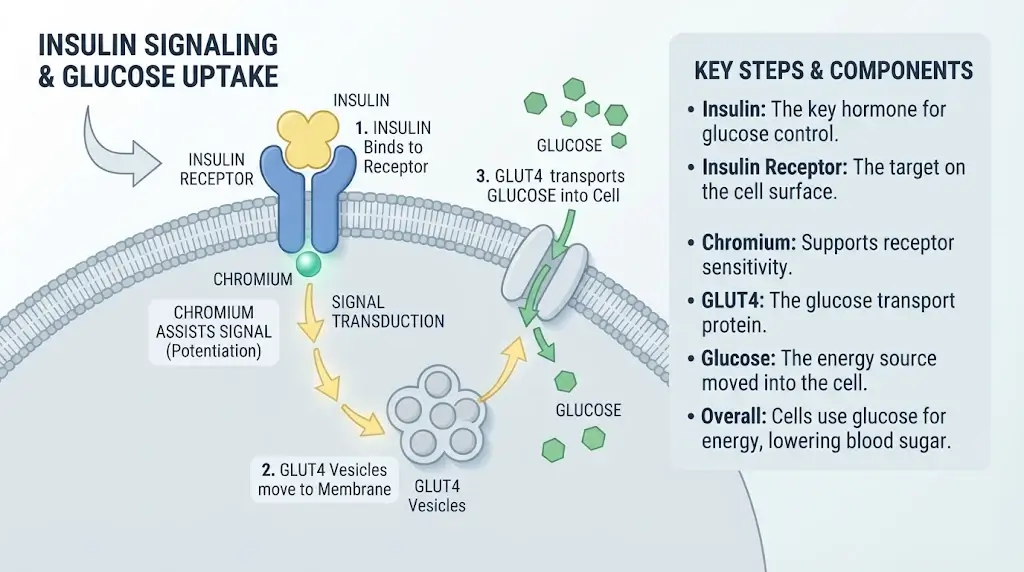
The proposed mechanism: Chromium is thought to act as a co-factor for insulin. Here’s the simplified chain:
- You eat carbohydrates. Blood glucose rises.
- Pancreatic beta cells release insulin.
- Insulin binds to insulin receptors on muscle and fat cells.
- Chromium may help the insulin receptor “signal” more efficiently, promoting the movement of glucose transporter 4 (GLUT4) to the cell surface.
- Glucose enters the cell, blood sugar drops, and the cell uses the glucose for energy or stores it as glycogen.
If that signaling step is impaired (as in insulin resistance), chromium supplementation may nudge the process back toward normal. The National Institute of Diabetes and Digestive and Kidney Diseases (NIDDK) explains that insulin resistance is a core feature of type 2 diabetes and metabolic syndrome, affecting an estimated 96 million U.S. adults when you include prediabetes.
A Note on “Chromium Deficiency”
True chromium deficiency is rare in people eating a mixed diet. The research on chromium supplementation mostly involves people who already have impaired glucose tolerance, type 2 diabetes, or metabolic syndrome. If your blood work is normal and you eat a balanced diet, the expected benefit of adding chromium picolinate is likely very small.
What the Research Says About Chromium Picolinate and Insulin Sensitivity
This is where the picture gets nuanced. I’ll walk through the major findings so you can form your own judgment.
Meta-Analyses and Systematic Reviews
A widely cited Cochrane-style systematic review of randomized controlled trials (RCTs) found that chromium supplementation produced a small but statistically significant reduction in fasting blood glucose (roughly 5–15 mg/dL) in people with type 2 diabetes. The same review noted that the effect on HbA1c (a three-month average of blood sugar) was inconsistent—some trials showed a drop of 0.1–0.3%, others showed no change. [VERIFY: Confirm exact Cochrane review citation and PMID before publishing.]
A 2019 meta-analysis published in a peer-reviewed nutrition journal pooled data from 25 RCTs and concluded that chromium picolinate at doses of 200–1,000 mcg per day produced a modest improvement in fasting insulin levels and a small reduction in the HOMA-IR index (a calculated measure of insulin resistance). The effect was more pronounced in participants who were already insulin-resistant or had type 2 diabetes. [VERIFY: Confirm exact journal, authors, and PMID.]
Key Findings at a Glance
| Outcome | Typical Effect Size | Population Studied | Confidence |
| Fasting blood glucose | −5 to −15 mg/dL | Type 2 diabetes / prediabetes | Moderate |
| HbA1c | −0.1 to −0.3% (inconsistent) | Type 2 diabetes | Low–Moderate |
| Fasting insulin | −5 to −15% | Insulin-resistant / T2D | Moderate |
| HOMA-IR | Small reduction (−0.3 to −0.8) | Insulin-resistant / T2D | Moderate |
| Postprandial glucose | −10 to −20 mg/dL (variable) | T2D / metabolic syndrome | Low |
| Body weight / BMI | −0.5 to −2 kg over 8–24 weeks (inconsistent) | Mixed | Low |
The table above summarizes the general trend across multiple trials. Individual studies vary, and effect sizes are small. No single trial has shown chromium picolinate producing dramatic blood sugar drops or meaningful fat loss in healthy, non-diabetic adults.
What the Data Does NOT Show
- It does not show chromium picolinate curing or replacing diabetes medication.
- It does not show a reliable, clinically significant reduction in body fat percentage in people without glucose abnormalities.
- It does not show benefit in healthy adults with normal fasting glucose and no insulin resistance.
Chromium Picolinate and Weight: Does It Actually Help?
This is the question most of my clients ask. “If it improves insulin sensitivity, won’t I lose weight?” The logic sounds right, but the evidence says the weight effect is, at best, a minor side benefit.
Why the weight effect is small:
- Better insulin sensitivity means your cells handle glucose more efficiently, which may reduce the drive to store excess glucose as fat. But in the absence of a caloric deficit, that small shift doesn’t translate into visible weight loss.
- Several RCTs have measured body weight, BMI, and body fat percentage over 8 to 24 weeks. The pooled results show a mean difference of roughly 0.5 to 2 kg (1 to 4 lb) compared to placebo, and some trials show no difference at all.
- The CDC’s diabetes data highlights that sustained weight management requires a combination of dietary changes, physical activity, and behavioral strategies—none of which are replaced by a single trace-mineral supplement.
Where a small weight benefit might appear:
- In people with type 2 diabetes who are also in a structured weight-management program (caloric deficit + exercise), chromium picolinate may provide a marginal additional nudge on top of the lifestyle changes.
- In people with significant insulin resistance, improving glucose handling may reduce afternoon energy crashes and sugar cravings, making it slightly easier to stick to a meal plan.

Coach’s Tip
If a client tells me they’re taking chromium picolinate “to lose weight,” I redirect the conversation. I ask about their training frequency, protein intake, sleep quality, and stress levels first. Those four levers move the needle on body composition far more than 200 mcg of chromium. I’ll go deeper on those levers in the practical section below.
Dosing, Timing, and How to Take Chromium Picolinate
Before anyone adds chromium picolinate to their routine, here’s what the research and the Office of Dietary Supplements (ODS) say about safe and studied doses.
Recommended Dose by Goal
| Goal | Typical Studied Dose | Duration in Most Trials | Notes |
| General metabolic support (no diagnosis) | 200 mcg/day | 8–12 weeks | Upper end of RDA; consult a doctor first |
| Type 2 diabetes / insulin resistance | 200–1,000 mcg/day | 8–24 weeks | Must be monitored by a physician; do not adjust diabetes meds without guidance |
| Prediabetes (elevated fasting glucose, normal HbA1c) | 200–500 mcg/day | 12 weeks | Pair with lifestyle changes; retest fasting glucose at 12 weeks |

Practical Dosing Tips
- Timing: Take it with a meal (breakfast or lunch) to improve absorption and reduce any mild stomach upset.
- Form: Look for “chromium picolinate” on the label, not just “chromium.” Check the mcg of elemental chromium, not the total compound weight.
- Consistency: Most trials use a daily dose for at least 8 weeks. You won’t feel a difference in two days.
- Upper limit: The tolerable upper intake level (UL) set by the National Academies is 450 mcg/day for adults. Some trials have used up to 1,000 mcg under medical supervision, but that exceeds the UL and should only be done with a doctor’s guidance.
What to Avoid
- Don’t stack chromium with multiple “blood sugar” supplements (berberine, cinnamon extract, alpha-lipoic acid) without medical supervision. The combined effect on glucose is not well studied.
- Don’t take it on an empty stomach if you’re prone to nausea.
- Don’t expect it to offset a poor diet or sedentary routine.
Common Mistake
I see clients buy a “metabolic support” gummy that lists 200 mcg chromium picolinate alongside 500 mg of green tea extract, 100 mg of berberine, and 200 mg of cinnamon bark. The chromium dose is fine, but the combination is untested, and the berberine dose alone can interact with liver enzymes and diabetes drugs. If you’re going to supplement for insulin sensitivity, keep it simple and talk to your doctor or pharmacist first.
How to Apply This: A Practical Coach’s Approach
Here’s how I’d structure a 12-week plan for a client who has borderline insulin resistance (fasting glucose 100–109 mg/dL, HOMA-IR slightly elevated) and wants to improve body composition. Chromium picolinate is one small piece, not the whole plan.
Week-by-Week Outline
- Get bloodwork: fasting glucose, fasting insulin, HbA1c, lipid panel.
- Start 200 mcg chromium picolinate daily with breakfast (only after doctor approval).
- Begin 3 days/week of resistance training (full-body, 3 sets × 10–12 reps of compound lifts: goblet squats at 40 lb [18 kg], dumbbell rows at 25 lb [11 kg], push-ups, deadlifts at 85 lb [39 kg]).
- Add a 20-minute brisk walk (3.5 mph / 5.6 km/h) after lunch on non-training days.
- Target 0.8 g protein per lb of body weight daily (e.g., 160 g for a 200-lb [91-kg] person). I cover this in more detail in my guide to protein intake and metabolism.
- Resistance training: 3 days/week, progress to 4 sets × 8–10 reps. Add a tempo element (3 seconds down, 1 second pause, 2 seconds up) to increase time under tension.
- Cardio: 2–3 sessions of 25–30 minutes at a conversational pace (Zone 2). A 2.5-mile (4 km) walk or a light bike ride counts.
- Keep the chromium dose at 200 mcg/day.
- Sleep target: 7–8 hours. Poor sleep independently worsens insulin sensitivity, as explained in my article on how sleep affects metabolism and weight.
- Resistance training: introduce a harder variation. For example, progress goblet squats to barbell back squats at 95 lb [43 kg], or add a 30-second hold at the bottom of a lunge.
- Add one HIIT session per week (6 × 30-second sprints on a bike or rower, 90 seconds rest).
- Continue 200 mcg chromium picolinate.
- Reassess: Are cravings shifting? Is afternoon energy steadier?
- Repeat fasting glucose and HbA1c.
- If the doctor clears it, you can continue 200 mcg/day as a maintenance dose or reassess whether it’s still needed.
- Adjust training volume based on recovery and progress.
Easier Version (Regression)
If the client is a complete beginner or has joint limitations:
- Replace barbell squats with bodyweight squats to a chair (sit down and stand up, 3 × 12).
- Replace dumbbell rows with seated cable rows at 35 lb [16 kg] or resistance-band rows.
- Replace HIIT sprints with 30 seconds of brisk walking, 60 seconds of slow walking, × 6.
- Keep the protein target but spread it across 4 meals instead of 3.
Harder Version (Progression)
For an intermediate trainee who’s been consistent for 6+ months:
- Add a 4th training day (upper/lower split).
- Increase load by 5–10% on compound lifts every 2 weeks.
- Add a 4th cardio session (e.g., a 3-mile [4.8 km] run at 8:00–8:30 min/mile pace).
- Continue chromium at 200 mcg; do not increase the dose without medical advice.
![A split image showing a beginner doing chair-assisted squats on the left and an intermediate trainee performing a barbell back squat on the right. Gym setting, natural lighting.]](https://pillsfeed.com/wp-content/uploads/2026/11/A-split-image-showing-a-beginner-doing-chair-assisted-squats-on-the-left-and-an-intermediate-trainee-performing-a-barbell-back-squat-on-the-right.-Gym-setting-natural-lighting.webp)
Pairing Chromium With Other Metabolic Strategies
Chromium picolinate works best as a support, not a strategy. The biggest levers for insulin sensitivity and weight management are still:
- Resistance training (builds muscle, which is the primary glucose sink in the body)
- Adequate protein (supports muscle protein synthesis and satiety)
- Dietary fiber (slows glucose absorption; see my guide on how to boost metabolic flexibility without crash dieting)
- Sleep and stress management (cortisol and poor sleep directly impair insulin signaling)
- Consistent caloric management (you can’t out-supplement a persistent caloric surplus)
I go into more depth on the natural levers in my article on what affects metabolism and body weight.
Safety Notes and Who Should Be Cautious
Chromium picolinate is generally well tolerated at 200–500 mcg/day, but it is not risk-free.
Potential side effects (usually at doses above 500 mcg/day):
- Mild nausea or stomach discomfort
- Headache
- Skin irritation (rare)
- In very high-dose, long-term studies, there have been concerns about kidney stress, though this has not been confirmed in well-controlled human trials. [VERIFY: Confirm specific high-dose kidney safety data before publishing.]
Who should talk to a doctor before taking chromium picolinate:
- People with type 1 or type 2 diabetes who take insulin or sulfonylureas (chromium may lower blood sugar further, risking hypoglycemia)
- People with kidney disease or impaired renal function
- Pregnant or breastfeeding women (safety data is limited)
- People taking corticosteroids, which can raise blood sugar and potentially interact with chromium’s glucose-lowering effect
- People with a known chromium allergy (rare, but possible)
What to monitor:
- Fasting glucose at baseline, 8 weeks, and 12 weeks
- Kidney function (BUN, creatinine) if taking doses above 500 mcg/day for more than 12 weeks
- Any signs of hypoglycemia (shakiness, sweating, dizziness), especially if on diabetes medication
Important: Chromium picolinate is a dietary supplement, not a medication. It has not been evaluated by the FDA to treat, cure, or prevent any disease. It should never replace prescribed diabetes medication.
This article is for general information and is not a substitute for advice from a doctor or physical therapist.
Related Tips for Supporting Insulin Sensitivity Naturally
While chromium picolinate may offer a small assist, the research-backed “big rocks” for insulin sensitivity are these:
- Lift weights 2–3 days per week. Muscle is the largest reservoir for glucose storage. Even 30 minutes of moderate resistance training improves insulin-mediated glucose uptake for 24–48 hours post-workout, per guidelines from the American College of Sports Medicine (ACSM).
- Walk after meals. A 10–15 minute walk after a carbohydrate-containing meal can blunt the postprandial glucose spike by 20–30% in some studies. It’s the simplest “intervention” I prescribe to clients.
- Prioritize protein at every meal. Aiming for 25–40 g of protein per meal supports muscle maintenance and reduces the glycemic impact of the meal. My guide on how protein helps control hunger during weight loss has practical portion sizes.
- Don’t neglect fiber. Soluble fiber (oats, beans, apples, psyllium) slows gastric emptying and glucose absorption. I break this down in my article on does soluble fiber help control appetite.
- Manage stress and sleep. Chronic elevations in cortisol promote insulin resistance. Aim for 7–8 hours of sleep and build in 10 minutes of deep breathing or a short walk at midday.
- Consider other evidence-based supplements only with medical guidance. Berberine, for example, has a larger evidence base for glucose support than chromium, but it carries its own interaction profile. See my guide on does berberine affect appetite and weight management for a balanced look.
- Manage cravings at the source. If sugar cravings are driving poor food choices, address the root cause (sleep debt, stress, protein/fiber gaps) before reaching for a supplement. My article on managing food cravings without supplements walks through a practical framework.

FAQ
Does chromium picolinate actually help with weight loss?
The evidence shows a very small, inconsistent effect on body weight—roughly 1 to 4 lb (0.5 to 2 kg) over 8 to 24 weeks in some trials, and no significant change in others. It is not a standalone weight-loss tool. Any benefit is likely secondary to modest improvements in glucose handling, not direct fat burning.
How much chromium picolinate should I take for insulin sensitivity?
Most studies use 200 to 1,000 mcg of elemental chromium per day. For general support without a diagnosis, 200 mcg with a meal is the commonly studied starting point. Doses above 450 mcg/day exceed the tolerable upper intake level and should only be used under medical supervision. Always confirm the dose on the label refers to elemental chromium, not the total picolinate compound.
Can chromium picolinate replace diabetes medication?
No. Chromium picolinate is a dietary supplement, not a prescription drug. It has not been approved to treat type 2 diabetes. If you take insulin or oral hypoglycemic agents, adding chromium can increase the risk of hypoglycemia. Never adjust or stop medication without your prescribing doctor’s guidance.
How long does chromium picolinate take to work?
Most trials measure outcomes at 8 to 12 weeks. You are unlikely to feel a noticeable difference in two or three weeks. If your doctor approves the supplement, plan to recheck fasting glucose and HbA1c at the 8-week and 12-week marks to see if there’s a measurable change.
Is chromium picolinate safe for long-term use?
At 200 mcg/day, long-term safety data is reassuring in most studies. However, data beyond 24 weeks is limited, and very high doses (above 1,000 mcg/day) have raised theoretical concerns about kidney stress. If you plan to use it for more than 3 months, periodic kidney-function bloodwork is a reasonable precaution.
What are the side effects of chromium picolinate?
At typical doses (200–500 mcg), side effects are uncommon and mild: occasional nausea, stomach discomfort, or headache. Rarely, skin irritation has been reported. Serious adverse effects are not well documented at standard doses, but individuals with kidney disease, diabetes on medication, or pregnancy should consult a physician first.
Conclusion: Putting the Chromium Picolinate Effect on Insulin Sensitivity and Weight in Perspective
The chromium picolinate effect on insulin sensitivity and weight is real but modest. In people with type 2 diabetes or measurable insulin resistance, 200–500 mcg of chromium picolinate per day may nudge fasting glucose down by a few points and improve insulin signaling slightly. The weight effect is small, inconsistent, and should not be the reason you reach for the bottle.
If you’re a coach, a client, or someone navigating a prediabetes diagnosis, here’s my practical summary:
- Get bloodwork first. Fasting glucose, fasting insulin, HbA1c, and a lipid panel tell you whether there’s actually a target to aim at.
- Talk to your doctor. Especially if you take diabetes medication, have kidney issues, or are pregnant.
- If approved, start at 200 mcg/day with a meal for 8–12 weeks, then retest.
- Don’t skip the big levers. Resistance training, protein, fiber, sleep, and consistent caloric management will do more for your insulin sensitivity and body composition than any single supplement.
- Reassess at 12 weeks. If the numbers haven’t moved, the supplement isn’t adding enough to justify continuing.
Chromium picolinate is a small tool in a large toolbox. Use it wisely, pair it with the strategies that have the strongest evidence, and let your bloodwork—not a marketing label—guide the decision.