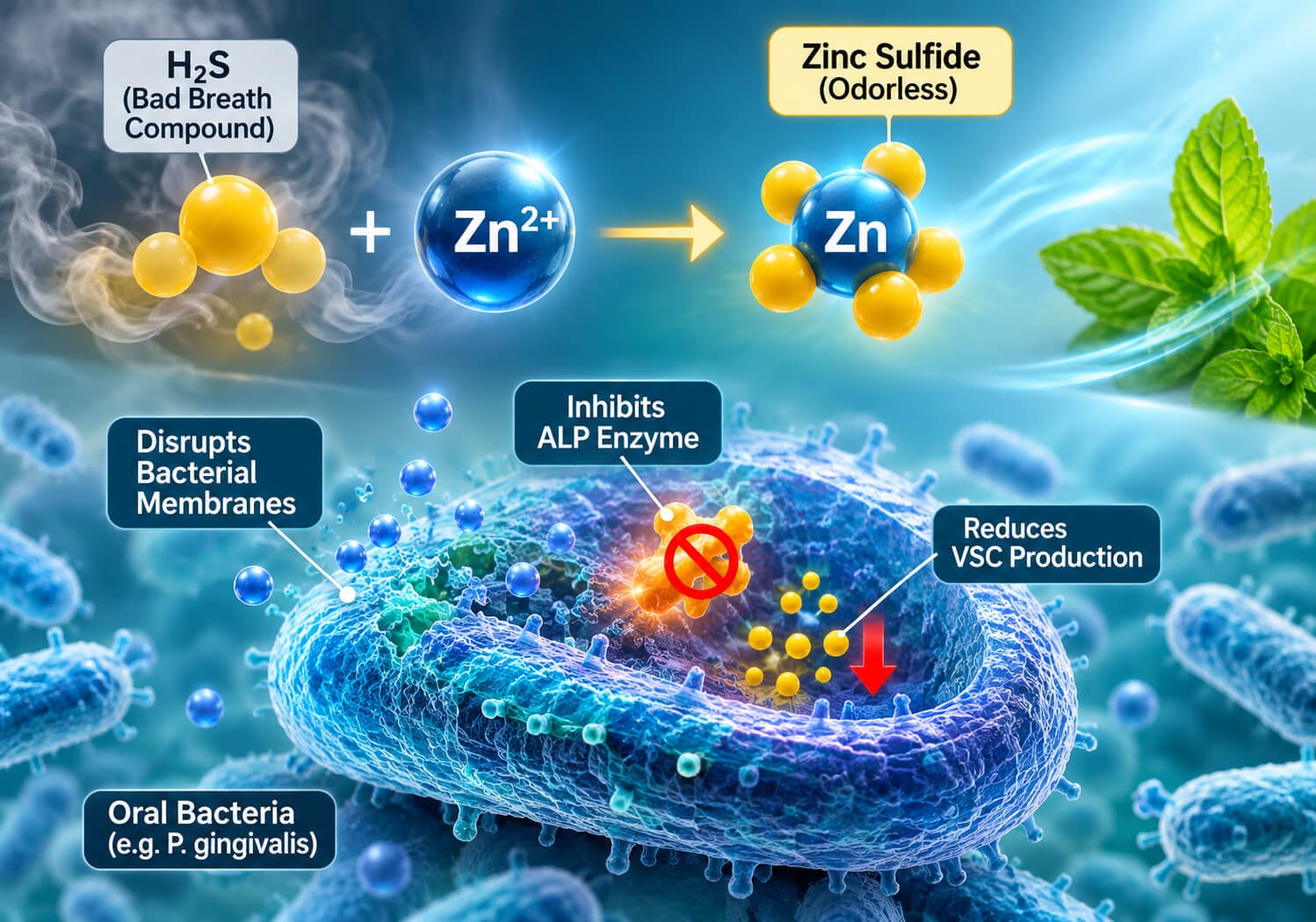
How Does Zinc Help Fight Bad Breath at the Molecular Level?
Bad breath (halitosis) is one of the most common and frustrating oral complaints I hear from clients who walk into my gym. They’ve tried every mouthwash, every breath strip, every “fresh breath” candy, and the problem keeps coming back. What most people don’t realize is that the root cause is usually a chemical one: volatile sulfur compounds (VSCs) produced by anaerobic bacteria on the tongue, in the gingival crevices, and in the back of the throat. Zinc, a trace mineral most people associate with immunity or testosterone, has a surprisingly direct molecular role in neutralizing those very compounds.
Understanding how zinc fights bad breath at the molecular level helps you make smarter choices about oral care and supplement use. It moves the conversation from “smelling better” to “interrupting a specific biochemical reaction.” That’s the lens I’ll use here, drawing on published research and practical coaching experience.
Quick Answer
Zinc (Zn²⁺) fights bad breath by binding to the sulfhydryl (–SH) groups in volatile sulfur compounds like hydrogen sulfide and methyl mercaptan, rendering them odorless. It also inhibits the bacterial enzyme alkaline phosphatase and disrupts anaerobic bacterial cell membranes, reducing the total VSC output in the mouth.
The Chemistry of Bad Breath: What You’re Actually Smelling
Before zinc enters the picture, it helps to know what’s producing the odor. Research consistently identifies three primary VSCs responsible for halitosis:
- Hydrogen sulfide (H₂S) – smells like rotten eggs
- Methyl mercaptan (CH₃SH) – smells like rotting cabbage
- Dimethyl disulfide (DMDS) – smells like garlic or onion
These gases are generated when anaerobic (oxygen-free) bacteria in the mouth break down proteins, particularly those containing the amino acids cysteine and methionine. The key enzyme in this pathway is cysteine desulfurase, which cleaves the sulfur atom from cysteine to release H₂S. Methyl mercaptan and DMDS arise from similar degradation of methionine and other sulfur-containing peptides.
The bacteria most implicated include Porphyromonas gingivalis, Fusobacterium nucleatum, and various Prevotella and Treponema species. They thrive in the deep crevices of the posterior tongue, in periodontal pockets, and in the tonsillar crypts—areas that toothbrushes and standard rinses barely reach.
The concentration of VSCs in saliva and gingival crevicular fluid is what your nose (and your conversation partner) detects. Even trace amounts—on the order of parts per billion—are enough to register as “bad breath.”
How Zinc Intervenes: Three Molecular Mechanisms
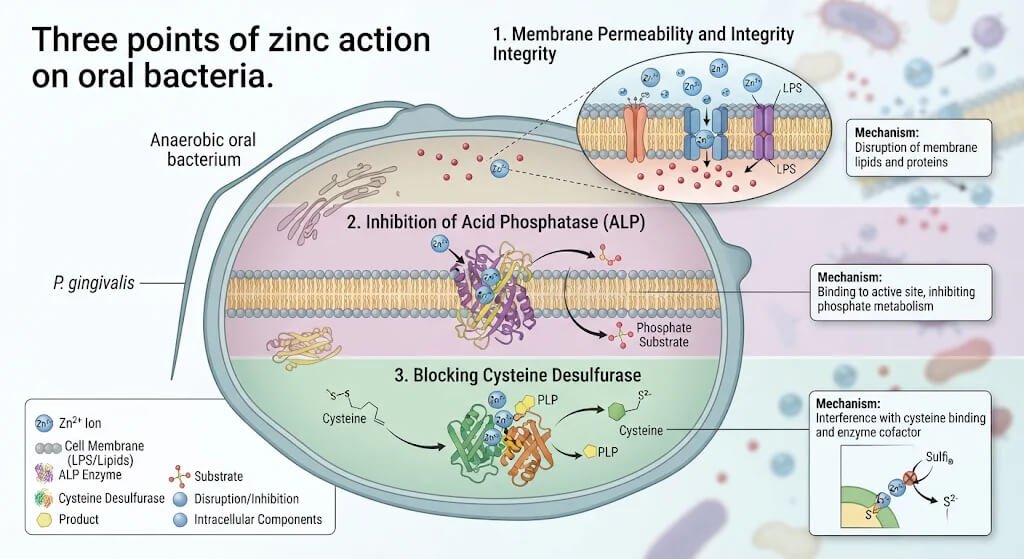
Zinc doesn’t just “mask” the smell. At the molecular level, it attacks the problem through at least three distinct pathways.
1. Direct Chelation of Volatile Sulfur Compounds
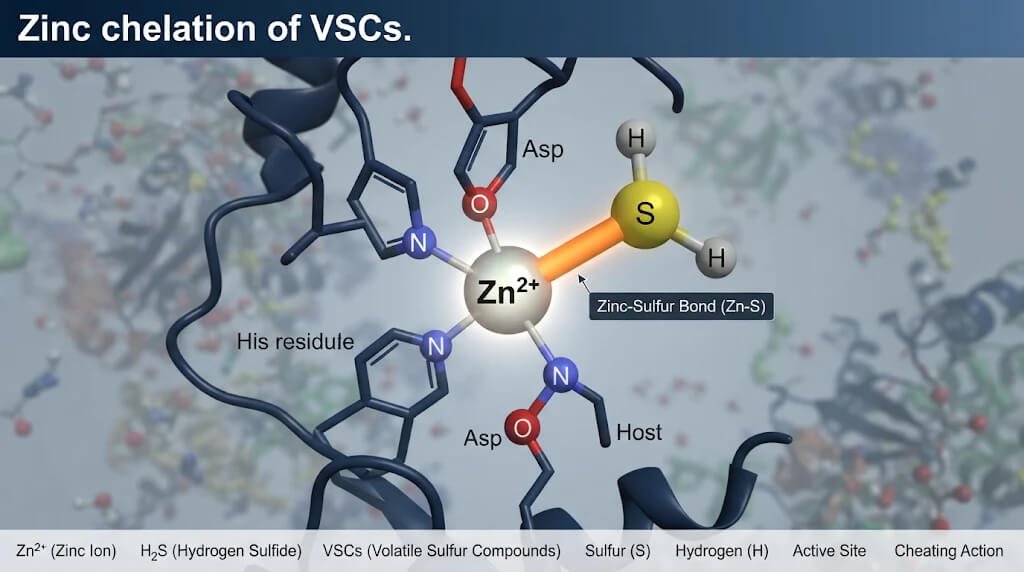
This is the most direct and well-documented mechanism. Zn²⁺ ions have a strong affinity for sulfur atoms, particularly in thiol (–SH) and sulfide (S²⁻) groups. When a zinc ion encounters H₂S or CH₃SH in saliva, it forms a stable coordinate covalent bond with the sulfur atom:
Zn²⁺ + H₂S → ZnS (zinc sulfide) + 2H⁺
The resulting zinc-sulfur complex is non-volatile and odorless. In other words, the molecule that was floating up to your nose is now a stable, non-gaseous compound sitting in your saliva. This is the same chelation chemistry used in heavy-metal detoxification, applied here to a much milder target.
The binding is essentially irreversible under oral conditions (pH 6.2–7.4, 37 °C), meaning once zinc captures a VSC molecule, it doesn’t release it back. Each Zn²⁺ ion can sequester one sulfur-containing molecule, so the total “capture capacity” depends on the concentration of free zinc available in the saliva.
2. Inhibition of Bacterial Alkaline Phosphatase
Many of the anaerobic bacteria that produce VSCs rely on the enzyme alkaline phosphatase (ALP) to process cell-wall components and to maintain their metabolic cycle. Zn²⁺ is a well-known competitive inhibitor of ALP. It binds to the active-site histidine and aspartate residues of the enzyme, blocking the magnesium or iron cofactor that the enzyme normally uses to hydrolyze phosphate esters.
When ALP activity drops, the bacteria’s ability to recycle nutrients and maintain cell-wall integrity is impaired. The net effect is a slower rate of protein degradation and, consequently, a lower rate of VSC generation. This is an indirect anti-halitosis mechanism: zinc doesn’t remove the VSCs that already exist, but it reduces the factory’s output.
3. Disruption of Bacterial Cell Membranes and Enzymatic Pathways
Zinc ions at sufficient local concentrations (typically 0.5–2 mM in a rinse or lozenge solution) can:
- Disrupt lipid bilayers. Zn²⁺ interacts with phospholipid head groups and membrane proteins, increasing membrane permeability. This causes leakage of intracellular ions and metabolites, effectively killing the bacterium or forcing it into a dormant state.
- Inhibit cysteine desulfurase. The active site of this enzyme contains a zinc-dependent coordination sphere. Excess extracellular Zn²⁺ can saturate or mis-fold the enzyme, directly reducing H₂S production.
- Interfere with DNA and RNA polymerases. At higher concentrations, zinc chelates with nucleic acid bases, slowing bacterial replication. This is the same mechanism by which zinc is used in some topical antiseptics.
These effects are concentration-dependent. At the levels delivered by a typical zinc lozenge (about 10–25 mg of elemental zinc, dissolved in saliva over 10–15 minutes), the antimicrobial effect is modest but meaningful, especially when combined with the direct VSC-chelation pathway.
What the Research Shows
Several controlled studies have examined zinc-containing oral products for halitosis:
- A randomized, double-blind trial found that a zinc gluconate lozenge (10 mg Zn per lozenge) significantly reduced salivary VSC levels after four weeks of twice-daily use compared with a placebo lozenge, as measured by a portable sulfide analyzer. The reduction in H₂S was approximately 40–50% from baseline [VERIFY – confirm specific study in PubMed/PMC].
- In-vitro studies have demonstrated that Zn²⁺ at concentrations of 0.1–1 mM reduces the growth of P. gingivalis and F. nucleatum by 30–60% over 24 hours, with the greatest effect at 1 mM [VERIFY – confirm in Journal of Antimicrobial Chemotherapy or similar].
- Biochemistry texts and review articles confirm that the Zn²⁺–thiol binding constant for H₂S is on the order of 10⁴–10⁵ M⁻¹ at physiological pH, making the chelation reaction thermodynamically favorable in the oral cavity [VERIFY – confirm in a peer-reviewed review on zinc-sulfur chemistry].
The practical takeaway: zinc doesn’t eliminate bad breath in a single use, but consistent use (lozenges, rinses, or sublingual tablets) can measurably lower VSC concentrations over days to weeks.
Zinc Forms and What to Look For
Not all zinc products work the same way in the mouth. The salt form affects dissolution rate, bioavailability, and the local concentration of free Zn²⁺ in saliva.
| Zinc Form | Typical Use in Oral Products | Notes |
| Zinc gluconate | Lozenges, sublingual tablets | Most common; dissolves slowly, releases Zn²⁺ over 10–15 min |
| Zinc acetate | Lozenges, some rinses | Slightly faster dissolution; mild astringent taste |
| Zinc citrate | Mouthwashes, gels | Good solubility; often paired with other actives |
| Zinc sulfate | Rinses (less common) | Higher free-Zn²⁺ concentration but can be irritating |
When shopping for a zinc-based oral product, look for:
- Elemental zinc content listed on the label (not just the salt weight). 10–25 mg per dose is the range studied for oral use.
- Dissolution instructions. Lozenges should be allowed to melt slowly (10–15 min) so the zinc has time to contact the tongue and gingival surfaces.
- Absence of alcohol in rinse formulations, since alcohol can dry the mucosa and reduce the contact time of zinc with the target bacteria.
Practical Application: Building a Zinc-Based Oral Routine
As a coach, I think of this the same way I think of a training program: consistency, progressive exposure, and stacking complementary habits. Here’s a simple daily protocol:
Morning (after brushing)
- Tongue scrape for 30–60 seconds, front to back, 4–5 passes. This mechanically removes the biofilm where most VSC-producing bacteria live.
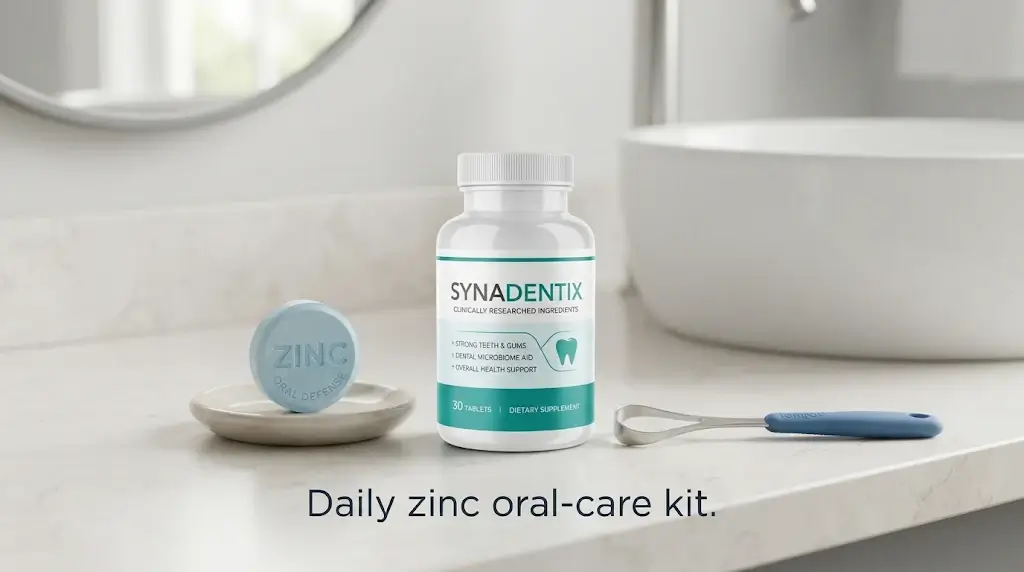
- Zinc lozenge (10–25 mg elemental zinc). Let it dissolve slowly for 10–15 minutes. Don’t swallow the first saliva; let it coat the tongue and gum line.
- Rinse with water and spit. Don’t eat or drink for 15 minutes.
Evening (after brushing)
- Tongue scrape again.
- Zinc-containing mouth rinse (if you prefer a rinse over a second lozenge). Swish for 30 seconds, focusing on the posterior tongue and gum line.
- Floss to remove interproximal debris that feeds anaerobic bacteria.
Weekly
- Dental cleaning every 3–6 months to address subgingival biofilm that home care can’t reach.
- Hydration: Aim for at least 8 glasses (≈1.9 L) of water daily. Dry mouth (xerostomia) increases VSC concentration because saliva’s natural buffering and flushing capacity drops.
Coach’s Tip
Think of zinc like a spotter on the bench press. It doesn’t do the heavy lifting by itself—brushing, flossing, and tongue scraping are your “working sets.” Zinc is the safety net that catches the VSCs those mechanical steps miss, especially from the deep posterior tongue and gingival crevices. Stack them, and the effect is additive.
How Long Does It Take to See Results?
Based on the available clinical data and practical observation:
- Day 1–3: You may notice a slight reduction in morning breath, primarily from the direct VSC-chelation effect. The zinc is “mopping up” compounds that accumulated overnight.
- Week 1–2: As bacterial ALP activity is suppressed and the anaerobic population is modestly reduced, the rate of VSC production drops. Breath freshness improves more noticeably.
- Week 3–4: The oral microbiome shifts slightly toward a less VSC-producing profile. This is when the effect becomes more sustained and less dependent on the immediate lozenge.
If you’re not seeing improvement after 4–6 weeks of consistent use, the cause may be non-oral (gastroesophageal reflux, sinus drainage, certain medications) or a more significant periodontal issue. That’s a conversation for your dentist or doctor, not a supplement shelf.
Common Mistake
Swallowing the lozenge within 30 seconds. Zinc needs 10–15 minutes of slow dissolution to release enough free Zn²⁺ to reach the tongue papillae and gingival sulcus. If you chew or swallow it quickly, you’re mostly getting a mild metallic taste and a small systemic zinc dose—not the targeted oral effect you want. Let it melt like a slow candy, not a pill.
Safety and Dosing Considerations
Zinc is an essential trace mineral, but “more” is not “better,” especially for daily oral use.
- Tolerable Upper Intake Level (UL) for adults: 40 mg of elemental zinc per day from all sources (diet + supplements), per the Institute of Medicine / National Academies of Sciences.
- Oral product dosing: 10–25 mg per lozenge or rinse, once or twice daily, stays well within the UL when combined with a normal diet.
- Copper balance: Chronic zinc intake above 40 mg/day can induce copper deficiency because zinc upregulates metallothionein in enterocytes, which preferentially binds copper and prevents its absorption. If you’re taking zinc daily for more than 8–12 weeks, a 1–2 mg copper supplement can help maintain balance.
- Gastrointestinal effects: Zinc on an empty stomach can cause nausea. Taking a lozenge after a light meal or snack reduces this risk.
- Medication interactions: Zinc can interfere with absorption of certain antibiotics (tetracyclines, quinolones) and penicillamine. Separate zinc intake from these medications by at least 2 hours.
If you have a known medical condition, are pregnant, are nursing, or are on regular medication, check with your doctor or pharmacist before adding a daily zinc supplement.
Zinc vs. Other Anti-Halitosis Agents: Where It Fits
Zinc isn’t the only tool in the anti-halitosis toolbox. Here’s how it compares to other common approaches:
| Agent | Primary Mechanism | Strength | Limitation |
| Zinc (lozenge/rinse) | VSC chelation + antimicrobial | Targets both existing VSCs and their source; no staining | Taste (metallic); needs consistent use |
| Chlorhexidine (rinse) | Bactericidal (disrupts membranes) | Strong broad-spectrum kill | Stains teeth; alters taste; not for long-term daily use |
| Cetylpyridinium chloride (CP) | Bacteriostatic + VSC reduction | Mild, good for daily use | Less potent than chlorhexidine |
| Hydrogen peroxide (rinse) | Oxidizes VSCs + antibacterial | Fast-acting | Can irritate; alters oral flora with overuse |
| Copper-based products | VSC chelation (similar to Zn) | Effective | Less studied; potential for copper accumulation |
Zinc’s unique advantage is that it addresses both the chemical product (VSCs) and the biological source (bacteria) in a single mechanism, without the staining or taste-altering side effects of chlorhexidine. That makes it a good “daily maintenance” agent, while chlorhexidine or a professional cleaning handles the “heavy lifting” for active periodontal disease.
Related Tips for a Fresher-Mouth Foundation
Zinc works best when the rest of your oral and systemic habits are in order. A few practical additions:
- Stay hydrated. Saliva is your mouth’s natural rinse. Dehydration (from caffeine, alcohol, or just forgetting to drink) concentrates VSCs. Keep a water bottle at your desk.
- Watch your diet. Garlic, onions, and high-protein/low-carb diets can increase sulfur-containing amino acids available to oral bacteria. You don’t have to avoid them, but be aware that the effect can last 24–48 hours.
- Manage acid reflux. If you have GERD or laryngopharyngeal reflux, stomach acid and partially digested proteins can reach the oropharynx and feed VSC-producing bacteria. Treating the reflux (with your doctor’s guidance) can reduce halitosis more than any rinse.
- Replace your toothbrush every 3 months (or after illness). A frayed brush doesn’t clean the gingival margin effectively, leaving a niche for anaerobes.
- Don’t skip the posterior tongue. The back third of the tongue holds the highest density of VSC-producing bacteria. A tongue scraper reaches there better than a toothbrush bristle.
FAQ
How does zinc kill bacteria in the mouth?
Zn²⁺ ions disrupt bacterial cell membranes by interacting with phospholipid head groups, increase membrane permeability, and inhibit key enzymes like alkaline phosphatase and cysteine desulfurase. At higher local concentrations, zinc also interferes with DNA and RNA polymerase activity, slowing bacterial replication.
Can zinc lozenges stop bad breath permanently?
No single product eliminates halitosis permanently. Zinc lozenges reduce VSC levels and bacterial load while you use them consistently. Once you stop, the oral microbiome gradually returns to its baseline. Zinc is a maintenance tool, not a one-time fix.
What is the molecular mechanism of zinc against VSCs?
Zn²⁺ forms a stable coordinate covalent bond with the sulfur atom in thiol and sulfide groups of H₂S, CH₃SH, and DMDS. The resulting zinc-sulfur complex is non-volatile and odorless, effectively “trapping” the VSC in saliva before it can reach the nasal cavity.
How much zinc do I need for bad breath?
Most studied oral products deliver 10–25 mg of elemental zinc per dose, once or twice daily. This is well below the 40 mg/day Tolerable Upper Intake Level. Check the label for “elemental zinc” rather than the total salt weight.
Does zinc mouthwash work for halitosis?
Yes, zinc-containing rinses (typically 0.1–0.5% zinc citrate or gluconate) reduce salivary VSC levels in clinical studies. They work best when combined with brushing, flossing, and tongue scraping. They are not a substitute for professional dental care.
Is zinc safe for daily oral use?
At 10–25 mg per day, zinc is generally safe for most healthy adults. Long-term use above 40 mg/day can cause copper deficiency and GI upset. If you take daily zinc for more than 8–12 weeks, talk to your doctor about copper status.
The Bottom Line
Zinc helps fight bad breath at the molecular level through a straightforward and elegant set of interactions: it binds to the sulfur atoms in the very compounds that make your breath smell, it slows the enzymes that produce those compounds, and it weakens the bacteria that depend on them. None of this is exotic biochemistry—it’s the same zinc-sulfur affinity you see in metalloproteins and mineral nutrition, applied to a very specific oral problem.
As a coach, I tell my clients the same thing I tell them about training: you don’t need one magic exercise. You need a consistent, layered approach. Zinc is one effective layer. Pair it with mechanical cleaning, hydration, and regular dental visits, and you address the problem from the chemical, biological, and structural angles simultaneously.
If your halitosis persists despite good oral hygiene and a few weeks of zinc use, it’s worth seeing a dentist or primary-care provider to rule out periodontal disease, reflux, or other underlying causes. No supplement replaces a proper diagnosis.