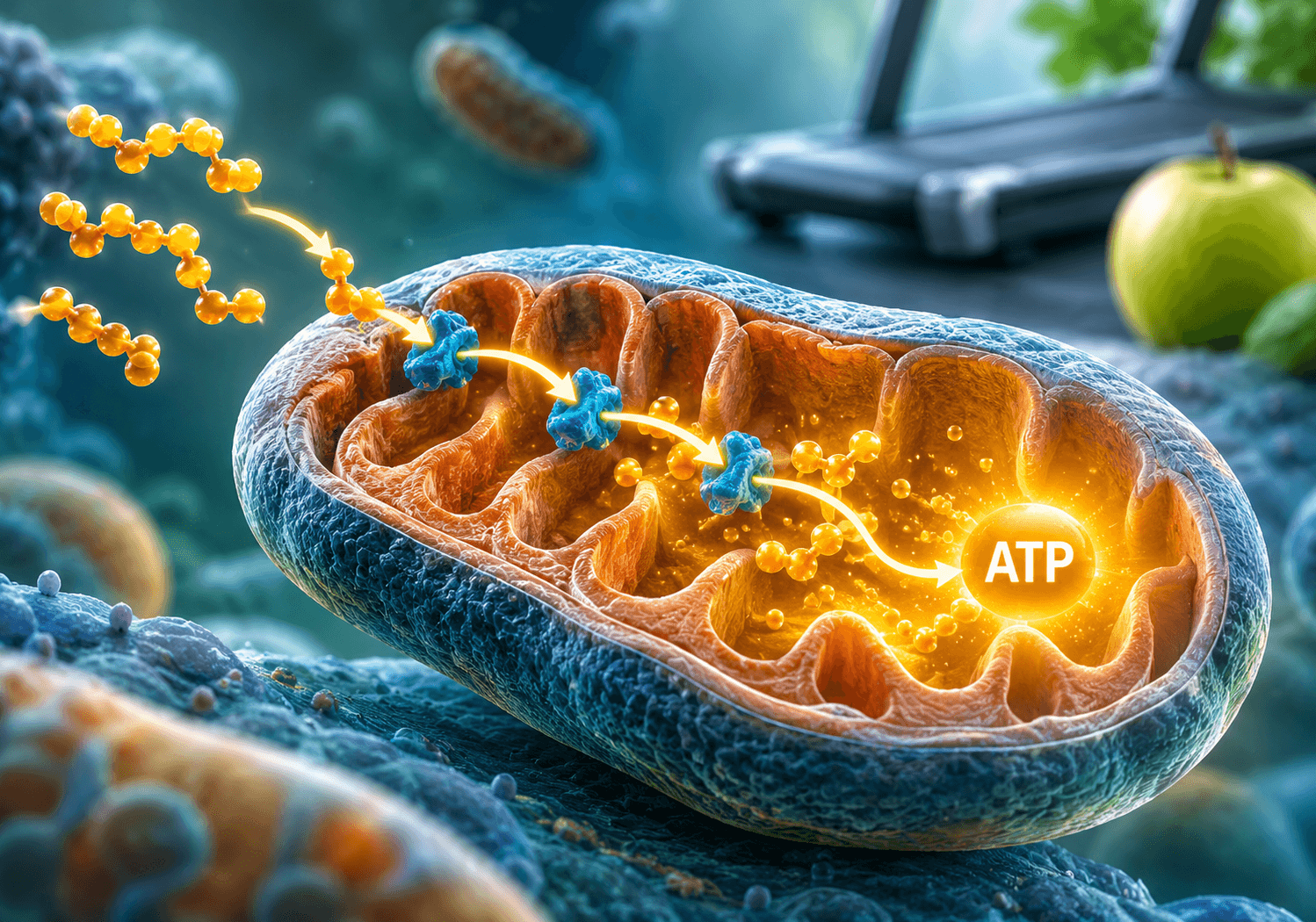
L-carnitine is one of the most searched fat-loss supplements on the market, and most product labels oversell it. The honest answer to how does l-carnitine support fat burning and cellular energy production starts inside your cells: L-carnitine is the shuttle that carries long-chain fatty acids into the mitochondria, where they are burned for fuel through beta-oxidation. Without enough carnitine, that transport slows down and your muscles shift toward burning more carbohydrate instead of fat. But a working shuttle only matters if there is fuel to move and a reason to burn it, which is where training and calorie intake come in. This guide explains the real mechanism, what the research actually shows, how I would use it as a coach, and who should be careful with it.
Quick Answer: L-carnitine transports long-chain fatty acids into your mitochondria so they can be burned for energy through beta-oxidation. Research suggests it may produce modest fat loss of about 2 lb (1 kg) over 8 to 24 weeks, mostly in people who are overweight and who also train and eat in a calorie deficit. It is not a standalone fat burner.
How Does L-Carnitine Support Fat Burning and Cellular Energy Production? The Science Explained
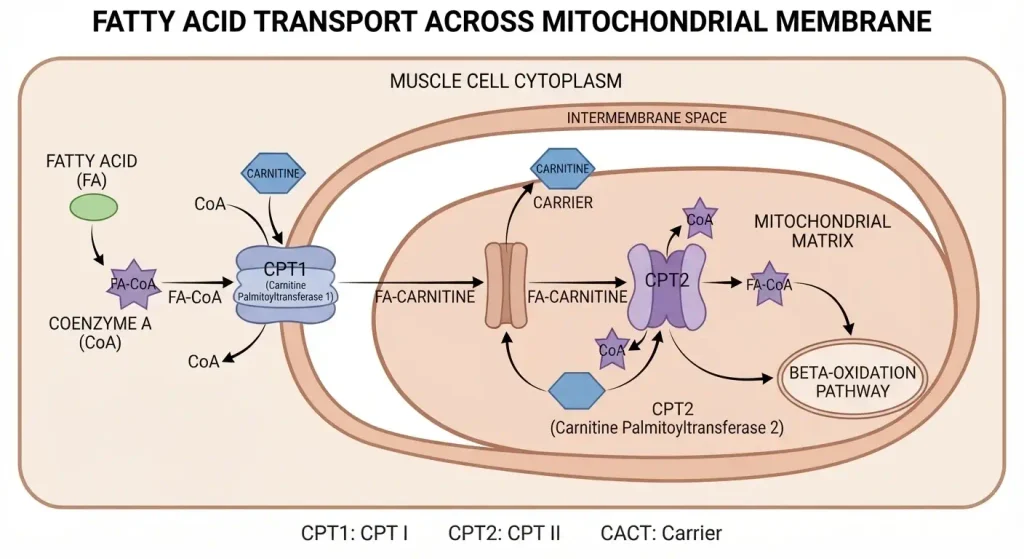
Think of a fatty acid molecule as cargo and a mitochondrion as the furnace. Long-chain fatty acids, the kind that make up most of your stored body fat, cannot cross the mitochondrial membrane on their own. The carnitine shuttle is the delivery system that moves them inside so they can be oxidized and turned into ATP, your cells’ usable energy currency. A review in Molecules describes this as L-carnitine’s core job: transporting long-chain fatty acids into the mitochondrial matrix where fatty acid oxidation happens, while also preventing the buildup of acyl-CoA by converting it into acylcarnitines (Gnoni et al., Molecules, 2020).
The shuttle has three parts, and each is worth knowing by name:
- CPT1 sits on the outer mitochondrial membrane and attaches the fatty acid to carnitine, forming acylcarnitine.
- The carnitine-acylcarnitine carrier swaps the acylcarnitine into the matrix and moves free carnitine back out.
- CPT2 detaches the fatty acid from carnitine inside the matrix, where beta-oxidation chops the fatty acid into acetyl-CoA units that feed the Krebs cycle and the electron transport chain to make ATP.
If CPT1 or CPT2 fails, or if carnitine runs short, long-chain fats essentially pile up outside the furnace. That is not a theoretical problem. In true carnitine deficiency, the body cannot move fat into mitochondria efficiently, and the result can be muscle weakness, low blood sugar, and heart problems, because the heart relies heavily on fat oxidation for fuel. The NIH Office of Dietary Supplements notes that deficiency states impair fat oxidation and are treated with high-dose carnitine, while healthy people make all the carnitine they need from the amino acids lysine and methionine in the liver, kidneys, and brain.
Carnitine also plays a second, less-known role in cellular energy production. During high-intensity exercise, free carnitine in the muscle drops, and research from the Journal of Physiology shows this limits how fast the pyruvate dehydrogenase complex can process carbohydrate fuel. Raising muscle carnitine buffers acetyl groups, which helps aerobic energy production ramp up smoothly at the start of exercise and supports the balance between fat and carbohydrate burning (Stephens et al., Journal of Physiology, 2007). In plain language: carnitine is not only the fat shuttle, it is also a traffic controller that keeps energy production from jamming when intensity climbs.
One more mechanism matters for the “fat burning” story. Fat oxidation is intensity-dependent. As you move from a brisk walk into a hard run, your body shifts from fat toward carbohydrate, and the carnitine shuttle’s limits are part of why (Gnoni et al., 2020). This is why low-intensity cardio, often called Zone 2 or LISS training, is where fat oxidation runs at its highest share, and why a fat-oxidation supplement is most plausible as a support for easy cardio, not hard intervals.
Does L-Carnitine Actually Burn Fat? What the Research Says
The mechanism is real, but mechanism is not outcome. Here is what controlled trials show, and I want to be blunt about the size of the effect before you spend money.
A meta-analysis of 37 randomized controlled trials with 2,292 participants found that L-carnitine supplementation significantly reduced body weight by about 2.7 lb (1.21 kg), BMI by 0.24, and fat mass by about 4.6 lb (2.08 kg) compared with placebo, with the dose-response analysis pointing to 2,000 mg per day as the dose with the maximum effect (Talenezhad et al., Clinical Nutrition ESPEN, 2020).
An updated meta-analysis of 43 trials found similar numbers, around 2.5 lb (1.13 kg) of weight loss and 2.6 lb (1.16 kg) of fat mass reduction, but the subgroup detail is what a coach cares about: the anti-obesity effect showed up only in people who were overweight or obese, and mainly when carnitine was combined with other lifestyle changes like diet and exercise (Askarpour et al., Pharmacological Research, 2020).
An earlier meta-analysis in Obesity Reviews of 9 trials with 911 participants found about 2.9 lb (1.33 kg) more weight loss than placebo (Pooyandjoo et al., Obesity Reviews, 2016), and a 2025 umbrella meta-analysis pooling 16,352 participants across eight prior meta-analyses confirmed reductions in weight, BMI, and waist circumference, with effect sizes clustering around 2.4 lb (1.1 kg) of weight (Hamedi-Kalajahi et al., 2025).

Put honestly: across the strongest evidence we have, L-carnitine is linked to roughly 2 to 3 lb (1 to 1.3 kg) of additional weight loss over weeks to months. That is real but small. For context, a modest calorie deficit of 300 calories per day produces around 2 lb (0.9 kg) per month on its own. No carnitine product replaces the deficit, and the trials themselves mostly paired the supplement with diet and exercise changes.
The exercise-performance picture is even more sobering, and this is where marketing claims fall apart. A 2026 systematic review of 18 placebo-controlled trials in active people concluded that while some endurance outcomes improved, fat oxidation during exercise did not significantly change after either acute doses of 2 to 4 g or chronic supplementation of 2 g per day for 2 to 4 weeks, and the authors wrote that carnitine’s reputation as a fat-burning ergogenic aid is not supported by current short-term evidence (Eryiğit et al., International Journal of Sport Nutrition and Exercise Metabolism, 2026). Reviews going back further agree that VO2max and time to exhaustion generally do not improve in healthy, trained people (Gnoni et al., 2020).
Where there is more consistent signal is recovery. A review of L-carnitine studies found that supplementation, typically 2 g per day, was associated with reduced markers of muscle damage, lower free radical formation, and less muscle soreness after hard training, possibly through improved blood flow and oxygen delivery to muscle (Fielding et al., Nutrients, 2018). One acute study in footballers found that 3 to 4 g taken before exercise lowered lactate and heart-rate responses and delayed exhaustion (Örer and Güzel, Journal of Strength and Conditioning Research, 2014), though those doses are above what most people should take casually.
Coach’s Tip: If you take L-carnitine, take it with carbs, not on an empty stomach. Muscle uptake of carnitine is insulin-dependent, which is why the trials showing muscle carnitine increases paired the supplement with a carbohydrate load. A dose with your post-workout meal or a piece of fruit does more than a capsule on an empty stomach first thing in the morning.

Evidence summary at a glance
Table
| Finding | What studies show | Best available estimate |
| Weight loss vs placebo | 37 to 43 RCTs, thousands of participants | About 2 to 3 lb (1 to 1.3 kg) over 8 to 24 weeks |
| Fat mass | Significant in pooled analyses | About 2.6 to 4.6 lb (1.2 to 2.1 kg) |
| Who benefits most | Subgroup analyses | Adults with overweight or obesity, combined with diet and exercise |
| Fat oxidation during exercise | 18-trial systematic review, 2026 | No significant change with short-term use |
| Endurance performance | Mixed; recovery markers better than performance | Modest, inconsistent; not a VO2max booster |
| Effective dose | Dose-response analyses | 2,000 mg per day, taken for 8+ weeks |
How Does L-Carnitine Support Fat Burning and Cellular Energy Production in Practice? A Coach’s Routine
Knowing the mechanism is useless without a plan. Here is how I would actually slot carnitine into a fat-loss phase, alongside the training and nutrition work that does the heavy lifting.
Step 1: Fix the calorie deficit and protein first
The single biggest driver of fat loss is the energy gap. Set your deficit at 300 to 500 calories per day below maintenance, and keep protein at roughly 0.7 to 1 g per lb (1.6 to 2.2 g per kg) of body weight to protect muscle. If you want a refresher on the fundamentals, our guide to what affects metabolism and body weight covers the big levers. L-carnitine sits at the bottom of the priority list, after sleep, protein, resistance training, and the deficit itself.
Step 2: Dose and timing
Based on the dose-response data, 2,000 mg per day is the evidence-backed target for adults, split as two 1,000 mg doses or taken once daily. Supplemental absorption is low, roughly 14 to 18 percent according to the NIH fact sheet, which is one reason food sources and consistency over weeks matter more than a single large dose. Expect any effect to take 8 to 12 weeks to show up on the scale, not days.
Table
| Timing option | How to take it | Why |
| With breakfast | 1,000 mg with a carb-containing meal | Insulin drives muscle uptake |
| Pre-cardio, 60 to 90 min before easy Zone 2 work | 1,000 mg with juice or fruit | Matches the timing used in exercise studies |
| Post-workout | 1,000 mg with your recovery meal | Pairs with insulin and recovery window |
Step 3: Pair it with the training that actually oxidizes fat
Fat oxidation is highest during low-to-moderate intensity work. My template for a fat-loss week:
- 3 strength days. Full body, 45 minutes. Goblet squats 3 sets of 8 to 10 reps at 35 to 50 lb (16 to 23 kg), dumbbell Romanian deadlifts 3 sets of 8 to 10 at 25 to 40 lb (11 to 18 kg) per hand, push-ups or dumbbell bench press 3 sets of 8 to 12, rows 3 sets of 10, plank 3 rounds of 30 to 45 seconds. Rest 60 to 90 seconds between sets. Muscle is your metabolic engine, and resistance training is non-negotiable.
- 2 easy cardio days. 30 to 45 minutes at a conversational pace, around 3.0 to 3.8 mph (4.8 to 6.1 km/h) on an incline treadmill, or a steady bike ride of 6 to 10 miles (10 to 16 km). You should be able to talk in full sentences. This is the zone where the carnitine shuttle is doing real work.
- 1 optional interval day. After a base is built: 8 rounds of 1 minute hard, 2 minutes easy on a bike or rower. Intervals burn more total calories per minute even though their fat-oxidation percentage is lower.
Coach’s Tip: Judge carnitine over a 12-week block, not a week. Weigh in 3 to 4 mornings per week, average the numbers, and compare month to month. If your monthly trend line has not moved after 12 weeks of honest tracking, the supplement is not doing enough to justify the cost, whatever the label says.

Step 4: Consider food sources before pills
Beef is the richest source, with about 56 to 87 mg of carnitine per 3 oz (85 g) serving, followed by fish, chicken, milk, and cheese. Plant foods contain almost none, which is why vegans tend to have lower blood carnitine levels, though their bodies compensate by reabsorbing carnitine more efficiently and producing more of it. If you eat red meat regularly, you are already getting a meaningful amount, and the supplement question is mainly relevant for vegans, older adults, and people with higher needs.
Safety Notes: Who Should Be Careful
This is the section most fat-burner content skips. Do not skip it.
- Doses above 3 g per day may cause nausea, vomiting, abdominal cramps, and diarrhea, and excess carnitine is excreted in urine. B gut bacteria can degrade unabsorbed carnitine into trimethylamine, which produces a fishy body odor at high doses, per the NIH Office of Dietary Supplements.
- Long-term cardiovascular questions are unresolved. Landmark research in Nature Medicine showed that gut bacteria convert L-carnitine into TMAO, a metabolite linked in observational data to atherosclerosis and cardiac events, and that omnivores produced more TMAO from carnitine than vegans and vegetarians did (Koeth et al., Nature Medicine, 2013). The NIH notes some longer-term studies suggest carnitine supplementation of 6 months or more might increase heart disease risk, while others show mixed or neutral results. This does not mean a 12-week supplement phase is dangerous, but it argues against high-dose, indefinite use.
- Kidney disease, seizure disorders, and thyroid conditions: carnitine handling changes with kidney function, and people on dialysis have different carnitine needs entirely. Check with your doctor before supplementing.
- Medication interactions: carnitine may interact with thyroid hormone, blood thinners like warfarin, and some antibiotics. If you take prescriptions, ask your pharmacist.
- Pregnancy and breastfeeding: evidence is limited. Get medical guidance first.
Talk to your doctor or a registered dietitian before starting L-carnitine or any fat-loss supplement, especially if you have a health condition, take medication, or are pregnant or breastfeeding.
Related Tips for Better Fat Burning and Cellular Energy
- Support the whole energy-production chain. Carnitine is one transporter among many. B vitamins, magnesium, and iron all participate in mitochondrial energy production, and our guide to which nutrients support normal energy metabolism breaks down the full chain.
- Do not stack it blindly with stimulants. Many fat burners combine carnitine with caffeine and thermogenic ingredients. If you use caffeine, time it earlier in the day to protect sleep, since poor sleep undermines the deficit. Our guide to thermogenesis and metabolism explains how heat-producing supplements actually work, and our article on why caffeine pills cause energy crashes covers the timing details.
- Consider the recovery angle if fat loss is the goal. The most consistent benefit in the literature is reduced muscle soreness and damage markers after hard training (Fielding et al., 2018). Training harder and recovering faster compounds into more total weekly work, which matters more for fat loss than any direct fat-burning effect.
- Track body composition, not just weight. Fat mass fell more consistently than body fat percentage in the meta-analyses. Use waist circumference and how your clothes fit alongside the scale. Our guide to boosting metabolic flexibility without crash dieting covers why fat versus carbohydrate flexibility matters over time.
- Compare before you buy. If you are evaluating a fat-burner stack that lists carnitine, read our coach’s guide to ingredients in weight management supplements and our evidence-based review of whether ketone supplements increase fat burning, since many products blend carnitine with keto-style ingredients.
Common Mistake: People judge carnitine by how they feel in the first few days, then quit or double the dose when nothing happens. Muscle carnitine pools fill slowly, and the trials that showed any benefit ran 8 weeks minimum. Doubling from 2 g to 4 g per day does not double the effect and moves you toward the nausea and GI side-effect range.
FAQ
Does L-carnitine burn fat without exercise?
The evidence does not support it as a standalone fat burner. Meta-analyses show the weight-loss effect mainly in people who are overweight or obese and combining the supplement with diet and exercise changes. In healthy, active people doing nothing different, the measurable effect approaches zero.
How much L-carnitine should I take per day for fat loss?
Dose-response analysis across 37 trials points to 2,000 mg per day as the dose with the maximum effect. Stay at or below 3 g per day to avoid nausea, cramps, and diarrhea, and give it 8 to 12 weeks before judging results.
When should I take L-carnitine, morning or before a workout?
Either works if you take it with carbohydrates, because insulin drives carnitine into muscle cells. A practical split is 1,000 mg with breakfast and 1,000 mg with your post-workout meal, which covers both timing strategies without extra pills.
Is L-carnitine safe to take long term?
Up to about 2 g per day, most evidence shows good tolerance, but the long-term cardiovascular picture is unsettled because gut bacteria convert carnitine into TMAO, a metabolite associated with heart risk in some studies. Periodic breaks and staying at 2 g or less are the cautious play.
Can you get enough L-carnitine from food?
Yes, for most people. A 3 oz (85 g) serving of beef provides roughly 56 to 87 mg, and your liver and kidneys also synthesize carnitine from lysine and methionine. Vegans and people with kidney disease or on certain medications are the groups most likely to run low.
What is the difference between L-carnitine and acetyl-L-carnitine?
L-carnitine is the form used in most fat-metabolism and exercise research. Acetyl-L-carnitine crosses into the brain more readily and is studied mainly for cognition and nerve health. For the fat-shuttle purpose described here, plain L-carnitine or L-carnitine tartrate has the most direct evidence.
Conclusion
Here is the honest coach’s answer to how does l-carnitine support fat burning and cellular energy production. Mechanistically, it is essential: it shuttles long-chain fatty acids into mitochondria for beta-oxidation and keeps energy production running smoothly as intensity rises. Practically, it is a small lever. The best pooled evidence links 2 g per day to roughly 2 to 3 lb (1 to 1.3 kg) of extra weight loss over 8 to 24 weeks, mainly in people with overweight or obesity who are also training and eating in a deficit. It does not meaningfully raise fat oxidation during exercise in the short term, and it is not a substitute for the deficit, protein, and resistance training that do the real work. If you are a vegan, an older adult, or someone in a serious training block fighting soreness, it is a reasonable, generally well-tolerated add-on at 2 g per day with carbs. Everyone else: build the habits first, and treat carnitine as the cherry, never the cake.