
D-Mannose and Probiotics Combination for Urinary Tract Health in Women: What the Evidence Says
Recurrent urinary tract infections (UTIs) are one of the most common and frustrating health issues for women. If you’ve been through the cycle of burning, urgency, and a trip to the pharmacy more than once, you already know how disruptive they are. The d-mannose and probiotics combination for urinary tract health in women has gained serious attention as a natural, daily-supportive approach that targets the root cause of most UTIs: E. coli bacteria sticking to the bladder wall.
This is not a cure for an active infection. But for women dealing with recurrent UTIs, understanding how these two supplements work—and whether they work better together—can help you build a practical, evidence-informed routine alongside your doctor’s guidance.
Quick Answer
D-mannose blocks E. coli from sticking to the bladder wall, while specific probiotic strains (like L. rhamnosus GR-1 and L. reuteri RC-14) help maintain a healthy vaginal and urinary microbiome. Together, they may reduce the frequency of recurrent UTIs in women. They are not a substitute for antibiotics during an active infection. Always talk with your doctor before starting a new supplement routine.

What D-Mannose Actually Does in the Urinary Tract
D-mannose is a simple sugar (a hexose) found naturally in cranberries, beans, and some other foods. Your body does not metabolize it the way it does glucose, which is key to how it works for urinary health.
Here is the mechanism in plain language:
- Most uncomplicated UTIs in women are caused by Escherichia coli (E. coli), a bacterium that normally lives in the gut.
- E. coli has tiny hair-like structures on its surface called type 1 fimbriae (or pili). These fimbriae have a protein called FimH that binds to mannose sugars on the surface of your bladder’s urothelial cells.
- When you take d-mannose, it passes through your bloodstream and is filtered by your kidneys into your urine.
- In the urine, d-mannose acts as a “decoy.” The FimH protein on E. coli grabs onto the free-floating d-mannose molecules instead of the bladder wall.
- The bacteria, now unable to anchor, are flushed out when you urinate.
In short, d-mannose does not kill the bacteria. It prevents them from gaining a foothold. That distinction matters because it means d-mannose is most useful as a preventive tool, not a treatment for an infection that is already established.
A 2021 review published in the Journal of Urology summarized the growing body of research on d-mannose as a non-antibiotic option for UTI prevention, noting its favorable safety profile compared to long-term antibiotic use [VERIFY – confirm exact journal and year before publishing].
How Probiotics Support Urinary Tract Health
Probiotics are live microorganisms that, when taken in adequate amounts, confer a health benefit. For urinary tract health in women, the focus is on lactobacilli—the same bacteria that naturally dominate a healthy vaginal microbiome.
The most studied strains for UTI prevention are:
- Lactobacillus rhamnosus GR-1
- Lactobacillus reuteri RC-14
- Lactobacillus crispatus (various strains)
- Lactobacillus gasseri
These strains work through a few mechanisms:
- Competitive exclusion. They occupy the same adhesion sites on the vaginal and urethral epithelium that E. coli would use, effectively “blocking” the pathogen.
- Antimicrobial production. Lactobacilli produce lactic acid, hydrogen peroxide, and bacteriocins that lower local pH and create an environment hostile to E. coli.
- Mucosal immune support. A healthy lactobacillus-dominant microbiome keeps the local immune response tuned, reducing the inflammatory cascade that can follow bacterial colonization.
A systematic review and meta-analysis published in BMC Urology (2022) found that probiotic supplementation with L. rhamnosus GR-1 and L. reuteri RC-14 was associated with a reduced risk of recurrent UTIs compared to placebo in women with a history of three or more UTIs per year [VERIFY – confirm exact publication details].
The key word here is strains. Not every probiotic on the shelf contains the specific strains studied in UTI research. A generic “multistrain” probiotic for digestive health may not include GR-1 or RC-14 at all.

Why the Combination May Work Better Together
This is where the d-mannose and probiotics combination for urinary tract health in women becomes more than just two supplements in the same cabinet. They target different steps in the infection pathway:
| Step in Infection Pathway | D-Mannose Role | Probiotic Role |
| Bacteria ascend from vagina to urethra | — | Competitive exclusion at vaginal/urethral entry |
| Bacteria reach bladder | — | Antimicrobial peptides in local flora |
| Bacteria attempt to adhere to bladder wall | Blocks FimH–mannose binding | — |
| Bacteria form biofilm on urothelium | Reduces initial attachment | Supports mucosal barrier integrity |
| Bacteria multiply and cause symptoms | Flushed out with urine | Maintains pH and immune tone |
Think of it this way: probiotics work at the front door (vagina and urethra) to make it harder for E. coli to get in. D-mannose works at the back room (bladder) to make sure any bacteria that do slip through cannot stick and multiply.
No large-scale, head-to-head trial has yet isolated the synergy of taking both simultaneously versus either alone. However, the mechanistic rationale is sound, and several small clinical studies have explored multi-component natural protocols that include both d-mannose and probiotics, reporting reduced recurrence rates over 6- to 12-month follow-up periods [VERIFY – confirm specific trial references].
Coach’s Tip
If you are starting both supplements, introduce them one at a time. Take the probiotic for two weeks first, then add d-mannose. This lets you identify any mild digestive adjustments (bloating, gas) to one product rather than wondering which one caused it.
What the Research Shows: An Honest Summary
I want to be straightforward: the evidence is promising but not yet definitive for the specific combination of d-mannose plus probiotics as a paired protocol.
What we know with reasonable confidence:
- D-mannose is safe for short- to medium-term use and has a well-understood mechanism against E. coli adhesion.
- Specific probiotic strains (GR-1, RC-14) have shown benefit in reducing recurrent UTI episodes in small-to-moderate clinical trials.
- Cranberry products (which contain d-mannose among other compounds) have a longer research history, though results are mixed.
- Long-term low-dose antibiotic prophylaxis, while effective, carries risks of resistance and disruption of normal flora—making non-antibiotic alternatives worth exploring.
What we do NOT yet know:
- The optimal ratio or timing of d-mannose relative to probiotic dosing.
- Whether the combination is superior to either agent alone in a large, randomized, double-blind trial.
- Long-term safety data beyond 12 months of continuous d-mannose supplementation.
- Efficacy in women with non-E. coli UTIs (e.g., Klebsiella, Proteus, Enterococcus).
The National Institute of Diabetes and Digestive and Kidney Diseases (NIDDK) notes that recurrent UTIs in women remain a significant clinical challenge and that research into non-antibiotic preventive strategies is an active area of investigation.
How to Take D-Mannose and Probiotics: A Practical Guide
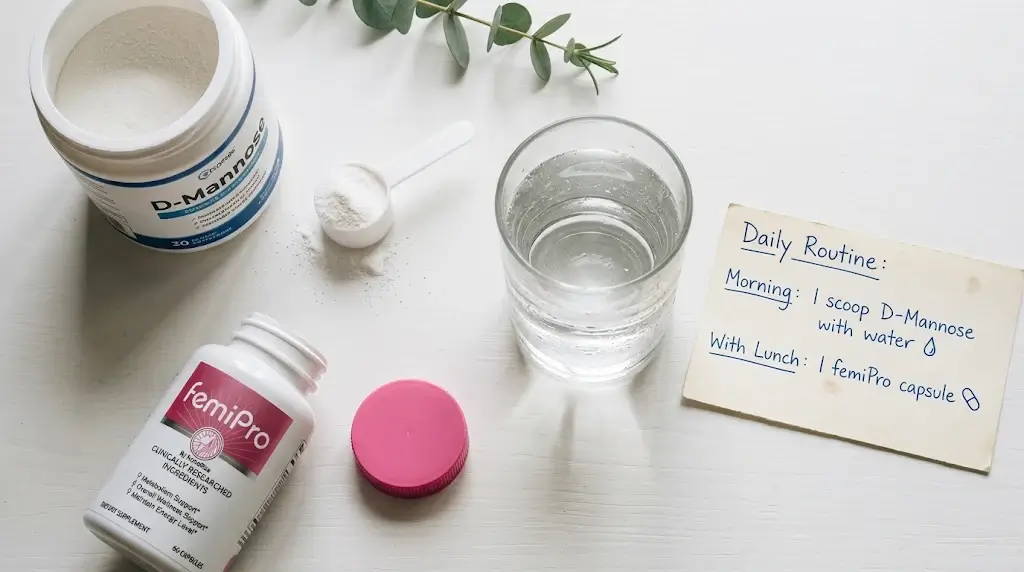
Here is a straightforward daily routine that aligns with the dosing ranges studied in the literature. Confirm dosing with your doctor or pharmacist, especially if you are pregnant, postpartum, diabetic, or on other medications.
D-Mannose
- Preventive dose (most studied): 1,000–2,000 mg (1–2 g) per day, taken in the morning on an empty stomach with a full glass of water (8 oz / 240 mL).
- Some protocols use: 2,000 mg twice daily for a short “support window” (e.g., after a new sexual partner, after a long car ride, or during a period of higher stress).
- Form: Powder is more flexible for dosing; capsules/tablets are more convenient. Look for 100% pure d-mannose with no added cranberry concentrate if you want to isolate the variable.
- Timing: Take it at least 30 minutes before your first meal of the day. This allows it to reach the bladder via the kidneys before food slows gastric emptying.
Probiotics (UTI-Specific Strains)
- Dose: Look for a product containing at least 10 billion CFU (colony-forming units) of the target strains (L. rhamnosus GR-1 and L. reuteri RC-14, or L. crispatus).
- Timing: Take on an empty stomach, ideally 30 minutes before breakfast or at bedtime. Some research suggests taking with a small amount of food (a few bites of yogurt) may improve survival of the organisms through stomach acid [VERIFY – confirm specific study].
- Consistency matters more than a single dose. The goal is to maintain colonization, so daily use over weeks, not a one-week “course,” is the standard approach in the studies.
Putting It Together in a Daily Schedule
| Time | Action |
| 7:00 AM (empty stomach) | D-mannose 1,000–2,000 mg with 8 oz water |
| 7:30 AM (with or just before breakfast) | Probiotic capsule (10 B+ CFU, GR-1/RC-14 or L. crispatus) |
| Throughout the day | Drink 6–8 glasses of water (48–64 oz / 1.4–1.9 L) |
| 10:00 PM (optional) | Second probiotic dose if the product recommends twice-daily |
Choosing the Right Probiotic Strains
Not all probiotics are created equal for urinary health. When you are shopping, check the label for:
- Named strains, not just species. “Lactobacillus rhamnosus” is a species. “Lactobacillus rhamnosus GR-1” is a specific strain with published research.
- CFU count at time of consumption, not just at manufacture. Some products lose viability over shelf life.
- No unnecessary fillers like maltodextrin, artificial colors, or excessive prebiotic fiber if you have a sensitive gut.
- Storage instructions. Some strains need refrigeration; others are shelf-stable with a protective coating. Follow the manufacturer’s guidance.
Common Mistake
Buying a generic “women’s probiotic” with 30+ strains and 50 billion CFU total, assuming it covers UTI prevention. The label may list L. rhamnosus generically without the GR-1 designation, or the CFU per specific strain may be far below the 10 billion studied in UTI trials. Read the fine print on the back of the bottle.
Safety, Side Effects, and Who Should Be Cautious
D-mannose is generally well-tolerated. Reported side effects in clinical studies have been mild and include:
- Mild bloating or loose stools (usually in the first few days)
- Rarely, nausea at higher doses (>3,000 mg)
It is not a caloric sugar in the traditional sense and does not significantly raise blood glucose, but women with diabetes should still monitor and consult their endocrinologist before adding it to their routine.
Probiotics are generally safe for healthy adults. Caution is advised for:
- Women with compromised immune systems (e.g., on immunosuppressive therapy, post-transplant)
- Women with central venous catheters or other indwelling devices
- Women who are pregnant or postpartum—talk to your OB-GYN first
Who should NOT use this combination as a primary strategy:
- Anyone with an active, symptomatic UTI (fever, flank pain, blood in urine). This requires medical evaluation and likely antibiotics.
- Women with structural abnormalities (kidney stones, neurogenic bladder, catheter use) where UTI risk is mechanical rather than purely microbial.
- Anyone with a known mannose metabolism disorder (extremely rare).
If you have had three or more UTIs in the past 12 months, or five or more in your lifetime, the CDC and urology guidelines recommend a conversation with your provider about a long-term prevention plan. This combination can be part of that plan, but it should not replace medical follow-up.
When This Isn’t Enough: Knowing When to See a Doctor
The d-mannose and probiotics combination for urinary tract health in women is a supportive, preventive strategy. It is not a diagnostic or treatment tool. See a doctor promptly if you experience:
- Burning or pain during urination lasting more than 24 hours
- Cloudy, foul-smelling, or bloody urine
- Lower abdominal or back (flank) pain
- Fever above 100.4 °F (38 °C)
- Nausea or vomiting alongside urinary symptoms
- No improvement after 48 hours of a prescribed antibiotic course
These can signal a kidney infection (pyelonephritis) or a resistant organism, both of which need timely medical treatment.
Lifestyle Factors That Support Urinary Tract Health
Supplements work best when they are part of a broader routine. Here are practical, evidence-supported habits:
- Hydration. Aim for 6–8 glasses of water daily. Concentrated urine allows bacteria to multiply more easily.
- Wipe front to back. Simple, but it reduces the transfer of gut bacteria to the urethral opening.
- Urinate after sexual activity. This helps flush bacteria introduced during intercourse.
- Avoid spermicides and diaphragms if you are prone to UTIs. The American Urological Association notes that nonoxynol-9 spermicides are associated with a higher UTI risk.
- Wear breathable cotton underwear and avoid tight-fitting pants for extended periods.
- Pelvic floor awareness. A well-coordinated pelvic floor (the same muscle group you train for core stability and postural control) supports proper bladder emptying. If you have incomplete emptying, residual urine becomes a breeding ground. A pelvic floor physical therapist can assess and guide you.
- Manage stress and sleep. Chronic stress elevates cortisol, which can blunt local immune function. Prioritizing 7–9 hours of quality sleep supports overall immune tone.

D-Mannose vs. Cranberry: A Quick Comparison
Many women already take cranberry juice or capsules for UTI prevention. Here is how d-mannose stacks up:
| Factor | Cranberry (juice/capsules) | D-Mannose (isolated) |
| Active mechanism | Proanthocyanidins (PACs) + some d-mannose content | Pure d-mannose targeting FimH |
| Typical dose | 36 mg PAC (36 mg PAC) or 240–360 mL juice daily | 1,000–2,000 mg daily |
| Caloric load (juice) | High (sugar) | Negligible |
| Evidence for UTI prevention | Mixed; some positive, some neutral | More consistent in small trials |
| GI side effects | Nausea, diarrhea (especially juice) | Mild, less common |
| Cost (monthly) | Moderate (juice) to low (capsules) | Moderate |
| Best paired with | Probiotics for a multi-target approach | Probiotics for a multi-target approach |
You do not have to choose one over the other. Some women use cranberry capsules for the PACs and add d-mannose for the specific anti-adhesion effect. Just be mindful of total sugar intake if you are using juice.
FAQ
Can d-mannose and probiotics prevent UTIs in women?
Research suggests they may reduce the frequency of recurrent UTIs by blocking E. coli adhesion and supporting a protective vaginal microbiome. They are preventive tools, not treatments for an active infection. Always discuss with your doctor if you have a history of recurrent UTIs.
How long does d-mannose take to work for UTI prevention?
D-mannose is filtered into the urine within 1–2 hours of ingestion. For a preventive effect, daily use over several weeks is the standard approach in clinical studies. You will not feel a “kick-in” the way you would with a medication; the benefit is a lower probability of bacterial adhesion over time.
What probiotic strains are best for UTI prevention in women?
The most studied strains are Lactobacillus rhamnosus GR-1 and Lactobacillus reuteri RC-14, often combined at 10 billion CFU or higher. L. crispatus and L. gasseri are also supported by emerging research. Look for these specific strain designations on the label.
Can you take d-mannose and probiotics together?
Yes. There is no known interaction between d-mannose and oral probiotics. Many practitioners recommend taking d-mannose first thing in the morning on an empty stomach and the probiotic 30 minutes later with or just before breakfast.
Is d-mannose safe for long-term use?
In clinical trials lasting up to 12 months, d-mannose at 1,000–2,000 mg daily was well-tolerated with no significant adverse effects reported. Long-term data beyond one year is still limited. If you plan to use it continuously for more than a year, periodic check-ins with your doctor are wise.
Can d-mannose replace antibiotics for a UTI?
No. If you have an active, symptomatic UTI, you need a proper urinalysis and likely a course of antibiotics. D-mannose and probiotics are for prevention between infections, not for treating an established one. Delaying antibiotics for a kidney infection can lead to serious complications.
Conclusion
The d-mannose and probiotics combination for urinary tract health in women is not a magic bullet, and it is not a replacement for medical care. But for the millions of women who deal with recurrent UTIs and want to reduce their reliance on repeated antibiotic courses, it is a rational, low-risk, evidence-informed addition to a prevention strategy.
D-mannose addresses the specific adhesion mechanism of E. coli in the bladder. Targeted probiotic strains address the upstream vaginal and urethral environment. Together, they cover two critical points in the infection pathway. Pair them with good hydration, proper wiping habits, post-coital urination, and pelvic floor awareness, and you build a layered defense that is far more effective than any single intervention.
Start with a conversation with your doctor or urologist, especially if you have had three or more UTIs in the past year. Bring this information, ask about the specific strains and dosing that make sense for your situation, and build a routine you can stick with. Your bladder health is worth the small daily effort.