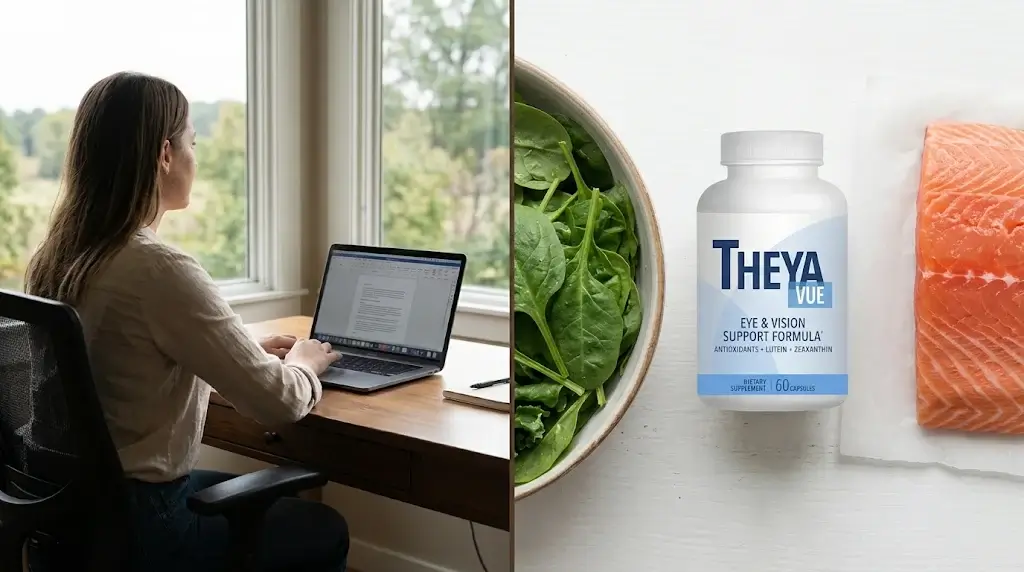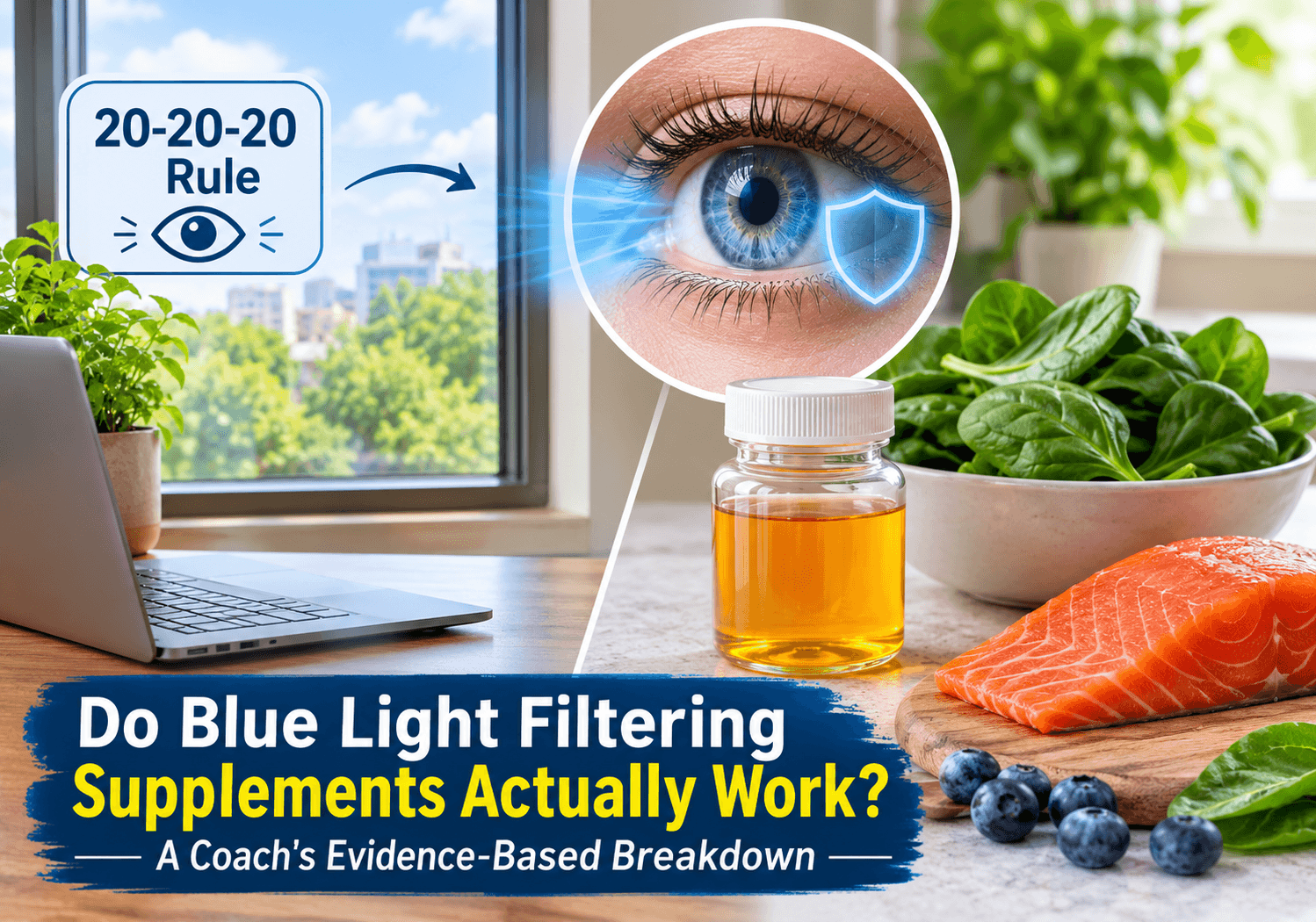
You stare at a laptop for eight hours, scroll your phone at night, and your eyes feel gritty, tired, and achy by 6 p.m. Then you see an ad: “Blue light filtering supplements – protect your eyes from screen damage in one daily pill.” It sounds convenient. But do blue light filtering supplements actually work the way the marketing claims? I’ve coached people who sit at desks all day, and eye strain from screens is one of the most common complaints I hear. So I dug into the peer-reviewed literature, the National Eye Institute guidance, and the clinical trial data to give you a straight answer.
Quick Answer
No supplement can “filter” blue light the way tinted lenses do. However, carotenoids like lutein, zeaxanthin, and meso-zeaxanthin accumulate in your macula and may absorb a small amount of incoming blue light, acting as a built-in sunshade for the back of your eye. Research supports modest benefits for macular pigment density, but supplements will not eliminate digital eye strain or replace proper screen habits.

What “Blue Light Filtering” Supplements Actually Do (and Don’t Do)
Let’s clear up the biggest confusion first. A blue light filter, in the optical sense, is a piece of glass or plastic that physically blocks or absorbs wavelengths around 400–500 nanometres before they reach your retina. Blue light glasses and screen coatings do this. A pill cannot do that.
What a supplement can do is load up the macula – the tiny, light-sensitive centre of your retina – with pigment molecules that absorb some of the blue wavelengths that do make it through your cornea and lens. The three carotenoids most studied for this role are:
- Lutein – found in kale, spinach, and egg yolks
- Zeaxanthin – found in corn, orange peppers, and marigold petals
- Meso-zeaxanthin – found in small amounts in shellfish and tomatoes; it sits right in the centre of the macular pigment
When you take these daily, they travel through your bloodstream, deposit into the macula, and raise your macular pigment optical density (MPOD). A higher MPOD means more blue light is absorbed before it hits the photoreceptor cells, which may reduce oxidative stress in that area.
Coach’s Tip: Think of lutein and zeaxanthin like the UV sunscreen for the back of your eye. They don’t block 100 % of the light, and they don’t stop the ciliary muscles from getting tired. But they add a layer of photoprotection that your diet alone may not provide, especially if you don’t eat much leafy greens.
What these supplements will not do:
- Reduce the physical strain of focusing on a screen for hours (that’s a ciliary muscle issue, not a pigment issue)
- Replace the 20-20-20 rule or proper lighting
- Cure or prevent age-related macular degeneration (AMD) on its own
- Make your eyes feel less dry or tired from reduced blinking
If a product label promises to “block blue light” or “neutralise screen radiation,” that is a marketing claim, not a physiological one. No oral compound can intercept photons in the air between your monitor and your cornea.
What the Research Says About Blue Light and Eye Health
The blue light–eye damage question
Blue light (sometimes called high-energy visible, or HEV, light) is a real part of the visible spectrum. The sun emits it, and so do LED screens, fluorescent office lighting, and phone displays. The concern is that shorter-wavelength blue light carries more energy per photon than red or green light, which in theory could generate reactive oxygen species (ROS) in retinal cells.
However, the amount of blue light that actually reaches the retina from a typical laptop or phone is a small fraction of what you get from outdoor daylight. The National Eye Institute notes that the cornea and lens absorb a significant portion of the shortest wavelengths before they reach the macula, and the overall risk of retinal damage from everyday screen use remains very low for healthy eyes.
The American Academy of Ophthalmology has stated that there is currently no conclusive evidence that the level of blue light from digital devices causes permanent retinal damage in the short term. What is well documented is digital eye strain (also called computer vision syndrome): dryness, blurred vision, headaches, and neck tension after prolonged near-focus work. That is a muscular and tear-film problem, not a phototoxic one, and no pill will fix it directly.
Lutein, zeaxanthin, and MPOD
Here is where the supplement evidence gets more concrete. Multiple randomised controlled trials published in journals indexed on PubMed have shown that daily oral lutein (typically 10–20 mg) and zeaxanthin (2–8 mg) can raise MPOD over 4–12 weeks. A higher MPOD is associated with:
- Greater absorption of 420–460 nm blue light at the macula
- Reduced risk of advanced AMD in some observational cohorts
- Slightly improved contrast sensitivity under bright lighting
The landmark AREDS2 clinical trial (published in JAMA Ophthalmology, 2013) tested a formula containing lutein 10 mg and zeaxanthin 2 mg as part of a vitamin and mineral combination for people with intermediate to advanced AMD. The trial found that adding lutein and zeaxanthin was safe and did not worsen outcomes, though it did not show a dramatic reduction in progression to advanced AMD on its own. The formula is still widely recommended by ophthalmologists as a supportive measure, not a cure.
Astaxanthin and omega-3 fatty acids
Astaxanthin, a carotenoid found in salmon, krill, and microalgae, has shown antioxidant and anti-inflammatory properties in cell and animal studies. A few small human trials suggest it may support retinal cell health and reduce oxidative markers, but the evidence base is still thin compared to lutein and zeaxanthin. You can read more about astaxanthin’s broader antioxidant role in our guide to astaxanthin supplements for skin and anti-aging.
Omega-3 fatty acids (EPA and DHA) are structural components of retinal cell membranes. Adequate DHA intake is linked to better tear film quality and may ease dry-eye symptoms, which are a major part of digital eye strain. The research on omega-3s and overall retinal health is promising but still evolving. Our breakdown of omega-3 fatty acids and their anti-inflammatory effects covers the dosing and sourcing details.
The bottom line from the literature
- Lutein + zeaxanthin: moderate evidence for raising MPOD and providing a small degree of blue-light absorption at the macula.
- Astaxanthin: emerging evidence, mostly preclinical.
- Omega-3s (DHA/EPA): supportive evidence for tear film and retinal cell structure, not a blue-light filter per se.
- No supplement has been shown to prevent digital eye strain or block blue light the way lenses do.
The Key Ingredients to Know (at a Glance)
| Ingredient | Typical Study Dose | Primary Eye Role | Evidence Strength | Food Sources |
| Lutein | 10–20 mg/day | Macular pigment; absorbs ~420–460 nm blue light | Moderate (multiple RCTs, AREDS2) | Kale, spinach, egg yolk, peas |
| Zeaxanthin | 2–8 mg/day | Macular pigment (outer ring); blue-light absorption | Moderate (AREDS2, MPOD trials) | Corn, orange peppers, marigold extract |
| Meso-zeaxanthin | 4–6 mg/day | Central macular pigment; peak blue-light absorption | Low–moderate (fewer trials) | Shellfish, tomatoes (small amounts) |
| Astaxanthin | 4–12 mg/day | Antioxidant; may protect retinal cells from ROS | Low (mostly preclinical) | Salmon, krill, Haematococcus algae |
| DHA (omega-3) | 250–500 mg/day | Retinal cell membrane structure; tear film support | Moderate (observational + small RCTs) | Fatty fish, algae oil |
| Vitamin A (retinol/β-carotene) | 700–900 µg RAE/day | Rhodopsin production (low-light vision) | Strong (deficiency causes night blindness) | Liver, sweet potato, carrots, eggs |
| Zinc | 8–11 mg/day | Enzyme cofactor in the retina; vitamin A transport | Moderate | Oysters, beef, pumpkin seeds |

How to Build a Practical Eye Health Supplement Routine
If you spend six or more hours a day in front of screens and want to add a sensible supplement layer on top of good habits, here is a straightforward protocol I walk my desk-bound clients through. This is not a prescription – it is a general starting point. Check with your doctor or an optometrist before starting any new supplement, especially if you take blood thinners, have a liver condition, or are pregnant.
Basic routine (easier version)
- Lutein 10 mg + Zeaxanthin 2 mg – take with a meal that contains some fat (avocado, olive oil, eggs) to improve absorption. One capsule, once a day.
- Omega-3 (DHA/EPA) 250–500 mg – one softgel with lunch or dinner.
- Aim for 2–3 servings of dark leafy greens per week to get dietary lutein and zeaxanthin on top of the pill.
This is the minimum effective stack. You do not need to take five different “eye vitamins” to get a benefit.
Comprehensive routine (progression)
- Lutein 20 mg + Zeaxanthin 8 mg + Meso-zeaxanthin 6 mg – a “marigold extract” or “palm oil” based formula. Take with the largest meal of the day.
- Astaxanthin 4–6 mg – once in the morning with food.
- Omega-3 (DHA 250 mg / EPA 250 mg) – once daily.
- Vitamin A 700–900 µg RAE – only if your diet is low in preformed vitamin A (liver, eggs, dairy). Do not exceed 3,000 µg RAE from supplements.
- Zinc 8–11 mg – with a meal, away from iron or calcium supplements.
- Dietary targets: 2 servings of leafy greens, 2 servings of fatty fish, and a variety of colourful vegetables per week.
Common Mistake: Buying a “blue light eye gummy” that contains 5 mg of lutein and 1 mg of zeaxanthin and expecting it to do the same job as a 10 mg / 2 mg capsule. The dose matters. If the label lists a proprietary blend with no individual amounts, you cannot verify you are getting a studied dose. Look for the specific milligram numbers on the Supplement Facts panel.
How long before you notice anything?
MPOD trials typically show a measurable increase after 4 to 12 weeks of consistent daily dosing. You will not feel a difference in the first week. The macular pigment builds up gradually. If you are taking the supplement to support long-term retinal health rather than to fix today’s sore eyes, think of it as a maintenance habit, not an acute fix.
Pairing supplements with non-supplement habits
No pill will compensate for poor screen ergonomics. Alongside your supplement routine, build in:
- 20-20-20 rule: every 20 minutes, look at something 20 feet (6 m) away for 20 seconds. This gives the ciliary muscle a break.
- Blink consciously: screen use reduces blink rate by up to 60 %, which dries the tear film. Set a phone reminder to blink fully every few minutes.
- Adjust screen brightness and colour temperature: use a warm-light or “night shift” mode after sunset. This reduces the blue-light output at the source, which is far more effective than any pill.
- Position your monitor so the top of the screen is at or slightly below eye level, about an arm’s length (20–28 in / 50–70 cm) away.
- Get an annual eye exam if you notice persistent blurring, double vision, or a shadow in your visual field.
Safety Notes and Who Should Talk to a Doctor First
Most of the ingredients above are well tolerated at the doses listed. That said, a few cautions are important:
- High-dose vitamin A (above 3,000 µg RAE from supplements) can be toxic and is especially risky during pregnancy. If you are pregnant, postpartum, or trying to conceive, talk to your OB-GYN before adding any vitamin A or carotenoid supplement.
- Zinc above 40 mg/day long-term can deplete copper levels. Stick to 8–11 mg unless a blood test shows a deficiency.
- Omega-3s at high doses (above 3 g/day) can thin the blood. If you take warfarin, apixaban, or other anticoagulants, check with your prescribing doctor first.
- Astaxanthin is generally safe, but there is limited long-term safety data in humans above 12 mg/day.
- If you have existing macular degeneration, diabetic retinopathy, glaucoma, or any retinal condition, do not rely on a supplement as a treatment. Follow your ophthalmologist’s management plan. Supplements may be an adjunct, not a replacement.
If you experience any new visual symptoms – sudden floaters, a curtain over part of your vision, or a flash of light – seek urgent eye care. Those can signal a retinal tear or detachment, and no supplement will address them.
This article is for general information and is not a substitute for advice from a doctor or physical therapist.
Related Tips for Reducing Blue Light Exposure at the Source
Supplements add a small layer of protection at the retina. But the most effective “blue light filter” is the one that stops the light before it enters your eye. Here are practical, no-cost (or low-cost) steps:
- Use a screen filter or software. Windows has “Night Light,” macOS has “Night Shift,” and phones have a built-in warm-light mode. Turn them on after sunset. This cuts the blue-light output by a meaningful amount without any pill.
- Wear blue-light-blocking glasses for long screen sessions if you find them helpful. They are not medically necessary for most people, but if they reduce your perceived eye fatigue, that is a reasonable comfort measure. The AAO notes they are safe but does not endorse them as a medical treatment.
- Lower your screen brightness to match the ambient room lighting. A bright white screen in a dark room is the worst combination for both blue-light exposure and ciliary muscle strain.
- Increase your time outdoors. Natural daylight, even on overcast days, is far brighter than any screen, but it also triggers a healthy circadian response. The WHO and CDC both recommend regular outdoor activity as part of overall health.
- Take real breaks. Stand up, walk to a window, look at the horizon. Ten minutes outside every two hours does more for your eyes than any gummy.
You can also look at how your overall daily habits affect recovery and energy. Our guide to how sleep affects metabolism and weight management touches on the eye-strain–sleep connection: staring at a bright screen right before bed suppresses melatonin and makes it harder to fall asleep, which then compounds the next day’s fatigue.
FAQ
Do lutein supplements protect against blue light?
Lutein and zeaxanthin accumulate in the macula and absorb a portion of incoming blue light (roughly 420–460 nm), acting as a mild internal filter. Clinical trials show they raise macular pigment optical density over several weeks. However, they do not block blue light the way tinted lenses do, and they will not prevent digital eye strain caused by prolonged near-focus work.
Are blue light blocking pills worth it?
If you already eat very little leafy greens and you are exposed to screens for many hours daily, a lutein-zeaxanthin supplement at a studied dose (10–20 mg lutein, 2–8 mg zeaxanthin) is a reasonable, low-risk addition to your routine. It is not a must-have, and it will not fix dry eyes or headaches. The “worth it” answer depends on your diet, screen time, and whether you want a small extra layer of macular protection.
Can supplements replace blue light glasses?
No. Glasses (or a screen coating) physically block or absorb blue wavelengths before they enter the eye. A supplement works inside the retina, after the light has already passed through the cornea and lens. They address different parts of the pathway. If you find glasses comfortable and they reduce your screen fatigue, keep using them. A supplement is an add-on, not a swap.
What supplements help with screen eye strain?
Digital eye strain is primarily a muscular and tear-film problem. No supplement directly relaxes the ciliary muscle or increases blink rate. Omega-3 fatty acids (DHA/EPA, 250–500 mg/day) may support tear film quality, and lutein/zeaxanthin support long-term retinal health. The most effective “treatments” are the 20-20-20 rule, proper screen positioning, adequate room lighting, and regular blinking.
How long do you need to take lutein for blue light protection?
MPOD studies typically show a measurable increase in macular pigment after 4 to 12 weeks of consistent daily dosing. The pigment continues to build with ongoing use. You will not feel an acute difference in the first few days. Think of it as a slow, cumulative process, similar to how vitamin D levels build over weeks of consistent intake or sun exposure.
Are blue light supplements safe to take daily?
At the doses studied in clinical trials (lutein 10–20 mg, zeaxanthin 2–8 mg, astaxanthin 4–12 mg, omega-3 250–500 mg), these ingredients are generally well tolerated. Long-term safety data for lutein and zeaxanthin is reassuring, including the multi-year AREDS2 trial. If you have a liver condition, take blood thinners, or are pregnant, check with your doctor before starting any new supplement.
Conclusion: Do Blue Light Filtering Supplements Actually Work?
Here is the honest, coach-to-client summary. Do blue light filtering supplements actually work? Partially, and not the way the ad copy suggests. No pill can intercept blue photons in the air. But the carotenoids lutein, zeaxanthin, and meso-zeaxanthin do build up in your macula and absorb a small amount of blue light before it reaches the photoreceptors. That is a real, measurable, and modest photoprotective effect backed by multiple randomised trials and the AREDS2 data.
If you sit in front of a screen for most of your workday, a daily lutein-zeaxanthin capsule at a studied dose, paired with omega-3s and a diet that includes leafy greens and fatty fish, is a sensible, low-risk habit. It is not a magic fix for gritty, tired eyes. For that, you need the 20-20-20 rule, proper lighting, a warm colour temperature in the evening, and regular breaks. The supplement is the long-term insurance policy; the habits are the daily maintenance.
Use both. Your eyes will thank you in five years, not five minutes.