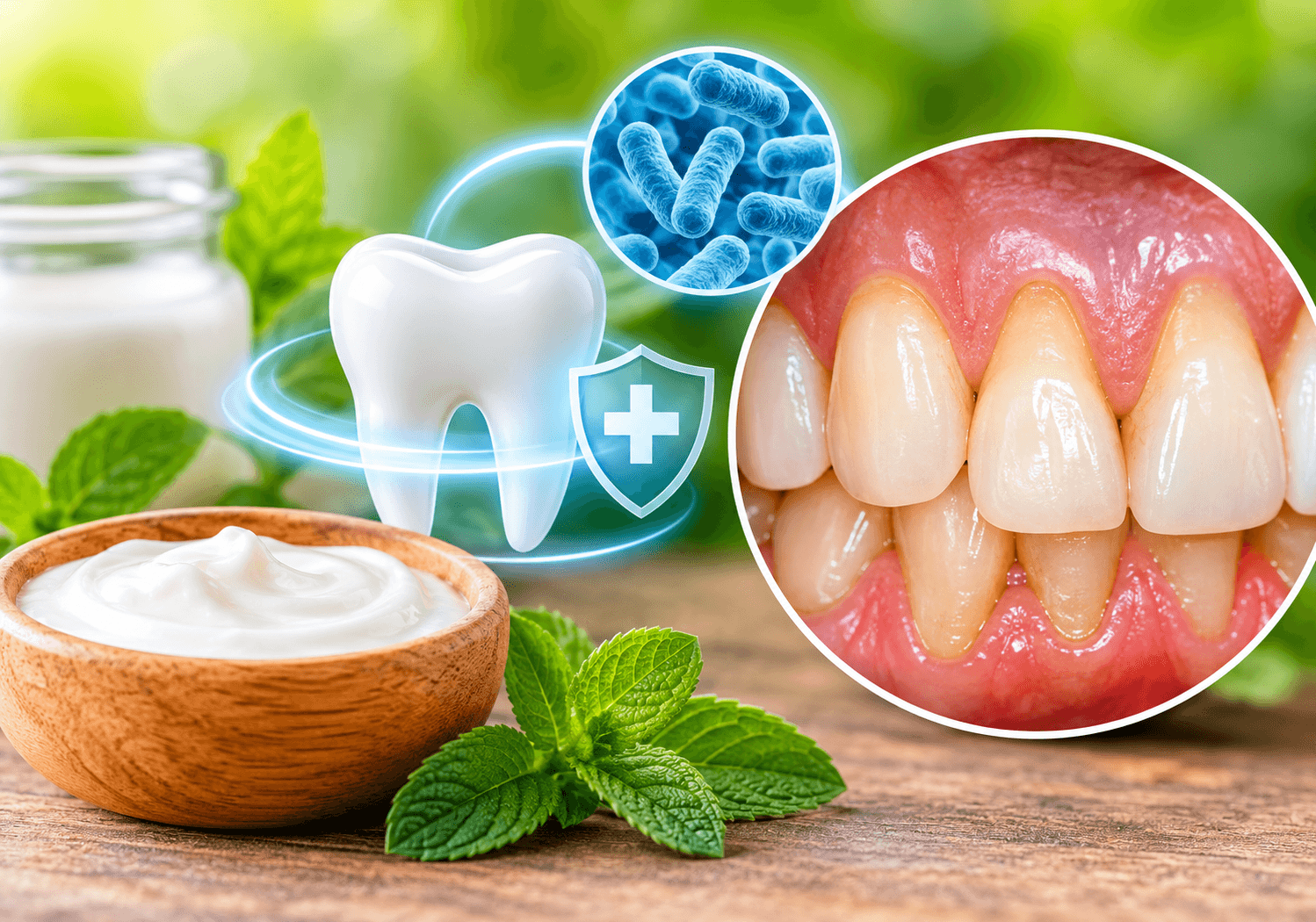
Gum recession can make teeth appear longer, expose sensitive roots, and increase the risk of root cavities. If your gums are pulling away from your teeth, you may have seen oral probiotics promoted as a way to improve gum health and support a healthier mouth.
The best oral probiotic strains for receding gums are not necessarily the ones with the highest number of bacteria or the most impressive marketing claims. Research has focused mainly on specific strains of Lactobacillus reuteri, Streptococcus salivarius, and Lactobacillus salivarius for their potential effects on gum inflammation, dental plaque, and periodontal health.
However, an important distinction matters: reducing inflammation is not the same as reversing gum recession. Probiotics may offer additional support for certain oral health measures, but they cannot reliably regrow gum tissue that has already been lost.
This guide explains which probiotic strains have the most relevant evidence, how they may work, what research says about their benefits, and how to choose an oral probiotic without overlooking proven dental treatment.
Quick Answer
The most researched oral probiotic strains for gum health include Lactobacillus reuteri DSM 17938 and ATCC PTA 5289, Streptococcus salivarius M18, and Lactobacillus salivarius WB21. Some studies suggest these strains may help reduce plaque, bleeding, or gum inflammation. However, no oral probiotic has been proven to reverse existing gum recession or regrow lost periodontal tissue. Probiotics should complement, not replace, professional periodontal care.
What Are Receding Gums, and Why Do They Matter?
Gum recession occurs when the gum tissue surrounding a tooth moves away from its usual position, exposing more of the tooth or its root. This can happen gradually, so some people notice it only when their teeth begin to look longer or become sensitive.
According to the American Academy of Periodontology’s gum disease information, receding gums can be a warning sign of periodontal disease. Other symptoms include bleeding during brushing, swollen gums, persistent bad breath, loose teeth, and changes in how teeth fit together.
Common causes of gum recession
Gum recession does not have one single cause. Several factors may contribute:
- Periodontitis: Advanced gum disease damages the tissues and bone supporting teeth.
- Aggressive brushing: Excessive pressure or incorrect brushing technique can contribute to gum tissue damage.
- Thin gum tissue: Some people naturally have thinner gums that are more vulnerable to recession.
- Tooth positioning: Teeth positioned outside the natural bone support may have a greater risk of recession.
- Tobacco use: Smoking can increase periodontal disease risk and interfere with healing.
- Plaque buildup: Poor plaque control can contribute to inflammation and periodontal damage.
Not every receding gum is caused by an active infection. A person may have recession without significant bleeding or inflammation, while another person may have periodontal disease with relatively few noticeable symptoms.
Can receding gums grow back naturally?
Generally, no. Once gum tissue has been lost, it does not predictably grow back through brushing, supplements, probiotics, or dietary changes.
Professional procedures such as gum grafting may help cover exposed roots and improve tissue thickness in suitable cases. The right treatment depends on the location, cause, and severity of recession.
This distinction is essential when evaluating oral probiotics. A product that reduces bleeding or plaque is not necessarily rebuilding the tissue that has receded.
How Oral Probiotics May Support Gum Health
Oral probiotics are live microorganisms intended to provide a health benefit when used in appropriate amounts. Unlike many conventional probiotics marketed for digestion, oral probiotic products are designed to interact with microorganisms in the mouth.
Researchers are interested in whether beneficial bacteria can influence the balance of the oral microbiome.
1. Supporting a healthier oral microbiome
The mouth contains hundreds of bacterial species. Many are normal residents that contribute to a balanced oral environment, while certain bacteria can become more abundant in disease-associated dental biofilms.
Probiotics may compete with undesirable bacteria for nutrients and attachment sites. Some strains also produce antimicrobial compounds that can influence the growth of other microorganisms.
A 2025 systematic review and meta-analysis of periodontal probiotics found improvements in certain periodontal outcomes, particularly plaque and bleeding measures in people with periodontitis.
These findings are encouraging, but they do not mean every probiotic product will produce the same effects.
2. Potentially reducing gum inflammation
Gingivitis is inflammation of the gums associated with dental plaque. Common signs include redness, swelling, and bleeding during brushing or flossing.
Some oral probiotic trials have reported improvements in gingival inflammation or bleeding. Researchers believe certain beneficial bacteria may influence the inflammatory response and the composition of dental plaque.
However, results vary considerably between studies. A 2020 systematic review of probiotics for gingivitis concluded that the evidence supporting improvements in inflammatory periodontal measures was weak.
3. Supporting periodontal treatment
Probiotics are often studied alongside professional periodontal treatment rather than as a replacement for it.
Scaling and root planing removes plaque and hardened deposits from below the gumline. Probiotics may potentially provide additional support after this mechanical treatment, although the benefits are not consistent across studies.
For someone with receding gums, this means the most important step is identifying whether active periodontal disease is present and treating it appropriately.
Best Oral Probiotic Strains for Receding Gums
The following strains have research related to gum inflammation, plaque, or periodontal disease. They are not ranked as proven recession treatments because the available evidence does not establish that any strain reverses gum loss.
L. reuteri – BioGaia Philippines
1. Lactobacillus reuteri DSM 17938
Strong research interest
A frequently studied oral probiotic strain, particularly in combination with ATCC PTA 5289. Research has examined its potential effects on gum inflammation, plaque, and periodontal treatment outcomes.
2. Streptococcus salivarius M18
Promising gingivitis research
This strain has been evaluated in randomized clinical trials for plaque accumulation and gingival inflammation. Its evidence is relevant to bleeding gums and plaque control, not gum regrowth.
3. Lactobacillus salivarius WB21
Additional periodontal evidence
Clinical research has explored this strain’s effects on periodontal condition, including plaque and probing pocket depth in selected participants.
1. Lactobacillus reuteri DSM 17938 and ATCC PTA 5289
Lactobacillus reuteri is one of the most frequently investigated probiotic species in periodontal research. Two particular strains, DSM 17938 and ATCC PTA 5289, have been used together in oral probiotic lozenges.
These strains have been studied for their potential to influence periodontal bacteria, plaque accumulation, and inflammation.
A randomized clinical trial published in 2011 evaluated L. reuteri lozenges in people with chronic periodontitis. The study included 30 participants and examined outcomes following scaling and root planing and probiotic use.
The researchers reported improvements in several periodontal measurements, including probing pocket depth and clinical attachment level, in the combined treatment group. The findings suggested that the probiotic could provide additional support during periodontal treatment.
Other studies have produced less favorable results.
A 2019 randomized controlled trial examined L. reuteri lozenges alongside nonsurgical periodontal therapy. It found no statistically significant additional clinical benefit compared with periodontal treatment alone.
This difference between trials is important. It shows why a strain should not be described as a guaranteed treatment for gum disease.
Potential benefits:
- May support improvements in some periodontal measurements.
- Has been investigated for effects on periodontal pathogens.
- May be useful as an adjunct to professional treatment in selected cases.
Limitations:
- Research findings are inconsistent.
- Clinical effects may depend on the treatment protocol and disease severity.
- It has not been demonstrated to regrow receded gum tissue.
2. Streptococcus salivarius M18
Streptococcus salivarius M18 is another oral probiotic strain with research examining gingival inflammation and plaque accumulation.
A 2023 randomized clinical trial published in Nutrients evaluated M18 in young adults with gingivitis. Participants received probiotic or placebo lozenges, and researchers assessed gum inflammation, bleeding, and plaque.
The probiotic group showed improvements in gingival condition and plaque-related measurements during the intervention. However, some improvements did not remain statistically significant after the follow-up period.
A separate 2024 randomized clinical trial investigated three months of M18 supplementation. Researchers reported reduced gingival bleeding and plaque accumulation during the intervention.
These results make M18 a promising strain for further study in gingivitis and oral hygiene support.
Nevertheless, people with receding gums should understand that less bleeding does not necessarily mean lost gum tissue has returned.
Potential benefits:
- May improve certain measures of gingivitis.
- Has clinical research involving plaque accumulation and bleeding.
- May complement daily plaque-control practices.
Limitations:
- Evidence does not establish reversal of recession.
- Some benefits may diminish after supplementation stops.
- More research is needed in people with advanced periodontal disease.
3. Lactobacillus salivarius WB21
Lactobacillus salivarius WB21 has been studied for its potential effects on periodontal health.
A randomized, double-blind, placebo-controlled study published in 2008 evaluated WB21-containing tablets in 66 volunteers. Participants received the probiotic or placebo for eight weeks.
The study found improvements in periodontal clinical parameters in both groups. Among current smokers in the probiotic group, researchers observed greater improvements in plaque index and probing pocket depth compared with the placebo group.
These results suggest that WB21 may have a role in supporting certain periodontal measurements, although the effects were not uniform across participants.
Potential benefits:
- Has been evaluated in a controlled periodontal study.
- May influence plaque and pocket-depth measurements in certain groups.
- Offers another strain-specific option for oral probiotic research.
Limitations:
- Evidence is less extensive than the broader research interest in L. reuteri.
- Findings from specific populations cannot automatically be generalized.
- There is no established gum-regrowth effect.
What Does the Research Say About Oral Probiotics?
Understanding the difference between promising research and proven treatment can help you make a better decision.
A 2022 systematic review and meta-analysis published in the International Journal of Molecular Sciences included 64 randomized clinical trials examining probiotics in periodontal disease. The researchers reported improvements in several clinical measurements, including plaque index, gingival index, probing pocket depth, clinical attachment level, and bleeding on probing.
However, these pooled findings included different probiotic species, formulations, populations, and treatment protocols. They cannot establish that one particular commercial product will produce the same result.
A 2025 systematic review in BMC Oral Health included 24 studies in its meta-analysis, covering gingivitis and periodontitis. It found some improvements in plaque and bleeding outcomes among patients with periodontitis, while results in gingivitis were less convincing.
The review also highlighted the need for better standardized studies and longer follow-up periods.
Which periodontal outcomes have probiotics improved?
| Outcome | What research suggests | Does it mean gums regrow? |
| Plaque index | Some studies report reduced plaque scores | No |
| Gingival index | Some strains may improve gum inflammation | No |
| Bleeding on probing | Certain trials report less bleeding | No |
| Probing pocket depth | Some adjunctive trials report improvements | Not necessarily |
| Clinical attachment level | Results vary between studies | Does not prove recession reversal |
| Gum tissue regeneration | No established probiotic effect | No |
Understanding clinical attachment level
Clinical attachment level is a measurement dentists use to assess the attachment of periodontal tissues to a tooth.
Improvement in this measurement after treatment does not automatically mean a receded gumline has returned to its original position. Changes in inflammation, pocket depth, and tissue healing can affect periodontal measurements without restoring all previously lost tissue.
This is why research involving periodontal disease should not be advertised as proof that oral probiotics reverse gum recession.
How to Choose an Oral Probiotic for Gum Health
If you and your dentist decide that an oral probiotic is appropriate, choosing a product with a clearly identified strain is more useful than selecting one based only on its total bacterial count.
Oral probiotic selection checklist
- The label identifies the exact strain, not only the bacterial species.
- The product specifies the viable microorganism count, preferably through the end of shelf life.
- The formulation is intended for oral use.
- Storage instructions are clear and practical.
- The product does not claim to regrow gums or cure periodontitis.
- The manufacturer provides appropriate quality and safety information.
- The product fits your budget without replacing necessary dental care.
1. Look for strain-specific identification
A product that lists Lactobacillus reuteri is not necessarily equivalent to a product containing DSM 17938 or ATCC PTA 5289.
Different strains within the same species may have different properties. Clinical evidence for one strain should not automatically be applied to another.
When comparing oral probiotics, check whether the label includes the strain designation used in clinical research.
2. Check the delivery format
Oral probiotic products may come in several forms:
| Format | Practical consideration |
| Lozenges | Dissolve slowly in the mouth and provide oral exposure |
| Chewable tablets | Convenient, but follow the specific product’s instructions |
| Capsules | Often swallowed; oral exposure may differ from lozenges |
| Powders | Require checking how they are intended to be used |
| Mouth-rinse products | Formulation and contact time may affect their use |
Many periodontal trials used lozenges that dissolved in the mouth. A swallowed capsule is not automatically equivalent to that delivery method.
3. Consider the viable bacterial count
Probiotic labels commonly list colony-forming units, or CFU. This measurement estimates the number of viable microorganisms.
A higher CFU count does not automatically mean a product is more effective. A product with a lower count of a clinically studied strain may be more relevant than a high-count product containing strains without evidence for gum health.
The important question is whether the product’s formulation and dose resemble those investigated in human research.

4. Avoid exaggerated marketing claims
Be cautious when a product promises:
- Complete reversal of gum recession.
- Regrowth of lost gum tissue without dental treatment.
- Permanent elimination of periodontal disease.
- Guaranteed results within a few days.
- Replacement of professional cleaning or gum surgery.
These claims go beyond the established evidence.
Coach’s Tip: Think of oral probiotics as a possible supporting tool, not the foundation of gum care. A consistent brushing, interdental cleaning, and professional periodontal maintenance routine matters more than chasing a particular supplement.
How to Use Oral Probiotics Alongside Dental Care
The most sensible approach is to maintain proven oral hygiene practices first and consider probiotics only as an additional measure.
Step 1: Get a periodontal assessment
If your gums are receding, arrange an examination with a dentist or periodontist.
The clinician can check gum measurements, periodontal pockets, bleeding, tooth mobility, and possible bone loss. These findings help determine whether you have active periodontitis, isolated recession, or another issue.
A probiotic cannot diagnose the underlying cause.
Step 2: Treat active gum disease
If periodontal disease is present, professional treatment may involve scaling and root planing, oral hygiene instruction, and periodontal maintenance.
The American Academy of Periodontology explains that untreated periodontitis can damage the tissues and bone supporting teeth. Treating this process is more important than relying on supplements.
Step 3: Maintain a consistent oral hygiene routine
A practical daily routine includes:
- Brush twice daily using a soft-bristled toothbrush.
- Use fluoride toothpaste.
- Clean between teeth daily with floss or suitable interdental brushes.
- Follow your dentist’s recommendations for areas that are difficult to clean.
- Avoid brushing with excessive pressure.
- Attend recommended periodontal maintenance appointments.
The goal is to control plaque without causing additional irritation.
Step 4: Use the probiotic as directed
If a dentist recommends trying an oral probiotic, follow the product’s instructions and the clinician’s advice.
Do not assume that taking more lozenges or using multiple probiotic products will improve results. The dose and duration used in studies vary, and no universal oral probiotic regimen has been established for receding gums.
Step 5: Monitor meaningful outcomes
Rather than judging a probiotic by how your mouth feels immediately after taking it, focus on clinically meaningful outcomes.
These may include:
- Bleeding during brushing or professional examination.
- Gum inflammation.
- Plaque accumulation.
- Periodontal pocket measurements.
- Changes in sensitivity.
- Stability of recession over time.
A dentist can determine whether changes reflect improved inflammation, stable periodontal health, or progression of disease.
Can Oral Probiotics Reverse Gum Recession?
This is the most important question for anyone considering probiotics specifically for receding gums.
Current evidence does not establish that oral probiotics can reverse existing gum recession.
Probiotics may influence the oral microbiome and reduce certain signs of inflammation. However, recession involves changes in the position and structure of gum tissue, and in some cases the underlying bone and periodontal attachment.
Reducing plaque or bleeding does not necessarily restore the lost tissue.
What can actually help with receding gums?
Treatment depends on the cause and severity.
| Situation | Possible approach |
| Plaque-related gingivitis | Professional cleaning and improved daily plaque control |
| Active periodontitis | Periodontal treatment and ongoing maintenance |
| Brushing-related irritation | Improved brushing technique and suitable toothbrush |
| Tooth-root sensitivity | Dentist-recommended desensitizing treatment |
| Significant gum recession | Assessment for periodontal procedures, including gum grafting |
| Progressive recession | Evaluation of contributing causes and appropriate treatment |
A periodontist may recommend a gum graft or another periodontal procedure when tissue coverage or protection of an exposed root is appropriate.
Probiotics may be considered an optional adjunct in some situations, but they should not delay these treatments.
Oral Probiotics vs. Traditional Probiotics
A common question is whether a probiotic marketed for digestive health can also support gum health.
The answer depends on the strains and how the product is used.
Oral probiotics are generally formulated to provide microorganisms intended to interact with the mouth. Some research products use lozenges to expose the oral environment to specific strains.
Traditional probiotics may be designed primarily for intestinal use, and their delivery format may differ.
| Feature | Oral probiotic | General digestive probiotic |
| Main intended use | Oral microbiome support | Often gut-related support |
| Common format | Lozenges or chewables | Capsules or powders |
| Oral contact | Often designed for longer contact | May be brief before swallowing |
| Gum-health evidence | Available for selected strains | Depends on specific strains and studies |
| Recession treatment | Not proven | Not proven |
A digestive probiotic should not be assumed to have periodontal benefits simply because it contains beneficial bacteria.
Safety and Who Should Be Careful
Oral probiotics are generally well tolerated in studies involving healthy participants, but safety is not identical for every person or product.
People with significant medical conditions or weakened immune systems should discuss probiotic use with a healthcare professional before starting.
Potential concerns
- Mild digestive discomfort may occur with some probiotic products.
- Allergies or sensitivities to product ingredients should be considered.
- Product quality and contamination risks matter.
- Safety evidence may be limited for people with serious underlying illnesses.
- Probiotic supplements should not replace prescribed treatment.
Anyone experiencing persistent bleeding gums, loose teeth, pus, worsening recession, or significant tooth sensitivity should seek dental assessment rather than attempting to manage the condition with probiotics alone.
When should you see a dentist?
Seek professional evaluation if you notice:
- Gums pulling away from one or more teeth.
- Bleeding that continues despite improved brushing.
- Persistent bad breath.
- Teeth becoming loose.
- Pain or swelling around the gums.
- Increasing sensitivity near exposed tooth roots.
These symptoms may indicate periodontal disease or another dental problem requiring treatment.
Frequently Asked Questions
1. What are the best oral probiotic strains for receding gums?
Lactobacillus reuteri DSM 17938, ATCC PTA 5289, Streptococcus salivarius M18, and Lactobacillus salivarius WB21 have research related to periodontal health. These strains may help improve certain measures of plaque or inflammation, but none has been proven to regrow receded gum tissue.
2. Can oral probiotics reverse gum recession?
No. Oral probiotics have not been established as a treatment that reverses existing gum recession. They may support gum health by influencing plaque or inflammation, but lost tissue generally requires professional evaluation. Periodontal procedures, including gum grafting, may help cover exposed roots in appropriate cases.
3. Does Lactobacillus reuteri help receding gums?
Lactobacillus reuteri has been investigated in periodontal clinical trials. Some studies report improvements in pocket depth, bleeding, or other periodontal measurements when it is used alongside professional treatment. However, results are inconsistent, and there is no convincing evidence that it restores previously lost gum tissue.
4. Do oral probiotic lozenges help bleeding gums?
Some clinical trials suggest that specific oral probiotic lozenges may reduce gingival bleeding or inflammation. For example, studies involving Streptococcus salivarius M18 have reported improvements in certain gingivitis measurements. However, probiotics are not a substitute for removing plaque or treating active periodontal disease.
5. How long do oral probiotics take to work?
Clinical trials have evaluated oral probiotics over periods ranging from several weeks to a few months. Some reported improvements during the intervention, but results vary by strain and outcome. There is no established timeline for reversing gum recession because probiotics have not been proven to accomplish that.
6. Can probiotics replace scaling and root planing?
No. Scaling and root planing mechanically removes plaque and hardened deposits from below the gumline. Probiotics may potentially complement periodontal treatment, but they cannot reliably remove established tartar or replace professional treatment for periodontitis.
Conclusion: Choosing the Best Oral Probiotic Strains for Receding Gums
The best oral probiotic strains for receding gums are those supported by strain-specific research rather than broad marketing claims. Lactobacillus reuteri DSM 17938 and ATCC PTA 5289, Streptococcus salivarius M18, and Lactobacillus salivarius WB21 are among the strains worth understanding when evaluating oral probiotic research.
Evidence suggests that some probiotics may help improve plaque accumulation, gingival inflammation, or bleeding in selected people. However, findings vary, and their effects depend on the strain, formulation, and periodontal treatment context.
The most important takeaway is that healthier gums and regenerated gums are not the same thing. Oral probiotics may offer additional support for periodontal health, but they cannot reliably reverse recession or replace professional treatment.
If your gums are pulling away from your teeth, begin with a dental examination, consistent plaque control, and appropriate periodontal care. Consider probiotics only as a possible additional tool after discussing their limitations with your dentist.