
Chromium picolinate for weight loss is one of the most common claims on supplement shelves, and I hear about it from gym members almost every month. The pitch is simple: take a small capsule, and the fat comes off, or at least the cravings fade. The research tells a more modest story. Some trials show a small effect, many show none, and the safety picture has open questions. This guide walks through what the studies found, how the supplement may work, what the safety data says, and how to decide if it belongs in your plan.
Quick Answer: Chromium picolinate for weight loss has weak support. A 2003 pooled analysis and a later Cochrane review found people lost about 1 kg (2.4 lb) more than placebo groups, but the evidence is low certainty. Safety data are mostly reassuring at typical doses, yet some animal and lab studies raise questions. Talk to your doctor first if you have diabetes, kidney problems, or take prescription medicine.
What Chromium Picolinate Is
Chromium is a trace mineral. The form found in food and most supplements is trivalent chromium, also written as chromium (III). The NIH Office of Dietary Supplements health professional fact sheet describes it as a trace element that is naturally present in many foods and sold as a dietary supplement.
Chromium picolinate is one of several supplement forms. Others include chromium chloride, chromium nicotinate, chromium polynicotinate, and chromium histidinate. The form matters less than most marketing suggests, because your body absorbs very little chromium from any source. The same NIH fact sheet notes that dietary chromium absorption is low, roughly 0.4% to 2.5%.
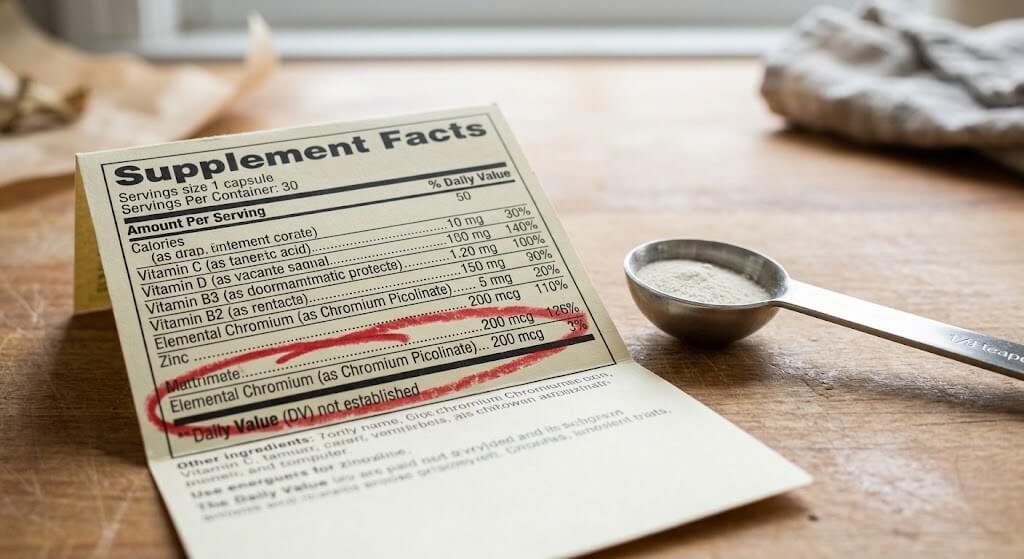
Most of the research on weight loss used chromium picolinate at doses between 200 and 1,000 micrograms (mcg) per day. The NIH reports that most multivitamin and mineral supplements contain 35 to 120 mcg of chromium, while chromium-only products commonly provide 200 to 500 mcg, and some contain up to 1,000 mcg.
Common Mistake: Reading the total weight of the chromium compound instead of the chromium itself. The Supplement Facts label lists elemental chromium, which is the amount your body can use. A capsule that says “200 mg of chromium picolinate” does not contain 200 mcg of chromium, so always check the elemental amount in micrograms.
Does Chromium Picolinate Help With Weight Loss? What the Research Shows
The honest answer is: maybe a little, in some people, and the evidence is not strong enough to count on it. Two major reviews sum up the research well.
The 2003 Meta-Analysis
In 2003, Pittler and colleagues published a meta-analysis of randomized trials in the International Journal of Obesity. They searched several medical databases and asked experts and manufacturers for unpublished studies. To qualify, a trial had to be randomized, double-blind, placebo-controlled, and report body weight.
Ten trials met the criteria and could be pooled. The pooled result favored chromium picolinate, with an average weight difference of 1.1 kg (about 2.4 lb) compared with placebo, though the confidence interval ran from 1.8 kg to 0.4 kg. The authors also ran a sensitivity analysis. It showed the result depended largely on one trial. Without that trial, the difference shrank to 0.9 kg, and the confidence interval crossed zero, meaning the result could easily be no effect at all.
The authors described the effect as relatively small. They also noted that only three of the reviewed trials reported on adverse events, and those reported none in the treatment groups. That is a thin safety record for a product sold to millions of people.
The Cochrane Review
Cochrane is widely considered the gold standard for evidence reviews. “Its review of chromium picolinate in overweight or obese adults pooled data from trials involving 622 participants: 346 assigned to the chromium picolinate group and 276 to the placebo group. Doses tested were 200, 400, 500, and 1,000 mcg, and follow-up lasted 12 to 16 weeks.”
Pooled results showed participants lost around 1 kg more than the placebo groups. The reviewers did not find that the effect grew with higher doses. They also found no firm evidence for changes in body mass index, body fat percentage, or waist circumference. The quality of evidence was rated low, which in Cochrane language means the true effect may be quite different from what the studies estimate.
Harvard’s Summary
The Harvard T.H. Chan School of Public Health’s Nutrition Source reaches a similar conclusion. It states that chromium supplements have not been found to produce significant weight loss, even though they remain popular with people hoping to manage weight.
What the Numbers Mean in Real Life
A 1 kg difference is about 2.4 lb, spread over 12 to 16 weeks. For context, that is less than a single standard bag of groceries. It is also an average across groups, so some people may lose more and others none. Think of it as a small possible nudge, not a fat-loss engine.
Coach’s Tip: Before you buy any supplement for weight loss, write down the number you expect to see on the scale after 12 weeks. If the answer is “a pound or two,” you will be realistic about what a small supplement effect looks like next to the changes that come from eating patterns and activity.
Why Results Vary Between Studies
Several factors explain why trials disagree:
- Different populations.“Caution is warranted when interpreting these results, as trials enrolled distinct populations which may respond differently to the intervention.”
- Different doses and durations. Studies used a range of doses and lasted anywhere from a few weeks to several months.
- Small sample sizes. Many trials had fewer than 100 participants, which makes single results unstable.
- Uneven diet and exercise control. When researchers do not control what people eat and how much they move, it becomes hard to isolate what the supplement did.
- Limited adverse event reporting. Only a few trials systematically tracked side effects, so safety data is incomplete.
How Chromium Might Work
Chromium is connected to how the body handles blood sugar. Researchers have proposed that chromium helps insulin do its job, which is moving glucose out of the bloodstream and into cells. The NIH Office of Dietary Supplements and Harvard both note that some clinical trials have shown benefits for insulin sensitivity and glucose metabolism, mostly in people who already have diabetes.
This is where the weight loss idea comes from. The reasoning goes like this: better blood sugar control may reduce cravings or fat storage, so a supplement that helps insulin might help with weight. For a deeper look at the blood sugar side of the story, read our article on chromium and glucose metabolism. A related hormone-focused idea appears in our piece on inositol and insulin sensitivity.
The logic is reasonable, but the leap from “may help insulin” to “helps you lose fat” is not well proven. Blood sugar and body weight are linked, but a link does not guarantee that adding one supplement will shift the scale.
There is also a question of need. Harvard notes that there is not enough data to set a Recommended Dietary Allowance for chromium, and instead an Adequate Intake was set as an estimated safe level. Most people eating a varied diet get some chromium from food, which means the supplement is not fixing a known gap for most adults.
Chromium Picolinate Safety: What the Evidence Shows
Safety is where the most important nuance lives. The short version is that chromium from food and supplements does not appear to cause harm in most people, but the long-term research is limited, and a few specific concerns deserve attention.
Overall Safety Signals
The NIH consumer fact sheet says chromium from food and dietary supplements does not appear to cause any harm, while adding that research is limited. Harvard adds that trivalent chromium is not considered toxic, but that caution is still wise with high-dose trace mineral supplements.
The DNA Damage Question
This is the concern that makes many people nervous, and it deserves a clear explanation. In 2010, the European Food Safety Authority (EFSA) published a scientific opinion on chromium picolinate. The panel noted that some genotoxicity studies suggest that, in test tubes at high concentrations, chromium picolinate might cause DNA damage. That finding comes from cell studies, not from people taking capsules.
EFSA also reviewed long-term animal studies. It concluded there was equivocal evidence of carcinogenic activity in male rats and no evidence in female rats or in mice. On the dose question, EFSA judged the safety margin between the highest no-effect animal dose and typical human intake to be very large.
Animal studies have produced mixed results. One study in db/db mice used clinically relevant doses and used a comet assay to measure DNA breaks. The authors reported that the highest variability in DNA damage appeared with prolonged treatment at high doses. Another study in obese Zucker rats found the opposite pattern for oxidative DNA damage: the chromium picolinate diet reduced an indicator of oxidative DNA damage in urine, though the researchers acknowledged that other studies had raised safety concerns.
What does this mean for you? The data do not show that normal supplement doses damage DNA in people. They do show that the question has not been settled, and that the strongest concerns come from lab and animal work. Keep that uncertainty in mind when you weigh the small possible benefit against the unknowns.
Common Mistake: Assuming “it’s a natural mineral, so it’s automatically safe.” Chromium is a natural element, but the form and dose matter. Chromium picolinate is made synthetically, and the safety questions above apply to it specifically.
Kidney and Liver Concerns
Harvard notes that a few case studies have found an association between chromium supplements and kidney and liver damage. Case reports are useful warning signs, but they cannot prove that a supplement caused the problem, because other factors may be involved. Still, the reports are a good reason to use chromium carefully, especially at high doses and if you already have kidney or liver issues.
Drug and Supplement Interactions
This is the most concrete safety issue. The NIH notes that if you take antidiabetes medicine, chromium supplements might cause your blood sugar to fall too low. If you take any prescription or over-the-counter medicine, tell your doctor and pharmacist before starting chromium. They can check for interactions that a general article cannot predict.
Who Should Be Extra Careful
- People with diabetes, especially those taking insulin or other blood sugar medicines, because of the low blood sugar risk.
- People with kidney or liver disease, given the case report concerns.
- Anyone on prescription medicine, since interactions are possible.
- Anyone considering high doses or stacking multiple chromium products.
- Anyone pregnant or breastfeeding, who should get medical advice before adding any new supplement.
If you fall into one of these groups, check with a doctor or pharmacist first. Do not start chromium picolinate on your own.
Dosing and Label Checks
If you and your doctor agree a supplement makes sense, here is how to approach it carefully.
- Find the elemental chromium amount. Look for the number in micrograms on the Supplement Facts label, not the compound weight.
- Stay within the label directions. Research has used doses from 200 to 1,000 mcg per day, but more is not better. The Cochrane reviewers found no clear dose gradient for weight loss.
- Avoid doubling up. Many multivitamins already contain some chromium. Adding a chromium-only product on top can push your total higher than you intend.
- Check for independent testing. Third-party testing seals can show that a product contains what the label says, but a seal does not prove the product works for weight loss.
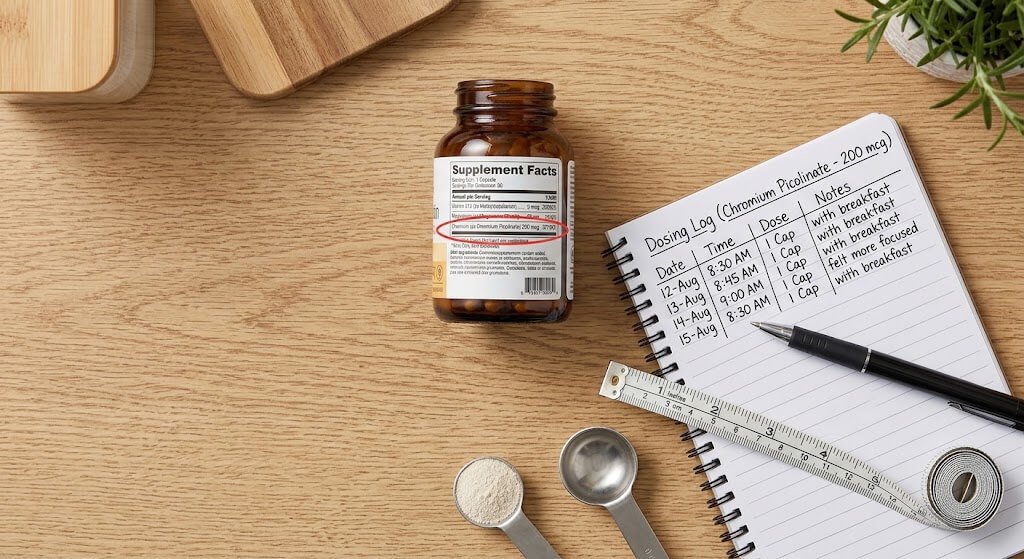
- Keep a simple log. Note the dose, the date you started, any symptoms, and your weight or waist measurement every two weeks. Bring the log to your doctor.
Coach’s Approach: What Actually Moves the Needle
I have spent years coaching people who want to change their bodies, and the pattern I see most often is that supplements get all the attention while the boring basics get skipped. Here is what I would put in front of any client before a supplement.
Adults should do muscle-strengthening activity involving all major muscle groups on at least two days a week, alongside 150 minutes of moderate aerobic activity. That guidance appears in a U.S. physical activity review [VERIFY: confirm article title and authors]. Strength training helps you keep and build lean muscle while you work on body composition, and walking or cycling supports your daily calorie output.
Beginner Full-Body Routine
Perform this routine two or three times per week, with at least one rest day between sessions. Use dumbbells you can control for all reps. A common starting point is a pair of 10 lb (4.5 kg) dumbbells for most beginners, and you can adjust from there.
| Exercise | Sets | Reps | Rest |
| Goblet squat | 2–3 | 8–12 | 60–90 seconds |
| One-arm dumbbell row | 2–3 per side | 8–12 | 60–90 seconds |
| Incline push-up | 2–3 | 8–12 | 60–90 seconds |
| Glute bridge | 2–3 | 10–15 | 60 seconds |
| Plank | 2–3 | 20–30 seconds | 60 seconds |
Goblet squat: Hold one dumbbell vertically at your chest. Sit your hips back and down, keeping your chest tall and knees tracking over your toes. Aim for a tempo of about 2 seconds down, 1 second pause, and 2 seconds up.
One-arm dumbbell row: Place one knee and hand on a bench, keeping your back flat. Pull the dumbbell toward your hip, leading with your elbow. Lower with control.
Incline push-up: Place your hands on a sturdy bench or counter. Lower your chest toward the edge while keeping your body in one straight line, then press back up.
Glute bridge: Lie on your back with knees bent and feet flat. Drive through your heels to lift your hips until your body forms a straight line from shoulders to knees. Squeeze at the top, then lower slowly.
Plank: Hold a straight line from head to heels on your forearms and toes. Brace your stomach and breathe steadily.
Coach’s Tip: Pick a weight where your last two reps feel hard but your form still looks clean. If every set feels easy, go up. If you cannot finish the reps with good form, go down. Your form is always more important than the number on the dumbbell.
Easier and Harder Versions
- Easier: Use a bodyweight squat to a box or chair, a resistance band row, a wall push-up, a shorter bridge with a 2-second hold, and a knee plank.
- Harder: Add weight to the goblet squat, slow the tempo to 3 seconds down, use a lower bench for the push-up, hold the bridge for 3 seconds at the top, and extend the plank time.
Common Mistake: Doing every set to failure from day one. Beginners often feel they need to exhaust every set to get results. In practice, stopping with 2 reps left in the tank keeps your form sharp and helps you stay consistent for weeks, which matters far more than any single hard session.

Realistic Expectations for the Next 12 Weeks
Here is a simple plan I would suggest to anyone who wants to try chromium picolinate alongside their training:
- Set a baseline. Record your weight, waist measurement, and how you feel on your current routine.
- Train consistently. Hit your strength sessions and daily walks for at least 12 weeks before judging anything.
- Track more than the scale. Watch waist size, how your clothes fit, your energy, and your strength numbers.
- Review with your doctor. If you do not see a change, or if you notice side effects, stop the supplement and talk it through.
- Do not raise the dose to chase results. The research does not support higher doses producing bigger effects.
Supplements can sit alongside a plan, but they are never the plan. The people who get the most out of their routines are usually the ones who build habits they can keep for years.

Frequently Asked Questions
Does chromium picolinate actually help you lose weight?
The research suggests a small possible effect. A 2003 meta-analysis found an average difference of about 1.1 kg (2.4 lb) compared with placebo, and a Cochrane review found a similar average. However, the evidence is low certainty, the effect depended heavily on one trial, and Harvard reports no significant weight loss from chromium supplements.
How much chromium picolinate should I take each day?
Research has used doses from 200 to 1,000 mcg per day, and chromium-only products commonly provide 200 to 500 mcg. Follow the label directions and check with your doctor before starting. Higher doses have not been shown to produce bigger weight changes, so there is no reason to exceed the label.
Can chromium picolinate cause side effects?
Side effects were rarely reported in the trials, and the NIH says chromium from supplements does not appear to cause harm. However, a few case reports link chromium supplements to kidney and liver problems, and animal and lab studies raise DNA damage questions. Stop use and contact your doctor if you notice unusual symptoms.
Does chromium picolinate affect blood sugar or diabetes medicine?
Yes, it can. The NIH warns that if you take antidiabetes medicine, chromium supplements might cause blood sugar to drop too low. Anyone with diabetes should speak with their doctor before using chromium, and should monitor blood sugar closely if they start it.
Is chromium picolinate better than other forms of chromium?
The research does not clearly show that one form is better for weight loss. Chromium picolinate was the form most studied in weight loss trials, but the safety questions about its DNA effects are the main reason some experts prefer other forms. Your body absorbs very little chromium from any source, so the form matters less than most marketing suggests.
Who should avoid chromium picolinate?
People with diabetes on blood sugar medicine, anyone with kidney or liver disease, people taking prescription medicines, and anyone who is pregnant or breastfeeding should talk to a doctor before using it. People considering high doses or stacking multiple chromium products should also get medical advice first.
Conclusion
Chromium picolinate for weight loss is a supplement with a small, uncertain effect and a safety record that is mostly reassuring but not fully settled. The best-known pooled analyses show about 1 kg of extra loss over several months, and the Cochrane reviewers rated that evidence as low certainty. If you are curious, you can try it with a doctor’s guidance, read the label closely, and track your results honestly. Just remember that consistent strength training, daily movement, and sensible eating will do far more for your body than any capsule. Build the habits first, and treat chromium as an optional extra at most.