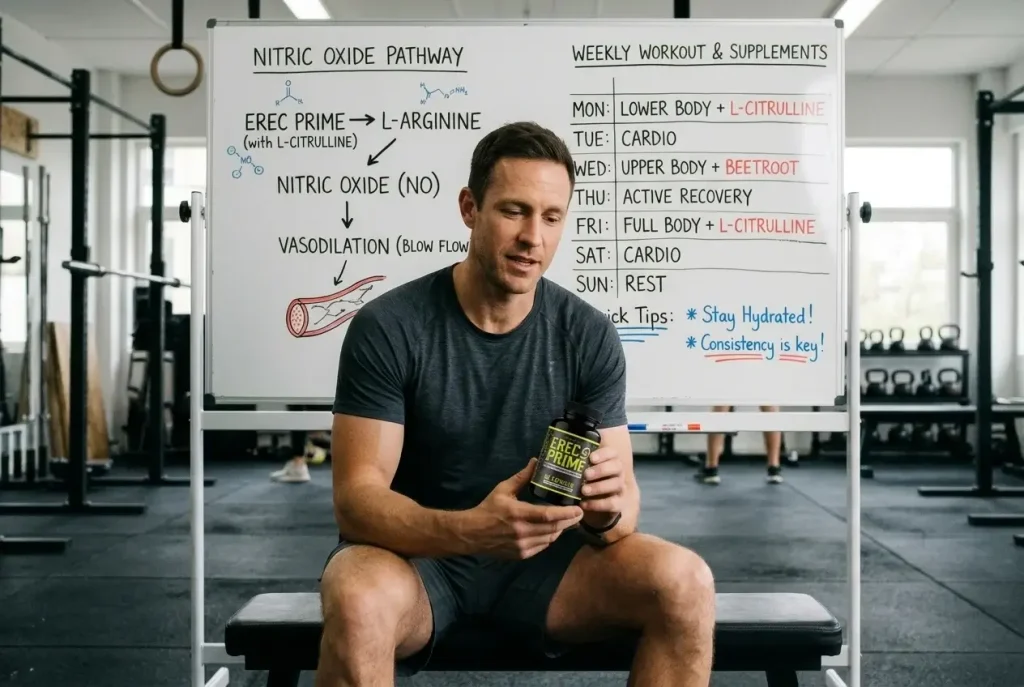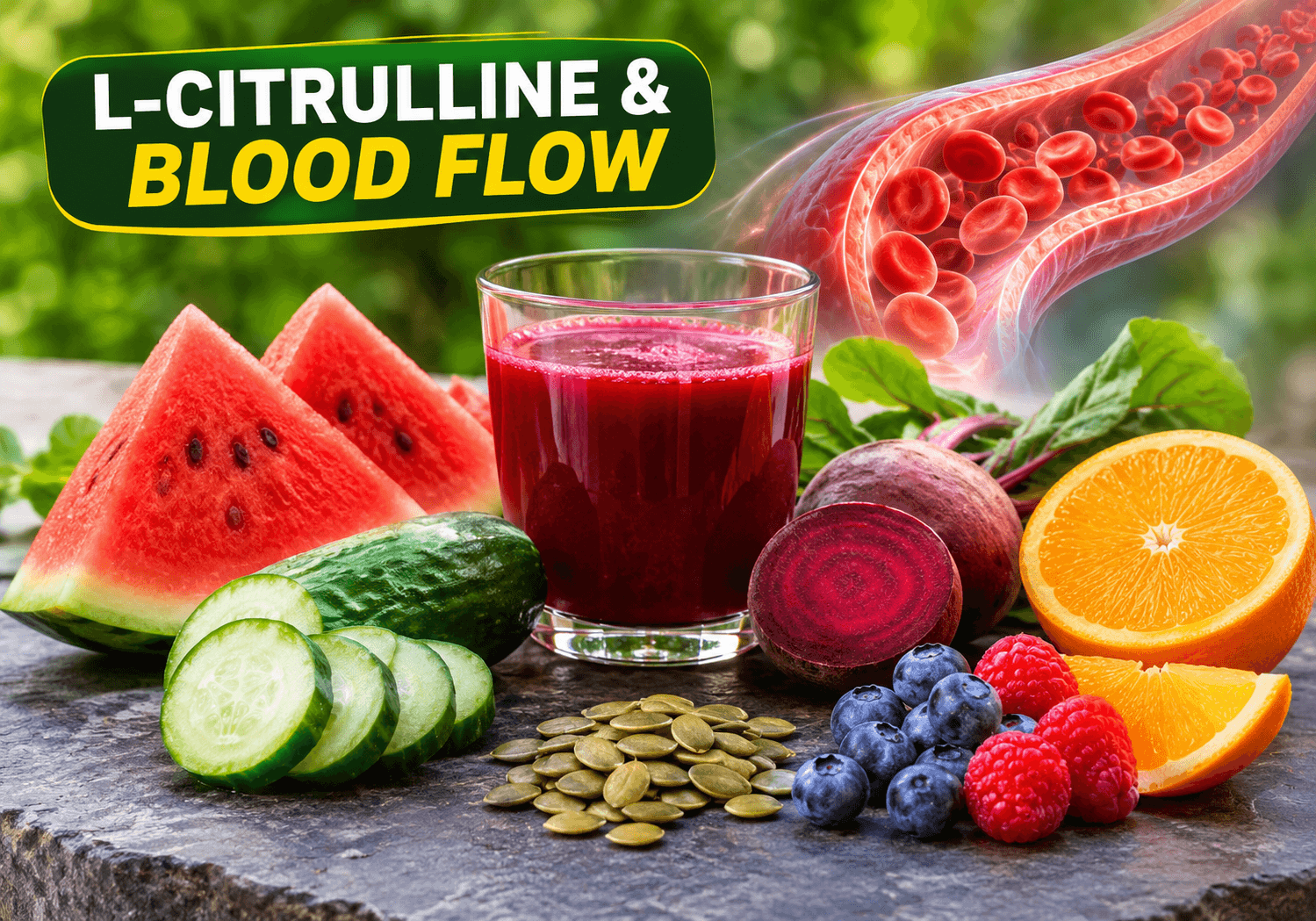
You’ve probably seen L-citrulline on supplement labels, gym forums, and “male performance” product lines. The claims range from “boosts your sex drive” to “works like a natural blood-flow enhancer.” As a strength and conditioning coach who’s answered this question in the gym hundreds of times, I want to cut through the marketing noise and show you what the science actually says about how L-citrulline affects libido and sexual stamina.
Here’s the short version: L-citrulline is an amino acid that your body converts into L-arginine, which then drives nitric oxide production. More nitric oxide means better blood vessel dilation, which in theory supports the blood flow needed for erectile quality and sustained sexual performance. But “supports blood flow” is not the same as “cures erectile dysfunction” or “sparks your libido overnight.” The research is promising but still limited, and the effect size is modest. Let’s break down exactly what’s proven, what’s plausible, and what’s still marketing hype.
Quick Answer: L-citrulline may improve sexual stamina and erectile quality by increasing nitric oxide–driven blood flow. It does not directly raise testosterone or act as an aphrodisiac. A typical studied dose is 3,000 mg (3 g) taken 60–90 minutes before activity. Effects on libido are indirect, linked to better circulation and reduced cardiovascular strain rather than hormonal change.
What the Research Actually Says
The Citrulline-Arginine Pathway: How It Works in Your Body
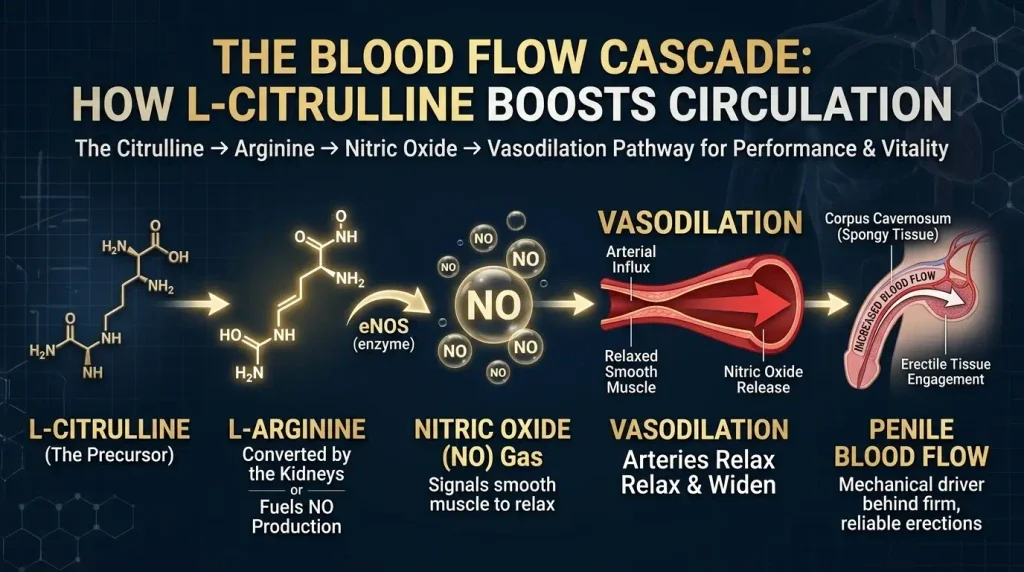
Before we talk about sex, let’s talk about biochemistry, because that’s where the real story lives. L-citrulline is a non-essential amino acid found in small amounts in watermelon, cucumbers, and pumpkins. On its own, it doesn’t do much. But once you swallow it, your kidneys convert it into L-arginine, another amino acid that serves as the direct substrate for nitric oxide synthase (NOS), the enzyme that produces nitric oxide (NO).
This matters because oral L-arginine supplements get heavily broken down in your liver during first-pass metabolism. You might take 5,000 mg of L-arginine and only a fraction reaches your bloodstream. L-citrulline bypasses that liver hit. Research published in peer-reviewed journals has shown that 3,000 mg of L-citrulline raises plasma arginine levels more effectively than 1,500–6,000 mg of L-arginine taken at the same time .
The end result is a steady, sustained rise in nitric oxide rather than a quick spike and crash. That sustained NO is what relaxes smooth muscle in arterial walls, widening the vessels and improving blood flow to every tissue in your body, including the penile arteries.
How Nitric Oxide Drives Blood Flow and Erectile Quality
Erections are hydraulic events. The corpora cavernosa in the penis fill with blood when the surrounding smooth muscle relaxes, a process driven almost entirely by nitric oxide signaling. When NO levels are adequate, the smooth muscle relaxes, arteries dilate, and blood rushes in. When NO production drops—due to age, poor cardiovascular health, oxidative stress, or certain medications—the smooth muscle stays tighter, and blood flow is restricted.
The NIH National Institute on Aging notes that erectile function is a sensitive barometer of overall vascular health. If your arteries are stiff or your endothelium (the inner lining of blood vessels) is inflamed, NO bioavailability drops, and sexual performance suffers before you ever notice cardiovascular symptoms.
This is where L-citrulline fits in. By feeding the arginine → NO pathway more efficiently than L-arginine alone, it may help maintain endothelial function and support the vasodilation needed for a firm, sustained erection. It’s not a magic switch. It’s a fuel for a system that has to be in reasonable shape to respond.
What Studies Show for Sexual Function and Stamina
The most direct human research I can point you to is a small randomized, double-blind, placebo-controlled trial examining L-citrulline in men with mild-to-moderate erectile dysfunction. Participants taking 1,500 mg of L-citrulline daily for eight weeks reported improvements in erectile hardness and satisfaction compared to placebo .
Separately, exercise-science research in the Journal of Strength and Conditioning Research and Medicine & Science in Sports & Exercise has shown that L-citrulline supplementation (typically 6–8 g of citrulline malate) reduces perceived muscle soreness, improves blood flow to working muscles, and supports sustained effort during resistance training. The mechanism is the same NO-driven vasodilation. If it helps a barbell stay off your shoulders for an extra rep by keeping oxygenated blood moving, the same principle applies to the pelvic vasculature.
For sexual stamina specifically, the logic is straightforward: better cardiovascular output, better oxygen delivery, and better venous return all contribute to the ability to sustain arousal and performance over a longer period. L-citrulline doesn’t “add stamina” the way a stimulant would. It removes a potential bottleneck—restricted blood flow—so your cardiovascular system can do its job more efficiently.
Important caveat: There is currently no robust, large-scale RCT proving that L-citrulline directly increases libido (sexual desire) in men with normal erectile function. Libido is driven by hormones (testosterone, DHEA), neurotransmitters (dopamine, oxytocin), psychological factors (stress, relationship dynamics, sleep quality), and overall energy. L-citrulline doesn’t touch most of those levers. If your low drive is hormonal or psychological, no amount of citrulline will fix it. If it’s partly vascular—your body can’t sustain the blood flow needed for arousal—then supporting NO production is a reasonable, low-risk step.
Dosage, Timing, and Form: What the Data Supports
| Factor | Detail |
| Studied dose (sexual function) | 1,500–3,000 mg L-citrulline daily |
| Studied dose (exercise performance) | 6,000–8,000 mg citrulline malate (≈2,400–3,200 mg free L-citrulline) |
| Timing | 60–90 min before the activity you want to support |
| Form | Free L-citrulline (pure powder or capsule) or citrulline malate (2:1 ratio with malic acid) |
| Cycle | Daily use for 4–8 weeks to see endothelial adaptations; no need to “cycle” |
| With food? | Can be taken with or without food; some prefer empty stomach for faster absorption |
| Onset | Acute blood-flow effects within 60–90 min; chronic vascular benefits build over 2–4 weeks |
Free L-citrulline and citrulline malate are not the same product. Citrulline malate is a 2:1 blend of L-citrulline and malic acid, popular in pre-workout formulas. If you’re targeting sexual wellness specifically, pure L-citrulline is the form most studied in that context. If you’re also using it for gym performance, citrulline malate works fine and gives you the malic acid bonus for the Krebs cycle.
Practical Dosing Protocol
Here’s how I’d structure it for a male client in his 30s–50s who wants to support vascular function and sexual stamina:
- Weeks 1–2: 1,500 mg L-citrulline daily, taken in the morning or 90 minutes before the activity you care about.
- Weeks 3–8: Increase to 3,000 mg daily if you tolerate the lower dose well.
- Ongoing: Maintain 1,500–3,000 mg daily. No need to exceed 3,000 mg for vascular/sexual purposes. Higher doses (6 g+) are for exercise performance and cost more.
- Before a specific event: Take your daily dose 60–90 minutes prior. Don’t double up on the same day.
Coach’s Tip: Pair L-citrulline with a consistent cardio routine. Thirty minutes of moderate-intensity cycling, swimming, or brisk walking, three to four times per week, does more for your endothelial function than any supplement. The ACSM’s Guidelines for Exercise Testing and Prescription recommend at least 150 minutes of moderate aerobic activity per week for cardiovascular health. L-citrulline is a supporting actor, not the lead.
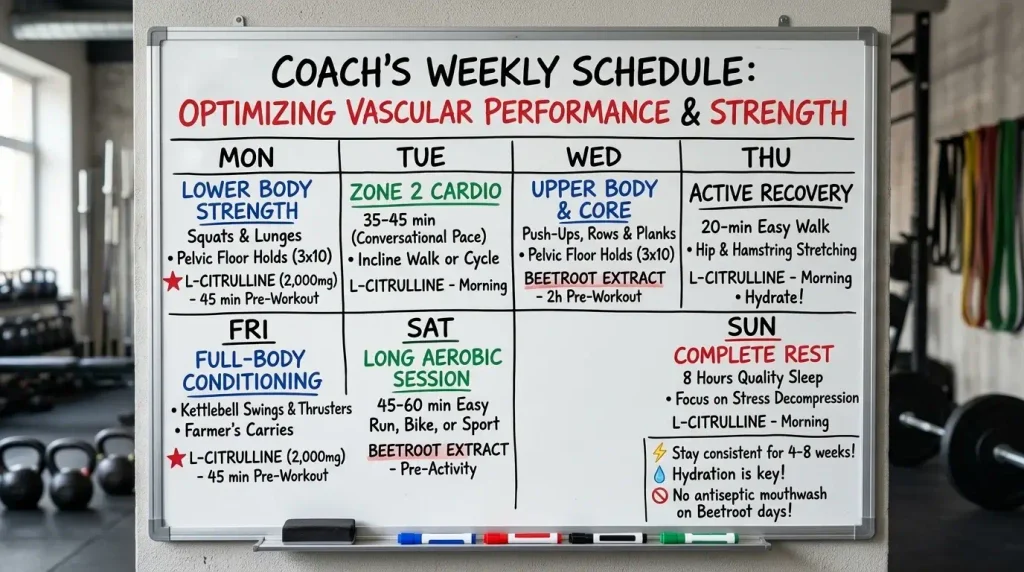
How to Apply This: A Practical Weekly Framework
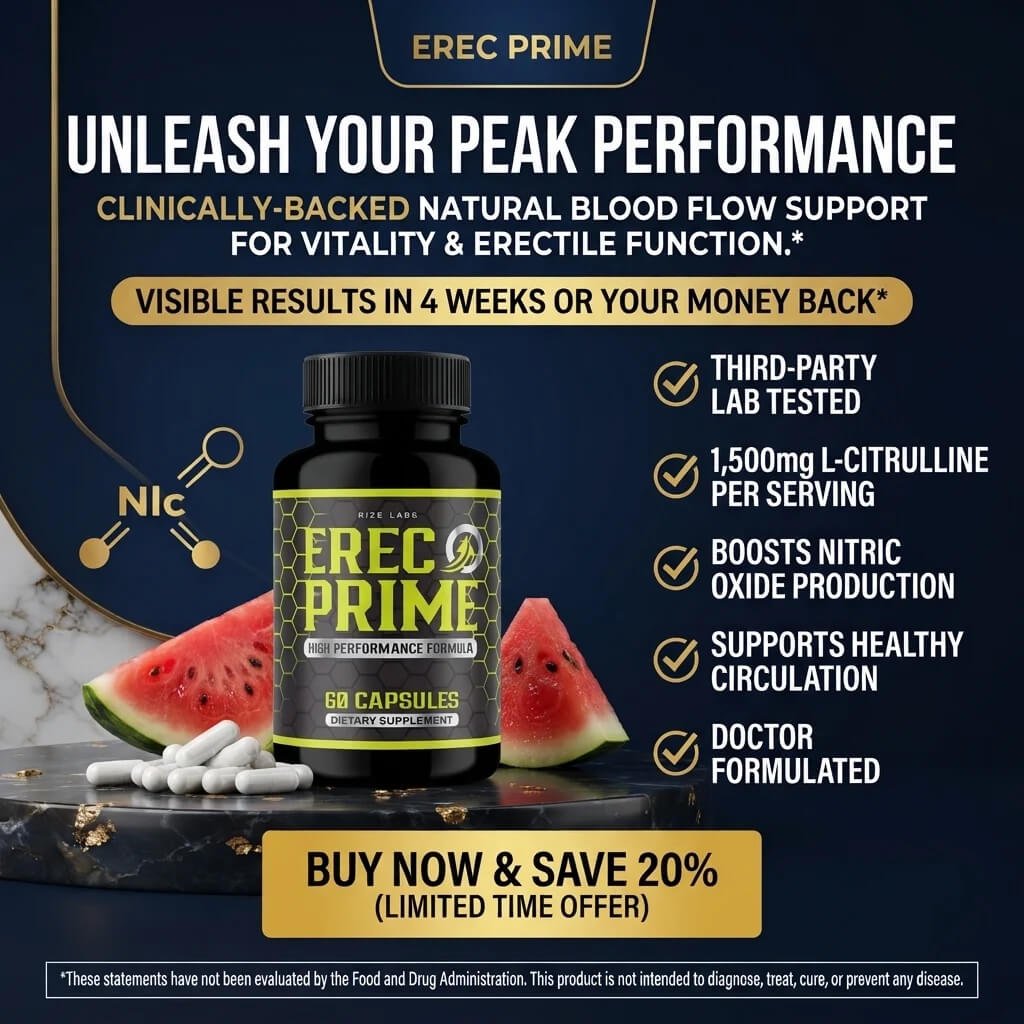
You don’t need a complicated protocol. Here’s a simple weekly structure that layers L-citrulline into a lifestyle that actually supports sexual wellness:
Daily non-negotiables:
- 1,500–3,000 mg L-citrulline (morning or pre-activity)
- 7–9 hours of sleep (poor sleep drops testosterone and raises cortisol, both of which tank libido—see how stress and poor sleep lower male libido)
- 30+ minutes of moderate movement (walk, cycle, swim)
Three times per week:
- Resistance training focused on compound lifts (squats, deadlifts, rows, presses). These movements recruit large muscle groups, drive systemic blood flow, and support healthy testosterone production.
- Take your L-citrulline 60–90 minutes before the session.
Two times per week:
- Zone 2 cardio (light cycling, easy running, rowing) for 30–40 minutes. This builds mitochondrial density and arterial compliance, the foundation for sustained stamina.
Before a specific date or event:
- Take your 3,000 mg dose 90 minutes prior.
- Avoid a heavy, high-fat meal within two hours before (it slows gastric emptying and diverts blood to digestion).
- Hydrate well. Dehydration reduces plasma volume and makes vasodilation less effective.
What to avoid while supplementing:
- High-dose niacin (can cause flushing that masks or competes with NO-mediated dilation)
- Excessive alcohol (raises oxidative stress, degrades endothelial function)
- NSAIDs taken chronically (some evidence suggests they impair NO signaling)
Safety, Side Effects, and Who Should Be Cautious
L-citrulline is classified as a generally safe dietary supplement at doses up to 9,000 mg per day in short-term studies. The most commonly reported side effects are mild gastrointestinal discomfort (bloating, nausea) at higher doses. Start at 1,500 mg and see how your stomach responds before jumping to 3,000 mg.
Who should talk to a doctor before taking L-citrulline:
- Men on PDE-5 inhibitors (sildenafil, tadalafil, vardenafil). Both L-citrulline and these drugs increase NO and vasodilation. Stacking them could cause an excessive drop in blood pressure. This is not a “don’t ever combine” rule, but it’s a “talk to your prescribing doctor first” rule.
- Men with uncontrolled hypertension or on antihypertensive medication. Adding a vasodilator supplement on top of blood-pressure meds can cause symptomatic hypotension (dizziness, lightheadedness, fainting).
- Men with known arterial insufficiency or recent cardiovascular events.
- Anyone taking more than three supplements simultaneously. Interactions get harder to track.
If you’re over 40 and noticing changes in erectile quality, don’t just reach for a supplement. Get a basic panel: total and free testosterone, fasting glucose, lipid panel, and a cardiovascular risk assessment. Low libido after 40 can be hormonal, vascular, psychological, or a combination. Understanding the root cause matters more than the supplement. For a deeper look, what causes low libido in men after 40 covers the diagnostic side.
Common Mistake: Buying a “male enhancement” product that lists 50 mg of L-citrulline among 20 other ingredients and expecting it to work. At 50 mg, you’re getting a homeopathic dose. Look for a product that provides at least 1,500 mg of L-citrulline per serving, ideally as the primary or sole ingredient. If you’re evaluating a supplement label, the same principles in how to evaluate ingredients in supplements apply: check the dose, check for proprietary blends that hide individual amounts, and check for third-party testing (NSF, Informed Sport, or USP verification).
Related Tips That Multiply the Effect
L-citrulline works on one pathway. Sexual stamina and libido are multi-system. Here’s what to layer in:
Support NO production from other angles:
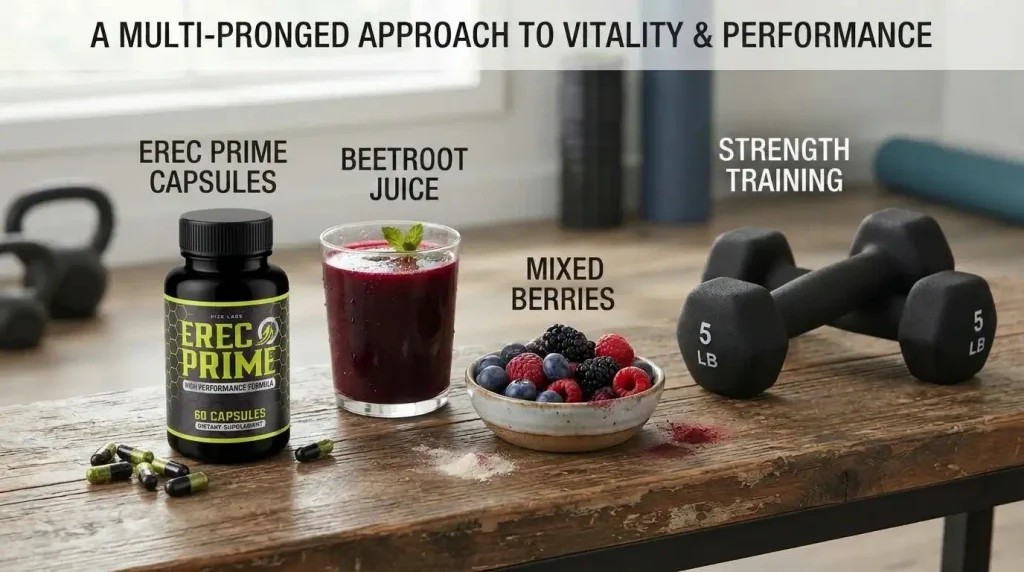
- Beetroot juice or beet powder (500–700 ml or 8 g of powder). Dietary nitrates convert to NO via a separate pathway (nitrate → nitrite → NO). Stacking nitrates with L-citrulline hits NO production from two directions.
- Vitamin C and flavonoids (citrus, berries, dark chocolate). These are antioxidants that protect NO from oxidative degradation, extending its half-life in the bloodstream.
- Omega-3 fatty acids (EPA/DHA from fish oil or algae). Support endothelial cell membrane fluidity and reduce vascular inflammation.
Address the non-vascular drivers of libido:
- Sleep. Non-negotiable. Testosterone peaks during deep sleep. Chronic sleep restriction below 6 hours is linked to measurably lower morning testosterone levels.
- Stress management. Cortisol suppresses the hypothalamic-pituitary-gonadal axis. Ten minutes of box breathing, a walk in nature, or a structured wind-down routine matters more than any supplement.
- Resistance training. Heavy compound lifts stimulate acute testosterone and growth hormone release. You don’t need to be a bodybuilder. Three sessions of squats, deadlifts, and presses per week is enough.
- Relationship and psychological health. If stress, anxiety, or relationship tension is the primary driver of low drive, no supplement will fix it. Consider talking to a therapist or counselor.
For broader sexual wellness strategies beyond supplements, check out how men improve stamina and sexual wellness naturally.
L-Citrulline vs. L-Arginine: Which Is Better for Blood Flow?
This is the question I get most often in the gym. Here’s the practical breakdown:
| Factor | L-Citrulline | L-Arginine |
| Bioavailability | Higher (bypasses hepatic first-pass) | Lower (heavily metabolized in liver) |
| Plasma arginine rise | Sustained over 3–4 hours | Quick spike, short duration |
| GI tolerance | Generally better at 3,000 mg | Diarrhea common above 3,000 mg |
| Studied for erectile function | Yes (small RCTs) | Yes (larger RCTs, modest effect) |
| Cost per effective dose | Comparable | Comparable |
| Best use case | Daily vascular support, sexual wellness | Acute pre-workout (if you prefer) |
The bottom line: for daily, sustained NO support aimed at sexual wellness, L-citrulline has the edge on bioavailability and GI tolerance. If you’re already taking L-arginine for a specific reason and tolerating it well, you don’t need to switch. But if you’re starting fresh, L-citrulline is the more efficient vehicle. For a deeper dive on the arginine side, see does L-arginine support blood flow and erectile function.
Does L-Citrulline Increase Testosterone?
No. There is no credible evidence that L-citrulline raises testosterone levels in men. It’s not a hormone precursor, it doesn’t stimulate the Leydig cells, and it doesn’t affect the HPG axis. If a product marketing L-citrulline claims it “boosts testosterone,” that’s a red flag.
What L-citrulline can do is support the cardiovascular and vascular environment in which healthy testosterone does its work. If your blood flow is poor, your body’s overall anabolic environment suffers, and you may feel lower energy, weaker erections, and reduced drive. Fixing the vascular bottleneck doesn’t create new testosterone, but it lets the testosterone you already have work more effectively.
If you’re genuinely low in testosterone (confirmed by two morning blood draws on separate days, below the lab’s reference range), talk to an endocrinologist or urologist. No supplement replaces medical treatment for clinically low T.
Can You Take L-Citrulline With Other Supplements?
Yes, in most cases. L-citrulline is not a stimulant and doesn’t interact with caffeine, creatine, beta-alanine, or most pre-workout ingredients. A few notes:
- With PDE-5 inhibitors: See the safety section above. Doctor first.
- With nitrate-rich foods (beets): Fine and potentially synergistic for NO production.
- With L-arginine: Redundant. Pick one. L-citrulline is the more efficient route.
- With other “male enhancement” blends: Be cautious. Many of these products are proprietary blends with unverified doses. If you’re going to stack, keep it simple: L-citrulline + creatine + a multivitamin with zinc is a clean, evidence-based stack. For more on supplement stacking, see supplements for libido and energy in men.
FAQ
Does L-citrulline directly increase libido or sexual desire?
L-citrulline does not act on the hormonal or neurological pathways that drive sexual desire. It supports the vascular component—blood flow—needed for arousal and erection. If your low libido is vascular in nature (poor circulation, endothelial dysfunction), improving NO-mediated blood flow may help you feel more physically responsive. If the cause is hormonal, psychological, or relationship-related, L-citrulline won’t address it.
How much L-citrulline should a man take for sexual stamina?
Most research on sexual function uses 1,500–3,000 mg of L-citrulline daily. For exercise performance, doses of 6,000–8,000 mg of citrulline malate (containing roughly 2,400–3,200 mg free L-citrulline) are studied. For sexual wellness specifically, 3,000 mg of pure L-citrulline taken 60–90 minutes before the activity is a reasonable starting point.
Is L-citrulline better than L-arginine for blood flow?
Yes, in terms of bioavailability. L-citrulline is converted to L-arginine in the kidneys, bypassing the liver’s first-pass metabolism that breaks down most of the arginine you swallow. This means a smaller dose of L-citrulline raises plasma arginine more effectively and for a longer duration than an equivalent or even larger dose of L-arginine.
Can L-citrulline help with mild erectile dysfunction?
A small number of randomized controlled trials suggest that daily L-citrulline (1,500 mg for 8 weeks) may improve erectile hardness and satisfaction in men with mild-to-moderate ED. The effect is modest and not a replacement for medical treatment. If you’re experiencing persistent erectile difficulties, see a urologist to rule out cardiovascular disease, hormonal issues, or medication side effects.
Does L-citrulline affect women’s sexual function?
The same NO-mediated vasodilation applies to female genital blood flow. However, there is very limited research on L-citrulline specifically in women. Theoretically, improved pelvic blood flow could support arousal, but there are no robust RCTs to confirm this. Women considering L-citrulline should consult their healthcare provider, especially if they are on blood-pressure medication.
How long does L-citrulline take to show effects?
Acute blood-flow effects (feeling warmer, better circulation) can occur within 60–90 minutes of a dose. Chronic vascular adaptations—improved endothelial function, better arterial compliance—typically take 2–4 weeks of consistent daily use. Don’t expect a single dose to transform your experience. Think of it as a daily maintenance dose for your vascular system.
Conclusion: What L-Citrulline Can and Can’t Do for You
L-citrulline is not a miracle pill, and anyone selling it as one is overselling. What it is is a well-supported, low-cost, generally safe amino acid that feeds the nitric oxide pathway more efficiently than its cousin L-arginine. For men whose sexual stamina or erectile quality is partly limited by suboptimal blood flow—common after 40, with sedentary habits, poor sleep, or early cardiovascular changes—3,000 mg of L-citrulline a day is a reasonable, evidence-informed addition to a broader wellness routine.
It will not raise your testosterone. It will not fix a relationship problem. It will not replace a urologist’s visit if you have persistent erectile dysfunction. But as one piece of a multi-system strategy—good sleep, regular cardio, resistance training, stress management, a balanced diet, and maybe a glass of beet juice—it can help keep your vascular system doing its job so that your body can respond when the moment calls for it.
If you’re new to supplementing or managing more than one health concern, the safest move is to run your plan past your primary care doctor or a sports-medicine specialist. They know your medications, your blood pressure, your history. That context matters.
This article is for general information and is not a substitute for advice from a doctor or physical therapist.