
Skin that bounces back less and joints that feel stiff in the morning often show up in the same decade. That is not a coincidence. Both depend on connective tissue, and both respond to the same daily habits.
This guide explains how to improve skin elasticity and joint health naturally with sun protection, food choices, smart movement, and cautious supplement use. You will get a simple weekly routine, specific sets and reps, and clear limits on what the research can and cannot promise.
Quick Answer
To improve skin elasticity and joint health naturally, protect your skin from UV rays, eat vitamin C-rich and omega-3-rich foods, do regular low-impact cardio plus strength training, and ask your doctor about collagen peptides. Research suggests these habits may help skin firmness and joint comfort over weeks to months, though results vary.
Why Skin Elasticity and Joint Health Decline Together
Your skin, tendons, ligaments, and cartilage all rely on collagen, a structural protein. With age, the body makes less of it. A 2023 systematic review in Nutrients describes skin aging as a drop in collagen production and skin blood supply, leading to less elasticity and more wrinkles.
Joints go through a parallel change. Cartilage can wear down over time, which is the process behind osteoarthritis. Stiffness, achiness, and reduced range of motion are common results.
Other factors speed things up. Sun exposure is a major one for skin. Inactivity is a major one for joints. Poor nutrition affects both.
The good news is that these are habits, not destiny. You cannot stop aging, but you can give your tissues better conditions to work with.
What “Natural” Means Here
In this guide, “natural” means lifestyle-first: sun habits, food, movement, and sleep-friendly routines. Supplements are covered separately and carefully, because the evidence is mixed and quality varies.
No natural method replaces medical care. If you have joint pain, a skin condition, or a health diagnosis, see your doctor before changing your routine.
What the Research Says
Collagen Peptides and Skin Elasticity
Hydrolyzed collagen is collagen broken into smaller pieces. It is the most-studied oral collagen form for skin. A meta-analysis of 26 randomized controlled trials with 1,721 participants found that hydrolyzed collagen improved skin hydration and elasticity compared with placebo. The trials lasted 2 to 12 weeks.
A separate Cureus meta-analysis of 14 studies and 967 participants also reported better skin moisture and elasticity, with the authors highlighting a 12-week regimen.
There are caveats. The Nutrients authors noted biases in the included trials and called for larger, better-designed studies. Many trials are also small or funded by supplement makers [VERIFY funding details before citing this point].
So the honest takeaway is this: collagen peptides may modestly help skin elasticity, but they are not a proven cure for aging skin.
Collagen Peptides and Joint Comfort
Evidence for joints is more limited and focused on knee osteoarthritis. A 2023 meta-analysis of randomized trials found that collagen peptides were associated with greater pain relief than placebo in people with knee osteoarthritis. The authors also cautioned that potential biases mean better trials are needed.
A systematic review of collagen peptides combined with exercise suggests the pairing may be beneficial for degenerative bone and joint conditions. Exercise is the key part of that pairing. Collagen alone is not a substitute for movement.
If you want to learn how long collagen may take to show effects on skin, see our guide on how long collagen supplements take to work.

Vitamin C: The Collagen Helper
Your body cannot make collagen without vitamin C. The NIH Office of Dietary Supplements lists collagen biosynthesis as a core function of vitamin C. The same page says fruits and vegetables are the best sources, including citrus, red and green peppers, kiwifruit, broccoli, and strawberries.
The Daily Value for adults is 90 mg, according to the NIH health professional fact sheet. That sheet also notes that five varied servings of fruits and vegetables can provide more than 200 mg.
Higher isn’t better. The NIH sets an upper limit of 2,000 mg per day for adults from all sources.
If you are curious about timing collagen with vitamin C, our article on the best time to take collagen powder goes deeper.
Omega-3 Fatty Acids
Omega-3s come from fatty fish such as salmon, mackerel, and sardines, and from flaxseed, chia, and walnuts, according to the NIH omega-3 fact sheet. The same source notes that a true omega-3 deficiency can cause rough, scaly skin, but that deficiency is very rare in the United States.
For joints, the picture is modest. Some clinical trials suggest omega-3 supplements may help manage rheumatoid arthritis when taken with standard treatment. The NIH says it is not clear whether they reduce joint pain, swelling, or stiffness.
So treat omega-3-rich foods as part of a healthy eating pattern rather than a joint cure. For more on skin-specific angles, see our piece on omega-3 fatty acids and skin hydration.
Safety note: High-dose omega-3 supplements may interact with blood thinners such as warfarin, according to the NIH. Check with your doctor first.
Sun Protection: The Biggest Skin Habit
Long-term UV exposure is linked to sun damage, premature aging, and skin cancer, according to the CDC Yellow Book. The CDC’s sun safety guidance recommends broad-spectrum sunscreen with SPF 15 or higher, shade, protective clothing, hats, and sunglasses. It also says to protect your skin when the UV Index is 3 or higher.
Sun protection does not rebuild lost elasticity. It helps stop further damage, which makes it one of the highest-value habits on this list.
Movement for Joint Health
The CDC states that physical activity can reduce joint pain and improve function and mood in people with arthritis. Its joint-friendly activity list includes brisk walking, cycling, swimming, dancing, tai chi, and water exercise.
For strength training, the CDC advises choosing weights or resistance bands that do not cause joint pain. It also says some pain, stiffness, or swelling is normal after starting a new program, but that it should improve over time. If it does not, contact your health care provider.
A CDC report in Preventing Chronic Disease notes the Physical Activity Guidelines for Americans recommend at least 150 minutes per week of moderate activity for adults, including those with arthritis.
Natural Strategies at a Glance
| Strategy | Main target | Evidence level | Practical start |
| Daily sun protection | Skin | Strong for protecting skin | SPF 15+ broad-spectrum, hat, shade |
| Vitamin C foods | Collagen support | Strong for the nutrient’s role; limited for “anti-aging” claims | 2-3 servings of fruit or veg rich in vitamin C daily |
| Fatty fish or plant omega-3s | Skin and general health | Mixed for joints | Fish 1-2 times per week, or flax, chia, walnuts |
| Low-impact cardio | Joints | Strong (CDC) | 30-minute brisk walk, about 1.5-2 miles (2.4-3.2 km) |
| Strength training | Joints and daily function | Strong (CDC) | 2 sessions per week |
| Collagen peptides | Skin and knee joints | Promising but mixed | Discuss with your doctor first |
How to Improve Skin Elasticity and Joint Health Naturally: 6 Daily Habits
This is where theory becomes routine. Here is how I would set up a client who is starting from scratch.
1. Make Sunscreen Automatic
Keep sunscreen next to your toothbrush. Apply a thick layer to exposed skin before going outside, and don’t forget your neck, ears, and the backs of your hands.
Reapply about every two hours when outdoors and after sweating or swimming, as the CDC advises. Add a wide-brim hat for walks.
Coach’s Tip: Put a small bottle in your gym bag and your car. The best sunscreen habit is the one that takes zero thinking.
2. Build a Vitamin C Plate
Aim to include a vitamin C-rich food at two or three meals. Easy options: strawberries with breakfast, a red pepper in your lunch salad, and broccoli with dinner.
Cooking can reduce vitamin C, so include some raw options, a point the NIH also makes. You do not need megadoses. Food covers the Daily Value for most people.
3. Eat Omega-3 Foods Regularly
The NIH notes that the American Heart Association recommends one to two servings of seafood per week for heart health. Salmon, sardines, and trout are good picks.
If you do not eat fish, add ground flaxseed to oatmeal, chia seeds to yogurt, or a handful of walnuts as a snack.
4. Walk Most Days
Start with 10-15 minutes and build toward 30. The CDC says short sessions of 5 to 10 minutes still count toward your weekly total.
Use the “talk test.” You should be able to hold a conversation. If you cannot, slow down.
![Adult couple walking briskly on a tree-lined path wearing hats and sunscreen]](https://pillsfeed.com/wp-content/uploads/2026/11/Adult-couple-walking-briskly-on-a-tree-lined-path-wearing-hats-and-sunscreen.webp)
5. Strength Train Twice a Week
Muscle around a joint helps share the load during daily tasks like stairs and getting out of a chair. The routine below takes about 25 minutes.
6. Consider Collagen Carefully
If you decide to try collagen peptides, pick a product with third-party testing (look for labels from groups like USP or NSF [VERIFY these programs before publishing]). Trial doses and durations vary, so follow the product label and your doctor’s advice.
Give it a fair trial of about 8-12 weeks, consistent with the study durations above, and watch for digestive upset or allergic reactions. Stop if you notice a reaction.
A 4-Week Routine for Skin Elasticity and Joint Health
This sample plan fits beginners and busy adults. It combines walking and two full-body strength sessions per week.
Weekly Schedule
| Day | Activity | Time |
| Mon | Strength session A | 25 min |
| Tue | Brisk walk | 20-30 min |
| Wed | Rest or gentle stretching | 10 min |
| Thu | Strength session B | 25 min |
| Fri | Brisk walk or swim | 20-30 min |
| Sat | Optional easy activity (cycling, dancing) | 30 min |
| Sun | Rest | – |
The Strength Session
Warm-up (5 minutes): Walk in place, then do 10 arm circles and 10 slow bodyweight squats to a chair.
| Exercise | Sets | Reps | Rest | Tempo |
| Sit-to-stand (or goblet squat) | 2-3 | 8-12 | 60-90 sec | 3 sec down, 1 up |
| Glute bridge | 2-3 | 10-15 | 60 sec | 2 sec up, hold 1, 2 down |
| Resistance band row | 2-3 | 10-12 | 60 sec | 2 sec pull, 2 return |
| Incline push-up | 2-3 | 6-12 | 60-90 sec | 2 down, 1 up |
| Step-up | 2 | 8 per leg | 60 sec | Controlled |
Move to the next level only when you finish all sets with good form and no joint pain.
How to Do Each Exercise
Sit-to-stand. Sit on a sturdy chair about 17-19 inches (43-48 cm) high. Place your feet hip-width apart, lean slightly forward, and stand up by pushing through your whole foot. Lower slowly.
You should feel it in your thighs and glutes, not as sharp pain in your knees.
- Easier: Use a higher seat or a cushion, and use your hands for help.
- Harder: Hold a dumbbell at your chest, 8-15 lb (3.6-6.8 kg), and move to a goblet squat.
Glute bridge. Lie on your back with knees bent and feet flat. Press through your heels and lift your hips until your body forms a straight line from shoulders to knees. Squeeze your glutes at the top.
- Easier: Lift only halfway and hold for one second.
- Harder: Do single-leg bridges, or place a dumbbell of 10-20 lb (4.5-9 kg) on your hips.

Resistance band row. Anchor a light band around a sturdy post at chest height. Stand tall, pull your elbows back, and squeeze your shoulder blades together. Return slowly.
Good posture here also supports your neck and shoulder joints.
- Easier: Use a lighter band or sit while rowing.
- Harder: Use a thicker band, or pause for 2 seconds at the end of each rep.
Incline push-up. Place your hands on a counter or sturdy bench about 30-36 inches (76-91 cm) high. Keep your body straight and lower your chest toward the surface.
- Easier: Use a higher surface, such as a wall.
- Harder: Move to a lower surface, such as a sturdy step about 12-18 inches (30-46 cm), then to the floor.
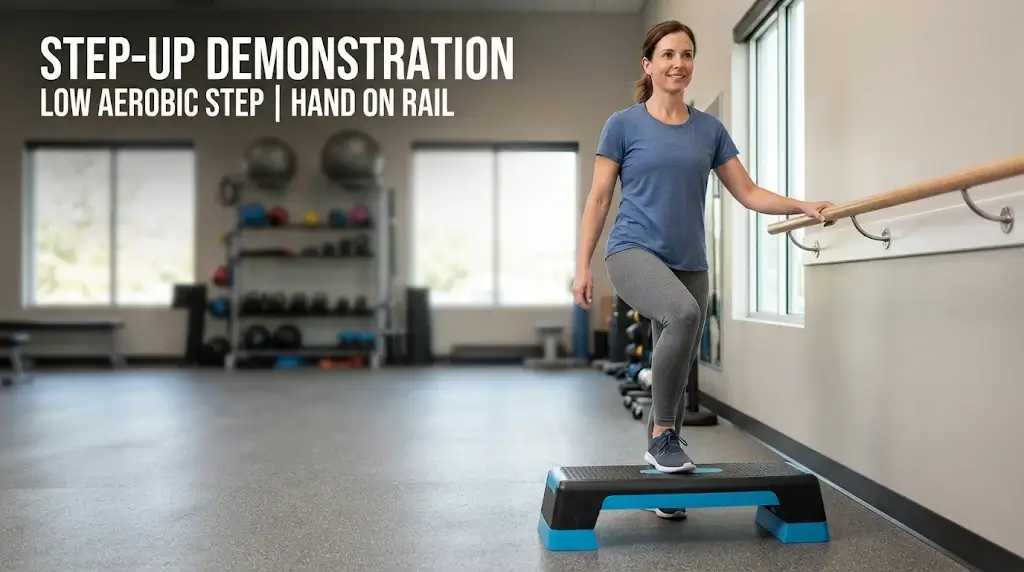
Step-up. Use a step 6-8 inches (15-20 cm) high. Place your whole foot on the step, press through your heel, and stand tall. Lower with control.
- Easier: Use a lower step and hold a rail.
- Harder: Use a taller step or hold light dumbbells of 5-10 lb (2.3-4.5 kg).
Common Mistake: Doing too much too soon. Adding heavy weights, extra sets, and long walks in the same week is how joint flare-ups start. Increase only one variable (reps, load, or time) at a time, by small amounts.
Cool-Down (5 minutes)
Walk slowly for 2 minutes. Then hold gentle stretches for your calves, thighs, and chest for 20-30 seconds each. Stretch to mild tension only.
Week-by-Week Progression
- Week 1: 2 sets of each exercise, walking 15-20 minutes.
- Week 2: 2 sets, add 2 reps per exercise, walking 20-25 minutes.
- Week 3: 3 sets if it feels easy, walking 25-30 minutes.
- Week 4: Add a small load (a light dumbbell or thicker band), keep walking at 30 minutes.
Keep a simple log. Notice how your joints feel the next morning, not just during the workout.
Safety Notes: Who Should Be Careful
Check with a doctor or physical therapist before starting if you have joint pain, a diagnosed condition like arthritis, a recent injury, heart or blood pressure concerns, or are pregnant. The CDC also says people with arthritis may benefit from seeing a physical therapist when starting out.
Stop an exercise and seek advice if you have sharp, stabbing pain, swelling, or a joint that feels hot or looks red. Persistent pain that does not improve over time is also worth a medical visit.
For supplements, tell your doctor and pharmacist what you take. Omega-3s and vitamin C can interact with some medications. People being treated for cancer should speak with their oncologist before using vitamin C or other antioxidant supplements, according to the NIH.
Be careful with skin products too. If you notice a changing mole, a sore that will not heal, or a rash, see a doctor rather than trying home remedies.
Related Tips for Healthy Aging
Evaluate supplements critically. Labels can be confusing, and marketing often outruns evidence. Our guide on how to evaluate supplement ingredients offers a checklist you can adapt to any product, even though it focuses on weight management.
Explore antioxidant options with caution. Some people ask about astaxanthin for skin. Read the research summary in our astaxanthin skin article and discuss it with your doctor before trying it.
Stay consistent. Skin and joint changes take weeks to months. Taking photos of your skin in the same light every 4 weeks, and tracking how your knees feel on stairs, gives you better feedback than the mirror alone.
Be skeptical of fast claims. Any product promising to “reverse aging in days” or “regrow cartilage” is not supported by the evidence reviewed here.
FAQ
Can you improve skin elasticity naturally?
You can support it. Daily sun protection, vitamin C-rich foods, and regular activity create better conditions for skin. Some trials of collagen peptides also report modest elasticity improvements. Results vary, and no habit fully reverses age-related changes, so aim for gradual improvement and realistic expectations.
Does collagen really work for skin and joints?
Meta-analyses suggest hydrolyzed collagen may modestly improve skin hydration and elasticity, and collagen peptides were linked to less knee osteoarthritis pain. However, the authors note possible bias and call for stronger trials. Treat collagen as an optional add-on, and check with your doctor first.
How long does it take to see results?
Most collagen trials in the skin meta-analysis ran 2 to 12 weeks, so plan on at least 8-12 weeks for supplements. Exercise benefits for joints can start sooner, but the CDC notes early soreness is common. Track changes monthly and be patient.
Which vitamin helps collagen the most?
Vitamin C is required for collagen biosynthesis, according to the NIH. Most people can get enough from fruits and vegetables like citrus, peppers, kiwifruit, and broccoli. The adult Daily Value is 90 mg, and the upper limit is 2,000 mg per day from all sources.
What exercise is best for stiff joints?
The CDC suggests joint-friendly options like brisk walking, cycling, swimming, tai chi, and water exercise, plus strength training with light weights or bands. Choose activities you enjoy and that cause little or no pain. Check with a doctor or physical therapist if stiffness is severe.
Does sun exposure reduce skin elasticity?
Long-term UV exposure is linked to sun damage and premature skin aging, according to the CDC. Using broad-spectrum SPF 15 or higher, shade, clothing, and hats helps protect your skin. Protection cannot undo past damage, but it may help prevent more.
Conclusion
Learning how to improve skin elasticity and joint health naturally comes down to a few repeatable habits. Protect your skin from the sun, eat vitamin C and omega-3 foods, walk most days, and strength train twice a week with weights or bands that feel comfortable.
Collagen peptides are an optional extra with promising but imperfect evidence. If you try them, give them 8-12 weeks, keep your expectations realistic, and talk to your doctor first.
Start small this week. Add sunscreen to your morning routine and take one 15-minute walk. Build from there, and your skin and joints will have better conditions to work with.