Tingling in your feet. A numb hand after sleeping wrong. That persistent “pins and needles” feeling that won’t quit. If you’ve been searching for nerve support supplement ingredients that actually work, you’ve probably waded through a sea of marketing claims, proprietary blends, and vague “nervous system support” language. Here’s the truth: a handful of ingredients have real research behind them, and most of the rest is filler.
As a strength and conditioning coach, I see clients every week who want to add a “nerve formula” to their stack because they feel off, sleep poorly, or deal with chronic tingling. My job is to cut through the noise and point them to what the evidence actually supports. That’s what this guide does. Below, I break down the specific ingredients with the strongest research, what doses the studies used, how long you might see changes, and what to skip.
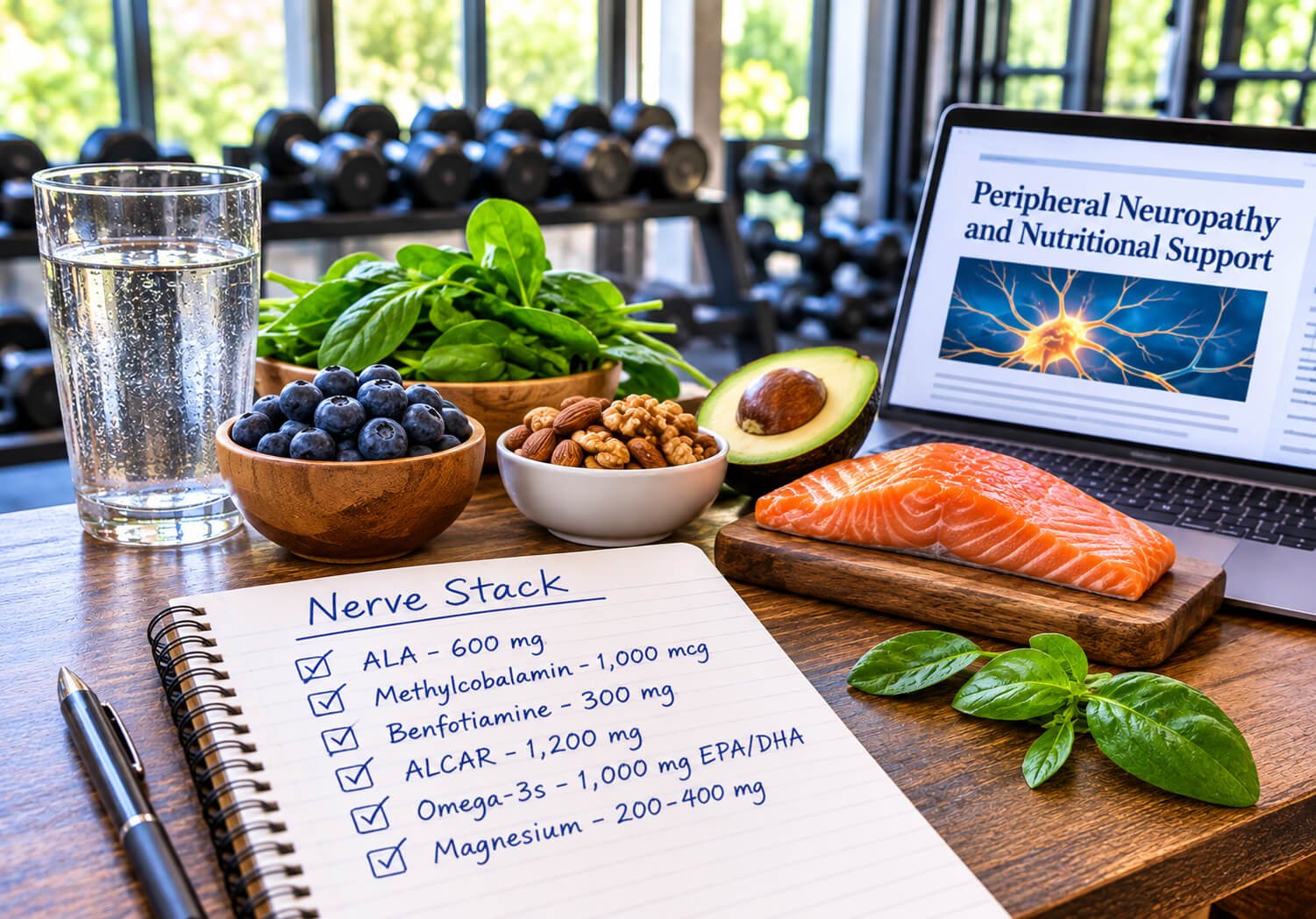
Quick Answer: The nerve support supplement ingredients with the strongest evidence are alpha lipoic acid (600 mg), methylcobalamin (vitamin B12, 500–1,000 mcg), benfotiamine (300 mg), acetyl-L-carnitine (1,200–2,000 mg), and omega-3 fatty acids (1,000–2,000 mg EPA+DHA). These five have the most human-trial data for peripheral neuropathy symptoms, nerve conduction, and neuroprotection. Start with a B12 blood test before supplementing, and talk to your doctor if you have a diagnosed condition.
Why Nerve Health Matters More Than Most People Realize
Your peripheral nerves carry signals from your brain and spinal cord to every muscle, joint, and organ. When those signals slow down or get disrupted, you feel it as numbness, tingling, burning, or weakness. The most common cause in adults is peripheral neuropathy, which affects an estimated 3–8% of the U.S. population, with prevalence climbing sharply in people with type 2 diabetes, according to the National Institute of Diabetes and Digestive and Kidney Diseases (NIDDK).
Nerve damage isn’t just an inconvenience. Slower nerve conduction velocity affects balance, reaction time, and how well you can grip a barbell or a pickleball paddle. For athletes and active adults, that translates to more falls, more joint strain, and longer recovery. For older adults, it’s a fall-risk factor that can change your whole training plan.
The good news: nerves are not as “set in stone” as old-school thinking suggested. They can regenerate, remyelinate, and improve with the right environment. Supplements won’t fix a severed nerve, but the right ingredients can reduce oxidative stress, support myelin integrity, improve blood flow to nerve endings, and give the mitochondria inside nerve cells the fuel they need to fire correctly.
The 8 Nerve Support Supplement Ingredients That Actually Work
Not every ingredient on a label earns a spot. I’ve organized these by the strength of the human-trial evidence, from the most studied to the “promising but still emerging” tier.
1. Alpha Lipoic Acid (ALA)
What it does: ALA is a potent antioxidant that works in both water- and fat-soluble environments. In the nervous system, it helps neutralize reactive oxygen species that damage axonal membranes and impairs mitochondrial electron transport in nerve cells.
The evidence: Multiple randomized controlled trials and a 2015 meta-analysis published in Phytomedicine found that oral ALA at 600 mg/day for 6–12 weeks reduced symptoms of diabetic peripheral neuropathy (burning, tingling, pain scores) compared to placebo. The European Association for the Study of Diabetes (EASD) has referenced ALA as a “useful adjunct” in neuropathy management. A separate review in Diabetes Care noted improved nerve conduction velocity in some participants.
Dose used in studies: 600 mg once daily, taken on an empty stomach (ALA competes with amino acids for absorption).
What to look for: R-acetyl-L-carnitine is sometimes bundled with ALA. You want the pure R-ALA form for the neuropathy data. Avoid “proprietary blends” that hide the ALA dose.
Timeframe: Most trials measured outcomes at 6–12 weeks. Don’t expect overnight relief.
Coach’s Tip: If you’re already taking a B-complex or a “nervous system” formula, check the label. Many of them only include 50–100 mg of ALA, which is well below the 600 mg studied. If ALA is your priority, buy it as a standalone capsule.

2. Methylcobalamin (Active Vitamin B12)
What it does: B12 is essential for myelin synthesis. Without adequate B12, the myelin sheath that insulates your nerves degrades, slowing conduction and causing the classic tingling, numbness, and “stocking-glove” pattern of peripheral neuropathy. Methylcobalamin is the active, co-enzyme form your cells can use directly, unlike cyanocobalamin, which must be converted first.
The evidence: The National Institutes of Health Office of Dietary Supplements confirms that B12 deficiency is a well-established, reversible cause of peripheral neuropathy. Repletion in deficient individuals restores nerve function. For people who are not deficient, the evidence for “extra” B12 improving healthy nerves is weaker, but methylcobalamin at 500–1,000 mcg is considered safe and is often included in neuropathy protocols as a baseline.
Dose: 500–1,000 mcg daily (sublingual or oral). If you’re vegetarian, vegan, or over 50, get a serum B12 and methylmalonic acid test first.
What to look for: The label should say “methylcobalamin,” not just “vitamin B12” or “cyanocobalamin.”
3. Benfotiamine
What it does: Benfotiamine is a fat-soluble synthetic form of vitamin B1 (thiamine). It crosses cell membranes more efficiently than standard thiamine and activates an enzyme (transketolase) that pulls excess glucose away from nerve-damaging pathways (the polyol and hexosamine pathways). In simple terms, it helps protect nerves from the oxidative and glycation stress that high blood sugar creates.
The evidence: A 2010 randomized trial in Diabetes Care showed that benfotiamine (300 mg/day) reduced nerve conduction abnormalities in people with type 2 diabetes over 24 weeks. The Cleveland Clinic lists nutritional support, including B-vitamin forms, as part of a comprehensive neuropathy management plan.
Dose: 300 mg once daily, taken with a meal containing fat (it’s fat-soluble).
Who benefits most: People with pre-diabetes, type 2 diabetes, or a history of high blood sugar. If your A1C is in range and you have no glucose issues, benfotiamine is lower priority.
4. Acetyl-L-Carnitine (ALCAR)
What it does: ALCAR is a modified form of L-carnitine that crosses the blood-brain barrier more easily. It supports mitochondrial fatty-acid transport (the “shuttle” that moves fuel into the mitochondria) and has been shown in animal models to stimulate nerve growth factor (NGF) expression, which is critical for axonal regeneration.
The evidence: A 2013 systematic review in Neurological Sciences summarized multiple RCTs showing ALCAR at 1,200–2,000 mg/day reduced neuropathic pain scores and improved nerve conduction velocity in diabetic and post-herpetic neuropathy. The European Academy of Neurology has referenced ALCAR in its position statements on neuropathic pain adjuncts.
Dose: 1,200–2,000 mg/day, split into two doses (morning and early afternoon) to avoid jitteriness.
What to look for: The label should specify “acetyl-L-carnitine” or “ALCAR,” not just “L-carnitine” or “L-carnitine tartrate.”
5. Omega-3 Fatty Acids (EPA + DHA)
What it does: EPA and DHA are incorporated into cell membranes, including those of Schwann cells (the cells that build and maintain myelin). They also reduce neuroinflammation by shifting the balance of eicosanoids away from pro-inflammatory arachidonic-acid metabolites.
The evidence: A 2019 meta-analysis in Nutrients found that omega-3 supplementation (≥1,000 mg combined EPA+DHA) was associated with reduced inflammatory markers and improved quality-of-life scores in peripheral neuropathy populations. The American Heart Association recommends at least 250–500 mg of combined EPA+DHA daily for general cardiovascular and anti-inflammatory support.
Dose: 1,000–2,000 mg combined EPA+DHA per day, with meals.
What to look for: Check the EPA/DHA numbers on the front label, not just “fish oil 1,000 mg.” A good quality fish oil or algae oil (for vegans) with third-party testing (IFOS, NSF) is ideal. If you want more on how omega-3s interact with systemic inflammation, see our guide on omega-3 and inflammation.
6. Pantothenic Acid (Vitamin B5)
What it does: B5 is a precursor to coenzyme A (CoA), which is required for fatty-acid synthesis in myelin and for energy metabolism in every nerve cell. It’s also a component of acetylcholine synthesis, which supports nerve signaling.
The evidence: True B5 deficiency is rare in the U.S., but suboptimal levels have been linked to impaired nerve conduction in small case series. The NIH Office of Dietary Supplements notes that B5 is involved in the synthesis of acetylcholine and other neurotransmitters. Doses of 250–500 mg/day have been used in European neuropathy protocols.
Dose: 100–500 mg/day (calcium pantothenate is the common supplement form).
Who benefits most: People with poor diets, chronic alcohol use, or those already on a B-complex who want to ensure adequate B5.
7. Magnesium
What it does: Magnesium acts as a natural NMDA-receptor blocker, which helps prevent excitotoxicity (over-firing of nerve cells that leads to damage). It also supports over 300 enzymatic reactions, including those in mitochondrial ATP production within nerve cells.
The evidence: A 2017 review in Neurology noted that magnesium deficiency is associated with increased nerve excitability and may worsen neuropathic symptoms. The National Institutes of Health recommends 400–420 mg/day for adult men and 310–320 mg/day for adult women.
Dose: 200–400 mg elemental magnesium (glycinate or threonate forms are better absorbed and less likely to cause GI upset).
What to look for: Avoid magnesium oxide (poorly absorbed). Magnesium glycinate or L-threonate are preferred for nerve and brain support.
8. N-Acetylcysteine (NAC)
What it does: NAC is a precursor to glutathione, your body’s master antioxidant. In nerve tissue, glutathione protects against oxidative damage to axonal membranes and supports mitochondrial function. NAC also has mild anti-inflammatory and neuroprotective properties.
The evidence: Preclinical studies in animal models show NAC reduces oxidative stress in sciatic nerve tissue. Human data is still limited to small pilot studies, so I’d classify NAC as “promising but not yet proven” for neuropathy specifically. A 2020 review in Oxidative Medicine and Cellular Longevity highlighted NAC’s role in modulating glutathione levels across multiple tissue types.
Dose: 600–1,200 mg/day, taken on an empty stomach.
Caveat: NAC can interact with nitroglycerin and may affect blood pressure. Check with your doctor if you’re on cardiovascular medications.

How to Build Your Nerve Support Stack (Practical Routine)
You don’t need all eight ingredients at once. Here’s a practical way to layer them:
- Get a blood test: B12, methylmalonic acid, folate, magnesium, vitamin D, A1C.
- If B12 is low or borderline: start methylcobalamin 1,000 mcg sublingual daily.
- Add omega-3s: 1,000–2,000 mg EPA+DHA with dinner.
- Add magnesium glycinate: 200–400 mg before bed.
- Alpha lipoic acid: 600 mg on an empty stomach, 30 min before breakfast.
- ALCAR: 1,200 mg in the morning, 1,200 mg at midday.
- Benfotiamine: 300 mg with a fat-containing meal (lunch or dinner).
Tier 3 – Optional Add-Ons (Week 12+):
- NAC: 600–1,200 mg if you want extra antioxidant support.
- Pantothenic acid: 250 mg if you’re not already getting it from a B-complex.
Common Mistake: Buying a $40 “Nerve Repair Complex” that lists 12 ingredients at 20–50% of the studied doses. You end up with a cocktail of sub-therapeutic amounts and no real benefit. It’s almost always better to buy 3–5 single-ingredient capsules at the doses in the research.
Easier version (budget-friendly, 3 ingredients): Methylcobalamin + omega-3s + magnesium. This covers the most common deficiencies and gives you a solid anti-inflammatory base.
Harder version (full protocol, 7 ingredients): All of the above plus ALA, ALCAR, and benfotiamine. This is the stack I’d recommend for someone with a confirmed diagnosis of peripheral neuropathy who is working with their doctor.
What the Research Does Not Support
It’s just as important to know what to skip:
- Proprietary blends that don’t disclose individual ingredient doses. You can’t verify you’re getting therapeutic amounts.
- High-dose B6 (pyridoxine) above 100 mg/day. Ironically, chronic B6 excess causes peripheral neuropathy. The NIH Office of Dietary Supplements sets the tolerable upper limit at 100 mg/day for adults.
- Nerve growth factor (NGF) supplements. NGF is a protein and cannot be taken orally in a form that reaches peripheral nerves. Any supplement claiming to deliver NGF is marketing, not science.
Safety Notes and Who Should Talk to a Doctor First
Supplements interact with medications. Before starting any nerve support protocol:
- Diabetes medications: ALA and benfotiamine can lower blood sugar. If you’re on metformin, insulin, or sulfonylureas, monitor closely.
- Blood thinners: Omega-3s at higher doses (≥3,000 mg) can have a mild antiplatelet effect.
- Anticonvulsants and sedatives: Magnesium and NAC may potentiate CNS-depressant effects.
- Pregnancy and breastfeeding: Get medical clearance before taking any supplement beyond prenatal vitamins.
If your tingling, numbness, or pain is new, worsening, or accompanied by muscle weakness, see a doctor or physical therapist before starting any supplement. Nerve symptoms can signal conditions that need diagnosis first. This article is for general information and is not a substitute for advice from a doctor or physical therapist.
If you’re already managing your overall metabolic health and want to understand how nutrition and lifestyle interact with nerve function, our guide on which nutrients support normal energy metabolism is a good companion read.
How Long Do Nerve Supplements Take to Work?
This is the question I get most often, and the honest answer is: it depends on the severity and cause.
- B12 deficiency neuropathy: If a blood test confirms low B12, repletion can begin improving symptoms within 4–8 weeks, with full recovery possible over 3–6 months if caught early.
- Diabetic peripheral neuropathy (ALA + benfotiamine + ALCAR): Trials typically measured outcomes at 6–12 weeks. Some participants reported symptom reduction by week 4, but the full effect was seen closer to week 12.
- General nerve health / mild tingling (omega-3s + magnesium): You may notice less “jittery” nerve firing within 2–3 weeks, but structural myelin changes take months.
Set a 12-week checkpoint. If you’re taking the right ingredients at the right doses and see zero change, that’s a signal to go back to your doctor and look for other causes (spinal issues, autoimmune conditions, medication side effects).

Nerve Support and Your Training
If you train in a gym or play a sport, nerve health directly affects your performance and injury risk. A few practical points:
- Grip strength: Peripheral nerve irritation in the hands can reduce your ability to hold a barbell, kettlebell, or racket. If your grip is fading mid-set, it’s worth checking for ulnar or median nerve compression before blaming “weak forearms.”
- Ankle stability: Reduced nerve signaling in the feet affects proprioception. If you’re doing single-leg work, step-downs, or court sports (tennis, pickleball), even mild foot numbness increases ankle-roll risk.
- Recovery: Nerves regenerate slowly. Avoid overtraining the same muscle group while you’re dealing with nerve symptoms. Give yourself 48–72 hours between sessions that load the affected area.
- Warm-up matters: A 5–10 minute dynamic warm-up (leg swings, ankle circles, wrist rotations) increases blood flow to peripheral nerves before you load them. This is especially important in cold weather, when vasoconstriction already reduces nerve perfusion.
If you’re building a full training plan around recovery and metabolic health, our article on how to support metabolism naturally for weight management covers the lifestyle side that pairs well with a supplement protocol.
Reading Supplement Labels Like a Coach
Here’s a quick checklist I use when a client holds up a bottle and asks, “Is this good?”
- Is the dose of the key ingredient listed on the front label? If it’s only in the “Supplement Facts” panel in tiny print, that’s a yellow flag.
- Is the form specified? “Methylcobalamin” ≠ “Vitamin B12.” “Acetyl-L-carnitine” ≠ “L-carnitine.” “R-ALA” ≠ “racemic ALA.”
- Are there 5+ “proprietary blend” ingredients? That usually means the manufacturer doesn’t want you to see the (low) doses.
- Is there a third-party testing seal? Look for NSF, Informed Sport, or IFOS (for fish oil).
- Does the brand publish a certificate of analysis (CoA) you can request? Legitimate brands will.
For a deeper dive on how to evaluate any supplement ingredient, our guide on how to evaluate ingredients in supplements walks through the same framework I use with clients.
Stress, Sleep, and the Nerve Connection
Chronic stress elevates cortisol, which over time can impair nerve regeneration and increase neuroinflammation. Poor sleep reduces growth hormone and BDNF (brain-derived neurotrophic factor) production, both of which support nerve repair. If your sleep is under 6 hours or you’re running on chronic stress, no supplement stack will fully compensate.
Address the basics first: 7–9 hours of sleep, a consistent training schedule with adequate rest days, and stress-management habits (walking, breathing work, time outdoors). Then layer in the supplements. If you want to understand the cortisol-stress-nerve axis more, our piece on adaptogens and cortisol management covers the research side.
FAQ
What supplements help repair damaged nerves?
The ingredients with the strongest human-trial evidence for supporting nerve repair and reducing neuropathy symptoms are alpha lipoic acid (600 mg), methylcobalamin (500–1,000 mcg), benfotiamine (300 mg), acetyl-L-carnitine (1,200–2,000 mg), and omega-3 fatty acids (1,000–2,000 mg EPA+DHA). Always get a medical diagnosis before starting a protocol.
Do B vitamins actually help nerve damage?
Yes, specifically B12 (methylcobalamin) and B1 (as benfotiamine). B12 is essential for myelin synthesis, and deficiency is a well-documented, reversible cause of peripheral neuropathy. B1 in the benfotiamine form protects nerves from glucose-driven oxidative damage. B6 above 100 mg/day can actually cause neuropathy, so keep it in the normal range.
Is alpha lipoic acid effective for neuropathy?
Multiple RCTs and meta-analyses support 600 mg of ALA daily for reducing symptoms of diabetic peripheral neuropathy over 6–12 weeks. It’s one of the most studied single ingredients in this space. It’s considered an adjunct, not a replacement for glucose management.
Can supplements reverse nerve damage?
If the damage is mild and the cause is reversible (e.g., B12 deficiency, early diabetic neuropathy), the right combination of supplements plus lifestyle changes can significantly improve nerve conduction and reduce symptoms over 3–6 months. Severe, long-standing axonal loss is harder to reverse. A doctor can assess the degree of damage via nerve conduction studies.
How long do nerve supplements take to work?
Most clinical trials measured outcomes at 6–12 weeks. B12 repletion in deficient individuals may show improvement in 4–8 weeks. For diabetic neuropathy protocols, expect to give it a full 12 weeks before judging effectiveness. Track symptoms in a simple journal (scale of 1–10 for tingling, pain, numbness) so you can see trends.
Are nerve supplements safe to take long term?
The ingredients listed above (ALA, methylcobalamin, benfotiamine, ALCAR, omega-3s, magnesium) have been studied for durations up to 12 months and are generally well-tolerated at the doses cited. Long-term safety beyond 12 months is less documented. Cycle or re-evaluate with your doctor every 6–12 months, especially if you have kidney or liver conditions.
The Bottom Line
When it comes to nerve support supplement ingredients that actually work, the evidence narrows the field to a short list: alpha lipoic acid, methylcobalamin, benfotiamine, acetyl-L-carnitine, omega-3s, magnesium, and (to a lesser extent) pantothenic acid and NAC. These are the ingredients that have human-trial data, clear dosing, and a plausible mechanism of action in nerve tissue.
Skip the proprietary blends, the “nervous system detox” gimmicks, and the high-dose B6. Get your bloodwork done first. Start with Tier 1, give it 12 weeks, and reassess. Pair your supplement protocol with good sleep, consistent movement, and stress management, because no capsule replaces the foundation.
And if your symptoms are new, worsening, or accompanied by weakness, don’t self-prescribe. See a doctor, get a nerve conduction study if needed, and build your supplement plan around the diagnosis, not instead of it.