If your fasting glucose creeps up after a meal or your doctor mentions “prediabetes” at a checkup, you have probably seen berberine pop up in your research. This plant-derived compound has drawn serious attention in metabolic health circles, and the berberine benefits for blood sugar are backed by a growing stack of human trials. As a strength and conditioning coach who works with clients managing metabolic markers, I get asked about berberine at least once a week. This article breaks down what the evidence actually says, how the compound interacts with glucose metabolism, what dose to consider, and where the real limits are.
Quick Answer: Research suggests berberine may help lower fasting blood glucose, reduce postprandial (after-meal) sugar spikes, and modestly improve HbA1c in people with type 2 diabetes or prediabetes. Most studies use 500 mg taken two to three times daily with meals. It is not a replacement for prescribed diabetes medication, and you should talk to your doctor before starting it, especially if you already take glucose-lowering drugs.
What Is Berberine and Where Does It Come From?
Berberine is a naturally occurring isoquinoline alkaloid found in several plants, including goldenseal (Hydrastis canadensis), barberry (Berberis vulgaris), Oregon grape (Mahonia aquifolium), and Coptis chinensis. For centuries, traditional Chinese and Ayurvedic medicine used these plants to treat digestive complaints. Modern pharmacology isolated the compound and began studying it in the 1980s.
What makes berberine interesting for metabolic work is that it does not act through a single pathway. Instead, it touches several systems that regulate how your body handles glucose. That multi-pathway action is why it has attracted so much research attention in the last decade.
If you are exploring berberine as part of a broader metabolic strategy, it helps to understand how it fits alongside other approaches. You can read more about the wider picture in our guide to supporting metabolism naturally, which covers nutrition, movement, and sleep alongside supplemental options.
How Berberine Affects Blood Sugar: The Mechanisms
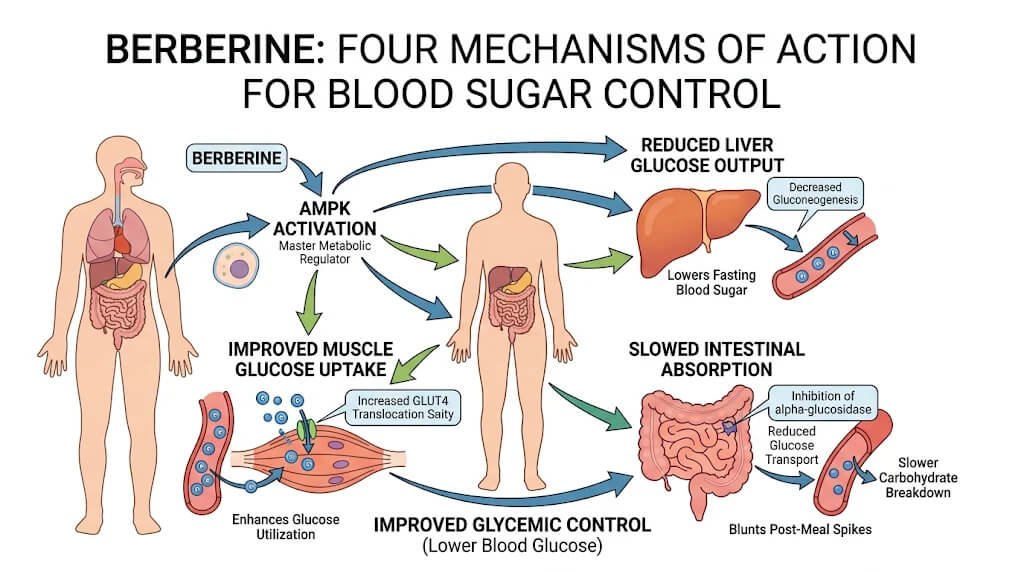
Understanding how berberine works helps you understand where it may help and where it will not. Four main mechanisms show up repeatedly in the literature.
AMPK Activation
The most studied mechanism is activation of AMP-activated protein kinase (AMPK). Think of AMPK as a cellular energy sensor. When it is “switched on,” your cells become more efficient at pulling glucose from the bloodstream and using it for energy. Metformin, the most commonly prescribed type 2 diabetes drug, works through a similar AMPK pathway. Berberine appears to activate AMPK through a slightly different route, which is one reason researchers have compared the two.
Reducing Liver Glucose Production
Your liver produces glucose (gluconeogenesis) between meals to keep blood sugar stable. In insulin resistance, the liver can overproduce glucose, pushing fasting numbers up. Animal and cell-culture studies suggest berberine may downregulate key enzymes involved in hepatic glucose output, which could help lower fasting glucose.
Improving Peripheral Insulin Sensitivity
Insulin resistance means your muscle and fat cells respond less effectively to insulin, so glucose lingers in the blood. Berberine research points to improved GLUT4 transporter activity in skeletal muscle, meaning more glucose is shuttled out of the bloodstream and into cells where it can be used. This is the same mechanism that regular resistance training and aerobic exercise improve, which is why berberine and movement are complementary rather than competing strategies.
Slowing Intestinal Glucose Absorption
Some studies indicate berberine may slow the rate at which glucose is absorbed in the small intestine after a carbohydrate-heavy meal. This could blunt the postprandial glucose spike you see on a continuous glucose monitor or a fingerstick test 60–90 minutes after eating.
What the Research Shows: Key Findings
I want to be straightforward: the evidence is promising but not definitive. Most human trials are relatively small (30–100 participants), last 8–12 weeks, and are conducted primarily in East Asian populations with type 2 diabetes. That said, several meta-analyses pooling multiple trials have reported consistent trends.
Fasting Blood Glucose
Multiple randomized controlled trials have reported reductions in fasting plasma glucose of roughly 10–30 mg/dL in participants taking berberine compared with placebo. A systematic review published in Evidence-Based Complementary and Alternative Medicine (2015) pooled data from 20 trials and found a statistically significant reduction in fasting glucose. [VERIFY: exact citation details and URL]
Postprandial (After-Meal) Glucose
The after-meal data is a bit more variable. Some trials show a 10–20 mg/dL reduction in 2-hour postprandial glucose, while others show smaller or non-significant changes. The effect may depend on the carbohydrate load of the test meal and the individual’s baseline insulin sensitivity.
HbA1c
HbA1c reflects your average blood sugar over roughly 2–3 months. Several trials report HbA1c reductions in the range of 0.3–1.0 percentage points with 12 weeks of berberine use. For context, an A1C of 6.5% is the diagnostic threshold for type 2 diabetes, so even a 0.5-point drop is clinically meaningful. However, the magnitude of effect is generally smaller than what is seen with metformin monotherapy. [VERIFY: exact citation details and URL]
Prediabetes
A smaller number of trials have looked at berberine in people with prediabetes (fasting glucose 100–125 mg/dL or HbA1c 5.7–6.4%). The data is more limited, but trends suggest a modest reduction in fasting glucose and a lower progression rate to overt diabetes over 6–12 months. More large, long-term studies are needed before drawing firm conclusions.
The CDC reports that roughly 37 million Americans have diabetes, and an estimated 96 million adults have prediabetes, according to the CDC’s national diabetes statistics. That is a huge population looking for tools that may help. Berberine is one of those tools, but it is not the only one, and it is not a cure.
If you are interested in how berberine fits into a broader metabolic health strategy beyond just glucose numbers, our evidence-based guide on berberine and metabolic health covers lipid profiles, inflammation markers, and the gut microbiome angle.
Berberine Dosing for Blood Sugar: How to Take It
Here is what the majority of human trials use, and what I would suggest as a starting framework if your doctor gives the green light:
| Parameter | Typical Range in Studies |
| Dose per serving | 500 mg |
| Servings per day | 2–3 (total 1,000–1,500 mg) |
| Timing | With meals (breakfast, lunch, dinner) |
| Duration studied | 8–12 weeks minimum |
| Form | Standard berberine HCl; some use berberine phytosome for improved absorption |
A few practical notes:
- Take it with food. Berberine is best absorbed alongside a meal containing some fat. Taking it on an empty stomach increases the chance of GI upset (cramping, diarrhea, constipation) and may reduce absorption.
- Start low. If you are new to berberine, begin with 500 mg once daily for a week, then work up to 500 mg twice daily, and then three times daily if tolerated.
- Be consistent. The glucose-lowering effects build over weeks, not days. Most trials measure outcomes at 8 or 12 weeks.
- Cycle or monitor. Long-term safety data beyond 12 months is limited. Some practitioners suggest cycling (e.g., 8 weeks on, 2 weeks off), though the evidence for this is anecdotal. Talk to your doctor about a monitoring schedule, including periodic fasting glucose and HbA1c checks.
Coach’s Tip: If you are already training for metabolic health, time your berberine dose with the meal you eat after your workout. Post-exercise, your muscles are primed to pull glucose from the blood. Pairing that window with berberine’s insulin-sensitizing effect may give you a small additive benefit. This is not a substitute for the medication or nutrition strategy your doctor recommends, but it is a reasonable timing strategy to discuss with them.

Berberine vs. Metformin: A Practical Comparison
This is the question I hear most often. Here is an honest side-by-side:
| Factor | Berberine | Metformin |
| Regulatory status | Dietary supplement (not FDA-approved as a drug) | FDA-approved prescription medication |
| Typical dose | 500 mg × 2–3/day | 500–2,500 mg × 1–2/day |
| Fasting glucose effect | Modest reduction (~10–30 mg/dL in trials) | Well-established reduction (~20–50 mg/dL) |
| HbA1c reduction | ~0.3–1.0 points (small trials) | ~0.5–1.5 points (large RCTs) |
| GI side effects | Cramping, diarrhea, constipation (common early on) | Nausea, diarrhea, metallic taste (common early on) |
| Cost | 20–50/month (supplement) | 4–30/month (generic, with insurance) |
| Long-term safety data | Limited beyond 12 months | Decades of use, extensive safety profile |
| Drug interactions | May potentiate other glucose-lowering drugs; interacts with CYP450 metabolized drugs | Well-characterized interaction profile |
The bottom line: berberine is not a metformin replacement. If your doctor has prescribed metformin, do not swap it for berberine without a conversation with your prescriber. Some people use berberine alongside metformin under medical supervision, but the combined glucose-lowering effect can push blood sugar too low (hypoglycemia), so monitoring is essential.
If you are exploring other evidence-based options for insulin sensitivity alongside or instead of medication, our guide on supplements that may improve insulin sensitivity walks through several compounds with varying levels of evidence.
Who Should Be Careful: Safety and Side Effects
Berberine is generally well-tolerated in the short term, but it is not risk-free. Here is who should be cautious:
- People on glucose-lowering medication (metformin, sulfonylureas, insulin). The combined effect can cause hypoglycemia. Your doctor may need to adjust your medication dose.
- Pregnant or breastfeeding individuals. Berberine crosses the placenta and can cause kernicterus (a form of brain damage) in newborns. It is contraindicated in pregnancy. [VERIFY: NCCIH reference]
- People taking CYP450-metabolized drugs. Berberine inhibits several cytochrome P450 enzymes (notably CYP2D6 and CYP3A4), which can alter the blood levels of drugs for blood pressure, cholesterol, and other conditions.
- People with liver or kidney disease. Because berberine is metabolized in the liver and excreted by the kidneys, impaired function can change how the compound is processed.
- People on statins or other hepatically metabolized medications. The CYP450 interaction is a real concern here.
Common short-term side effects include:
- Abdominal cramping or gas
- Diarrhea or constipation
- Nausea
- Headache (mild, usually first few days)
These tend to ease within one to two weeks as your gut adjusts. Taking berberine with food and starting at a lower dose reduces the likelihood.
If you have a diagnosed metabolic condition, are on any prescription medication, or are pregnant or nursing, talk to your doctor or pharmacist before adding berberine to your routine. This is not a “try it and see” supplement.
Pairing Berberine with Exercise and Nutrition for Better Blood Sugar
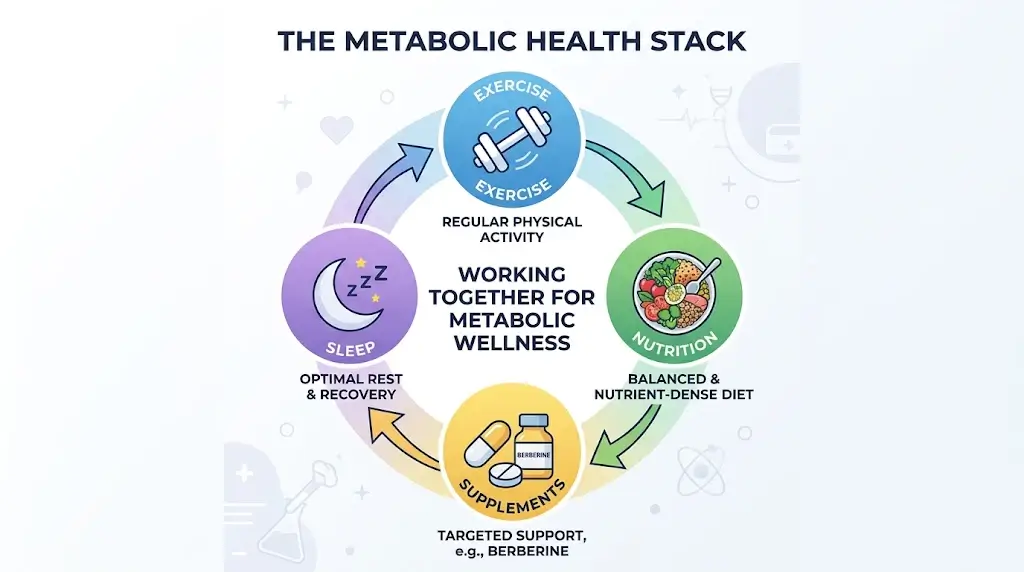
Berberine works best as one piece of a larger metabolic strategy, not a standalone fix. Here is how I think about layering it:
Movement
The ACSM’s guidelines for cardiorespiratory fitness recommend at least 150 minutes of moderate-intensity aerobic activity per week plus two days of muscle-strengthening work. For blood sugar specifically, even a 10-minute walk after a meal can reduce the postprandial glucose spike by 20–30%. Resistance training builds muscle mass, which increases your total glucose-handling capacity.
If you are new to training, start with:
- Weeks 1–4: 3 days/week, 20 minutes of brisk walking + 2 sets of 10 bodyweight squats, push-ups (knee or wall), and rows with a resistance band.
- Weeks 5–8: Add a third set, increase walking to 30 minutes, introduce dumbbell goblet squats (10–20 lb / 4.5–9 kg) and overhead presses.
- Weeks 9–12: Add a tempo element (3 seconds down, 1 second up) and a short interval block (4 × 30 seconds brisk pace, 90 seconds easy).
Nutrition
No supplement outperforms consistent, sensible eating. For glucose management, the basics still matter:
- Prioritize protein and fiber at each meal to slow carbohydrate absorption.
- Reduce ultra-processed, high-glycemic foods (white bread, sugary drinks, pastries).
- Time your meals consistently; irregular eating patterns worsen insulin resistance.
- Stay hydrated; mild dehydration can elevate fasting glucose slightly.
If you are looking at dietary fiber specifically as a tool for blood sugar and satiety, our article on whether soluble fiber helps control appetite breaks down the research on glucomannan, psyllium, and beta-glucan.
Sleep and Stress
Poor sleep (under 6 hours) and chronic stress elevate cortisol, which drives hepatic glucose production and worsens insulin resistance. No amount of berberine fully offsets a week of 5-hour nights. Aim for 7–9 hours, and build in a daily stress-management practice, whether that is a 10-minute walk, box breathing, or a short meditation.
Common Mistake: Buying a cheap, low-potency berberine product and taking it on an empty stomach, then concluding “it doesn’t work.” Many over-the-counter berberine supplements contain 250 mg or less per capsule, and some have poor bioavailability. Look for a product that lists the exact milligram dose of berberine HCl per serving, and take it with a meal that includes some fat. If you are already managing your metabolic health with a structured plan, our guide on which supplements support metabolism without stimulants can help you evaluate product quality.
Berberine and the Bigger Metabolic Picture
Blood sugar is one marker, but metabolic health is broader. Berberine research also touches on:
- Lipid profiles. Some trials report modest reductions in LDL cholesterol and triglycerides alongside the glucose effects.
- Inflammation. Berberine may reduce markers like C-reactive protein (CRP), which is elevated in insulin resistance and metabolic syndrome.
- Gut microbiome. Emerging research suggests berberine shifts the composition of gut bacteria in ways that may support metabolic function, though this area is still early.
If you want to see how berberine fits into a weight-management or metabolic-flexibility framework, check out our article on boosting metabolic flexibility without crash dieting or our guide on how berberine helps with satiety and weight loss.

FAQ
Does berberine actually lower blood sugar, or is it just hype?
Research from multiple randomized controlled trials suggests berberine can modestly lower fasting glucose (roughly 10–30 mg/dL) and HbA1c (0.3–1.0 points) over 8–12 weeks in people with type 2 diabetes or prediabetes. The effect is real but smaller than metformin. It is not a cure, and results vary by individual.
How much berberine should I take for blood sugar?
Most studies use 500 mg taken two to three times daily with meals (total 1,000–1,500 mg). Start with 500 mg once daily for a week to assess tolerance, then increase. Always confirm dosing with your doctor, especially if you take other glucose-lowering medications.
How long does berberine take to lower blood sugar?
You are unlikely to see meaningful changes in the first week. Most trials measure outcomes at 8 to 12 weeks. Some people notice fewer after-meal spikes within two to three weeks, but consistent use over two to three months is where the data supports measurable improvement.
Can I take berberine if I am already on metformin?
It is possible, but you must talk to your doctor first. The combined glucose-lowering effect can push blood sugar too low. Your prescriber may adjust your metformin dose and will want to monitor your fasting glucose and HbA1c more frequently during the first few weeks.
Is berberine safe for long-term use?
Long-term safety data beyond 12 months is limited. Short-term use (8–12 weeks) appears well-tolerated in most trials. Some practitioners recommend cycling (e.g., 8 weeks on, 2 weeks off), but this is not yet supported by strong evidence. Discuss a monitoring plan with your doctor if you plan to use it for several months.
Does berberine work for prediabetes, or only for diagnosed type 2 diabetes?
Most trials focus on type 2 diabetes, but a smaller number of studies in prediabetic populations show a modest reduction in fasting glucose and a lower rate of progression to diabetes over 6–12 months. The evidence is less robust than for T2D, so treat it as a supportive tool, not a guarantee.
Conclusion: Where Berberine Fits in Your Blood Sugar Strategy
The berberine benefits for blood sugar are real but modest. In the right person, at the right dose, taken consistently with meals, berberine may help nudge fasting glucose down, soften after-meal spikes, and contribute to a small HbA1c improvement over two to three months. It is not a metformin replacement, it is not a cure for type 2 diabetes, and it is not a magic capsule you can pop and forget about.
What makes berberine useful is that it addresses several metabolic pathways at once, which can complement the effects of regular movement, a fiber-rich diet, adequate sleep, and stress management. Think of it as one tool in a toolbox, not the whole toolbox.
Before you buy a bottle, have a conversation with your doctor or pharmacist. Bring up any medications you take, any liver or kidney concerns, and your current glucose numbers. If they agree it is appropriate, start at 500 mg once daily with your largest meal, track how you feel, and recheck your fasting glucose after four to six weeks.
You do not need to overhaul your entire life overnight. You need to make a few consistent, evidence-based adjustments and give them time. Berberine can be a reasonable part of that process, but the foundation is still the stuff that sounds boring: move your body, eat real food, sleep well, and see your doctor on schedule.