
Burning, tingling, or “pins and needles” in your feet at night can wreck your sleep and make the next day’s workout feel impossible. One of the most common—and fixable—reasons behind that sensation is a vitamin deficiency, specifically a shortfall in one or more B complex vitamins. When your body runs low on thiamine (B1), cobalamin (B12), pyridoxine (B6), or folate (B9), the small sensory nerves in your feet can become irritated, inflamed, or slowly damaged. The result is what doctors call peripheral neuropathy, and the burning often peaks after you lie down because blood flow shifts and your brain stops filtering out background nerve signals.
The good news: in many cases, identifying the missing nutrient and correcting it through diet or a doctor-guided supplement can ease the pain within weeks to a few months. This guide breaks down exactly which vitamins are involved, what the research says, and practical steps you can take tonight to start feeling better.
Quick Answer
The most common vitamin deficiency linked to burning feet at night is vitamin B12 (cobalamin) deficiency, followed by B1 (thiamine) and B6 (pyridoxine) shortfalls. These B vitamins keep your myelin sheath and sensory neurons healthy. Low levels can trigger small-fiber peripheral neuropathy, causing burning, tingling, and numbness that worsens at night. A doctor’s blood test can confirm the deficiency.
The B Vitamins Behind Burning Feet
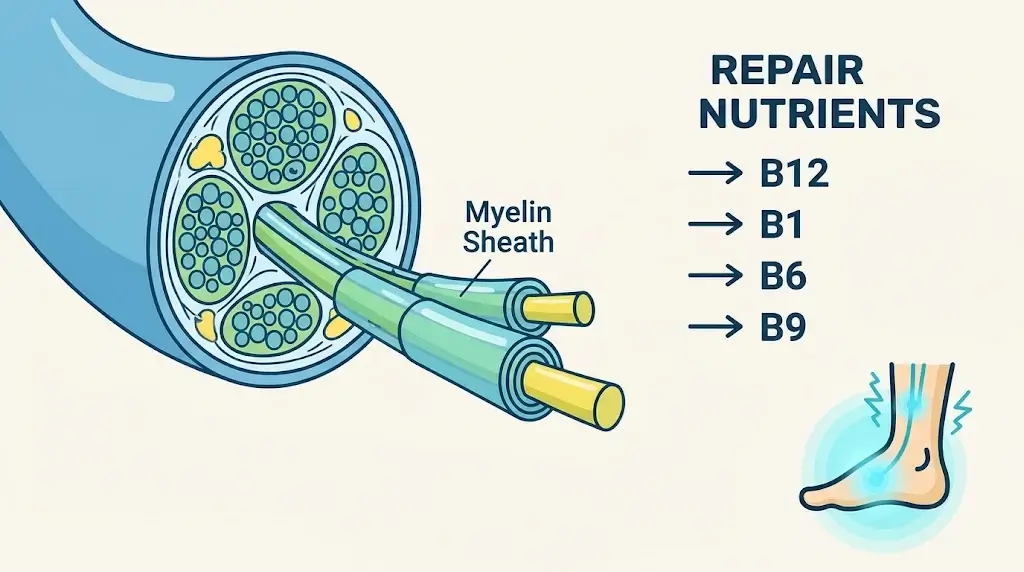
Your peripheral nervous system depends on a steady supply of B vitamins to build and repair the protective coating (myelin) around nerve fibers and to produce neurotransmitters that carry pain and temperature signals. When one or more of these nutrients drops below what your cells need, the small sensory fibers in your feet are usually the first to show symptoms because they are the longest and most metabolically active nerves in the body.
Vitamin B12 (Cobalamin)
B12 is the single most studied vitamin in connection with nerve damage. It is essential for myelin synthesis and the function of red blood cells that deliver oxygen to nerve tissue. The NIH Office of Dietary Supplements notes that B12 deficiency can lead to neurological symptoms including numbness, burning, and balance problems that often start in the feet and hands.
Who is at higher risk:
- People following strict vegan or vegetarian diets without B12-fortified foods
- Adults over 50 with reduced stomach acid (less B12 absorbed)
- People taking metformin for type 2 diabetes
- Individuals with pernicious anemia or gastrointestinal surgeries
Vitamin B1 (Thiamine)
Thiamine powers the metabolic pathways that convert glucose into energy for nerve cells. The NIH Office of Dietary Supplements thiamine fact sheet explains that thiamine deficiency can produce a condition called beriberi, whose dry form specifically damages peripheral nerves, causing burning pain, muscle weakness, and tingling in the lower limbs.
Who is at higher risk:
- People with chronic alcohol use
- Individuals with eating disorders or very restricted diets
- Those with malabsorption conditions (celiac disease, Crohn’s, bariatric surgery)
- People on long-term diuretic medications
Vitamin B6 (Pyridoxine)
B6 is a coenzyme in over 100 enzymatic reactions, including the production of neurotransmitters like serotonin and GABA that modulate pain signaling. A deficiency can lead to peripheral neuropathy with burning and tingling. However, there is a catch: excessive B6 supplementation (typically above 200 mg/day over months) can cause nerve damage that mimics deficiency. The NCCIH B12 and B-vitamin overview reminds readers that more is not always better with B6.
Vitamin B9 (Folate) and B3 (Niacin)
Folate works alongside B12 in DNA synthesis and red blood cell formation. A folate deficiency can compound B12-related nerve symptoms. Niacin (B3) deficiency historically caused pellagra, whose “3 Ds”—diarrhea, dermatitis, and dementia—were accompanied by peripheral nerve irritation. While classic pellagra is rare in developed countries, subclinical niacin shortfalls in low-calorie or monotonous diets can contribute to a burning sensation in the extremities, according to the NIH niacin fact sheet.

Why Burning Feet Hit Hardest at Night
You might wonder why the pain is manageable during the day but unbearable the moment your head hits the pillow. A few physiological factors explain the nighttime spike:
The Nighttime Pain Cycle
- Reduced distraction. During the day, movement, work, and conversation keep your brain’s attention away from low-level nerve signals. At night, with fewer competing stimuli, your brain amplifies the same signals, and they feel much louder.
- Blood flow changes. When you lie flat, blood redistributes. In people with compromised microcirculation (common with diabetes, smoking, or sedentary habits), the feet can experience a brief surge of pressure that irritates already-sensitive nerve endings.
- Temperature shift. A warm bed raises foot temperature. Inflamed or damaged small-fiber nerves are more reactive to heat, so the burning intensifies.
- Cortisol and inflammatory markers. Cortisol drops in the evening, which can allow low-grade nerve inflammation to become more perceptible.
Small Fiber vs. Large Fiber Neuropathy
Burning and tingling point to small-fiber neuropathy. Small fibers carry pain and temperature. Large fibers carry touch, vibration, and position sense. B-vitamin deficiencies tend to affect small fibers first, which is why the hallmark symptom is a burning or “hot foot” feeling rather than pure numbness. The Mayo Clinic’s overview of peripheral neuropathy explains that small-fiber damage is often the earliest and most painful stage, and it can be reversible if the underlying cause is caught early.
How to Know if a Deficiency Is the Culprit
Not every case of burning feet is a vitamin problem. Diabetes, alcohol use, chemotherapy, autoimmune conditions, and mechanical compression (like a tight shoe) can all produce similar symptoms. That said, a nutritional deficiency is on the table when you notice a cluster of the following:
Symptoms that suggest a B-vitamin link:
- Burning or tingling that starts in the toes and creeps up the soles
- Worsening over weeks to a few months (not sudden onset)
- Accompanied by fatigue, brain fog, pale or smooth tongue, or mild anemia
- No history of diabetes, recent surgery, or chemotherapy
- Diet that is very low in animal products, heavily restricted, or high in processed foods
When to see a doctor:
- Symptoms last more than two weeks
- You notice weakness, tripping, or balance changes
- The burning spreads above the ankles
- You are on metformin, proton-pump inhibitors, or have had GI surgery
A primary-care physician or neurologist will typically order a serum B12, methylmalonic acid, homocysteine, folate, and B6 (pyridoxal-5-phosphate) panel, plus a complete blood count and metabolic panel. If levels are low, treatment is straightforward. If levels are normal, the doctor will look for other causes.
Important: This article is for general information and is not a substitute for advice from a doctor or physical therapist. If you have persistent burning feet, schedule a medical evaluation before starting any supplement regimen.

What the Research Says: Vitamins, Deficiency, and Nerve Damage at a Glance
| Vitamin | Deficiency sign in feet | Typical onset | Reversibility with correction | Key dietary sources |
| B12 (Cobalamin) | Burning, numbness, balance loss | Months to years | Often reversible if caught early; prolonged deficiency may leave residual damage | Clams, liver, salmon, eggs, fortified plant milks |
| B1 (Thiamine) | Burning soles, muscle cramps, dry beriberi | Weeks to months (alcohol); slower in dietary deficiency | Generally reversible | Pork, whole grains, legumes, sunflower seeds |
| B6 (Pyridoxine) | Tingling, burning, mild neuropathy | Variable; also from excess supplementation | Reversible once intake is normalized | Poultry, fish, potatoes, chickpeas, bananas |
| B9 (Folate) | Compounds B12 symptoms; mild tingling | Months | Reversible | Dark leafy greens, lentils, asparagus, fortified grains |
| B3 (Niacin) | Burning, skin changes (pellagra) | Weeks to months in severe cases | Reversible | Tuna, chicken, peanuts, whole grains |
The CDC’s nutrition and health page emphasizes that a balanced diet providing all B vitamins in adequate amounts is the first line of defense against nutritional neuropathy. In the U.S., the Harvard Health B12 deficiency article highlights that up to 30% of adults over 60 have suboptimal B12 levels, making routine screening sensible for that age group.
How to Fix It: Practical Steps You Can Start Tonight
1. Get Tested Before You Supplement
This is the single most important step. Taking high-dose B12 or B6 without a confirmed deficiency can mask other conditions and, in the case of B6, actually worsen nerve irritation. Ask your doctor for the blood panel mentioned above.
2. Build a B-Vitamin-Rich Plate
If your levels are mildly low or you simply want to prevent a future shortfall, focus on whole foods:
- B12: 3–4 oz (85–113 g) of salmon, sardines, or eggs 4–5 times per week. Vegans: B12-fortified nutritional yeast (1–2 tbsp daily) or a 250–500 mcg supplement under a doctor’s guidance.
- B1: 1 cup (195 g) of cooked black beans or lentils, 2 oz (57 g) of sunflower seeds, or a serving of pork or whole-grain oats.
- B6: 4 oz (113 g) of chicken breast, 1 medium potato (173 g) with the skin, or ½ cup (84 g) of chickpeas.
- Folate: 1 cup (158 g) of raw spinach, ½ cup (90 g) of cooked lentils, or a serving of fortified cereal.
- Niacin: 3 oz (85 g) of tuna, 1 oz (28 g) of peanuts, or 1 cup (165 g) of cooked brown rice.
3. Supplement Only as Directed
If your doctor confirms a deficiency, they will prescribe a specific dose and duration. Common regimens include:
- B12: 1,000–2,000 mcg sublingual or oral daily, or monthly intramuscular injections for severe deficiency
- B1: 10–50 mg daily (higher doses under supervision for alcohol-related beriberi)
- B6: 25–50 mg daily (stay well below 200 mg to avoid iatrogenic neuropathy)
- Folate: 400–800 mcg daily
Coach’s Tip: I always tell clients that “more B vitamins” is not a free pass. If you are already taking a multivitamin with 100% DV of B12 and B6, adding a separate high-dose B6 gummy on top can push you past the safe ceiling. Check the label, keep total B6 under 100 mg/day unless a doctor says otherwise, and track your intake for a month to make sure you are not doubling up.
4. Address the Root Cause
- Metformin users: Ask your doctor to check B12 every 1–2 years.
- Alcohol use: Even moderate, chronic drinking depletes thiamine. Pair any reduction in intake with a B-complex under medical supervision.
- Gut issues: Celiac disease, H. pylori, or prior gastric surgery can impair absorption. Treating the gut issue is as important as the supplement.
- Diet too restrictive: If you cut out entire food groups, a registered dietitian can help you rebuild a balanced plate.
5. Support Nerve Recovery with Movement and Sleep
Once the nutritional gap is closing, gentle movement and good sleep speed up nerve repair.
- Ankle circles and toe spreads: 2 sets of 15 each morning and evening to keep foot joints mobile and blood flowing.
- Calf raises (bodyweight): 3 × 12, slow tempo (2 seconds up, 3 seconds down). This pumps blood through the lower leg and supports the small vessels feeding your foot nerves.
- Gentle walking: 15–20 minutes at a conversational pace, 5 days a week. Avoid running or high-impact work until the burning has clearly improved.
- Sleep hygiene: Keep your bedroom at 65–68 °F (18–20 °C). Use a thin cotton sock to avoid excess heat on the soles. Elevate your feet 6–8 inches (15–20 cm) on a pillow for the first 20 minutes after getting into bed to reduce the nighttime pressure spike.
Common Mistake: Many people with burning feet reach for a hot foot bath to “take the edge off.” Heat feels good for about 30 seconds, but it actually increases blood flow to already-irritated small-fiber nerves and can make the burning worse for the next hour. If you want a soak, use lukewarm water (around 95 °F / 35 °C) for no more than 10 minutes, and pat dry thoroughly.

Coach’s Perspective: Nutrition, Training, and Nerve Health
I work with clients who push hard in the gym, and I see it over and over: when someone’s energy and nerve health are off, their form degrades. A client with mild B12 deficiency may not realize that the “weird tingling” in their feet is making their ankle stability worse, which then shifts load to their knees and lower back during squats or lunges.
Here is how I approach it in a training session:
- Screen first. Before adding load, I ask about foot and hand sensations, sleep quality, and recent diet changes. If burning or tingling is present, I recommend a doctor’s visit before progressing to heavy lower-body work.
- Reduce impact temporarily. Swap running for cycling or swimming for 2–3 weeks while the nutritional issue is being addressed. This keeps cardiovascular fitness up without hammering the small-fiber nerves in the feet.
- Prioritize foot and ankle stability. While the deficiency is resolving, I build in:
- Single-leg balance holds: 3 × 30 seconds per side, eyes open, then eyes closed
- Heel-to-toe walking: 3 × 20 steps, focusing on a smooth, controlled gait
- Resistance-band ankle eversion/inversion: 3 × 15 per direction, light band (5–10 lb / 2–4.5 kg)
- Reassess in 4–6 weeks. If the burning has faded, I gradually reintroduce plyometrics, heavier squats, and running. If it has not, we loop back to the medical team.
The CDC physical activity guidelines recommend at least 150 minutes of moderate aerobic activity and two days of muscle-strengthening work per week for adults. Even with a mild nerve issue, staying active at a low-impact level supports circulation and prevents the deconditioning that makes recovery slower.
If you are also working on overall energy and metabolic health, it is worth reading up on which nutrients support normal energy metabolism and how to increase energy and stamina naturally. B-vitamin status is one piece of a larger puzzle that includes iron, magnesium, and adequate caloric intake.

Related Tips for Long-Term Nerve Health
Foot Care Basics
- Check your feet daily for redness, blisters, or skin changes, especially if you have diabetes or are over 60.
- Wear well-fitting shoes with a wide toe box. Avoid narrow heels or tight compression socks that restrict circulation.
- Keep toenails trimmed straight across to prevent ingrown nails that can add local irritation.
Exercise Considerations
- If you are a runner, cyclist, or pickleball player, replace high-impact sessions with low-impact ones (pool walking, elliptical, cycling) until the burning is resolved.
- Avoid barefoot training (CrossFit, yoga on hot mats) during the acute phase. The combination of heat and pressure on inflamed small fibers can prolong recovery.
- Gradually rebuild gait strength: heel walks, toe walks, and lateral shuffles for 10 minutes, 4–5 days a week.
Sleep and Recovery
- Keep a consistent sleep schedule (7–9 hours). Poor sleep raises inflammatory markers and lowers your pain threshold, making the burning feel worse.
- If you snore or have untreated sleep apnea, address it. Chronic low oxygen at night stresses peripheral nerves.
- Limit alcohol to no more than 1–2 drinks on any given day, and aim for several alcohol-free days per week.
Diet Beyond the B Vitamins
- Magnesium (found in nuts, seeds, dark chocolate, and leafy greens) supports nerve conduction and muscle relaxation.
- Omega-3 fatty acids (fatty fish, walnuts, flaxseed) have anti-inflammatory properties that may help soothe irritated nerve tissue.
- Vitamin D deficiency is common and can compound nerve symptoms. A simple blood test can check your level.
For a broader look at how nutrition supports overall metabolic and energy function, see how to support metabolism naturally for weight management and which vitamins support metabolism when you are deficient.
FAQ
Can vitamin B12 deficiency cause burning feet at night?
Yes. B12 is critical for myelin production and nerve signaling. The NIH Office of Dietary Supplements confirms that deficiency can produce peripheral neuropathy with burning, tingling, and numbness that often starts in the feet. Symptoms typically improve once B12 levels are restored, but prolonged deficiency can leave lasting nerve changes.
What vitamins help with burning feet?
The B complex vitamins—B1 (thiamine), B3 (niacin), B6 (pyridoxine), B9 (folate), and B12 (cobalamin)—are the most directly linked to nerve health. Correcting a confirmed deficiency through diet or a doctor-prescribed supplement is the standard approach. There is no single “burning feet vitamin”; it is usually a combination of B vitamins working together.
How long does it take for B12 to fix nerve damage?
Mild neuropathy from B12 deficiency often shows improvement within 4–8 weeks of treatment. More severe or longer-standing damage may take 3–6 months or longer, and some sensory changes may be permanent if the deficiency was present for years. Your doctor will monitor with repeat blood tests and, in some cases, nerve conduction studies.
Does B6 deficiency cause burning feet?
Yes, but it is less common than B12 or B1 deficiency. Low B6 can impair neurotransmitter production and myelin maintenance, leading to tingling and burning. Importantly, taking too much B6 (above 200 mg/day over months) can cause a similar neuropathy. Always stay within recommended doses unless a doctor directs otherwise.
Can you reverse neuropathy from a vitamin deficiency?
In most cases, yes—especially if the deficiency is caught early. The Mayo Clinic notes that treating the underlying cause (including nutritional deficiencies) is the first step in managing peripheral neuropathy. Recovery is faster when the deficiency has been present for months rather than years.
What does it mean when your feet burn at night but not during the day?
Nighttime burning often points to small-fiber nerve irritation. During the day, movement and distraction mask low-level nerve signals. At night, reduced activity, a warm bed, and lower cortisol allow the brain to “turn up the volume” on those signals. While this pattern is common with B-vitamin deficiency, it can also reflect early diabetic neuropathy, alcohol-related nerve damage, or a mechanical issue. A doctor can help narrow it down.
Conclusion: What Vitamin Deficiency Causes Burning Feet at Night—and What to Do Next
The short answer to what vitamin deficiency causes burning feet at night is: most often, it is a shortfall in B12, B1, or B6, sometimes compounded by low folate or niacin. These B complex vitamins are the building blocks and fuel for your peripheral nerves. When levels drop, the small sensory fibers in your feet are the first to send distress signals, and those signals peak after you lie down.
The path forward is clear:
- See your doctor and request a B-vitamin blood panel (B12, methylmalonic acid, homocysteine, B6, folate, B1).
- Eat a varied, B-rich diet while you wait for results and during recovery.
- Supplement only as prescribed, and never exceed safe upper limits—especially for B6.
- Move gently, sleep well, and protect your feet while your nerves heal.
- Recheck in 4–6 weeks to confirm levels are normalizing and symptoms are fading.
You do not have to white-knuckle burning feet through another season of poor sleep and stiff ankles. A simple blood test and a few dietary adjustments can make a real difference. Take the first step this week: book the appointment, clear your schedule, and bring a list of your current supplements and medications. Your feet (and your next workout) will thank you.