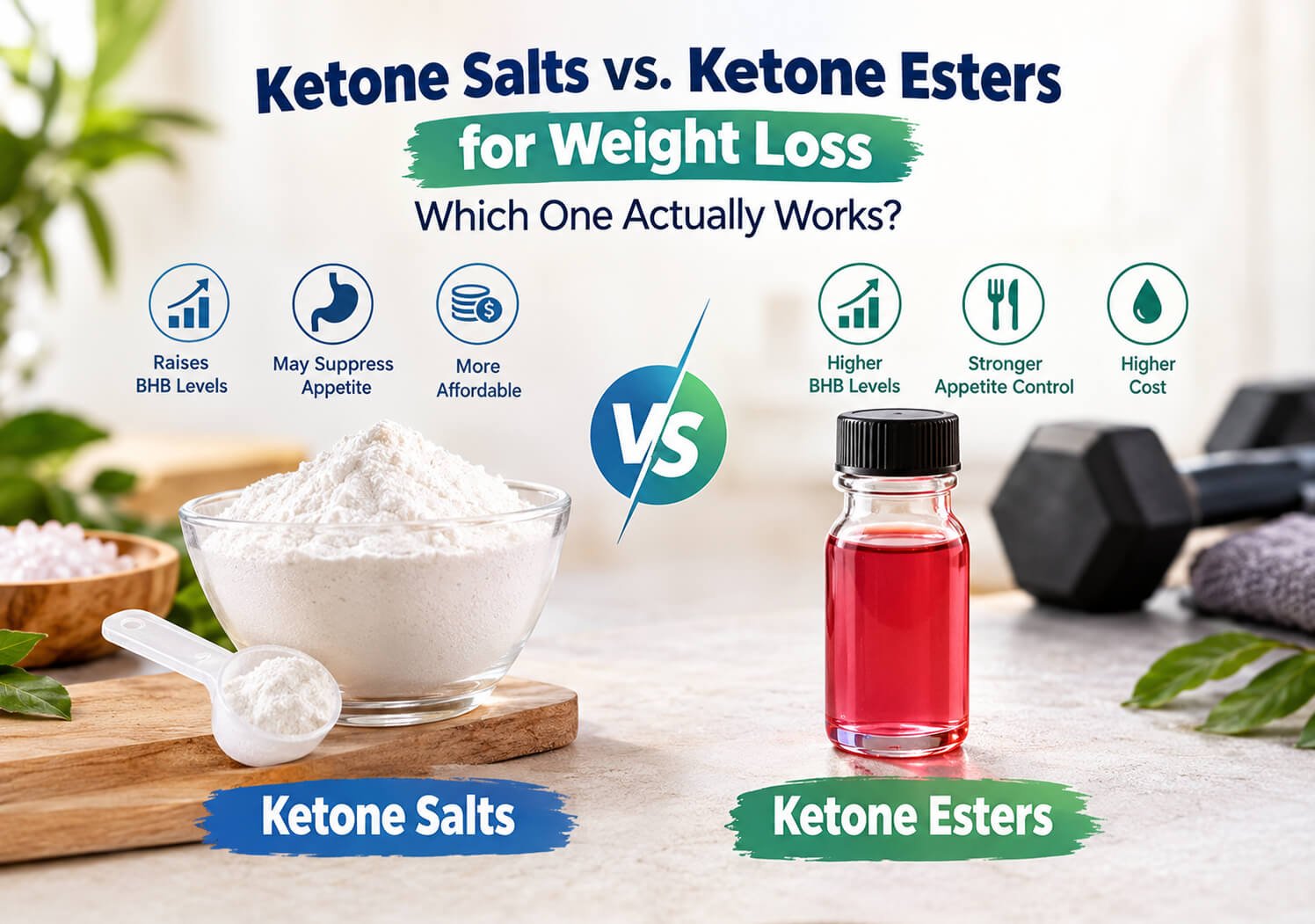
If you’ve searched ketone salts vs. ketone esters for weight loss, you’ve probably noticed both products promise the same thing — faster ketosis, less hunger, more fat loss — at very different prices. They don’t deliver the same results, and neither one is a guaranteed weight-loss tool on its own. Here’s what the research actually shows, so you can decide if either belongs in your routine.
Quick Answer
Ketone esters raise blood ketone levels roughly two to three times higher than ketone salts and show stronger short-term appetite suppression in human studies. Neither has been proven to cause meaningful fat loss on its own — most weight-related evidence comes from animal studies or acute (single-day) human trials, not long-term weight-loss trials in people.
Ketone Salts vs. Ketone Esters: Side-by-Side
| Factor | Ketone Salts | Ketone Esters |
| What it is | BHB bound to a mineral (sodium, potassium, calcium, or magnesium) | BHB bound to a non-mineral carrier, usually 1,3-butanediol |
| Typical blood BHB rise | ~0.8–1.1 mmol/L per dose | ~2.8–3.3 mmol/L per dose |
| Taste/form | Powder, often flavored; salty or bitter aftertaste | Liquid shot; strong, often unpleasant taste |
| GI tolerance | Can cause bloating, nausea, mild diarrhea, especially at higher doses | Generally fewer GI issues at matched BHB doses, but still possible |
| Electrolyte load | Meaningful sodium/mineral load with repeated daily use | Minimal electrolyte load |
| Cost | Lower, widely available | Significantly higher per serving |
| Human weight-loss evidence | Acute appetite and glucose data only; no controlled weight-loss trials | Acute appetite and glucose data in humans; weight-loss data mostly from mouse studies |
Key Differences That Actually Matter
1. How High They Raise Blood Ketones
This is the clearest, most consistent difference between the two. A crossover study comparing matched doses of BHB found that ketone ester drinks raised blood D-BHB to 1.4 mM and 2.8 mM at two doses, while the equivalent ketone salt doses only reached 0.8 mM and 1.1 mM. A broader systematic review and meta-analysis of exogenous ketone trials confirmed the pattern across studies, finding that consumption of exogenous ketones raised blood β-OHB and lowered blood glucose compared to placebo, with ketone monoesters producing significantly greater effects than ketone salts. Part of the gap comes down to chemistry: salts typically deliver a mix of the two mirror-image forms of BHB, and the difference in peak blood D-BHB concentrations between matched amounts of ester and salt arose because the salt form contained L-BHB, which the body processes differently than the D-BHB form. Exogenous Ketones: Fuel for Metabolism? +2
Coach’s Tip: If your main goal is to hit a specific blood-ketone number quickly (for example, before a fasted workout), esters get you there faster and higher. If you just want a mild, affordable nudge toward ketosis, salts are the more practical daily tool.
2. Appetite and Hunger Hormones
This is where exogenous ketones get most of their weight-loss buzz, and it’s almost entirely ester-specific research. In a controlled crossover trial, participants who drank a ketone ester beverage after an overnight fast had their blood BHB climb from roughly 0.2 to 3.3 mM within an hour, and postprandial ghrelin, insulin, GLP-1, and PYY levels were all significantly lower two to four hours after the ketone ester drink compared with a sugar drink, with hunger and desire to eat also significantly suppressed. The researchers concluded that increased blood ketone levels may directly suppress appetite through this drop in ghrelin and the related changes in hunger and desire to eat. nihnih
That effect doesn’t always hold up outside of rest, though. A separate study looking at exogenous ketones taken around exercise found that perceived hunger, satisfaction, fullness, and food consumption afterward were not significantly altered by exogenous ketosis, and two-hour post-exercise energy intake was unaffected. Ketone salts haven’t been tested for this effect nearly as thoroughly, and lower BHB peaks make a strong ghrelin response less likely in the first place. frontiersin
Common Mistake: Assuming a short-term appetite dip after one ketone drink will translate into sustained calorie reduction over weeks. The human studies behind this claim are single-day, lab-controlled experiments — not evidence that daily use shrinks your appetite long-term.
3. Digestive Tolerance and Taste
Neither form is gentle on an empty stomach at higher doses, but they don’t cause identical problems. A multi-study analysis of exogenous ketone drinks found that gastrointestinal symptoms after ketone monoester and ketone salt drinks were acute but generally mild, and fully resolved by the end of each study, with symptom severity varying by compound, dose, and whether exercise was involved. Separately, a small clinical-trial pilot study designed around taste-masking salt and ketone supplements noted that both salt loading and ketone supplementation can be unpleasant in terms of taste and can cause mild gastrointestinal distress, though in that particular trial distress scores stayed low overall. nihiupui
4. Electrolyte and Mineral Load
Ketone salts are, by definition, a mineral delivery system as much as a ketone one. Most commercial powders combine sodium, potassium, calcium, or magnesium BHB to spread out the load, because taking BHB bound to a single mineral in meaningful daily doses can push sodium or potassium intake higher than intended. Ketone esters skip this issue almost entirely since they’re bound to a non-mineral carrier instead of a salt.
If you already watch your sodium for blood pressure reasons, repeated daily servings of ketone salts are worth tracking against your overall intake. [VERIFY] exact sodium content varies by brand and should be checked on the product label before daily use.
5. Cost and Availability
Ketone salts are the budget option: they’re widely sold as flavored powders and cost a fraction of what esters cost per gram of BHB delivered. Ketone esters are harder to find, sold mostly as pre-measured liquid shots, and priced substantially higher — a 2017 analysis noted that ketone esters were not yet available to buy at retail at the time, despite having been tested in healthy volunteers and athletes, and availability has only gradually improved since. For most people comparing cost against benefit, the price gap is large enough that it should factor heavily into which one you try first. ketone
6. What the Weight-Loss Evidence Actually Shows
This is the part most marketing skips. The strongest data linking ketone esters to lower body weight and fat mass comes from mouse studies, not human trials. In one such study, researchers found that mice fed a high-fat, high-sugar diet with added ketone ester gained far less weight over nine weeks than controls, with body weight increasing 56% in the control group compared to only 13% in the ketone-ester group, alongside less fat accumulation overall. A related study in aging mice similarly reported that ketone-ester-fed mice showed significantly lower age-related gains in body weight and fat mass compared to controls. frontiersinfrontiersin
Those are promising signals for a mechanism, but mice are not people, and feeding a quarter of total calories as ketone ester (as these studies did) is not how anyone uses a ketone supplement in real life. In humans, the closest thing to direct weight-loss data is the appetite and glucose research above — changes in hunger and blood sugar, not measured pounds or body-fat percentage lost over weeks. No published human trial has shown that adding ketone salts or ketone esters to a normal diet produces meaningful weight loss on its own.
When to Choose Ketone Salts
- You want an affordable way to test how exogenous ketones feel before committing to anything expensive
- You’re easing into a ketogenic diet and want to blunt “keto flu” symptoms during the first week or two
- You don’t need a large BHB spike and are fine with a milder, more gradual rise
When to Choose Ketone Esters
- You want the highest achievable blood-ketone rise for a specific use case, such as research-style self-testing or endurance training
- You’re less sensitive to strong flavors and can tolerate the taste in exchange for a bigger effect
- Cost isn’t the deciding factor and you want the form with the most human research behind its appetite effects
Cost Comparison
Ketone salts typically run far cheaper per serving because the raw mineral-BHB compounds are less costly to produce than ester compounds, and salts are manufactured at larger commercial scale. Ketone esters remain a premium product: production is more complex, and the liquid-shot format usually means a higher price for a single serving than an entire week’s worth of salt powder. If budget is a real constraint, salts deliver more total BHB exposure per dollar, even though the BHB peak per serving is lower.
Who Should Be Careful
Talk to your doctor before starting either supplement if you have kidney disease, high blood pressure, diabetes, or you’re pregnant or breastfeeding — ketone salts’ electrolyte load and either supplement’s effect on blood glucose can matter more in these situations. [VERIFY with a physician] before combining ketone supplements with insulin or other glucose-lowering medications, since exogenous ketones measurably lower blood glucose on their own. nih
FAQ
Do ketone esters help you lose weight?
Not on their own, based on current human evidence. They raise blood ketones and reduce appetite hormones for a few hours after a dose, but no human trial has shown that this translates into sustained fat loss. The weight-loss data in mice is more promising but doesn’t automatically apply to people.
Are ketone salts effective for weight loss?
Ketone salts reliably raise blood BHB, just less than esters do. There’s no direct evidence they cause weight loss; most of their appeal is as a cheaper way to support a ketogenic diet or ease the transition into one.
Which is better for weight loss, ketone salts or ketone esters?
Neither has proven weight-loss benefits in humans. Esters produce a bigger BHB spike and the stronger appetite-suppression data, but that data comes from single-day lab studies, not multi-week trials measuring actual body weight.
Do exogenous ketones burn fat directly?
There’s no solid human evidence for this. Most of the “fat-burning” framing around exogenous ketones comes from rodent studies or from their general association with the ketogenic diet, not from controlled human trials of the supplements themselves.
Can I take ketone salts or esters without following a keto diet?
Yes, you can take either without cutting carbs, but the appetite and blood-ketone effects seen in research were measured in people who were fasted or following low-carb protocols. Expect smaller effects if you’re eating a typical mixed diet.
Are ketone salts safe to take every day?
For most healthy adults, occasional or moderate daily use appears to cause only mild, short-lived issues like bloating or an upset stomach. The bigger daily concern is the added sodium, potassium, or other minerals, which is worth tracking if you have blood pressure or kidney concerns.
Conclusion
Weighing ketone salts against ketone esters for weight loss comes down to this: esters raise blood ketones higher and have better short-term appetite data, salts are cheaper and gentler on the wallet, and neither one has been shown in human trials to directly cause weight loss. If you’re exploring exogenous ketones, treat them as a possible support tool alongside diet and exercise — not a substitute for either — and loop in your doctor first if you have any metabolic or cardiovascular condition.