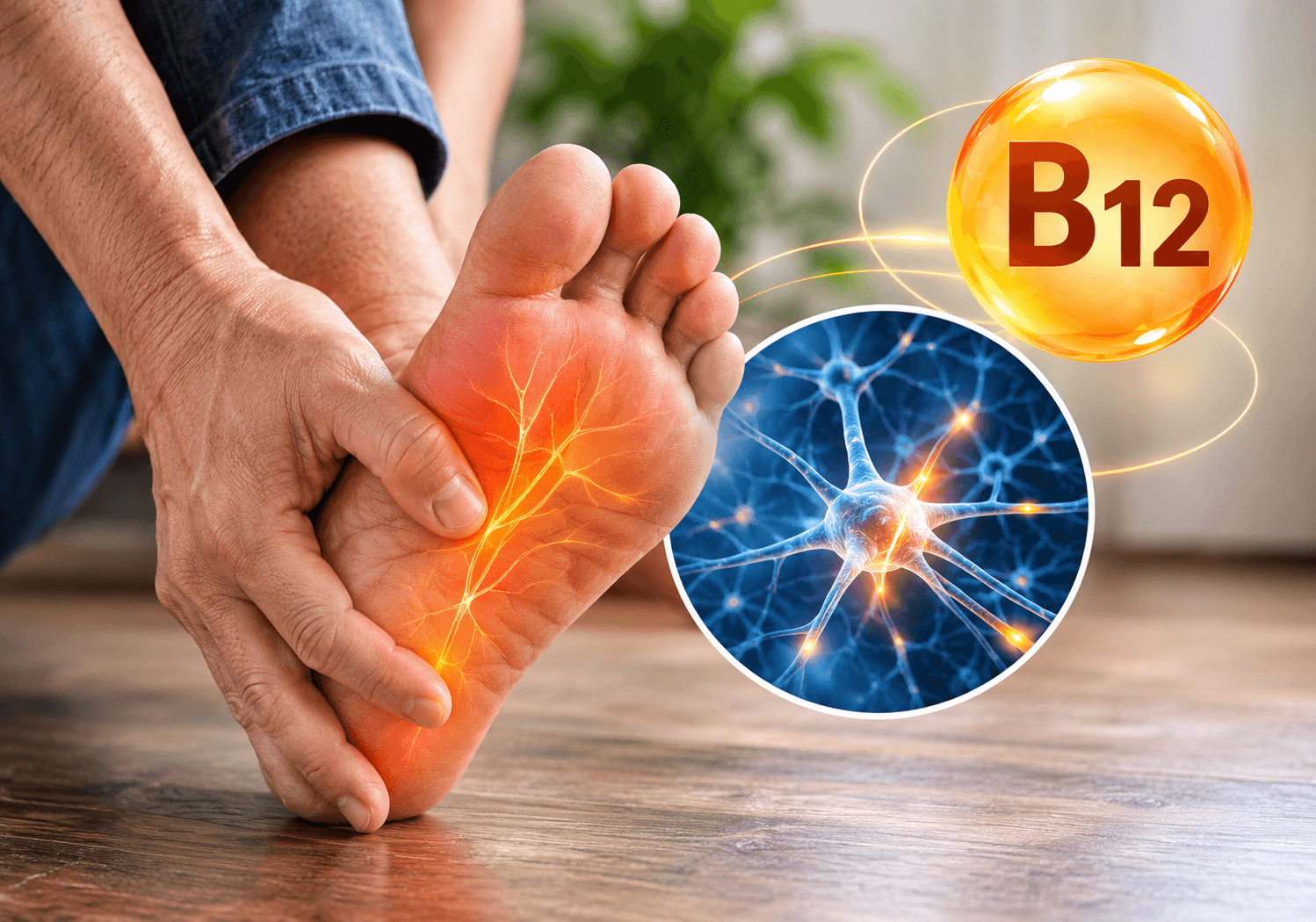
Pins and needles in your feet after a long walk. A hand that goes numb while you hold a dumbbell. A balance wobble on single-leg work that was never there before. Most lifters blame tight shoes, a pinched nerve, or just getting older. But vitamin B12 deficiency nerve pain symptoms can look exactly like this, and they are easy to miss in the early stages.
I coach a lot of adults over 40, and this is one of the few “non-training” issues I ask about when someone’s balance or grip suddenly drops. B12 keeps the protective coating on your nerves healthy. When levels fall low enough, nerves start misfiring, and the longest nerves, the ones to your feet and hands, usually complain first.
This guide walks you through what the symptoms feel like, why they happen, who is at risk, how doctors test for it, and how to train safely while you sort it out. If you have numbness or burning that lasts more than a few days, talk to your doctor before you change your diet, your supplements, or your workouts.
Quick Answer: Vitamin B12 deficiency nerve pain symptoms usually start as tingling, “pins and needles,” or numbness in the feet and hands, often on both sides. Burning pain, poor balance, weak grip, and trouble walking can follow. A simple blood test can confirm low B12, and early treatment gives nerves the best chance to recover.
What Vitamin B12 Does for Your Nerves
Vitamin B12 (cobalamin) helps your body make red blood cells, build DNA, and maintain myelin, the fatty sheath that wraps around nerve fibers. Myelin works like insulation on a wire. When it breaks down, signals slow, stall, or fire at the wrong time, and that is what you feel as tingling or pain.
Your body stores a few years’ worth of B12 in the liver, so a deficiency builds slowly. That is both good and bad news. You will not become deficient after one bad week of eating, but by the time symptoms show up, levels may have been dropping for a long time.
B12 only comes from animal foods and fortified products. It also needs stomach acid and a protein called intrinsic factor to be absorbed, according to the NIH Office of Dietary Supplements. That absorption step is where many people run into trouble, and we will cover it below.
Vitamin B12 Deficiency Nerve Pain Symptoms: What They Actually Feel Like
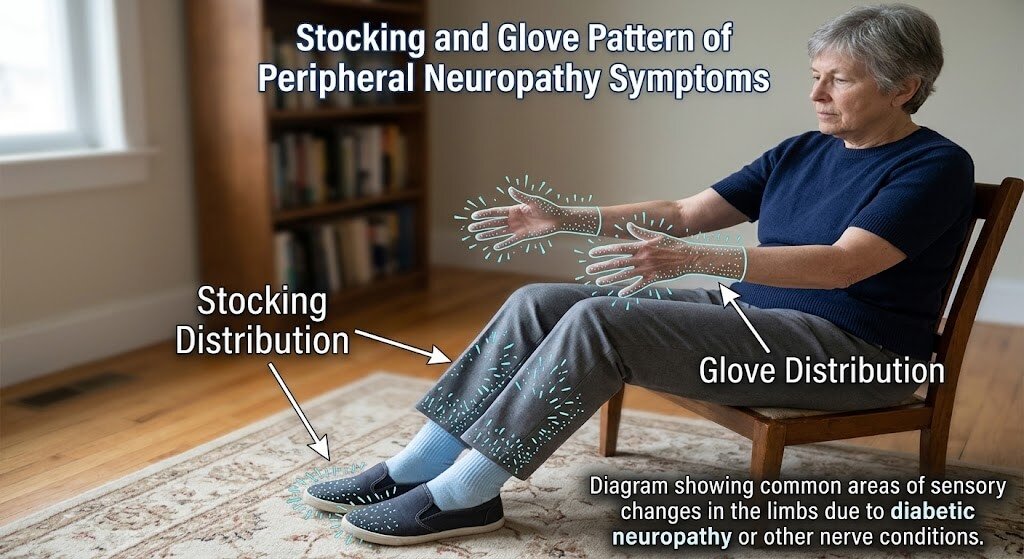
The medical term for nerve damage from low B12 is peripheral neuropathy. “Peripheral” means the nerves outside your brain and spinal cord. Symptoms tend to show up in a “stocking and glove” pattern, meaning the feet and lower legs first, then the hands.
Early signs most people ignore
- Tingling or pins and needles in the toes, soles, or fingertips that comes and goes
- Numb patches that feel like a sock is bunched up when it is not
- Mild burning in the feet at night or after standing a long time
- Clumsy grip on dumbbells, jar lids, or buttons
- Feeling off-balance when you close your eyes or stand on one leg
Later signs that need prompt medical attention
- Constant numbness that no longer comes and goes
- Sharp or electric-shock pain in the legs or feet
- Trouble walking, especially in the dark or on uneven ground
- Muscle weakness in the legs or hands
- Memory problems, confusion, or mood changes
- Fatigue, pale skin, or a sore red tongue (signs of anemia that often travel with the nerve problems)
The NIH fact sheet on vitamin B12 lists numbness and tingling in the hands and feet, balance problems, depression, confusion, and memory loss among the neurological symptoms of deficiency. The Mayo Clinic adds unsteady movements, muscle weakness, and personality changes to the list.
How symptoms usually progress
| Stage | What you might notice | What is happening |
| Early | Occasional tingling in toes or fingers, mild fatigue | Myelin starting to thin, signals slowing |
| Moderate | Numbness most days, burning at night, grip feels weak, balance wobble on one leg | Sensory nerves damaged, position sense reduced |
| Advanced | Trouble walking, falls, leg weakness, memory changes | Spinal cord tracts can be involved (subacute combined degeneration) |
One important point: nerve symptoms can appear even when blood counts look normal. The Harvard Health blog notes that B12 deficiency can be sneaky and that symptoms may develop before anemia shows up on a test. Do not assume you are fine because you are not anemic.
Why Low B12 Causes Nerve Pain: What the Research Says
B12 is a cofactor for an enzyme called methionine synthase. Without enough B12, homocysteine builds up and the body cannot make the methyl groups needed to maintain myelin. A second pathway, involving methylmalonyl-CoA, also stalls, and a substance called methylmalonic acid (MMA) rises. High MMA appears to be toxic to nerves and is one reason doctors measure it, as explained in the StatPearls review on vitamin B12 deficiency.
When myelin breaks down in the long sensory nerves, you lose “position sense,” the ability to feel where your foot is without looking. That is why balance gets worse in the dark or with your eyes closed. In more advanced cases, the back columns of the spinal cord are affected, a condition called subacute combined degeneration.
The key takeaway from the research is timing. The NIH notes that neurological damage from B12 deficiency can become permanent if the deficiency is not treated. Treatment usually stops the damage, and many people improve, but recovery is slower and less complete the longer nerves have been starved of B12.
Who Is Most at Risk
B12 deficiency is more common than most gym-goers think. The NIH reports that deficiency or marginal status affects a meaningful share of adults, with the numbers climbing in people over 60. [VERIFY exact prevalence figures against the NIH fact sheet before publishing.] The following groups should be especially alert.
Adults over 50
As we age, the stomach makes less acid, and acid is needed to free B12 from food. Because of this, the NIH advises that adults over 50 get most of their B12 from fortified foods or supplements, which are absorbed without stomach acid. If you are working on increasing your metabolism after 40, B12 status is worth checking at the same time.
People taking certain medications
- Metformin (common for type 2 diabetes and prediabetes) can lower B12 absorption with long-term use, according to the NIH fact sheet.
- Acid reducers such as proton pump inhibitors (omeprazole, pantoprazole) and H2 blockers (famotidine) reduce the stomach acid needed to release B12 from food.
- Nitrous oxide (laughing gas, used in dentistry and anesthesia) inactivates B12 and can trigger sudden nerve symptoms, especially with repeated exposure.
Plant-based eaters
Vegans and strict vegetarians get almost no B12 unless they use fortified foods or a supplement. This is not a knock on plant-based eating, which can be very healthy. It just means B12 has to be planned, not assumed.
Gut and autoimmune conditions
- Pernicious anemia, an autoimmune condition that destroys intrinsic factor
- Crohn’s disease, celiac disease, or any condition that damages the last part of the small intestine
- Bariatric surgery or stomach surgery that removes the acid-producing cells
- Heavy alcohol use, which irritates the stomach lining and reduces intake of quality food

B12 Nerve Pain vs. Other Causes: A Comparison Chart
Many conditions cause tingling and numbness. This table helps you describe your symptoms clearly to a doctor. It is not a diagnostic tool.
| Feature | B12 deficiency neuropathy | Diabetic neuropathy | Sciatica / pinched nerve | Overuse or compression (e.g., bike grip, tight shoes) |
| Location | Both feet and/or both hands, symmetrical | Both feet first, symmetrical | One leg or one arm, follows a nerve path | One spot, matches where pressure was applied |
| Onset | Gradual over months | Gradual over years | Often sudden, after lifting or twisting | During or right after activity |
| Other clues | Fatigue, pale skin, sore tongue, memory fog, balance loss | High blood sugar history | Low back or neck pain, worse with sitting or bending | Goes away within minutes to hours of removing pressure |
| Improves with | B12 treatment | Blood sugar control, foot care | Rest, movement, physical therapy | Changing grip, gear, or footwear |
Note that B12 deficiency and diabetic neuropathy can overlap, especially in people who take metformin. The Mayo Clinic peripheral neuropathy page lists vitamin deficiencies, including B12, among the causes of neuropathy alongside diabetes, so doctors often screen for both.
How Doctors Test for B12 Deficiency
If you report nerve symptoms, your doctor will usually order a few blood tests. Here is what they mean in plain language.
- Serum B12. The basic screening test. Low values point to deficiency, but “low-normal” values can still cause symptoms in some people.
- Methylmalonic acid (MMA). Rises when cells do not have enough usable B12. The NIH describes MMA as a more specific marker that helps clarify borderline serum results.
- Homocysteine. Also rises with low B12, but it rises with low folate too, so it is less specific.
- Complete blood count (CBC). Looks for large red blood cells (macrocytosis) and anemia. Normal results do not rule out nerve damage.
- Intrinsic factor antibodies. Checks for pernicious anemia if the cause is unclear.
Bring a list of your medications and your typical diet to the appointment. Telling your doctor “I have taken metformin for six years and eat mostly plant-based” can speed up the diagnosis.
Coach’s Tip: Do not start a high-dose B12 supplement the week before your blood test. It can push your serum level into the normal range and hide a real deficiency. Get tested first, then treat. If you already take B12, tell your doctor how much and for how long.

What Treatment Looks Like
Treatment depends on the cause and how severe the symptoms are. Your doctor decides the route and dose, but it helps to understand the options.
- Injections. Intramuscular B12 is the standard starting point for people with neurological symptoms or absorption problems. A typical approach is frequent injections at first, then a maintenance schedule, as described in StatPearls.
- High-dose oral tablets. Because about 1% of B12 is absorbed by simple diffusion even without intrinsic factor, large oral doses (often 1,000 to 2,000 mcg per day) can work for many people. The NIH notes that high oral doses may be as effective as injections for some patients. [VERIFY wording against NIH fact sheet.]
- Fixing the cause. Changing a medication, treating a gut condition, or adding fortified foods to a vegan diet.
What about timelines? Energy and blood counts often improve within weeks. Nerve symptoms are slower. Some people notice less tingling in one to three months, while others take six months to a year, and some symptoms may not fully resolve if treatment started late. Set patient expectations and keep your follow-up appointments.
Common Mistake: Taking a high-dose folic acid supplement to “cover your bases.” The NIH warns that large amounts of folic acid can correct the anemia of B12 deficiency while nerve damage continues to progress. Folate is important, but it is not a stand-in for B12.
How to Apply It: Getting Enough B12 Every Day
The Recommended Dietary Allowance for adults is 2.4 mcg of vitamin B12 per day, rising to 2.6 mcg during pregnancy and 2.8 mcg while breastfeeding, per the NIH. Most people who eat animal foods meet this easily. The challenge is absorption, not intake, for the high-risk groups above.
B12 content of common foods
| Food | Serving | Approximate B12 |
| Beef liver, cooked | 3 oz (85 g) | ~70 mcg |
| Clams, cooked | 3 oz (85 g) | ~17 mcg |
| Salmon, cooked | 3 oz (85 g) | ~2.6 mcg |
| Tuna, canned light | 3 oz (85 g) | ~2.5 mcg |
| Ground beef, cooked | 3 oz (85 g) | ~2.4 mcg |
| Milk, 2% | 1 cup (8 fl oz / 240 ml) | ~1.3 mcg |
| Plain yogurt | 6 oz (170 g) | ~1.0 mcg |
| Egg, whole | 1 large | ~0.5 mcg |
| Fortified breakfast cereal | 1 serving | varies, check label |
| Fortified nutritional yeast | 1 tbsp | varies, check label |
Values are rounded from the NIH ODS food table. [VERIFY each line against the current NIH table before publishing.]
Practical steps
- If you eat animal foods and are under 50 with no risk factors, a balanced plate with protein at each meal usually covers it. This fits well with the protein targets that support metabolism I give most clients anyway.
- If you are over 50, take metformin or acid reducers, or eat plant-based, ask your doctor about a daily B12 supplement or fortified foods. Cyanocobalamin is the most studied and least expensive form.
- If you have symptoms, get tested and treated under medical supervision. Do not self-treat nerve symptoms with a multivitamin and hope.
- Recheck levels on the schedule your doctor sets, usually a few months after starting treatment.
B12 is one of several nutrients that support normal energy metabolism, which is why low levels often show up first as unusual fatigue in the gym. If you are shopping for a supplement, use the same approach you would for any product and evaluate the ingredient list carefully rather than trusting the front label.
Training With Vitamin B12 Deficiency Nerve Pain Symptoms: A Coach’s Plan
Exercise does not fix a B12 deficiency. Only B12 does that. But the right training can help you keep strength, protect your balance, and stay active while your nerves recover. The Physical Activity Guidelines for Americans recommend that adults do muscle-strengthening work at least two days a week, and that older adults include balance training, which is exactly what reduced position sense calls for.
Get your doctor’s clearance first, especially if you have numb feet, since you may not feel a blister or an ankle roll. Here is the plan I use with clients who have mild to moderate neuropathy symptoms from any cause.
The balance and foot-sense circuit
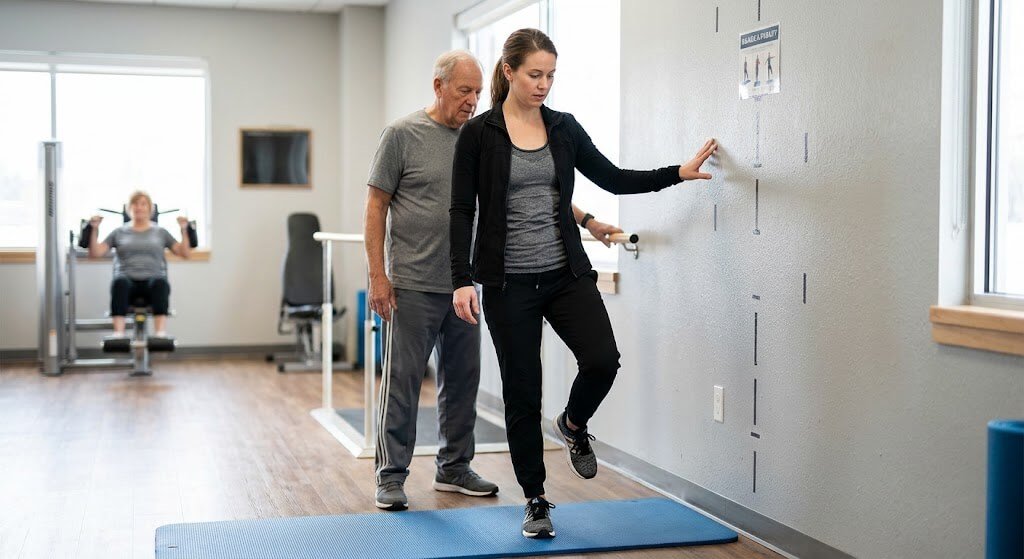
Do this 3 to 4 days per week, before your main workout or on its own. Rest 30 to 45 seconds between exercises. Stand next to a wall or sturdy rail for every drill.
| Exercise | Sets | Reps / Time | Rest |
| Sit-to-stand (no hands) | 3 | 10 reps | 45 sec |
| Single-leg stance | 3 per side | 20-30 sec | 30 sec |
| Heel-to-toe walk | 3 | 20 ft (6 m) out and back | 30 sec |
| Calf raise with pause | 3 | 12 reps, 2-sec hold at top | 45 sec |
| Seated foot alphabet | 2 per foot | A to Z | 30 sec |
| Farmer’s carry | 3 | 40 yd (37 m) | 60 sec |
How to do each exercise
Sit-to-stand. Use a chair 17 to 19 inches (43 to 48 cm) high. Feet flat, lean forward “nose over toes,” and stand up without pushing on your thighs. Lower under control for a 3-second count. You should feel this in your quads and glutes, not your lower back.
Single-leg stance. Stand tall, lift one foot an inch (2.5 cm) off the floor, and hold. Keep your eyes on a fixed point. Fingertips can touch the wall, but try to use them less each session. This retrains the position sense that B12 deficiency dulls.
Heel-to-toe walk. Place the heel of one foot directly in front of the toes of the other and walk a straight line. Go slow. Wobbling is normal and is actually the point, since your brain is relearning where your feet are.
Calf raise with pause. Rise onto the balls of your feet, hold for 2 seconds, and lower for 3 seconds. Lifters with numb feet often lose calf strength because they stop feeling the floor. This brings it back.
Seated foot alphabet. Sit, lift one foot, and “write” the alphabet with your big toe. This moves the ankle through every direction and keeps the joint mobile.
Farmer’s carry. Hold a dumbbell or kettlebell in each hand, start with 20 to 25 lb (9 to 11 kg) per hand, and walk tall. Grip is often one of the first things to weaken with hand numbness, so carries double as a grip test. If a weight slips, drop to a lighter load.
Easier version (regression)
- Sit-to-stand with hands on thighs or from a higher chair, 2 sets of 8
- Single-leg stance with one hand flat on the wall, 10 to 15 seconds
- Heel-to-toe walk along a wall or countertop, 10 ft (3 m)
- Seated calf raises instead of standing
- Farmer’s carry with 10 to 15 lb (4.5 to 7 kg) per hand, 20 yd (18 m)
Harder version (progression)
- Sit-to-stand holding a 20 lb (9 kg) dumbbell at your chest, 3 sets of 12
- Single-leg stance with eyes closed (hand hovering near the wall), 20 seconds
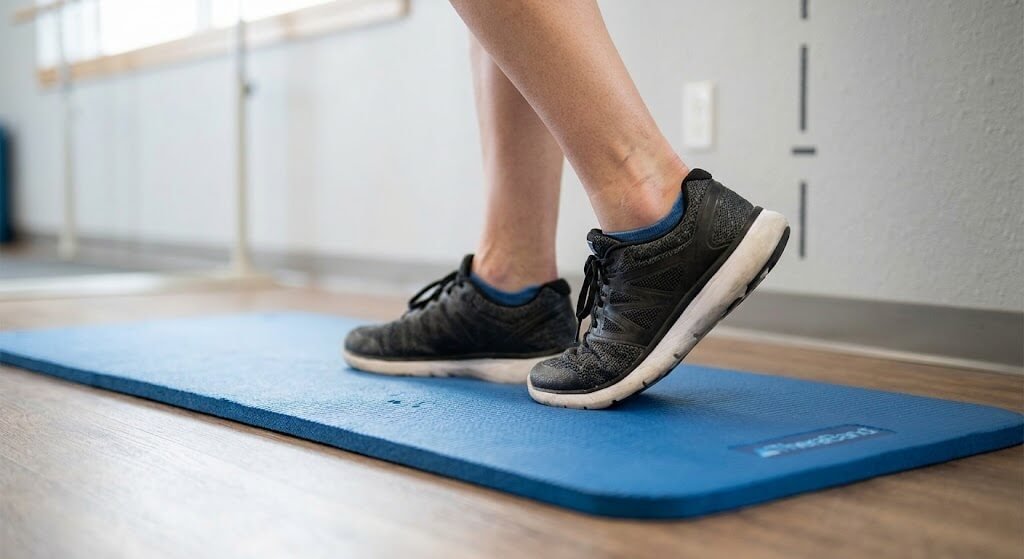
- Heel-to-toe walk on a folded yoga mat or foam pad
- Single-leg calf raises, 3 sets of 10 per side
- Farmer’s carry with 35 to 50 lb (16 to 23 kg) per hand, 50 yd (46 m)
Coach’s Tip: Train barefoot or in thin-soled shoes for the balance drills, on a clean indoor floor, so your feet get as much input as possible. Then wear supportive, well-fitting shoes for everything else, and check your feet for blisters or hot spots after every session. Numb feet do not report problems the way they should.
Adjusting your main lifts
You can usually keep lifting, but a few changes make it safer:
- Swap barbell lunges for split squats or use a rack, since stepping backward with reduced foot sense is a fall risk.
- Use straps or a neutral grip for heavy rows and deadlifts if hand numbness makes you drop weights. Keep building grip separately with carries.
- Choose machines for leg work on bad days. A leg press still builds strength without the balance demand of a free squat.
- Skip box jumps and plyometrics until your doctor confirms symptoms are improving. Landing on a foot you cannot feel is how ankles get sprained.
- Keep walking. Aim for 1.5 to 3 miles (2.4 to 4.8 km) per day on flat, well-lit paths. Research suggests that regular aerobic and strength exercise may help improve neuropathy symptoms and function in people with peripheral neuropathy. [VERIFY: cite a peer-reviewed trial such as Kluding et al., Journal of Diabetes and Its Complications, 2012, with confirmed PubMed URL.]
Safety Notes
- See a doctor before you treat yourself. Nerve symptoms have many causes, and some, like a spinal cord problem, need urgent care.
- Watch for red flags. Sudden weakness, loss of bladder or bowel control, numbness that spreads quickly, or symptoms on only one side of the body need same-day medical attention.
- Protect your feet. Inspect them daily, keep toenails trimmed, and never train barefoot outdoors or on gym floors with dropped plates.
- Mind your balance in the dark. Use a night light. Falls during nighttime bathroom trips are a classic problem when position sense is low.
- Tell your trainer. A good coach will modify the plan. There is no medal for hiding numb feet.
- Be careful with “nerve support” supplement blends. Many contain high-dose B6, which can itself cause neuropathy in large amounts over time, according to the NIH vitamin B6 fact sheet.
Related Tips for Recovery
Sleep is part of the treatment. Nerves repair during deep sleep, and poor sleep makes pain feel worse. If you are already working on how sleep affects metabolism, the same 7 to 9 hour target helps here.
Keep protein steady. B12 rides along with animal protein, so skipping protein at meals can cut intake without you noticing. Spread protein across three or four meals per day.
Check the rest of the picture. Thyroid function, blood sugar, alcohol intake, and other factors that affect metabolism and body weight often get tested at the same time as B12, because the symptoms overlap.
Be patient with progress. Track two things each week: how long you can hold a single-leg stance, and how far you can farmer’s carry without the weight slipping. Those two numbers usually improve before the tingling fully goes away, and they are proof that you are getting your body back.
FAQ
What does B12 deficiency nerve pain feel like?
Most people describe tingling, pins and needles, or numbness that starts in the toes or fingertips and shows up on both sides. Some feel burning in the feet at night or a sense of walking on cotton. Later, balance gets worse, especially in the dark, and grip strength can drop.
How long does it take for nerve pain from B12 deficiency to go away?
It varies. Blood counts and energy often improve within weeks of treatment, but nerve symptoms heal slowly. Many people see improvement over three to six months, and some continue improving for a year or more. If the deficiency went untreated for a long time, some symptoms may not fully resolve.
Can B12 deficiency cause nerve pain in the legs?
Yes. The longest nerves in the body run to the feet and lower legs, so they tend to be affected first. Symptoms commonly include tingling, numbness, burning, and weakness in both legs, and in advanced cases, difficulty walking. One-sided leg pain is more often a pinched nerve and should be checked separately.
Is B12 nerve damage reversible?
Often, but not always. The NIH notes that neurological damage from B12 deficiency can become permanent if it goes untreated. Treatment usually stops further damage, and earlier treatment gives the best chance of full recovery. That is why it is important to get tested as soon as symptoms appear rather than waiting it out.
Can I exercise with B12 deficiency nerve pain symptoms?
Usually yes, once your doctor clears you. Focus on balance drills, sit-to-stands, calf raises, and loaded carries, and skip plyometrics or backward-stepping lunges until symptoms improve. Check your feet after every session, since numb feet may not warn you about blisters or hot spots.
Should I take B12 supplements if I have tingling in my hands and feet?
Get a blood test first, because starting a supplement can mask a deficiency and delay a correct diagnosis. If your doctor confirms low B12, they will recommend injections or high-dose oral tablets based on the cause. Self-treating with a multivitamin is unlikely to be enough if absorption is the problem.
Conclusion
Vitamin B12 deficiency nerve pain symptoms are easy to dismiss as a tight shoe, an awkward sleeping position, or “just aging.” Tingling and numbness in both feet or both hands, burning at night, a weaker grip, and a new balance wobble are all reasons to ask your doctor for a B12 test, especially if you are over 50, take metformin or acid reducers, or eat plant-based.
The good news is that the test is simple, treatment is well established, and nerves often recover when the deficiency is caught early. While you heal, a short balance and foot-sense circuit, a few smart swaps in your main lifts, and daily walking will keep you strong and steady on your feet.