Protein shows up in almost every weight-loss plan, and the claims around it get wild fast: “boost your metabolism,” “melt fat,” “eat more to weigh less.” So how does protein intake affect metabolism and weight loss, and how much of the hype holds up?
As a strength coach, I like to separate what research supports from what marketing says. Protein does raise the calories you burn after a meal, and it may help you feel full. It also helps you hold on to muscle while you eat less. None of that is magic, and this guide shows you the real size of each effect.
You will get a plain-English explanation, daily protein targets by body weight, a food list, a sample strength routine, and safety notes. Because this article touches weight loss, check with your doctor before you change your diet, especially if you have kidney disease, diabetes, or another health condition.
Quick Answer
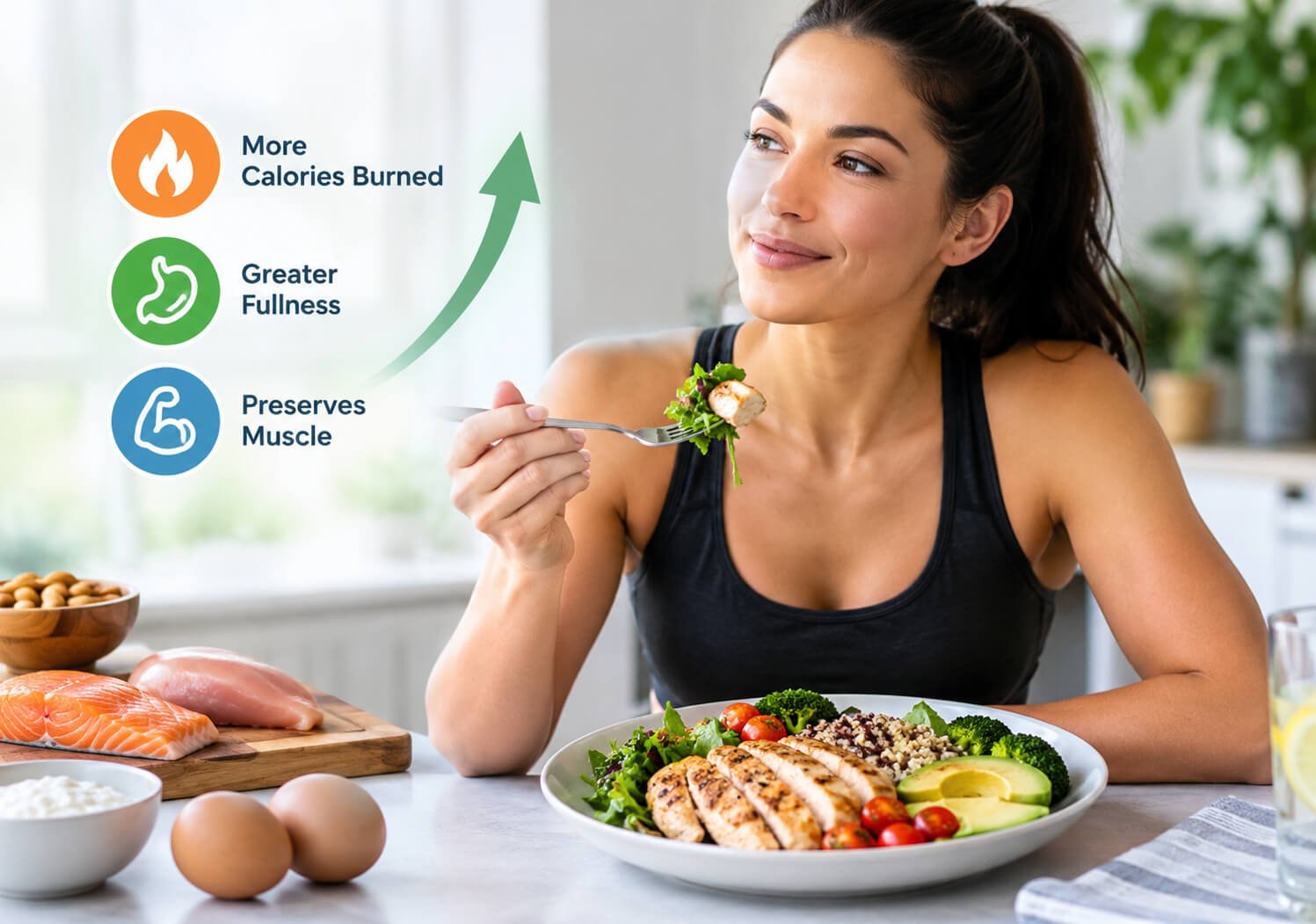
Protein affects metabolism and weight loss in three main ways: it burns more calories during digestion than carbs or fat, it may help you feel full longer, and it helps protect muscle while you eat less. The effects are modest, so protein works best alongside a calorie deficit and strength training.
How Does Protein Intake Affect Metabolism and Weight Loss? The Science in Plain Words
Think of protein as a tool, not a fat-burning switch. To use it well, you need to know how your body spends energy and where protein fits in. Let’s start there.
Your body burns calories in three ways
Your total daily energy expenditure has three main parts. Each one matters for weight loss, and protein touches all three.
- Basal metabolic rate (BMR): the energy your body needs at rest to keep you alive, such as breathing and circulation.
- Activity: everything from walking to the gym, including formal workouts and daily movement.
- Diet-induced thermogenesis (DIT): the energy used to digest, absorb, and store food. It is also called the thermic effect of food.
A review in Nutrition & Metabolism lists these same three parts of daily energy expenditure. A recent meta-analysis adds that DIT makes up about 10% of total daily energy expenditure. So DIT is real, but it is a small slice of your day.
The thermic effect of protein
Not all calories cost the same to process. Research on diet-induced thermogenesis shows a clear order: alcohol first, then protein, then carbohydrate, then fat, according to a review on diet-induced thermogenesis. The same review found that a mixed diet produces a DIT of about 5% to 15% of daily energy expenditure, and that values run higher when protein is high.
The meta-analysis from 2024 reached a similar view. It describes protein as the most thermogenic macronutrient, and it examined how different amounts and types of protein change DIT.
Here is the part marketing leaves out. One critical review reports that the thermic effect of food rises by roughly 29 kilojoules per 4,184 kilojoules eaten for each 10-point increase in the share of calories from protein, per this critical review of high-protein diets. That is about 0.7%. On a 2,000-calorie diet, moving from 15% to 25% protein would burn only about 14 extra calories a day (my math from that figure).
Coach’s Tip: Do not count on the thermic effect to do the work. It is a small bonus. Protein earns its place mostly through fullness and muscle protection, which we cover next.
Protein and fullness
Weight loss is hard because hunger rises when you eat less. Protein may help here. A critical review of high-protein diets found convincing evidence that higher protein intake increases satiety compared with lower protein diets. The review also found that higher-protein meals appear to lead to lower calorie intake later.
The picture gets more careful in newer work. A review in The American Journal of Clinical Nutrition found that higher-protein meals raise fullness and satiety hormones in short studies, but did not support a drop in calories at the next meal, as described in a review of protein in weight loss and maintenance. It also noted that people who stuck with a higher-protein plan did better than those who did not.
That last point matters to a coach. The best protein plan is the one you can follow for months. A “perfect” plan you quit in week three does nothing.
Protein, muscle, and resting metabolism
When you lose weight, you lose some muscle along with fat. That matters because muscle is active tissue, and losing it can lower your resting energy needs. It also makes you weaker and can change how your body looks at a lower weight.
A study of postmenopausal women in a 20-week diet and exercise program found that about 32% of the weight they lost was lean mass, and that women who ate more protein lost less lean mass, according to this analysis in the Journal of the American Dietetic Association. Their protein intake averaged only 0.62 grams per kilogram of body weight, which is below the standard daily minimum. Note that this was a retrospective analysis, so it shows a link and not proof of cause.
For athletes and lifters, the International Society of Sports Nutrition (ISSN) states that higher intakes of 2.3 to 3.1 grams per kilogram per day may be needed to maximize lean body mass retention in resistance-trained people during low-calorie periods. That range is high, and it applies to trained people. Most beginners will do well with far less, as the next sections show.
What this means for your metabolism
Here is the honest summary. Protein does not “speed up” your metabolism in a big way. It nudges calorie burn up a little through DIT, and it helps you keep the muscle that supports your resting energy use. Combined with lifting, that is a solid reason to eat enough of it.
How Does Protein Intake Affect Metabolism and Weight Loss? What the Research Says
The research supports protein, with caveats. Several short, tightly controlled feeding studies showed greater weight loss, more fat loss, and better lean mass retention on higher-protein diets compared with lower-protein diets, as summarized in the Leidy review. Longer studies were mixed, and poor adherence explained much of the gap.
A critical review from the Harvard School of Public Health reached a similar view. It found that some evidence shows more weight and fat loss on higher-protein diets, but the findings have not been consistent. The authors also suggested that, in practice, it may help to partly replace refined carbohydrates with protein foods that are low in saturated fat.
Here is how the main findings stack up:
| Question | What research suggests | How confident to be |
| Does protein burn more calories to digest? | Yes, more than carbs or fat | High, but the amount is small |
| Does protein help you feel full? | Often yes, especially in short studies | Moderate |
| Does protein help you keep muscle while dieting? | Yes, mainly when paired with strength training | Moderate to high |
| Does a high-protein diet cause more weight loss long term? | Mixed results; adherence matters | Low to moderate |
| Is it safe for healthy people? | Generally, in the short term | Moderate; long-term data is limited |
Common Mistake: Eating a lot of protein while ignoring total calories. Protein has calories too. If you add a protein shake, bars, and extra meat on top of your usual diet, you can gain weight. A calorie deficit is still the engine of fat loss.
How Much Protein Do You Need to Lose Weight?
There is no single number that fits everyone. Your best target depends on your body weight, your activity, your age, and your health. Here are the reference points that matter.
The baseline: the RDA
The Recommended Dietary Allowance (RDA) is 0.8 grams of protein per kilogram of body weight, or 0.36 grams per pound, according to Harvard Health. Harvard also explains that the RDA is the minimum to meet basic needs, not the exact amount you should eat each day. Think of it as a floor.
The active-person range
For people who exercise, the ISSN says that 1.4 to 2.0 grams per kilogram per day is enough for most exercising individuals to build or maintain muscle. The ISSN also suggests spreading protein evenly through the day, about every 3 to 4 hours.
For a person who is dieting but not training hard, a target between the RDA and the ISSN range is a common coaching approach, roughly 1.0 to 1.2 grams per kilogram. Ask your doctor or a dietitian before you pick a number if you have a medical condition.
Protein quality and sources
Not every protein source works the same way in your body. The ISSN notes that different types and quality of protein can change amino acid availability after you eat or drink it. In practice, animal foods, soy, and dairy are complete proteins, and plant eaters can mix beans, grains, nuts, and tofu across the day to cover their needs.
Quality also includes what comes with the protein. Fish, skinless poultry, beans, and low-fat dairy bring fewer saturated fats than processed meats, which is why Mayo Clinic steers people toward them. Pick the source you will enjoy and can afford, then keep it consistent.
Daily protein targets by body weight
| Body weight | RDA floor (0.8 g/kg) | Active-person range (1.4–2.0 g/kg) |
| 150 lb (68 kg) | about 54 g | about 95–136 g |
| 180 lb (82 kg) | about 65 g | about 115–164 g |
| 220 lb (100 kg) | about 80 g | about 140–200 g |
These figures are rounded math from the RDA and ISSN numbers above. Start at the low end of your range and move up only if you feel hungry or you are lifting hard. More is not always better.
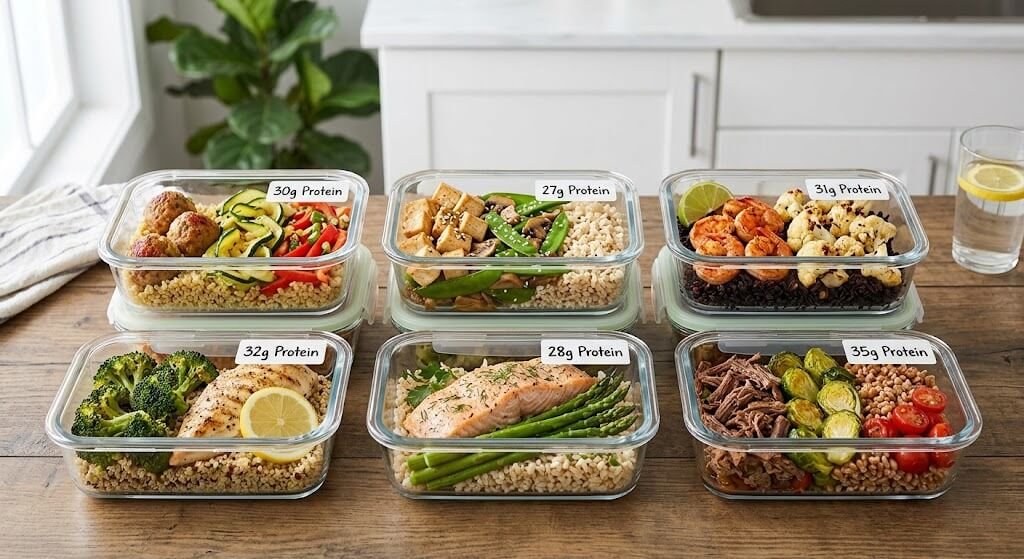
Coach’s Tip: Aim for about 25 to 40 grams of protein at each of three to four meals . It is easier to hit a daily total when you build each plate around a protein source first.
How to Apply It: Protein Intake, Metabolism and Weight Loss in Real Life
Knowing the science is step one. Now put it into your week. Here is a simple five-step plan I would give a client who is new to this.
Step 1: Pick your daily target
Use the table above. Multiply your weight in pounds by 0.36 for the floor, or by 0.64 to 0.91 for the active-person range. Write the number down. Then round to a number you can remember, such as 100 grams or 120 grams.
Step 2: Build every meal around protein
Plan the protein first, then add vegetables, whole grains, and healthy fats. Spreading it across the day beats cramming it into dinner. The ISSN notes that benefits come from even distribution across the day.
Step 3: Choose protein foods that fit your plan
Mayo Clinic advises picking protein with care and lists options such as soy, beans, nuts, fish, skinless poultry, lean beef, pork, and low-fat dairy, according to Mayo Clinic’s guidance on high-protein diets. It also warns against leaning on processed meats.
| Food (typical serving) | Approx. protein | Notes |
| Chicken breast, cooked, 3 oz (85 g) | about 26 g | Lean, easy to batch cook |
| Eggs, 2 large | about 12 g | Quick breakfast option |
| Plain Greek yogurt, ¾ cup (170 g) | about 17 g | Choose plain to limit added sugar |
| Salmon, cooked, 3 oz (85 g) | about 22 g | Also provides omega-3 fats |
| Lentils, cooked, ½ cup (100 g) | about 9 g | Adds fiber too |
| Cottage cheese, ½ cup (113 g) | about 12–14 g | Works as a snack |
| Tofu, firm, ½ cup (125 g) | about 10 g | Plant-based option |
Figures are typical values from memory and vary by brand and cooking method.
A sample day of eating (about 110 grams of protein)
This example fits the lower end of the active range for a 180 lb (82 kg) person. Scale portions up or down to match your own target.
| Meal | What to eat | Approx. protein |
| Breakfast | 2 eggs, ¾ cup plain Greek yogurt, and a piece of fruit | about 29 g |
| Lunch | Salad with 3 oz (85 g) cooked chicken and ½ cup lentils | about 35 g |
| Snack | ½ cup cottage cheese with berries | about 12–14 g |
| Dinner | 3 oz (85 g) salmon, ½ cup firm tofu stir-fried with vegetables, and rice | about 32 g |
Notice that each meal lands near the 25 to 40 gram range from the Coach’s Tip above, and no single meal has to carry the day. If you eat fewer meals, make each portion a little larger. If you are hungry between meals, add a small protein snack like yogurt or a boiled egg before you add more carbs or sweets.
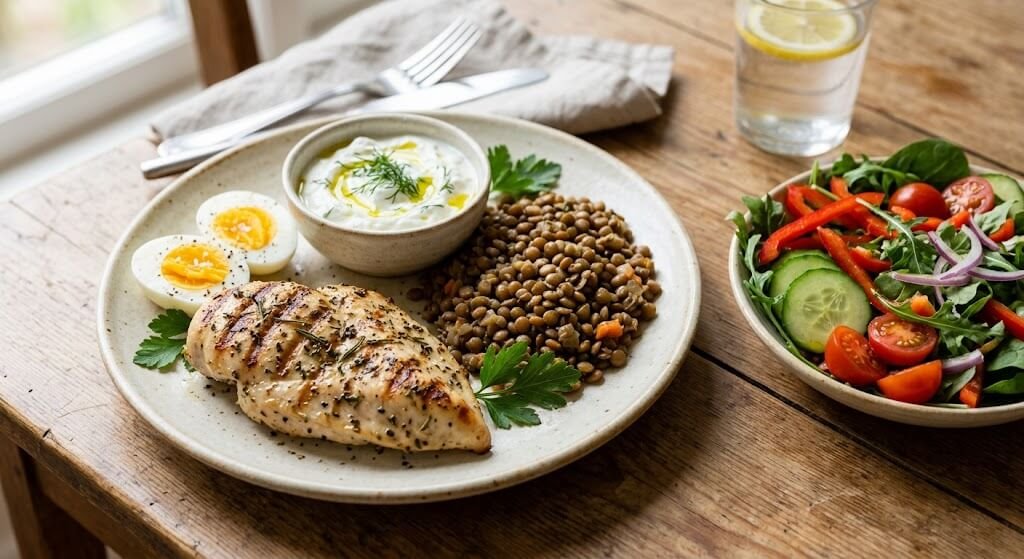
Prepare two or three protein foods on Sunday, such as baked chicken, boiled eggs, and a pot of lentils. Then you can assemble most meals in five minutes during a busy week, and you will be less tempted to grab something low in protein.
Step 4: Lift weights two to three days a week
Protein helps most when your muscles have a reason to keep working. The CDC says adults need at least two days of muscle-strengthening activity each week that works all major muscle groups. It also recommends 150 minutes of moderate aerobic activity weekly, such as brisk walking.
Here is a simple full-body routine. Do it on three non-consecutive days, such as Monday, Wednesday, and Friday. Warm up for five minutes with easy walking and arm circles first.
| Exercise | Sets | Reps | Rest | Tempo |
| Goblet squat | 3 | 8–12 | 60–90 sec | 2 sec down, 1 sec up |
| Dumbbell Romanian deadlift | 3 | 8–12 | 60–90 sec | 2 sec down, 1 sec up |
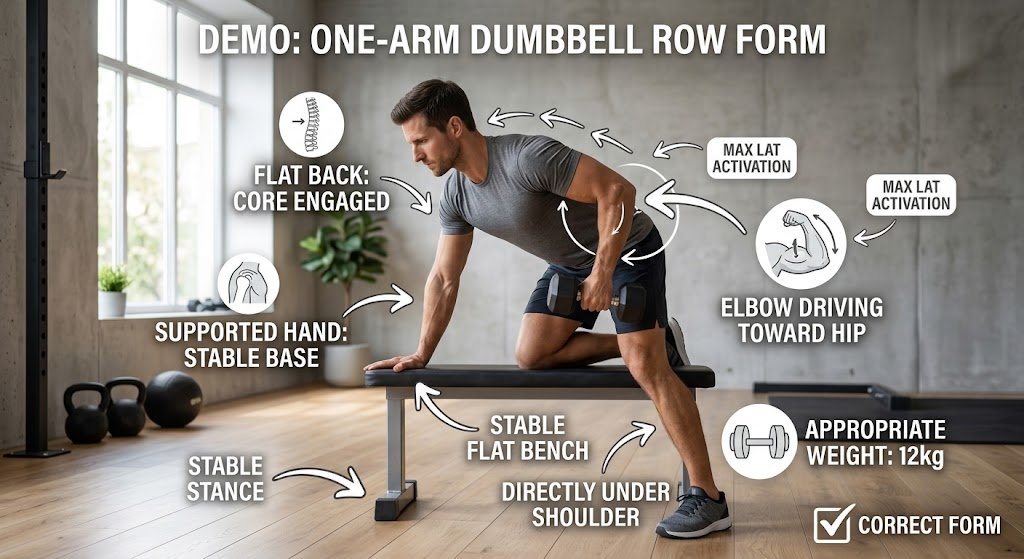
| One-arm dumbbell row | 3 | 10–12 each side | 60 sec | 2 sec down, 1 sec up |
| Push-up (or incline push-up) | 3 | 6–12 | 60 sec | Controlled |
| Dumbbell overhead press | 2 | 8–12 | 60 sec | Controlled |
| Plank | 2 | 20–40 sec | 45 sec | Hold steady |
Weight guidance: Pick a weight that leaves you able to do about two more reps when you stop each set. Many beginners start with 10 to 25 lb (4.5 to 11 kg) dumbbells for the squat and row. Add 2.5 to 5 lb (1 to 2 kg) when you hit the top of the rep range on every set.
Form cues for the goblet squat
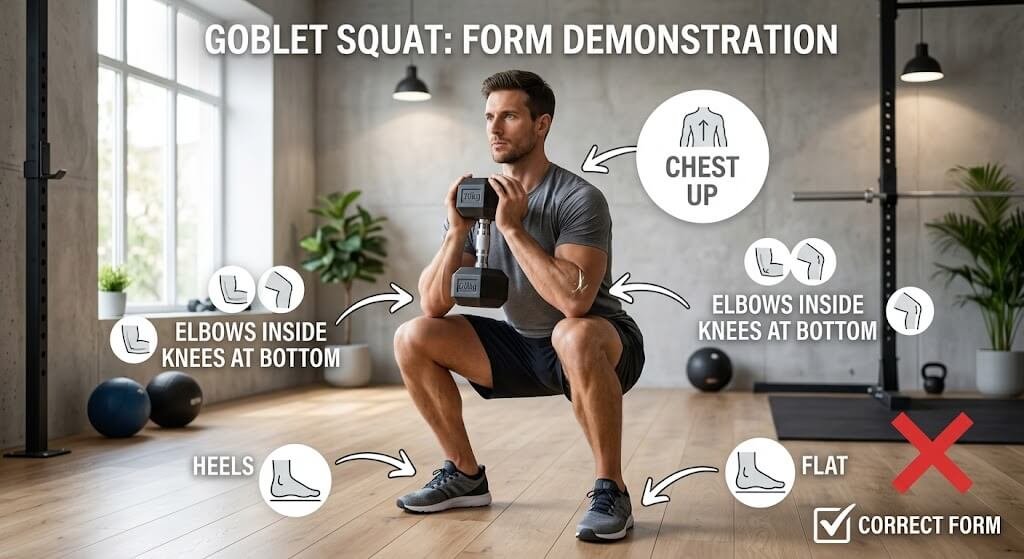
- Hold one dumbbell upright against your chest with both hands.
- Stand with your feet about shoulder-width apart and toes turned out slightly.
- Brace your core, sit your hips down and back, and keep your chest tall.
- Lower until your thighs are near parallel to the floor, or as low as you can with good form.
- Drive through your whole foot to stand. You should feel it in your quadriceps and glutes, not your lower back.
Common Mistake: Letting the knees cave inward or the heels lift off the floor. If this happens, shrink the range of motion, widen your stance slightly, and slow down. Think “spread the floor” with your feet.
Easier version (regression): Squat to a box or bench with no weight, or use a light 5 to 10 lb (2 to 4.5 kg) dumbbell. Cut each exercise to two sets for the first two weeks.
Harder version (progression): Add a pause of two seconds at the bottom of the squat, use a heavier dumbbell or kettlebell, or add a fourth set. Move from incline push-ups to full push-ups, then to feet-elevated push-ups.
Step 5: Add daily walking and track your progress
Walking burns calories and supports recovery. Aim for 30 minutes a day, about 1.5 to 2 miles (2.4 to 3.2 km) at a brisk pace, on most days. This fits within the CDC’s 150-minute weekly target.
Track three things for four weeks: your average daily protein, your lifting numbers, and your waist measurement or how your clothes fit. Scale weight can swing from water, so use it as one clue and not the whole story. If your strength is holding or rising while your weight falls slowly, your plan is working.
Safety Notes: Who Should Be Careful With High Protein
For most healthy people, a high-protein diet is generally not harmful in the short term, says Mayo Clinic. Researchers are still studying the long-term risks of high-protein diets that restrict carbohydrates, so a balanced plan is the safer path.
Mayo Clinic lists several cautions:
- A high-protein diet may worsen kidney function in people who already have kidney disease.
- Very low-carb versions may cut fiber and nutrients, which can cause bad breath, headaches, or constipation.
- Diets heavy in red and processed meat may raise heart disease risk because of saturated fat.
Talk with your doctor before you start a weight-loss diet, and this is especially important if you have kidney disease, diabetes, or another long-term condition. If you are pregnant, postpartum, older with health conditions, or taking medication, ask your care team for a personal protein target. Stop and get medical advice if you feel unwell.
Related Tips for Better Results
- Do not chase supplements for a metabolic boost. Protein powder can help you reach a target on a busy day, but food comes first. Some people also look at compounds such as chromium picolinate and glucose metabolism, and the evidence there is a separate question that deserves its own careful look.
- Pair protein with fiber. Vegetables, beans, and whole grains add volume and help you stay full on fewer calories.
- Watch your blood sugar. Protein-rich meals with fiber can make eating patterns steadier. If you are curious about how insulin response works, read about inositol and insulin sensitivity.
- Sleep and stress matter. Poor sleep can raise hunger and make it harder to stick to your plan.
- Be patient. Healthy weight loss is gradual. Avoid any plan that promises fast results.

FAQ
Does eating more protein speed up your metabolism?
Slightly. Protein has the highest thermic effect of the three macronutrients, so you burn a bit more energy digesting it, per a 2024 meta-analysis. The boost is small, though. Protein helps more by keeping you full and protecting muscle while you diet.
How much protein do I need to lose weight?
The RDA is 0.8 grams per kilogram of body weight, which Harvard Health calls a minimum. Active people often aim for 1.4 to 2.0 grams per kilogram, according to the ISSN. Ask your doctor or dietitian for a personal number.
Does protein keep you full longer?
Often, yes. Higher-protein meals raise fullness and satiety hormones in short studies, according to a review in the American Journal of Clinical Nutrition. That review did not find a clear drop in calories at the next meal, so fullness benefits vary from person to person.
Is a high-protein diet safe for your kidneys?
For most healthy people it is generally not harmful in the short term, says Mayo Clinic. It may worsen kidney function if you already have kidney disease. Talk with your doctor first if you have kidney disease, diabetes, or another chronic condition.
Do I need protein powder to lose weight?
No. You can reach your target with whole foods such as eggs, fish, poultry, beans, tofu, and yogurt. Powder is a convenience, not a requirement. If you use it, count its calories in your daily total, because extra calories can stall fat loss.
Can you eat too much protein and still gain weight?
Yes. Protein has calories, and the energy content of your whole diet is a main driver of weight change, as a review of diet-induced thermogenesis notes. If total calories sit above what you burn, extra protein will not stop weight gain.
Conclusion
So, how does protein intake affect metabolism and weight loss? It gives you a small calorie-burning bonus, it may help you feel fuller, and it helps you protect muscle while you eat less. Those are real benefits, but they are modest, and they work best inside a calorie deficit.
Start simple. Pick a daily protein target, build each meal around a protein food, lift weights two to three days a week, and walk most days. Review your progress after four weeks and adjust slowly.
Protein is a smart tool for a sensible plan. It will not do the work for you, but it makes the work easier to keep up.