
You don’t need a prescription, a supplement stack, or a magic pill. The same training principles that build a stronger heart, steadier breathing, and a more resilient nervous system also support better blood flow, hormonal balance, and confidence in the bedroom. As a strength and conditioning coach, I’ve seen men in their 30s, 40s, and 50s make real, measurable progress in both physical stamina and sexual wellness using nothing more than consistent cardio, targeted strength work, pelvic floor training, and smart lifestyle habits.
This guide breaks down exactly how to do that—exercise by exercise, set by set—so you can build a routine that fits your schedule and your current fitness level.
Quick Answer
Men can improve stamina and sexual wellness naturally by combining 150 minutes of moderate cardio per week, two sessions of lower-body and core strength training, daily pelvic floor (Kegel) exercises, 7–9 hours of quality sleep, and stress-management habits. These steps support cardiovascular health, nitric oxide production, hormonal balance, and nervous-system regulation—all key drivers of erectile function and endurance.
Why Stamina and Sexual Wellness Are Connected
Erectile function depends on healthy blood vessels. The small arteries in the penis are among the first to show signs of cardiovascular decline, which is why erectile changes are often an early warning signal for heart and vascular issues, according to Mayo Clinic [VERIFY]. When your heart pumps efficiently and your endothelium (the inner lining of blood vessels) produces nitric oxide smoothly, blood flows where it’s needed—including to the pelvic region.
Stamina, in the everyday sense, is your cardiovascular endurance plus your muscular endurance. Sexual wellness adds a layer of nervous-system regulation: the parasympathetic branch (“rest and digest”) triggers arousal, while the sympathetic branch (“fight or flight”) can shut it down under stress. Training both your aerobic engine and your stress-response system gives you more control over the whole process.
In short: a fitter heart, stronger pelvic muscles, better sleep, and lower chronic stress create the conditions for natural stamina and sexual wellness.

Build Cardiovascular Stamina
Cardio is the foundation. The CDC physical activity guidelines recommend at least 150 minutes of moderate-intensity aerobic activity or 75 minutes of vigorous activity per week for adults. For stamina and sexual wellness specifically, I’d aim to hit that baseline and add a little more.
Zone 2 Steady-State Cardio (3–4 sessions/week)
Zone 2 is the sweet spot: you can hold a conversation but you’re clearly breathing harder than at rest. Heart rate typically sits at 60–70% of your max.
- Duration: 30–45 minutes
- Options: brisk walking (3.5–4.5 mph / 5.6–7.2 km/h), cycling, rowing, swimming, or an elliptical
- Frequency: 3–4 times per week
- Why it works: Zone 2 training improves mitochondrial density, capillary networks, and resting heart rate. Over 6–8 weeks, you’ll notice you recover faster between sets and your breathing stays calmer under physical demand.
Easier version: Walk at a comfortable pace on flat ground for 20 minutes, 4 days a week. Add 5 minutes every two weeks.
Harder version: Add 4–6 weeks of 45-minute zone 2 sessions with a 5–10% incline on a treadmill or a light resistance setting on a stationary bike.
High-Intensity Interval Training (1 session/week)
One HIIT session per week adds a different stimulus: it pushes your VO2 max and trains your body to clear lactate quickly.
- Protocol: 30 seconds hard effort (sprint, fast bike, rowing) → 90 seconds easy recovery. Repeat 6–8 rounds. Total time: about 12–16 minutes.
- Frequency: 1x per week, on a separate day from your heavy strength work.
- Why it works: HIIT improves endothelial function and nitric oxide availability, both of which support penile blood flow. A 2019 meta-analysis in the Journal of Sexual Medicine found that aerobic exercise, including interval formats, was associated with improved erectile function scores in men with mild to moderate ED [VERIFY].
Coach’s Tip: Don’t skip the warm-up. Do 5 minutes of easy jogging or cycling, then 10 dynamic stretches (leg swings, arm circles, hip openers) before any HIIT session. Cold muscles and a cold heart rate spike raise your injury risk and blunt the cardiovascular benefit.
Sample Weekly Cardio Split
| Day | Type | Duration | Intensity |
| Mon | Zone 2 run or bike | 35 min | 60–70% HRmax |
| Tue | HIIT (rowing or bike) | 15 min + warm-up/cool-down | 85–95% HRmax intervals |
| Thu | Zone 2 walk or swim | 40 min | 60–70% HRmax |
| Sat | Zone 2 cycle or hike | 35 min | 60–70% HRmax |
Strength Training for Male Sexual Wellness
Strength work does three things for stamina and sexual wellness: it builds the lower-body and core muscles you need for physical endurance, it supports healthy testosterone and growth-hormone responses, and it improves insulin sensitivity, which keeps blood vessels clear.
Key Exercises (2 sessions/week)
Focus on compound, multi-joint movements. Here’s a practical split:
Session A – Lower Body + Core
| Exercise | Sets | Reps | Rest | Tempo |
| Barbell back squat | 4 | 6–8 | 90 s | 3-1-1-0 |
| Romanian deadlift | 3 | 8–10 | 75 s | 3-1-1-0 |
| Walking lunges (dumbbells) | 3 | 10/leg | 60 s | 2-1-1-0 |
| Hanging knee raise | 3 | 12–15 | 45 s | 2-1-2-0 |
| Plank | 3 | 30–45 s | 45 s | Hold |
Session B – Upper Body + Posterior Chain
| Exercise | Sets | Reps | Rest | Tempo |
| Dumbbell bench press | 4 | 8–10 | 90 s | 2-1-1-0 |
| Bent-over barbell row | 3 | 8–10 | 75 s | 2-1-1-0 |
| Pull-ups or lat pulldown | 3 | 8–12 | 60 s | 2-1-2-0 |
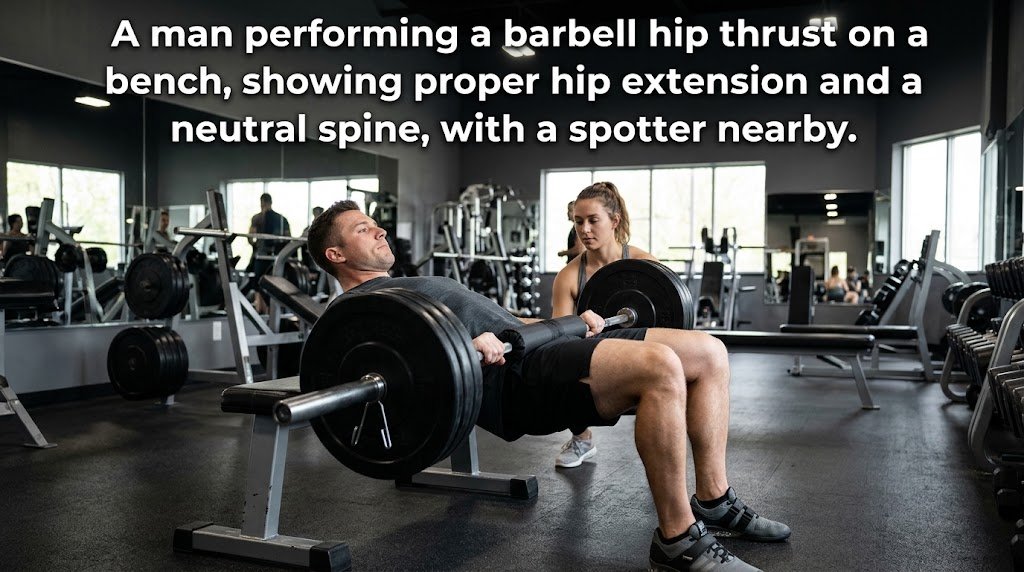
| Hip thrust (barbell) | 3 | 10–12 | 60 s | 2-1-1-0 |
| Farmer’s carry | 3 | 40 yd (37 m) | 60 s | Steady |
Weight guidance (starting points for a man around 160–180 lb / 73–82 kg):
- Back squat: 95–135 lb (43–61 kg)
- Romanian deadlift: 115–155 lb (52–70 kg)
- Dumbbell bench press: 35–50 lb (16–23 kg) per hand
- Hip thrust: 115–185 lb (52–84 kg)
Progress by adding 5–10 lb (2–5 kg) to the bar or 2.5–5 lb (1–2 kg) to dumbbells every 1–2 weeks, as long as form stays clean.
Common Mistake: Skipping the hip thrust or glute work. The glutes and hip extensors are the primary drivers of lower-body power. Weak glutes shift load to the lower back and reduce your ability to sustain physical effort. If you only squat and deadlift, you’re leaving a major muscle group under-trained.
Easier and Harder Progressions
- Squat regression: Goblet squat with a single dumbbell held at the chest, 3×10.
- Squat progression: Front squat or pause squat (2-second pause at the bottom), 4×5.
- Deadlift regression: Kettlebell deadlift, 3×10.
- Deadlift progression: Trap-bar deadlift with a 3-second eccentric, 4×6.
Pelvic Floor Exercises for Men (Kegels)
This is the piece most men skip, and it’s the one with the most direct link to sexual wellness. The pelvic floor—specifically the pubococcygeus and bulbocavernosus muscles—controls blood flow into and out of the erectile tissue. Weak or uncoordinated pelvic floor muscles are linked to erectile difficulties and reduced ejaculatory control, as noted by Cleveland Clinic [VERIFY].
Step-by-Step: How to Find and Train Your Pelvic Floor
- Locate the muscles. Next time you urinate, try to stop the stream mid-flow. The muscles you just squeezed are your pelvic floor. (Do this only once to identify them—don’t make it a habit, as it can interfere with bladder emptying.)
- Lie on your back. Knees bent, feet flat, hands at your sides. This removes gravity and makes it easier to isolate the muscles.
- Squeeze and lift. Contract the pelvic floor as if you’re trying to stop gas and lift the muscles upward toward your belly button. Hold for 3–5 seconds.
- Relax fully. Release for 5–8 seconds. The relaxation phase is just as important as the squeeze.
- Repeat. Aim for 10 repetitions per set, 3 sets per day (morning, midday, evening). Total time: about 5 minutes.
Progression Plan
| Week | Hold | Relax | Reps | Sets/Day |
| 1–2 | 3 s | 5 s | 10 | 3 |
| 3–4 | 5 s | 7 s | 10 | 3 |
| 5–6 | 7 s | 8 s | 12 | 3 |
| 7–8 | 10 s | 10 s | 10 | 3 |
| 9+ | 10 s | 5 s (fast) | 15 | 3 |
Easier version: Do the squeezes while lying down with knees bent. Focus on the “lift” sensation rather than a hard squeeze.
Harder version: Perform the same holds while standing, then while walking. Add a “quick flick” (contract 1 second, release 1 second) × 20 at the end of each set to train fast-twitch pelvic floor fibers.
Coach’s Tip: Don’t bear down or push your abdomen out when you squeeze. If you feel pressure in your lower back or see your belly bulge, you’re using the wrong muscles. Place one hand on your lower abdomen—it should stay soft and still while you contract the pelvic floor.
Lifestyle Factors That Support Natural Stamina
Exercise is the engine, but these habits determine how well the engine runs.
Sleep (7–9 hours/night)
Chronic sleep deprivation raises cortisol, lowers testosterone, and impairs endothelial function. Research published in The Journal of Clinical Endocrinology & Metabolism showed that men restricted to 5 hours of sleep per night for one week experienced a 10–15% drop in testosterone levels compared to their baseline [VERIFY]. Poor sleep also blunts your parasympathetic tone, making it harder to relax and stay aroused.
Practical steps:
- Set a consistent bedtime and wake time (±30 minutes), even on weekends.
- Keep the room cool (65–68 °F / 18–20 °C) and dark.
- Avoid screens 30–60 minutes before bed.
- If you snore loudly or wake up unrefreshed, get screened for sleep apnea—untreated apnea is a major contributor to erectile changes and daytime fatigue.
Quality sleep also supports your metabolism and recovery between workouts. For a deeper look at the hormonal side, see our guide on how sleep affects metabolism and weight management.
Stress Management
Cortisol is the enemy of stamina. When your sympathetic nervous system is in overdrive (tight jaw, shallow breathing, racing thoughts), blood is shunted away from the pelvic region and toward your extremities. Chronic stress also elevates blood pressure and contributes to arterial stiffness.
- Daily: 10 minutes of diaphragmatic breathing (4-count inhale, 6-count exhale) or a short walk outside.
- Weekly: One unstructured “downtime” block—no phone, no obligations.
- Before training: 2–3 minutes of box breathing (4-4-4-4) to shift your nervous system out of fight-or-flight.
Nutrition and Hydration
You don’t need a special “sexual wellness diet,” but a few patterns matter:
- Nitric oxide precursors: Beets, leafy greens (spinach, arugula), and citrus fruits support nitric oxide synthesis, which is essential for smooth muscle relaxation in blood vessels.
- Healthy fats: Olive oil, avocado, nuts, and fatty fish (salmon, sardines) support hormone production and vascular health.
- Zinc and magnesium: Found in lean meat, pumpkin seeds, dark chocolate, and legumes. These minerals are cofactors in testosterone synthesis and muscle relaxation.
- Hydration: Dehydration reduces blood volume and can make stamina drop noticeably. Aim for at least 64–96 oz (1.9–2.8 L) of water daily, more on training days.
- Alcohol: Heavy or frequent drinking raises estrogen, lowers testosterone, and impairs sleep architecture. If you drink, keep it to 1–2 standard drinks on an occasional basis.
For a broader look at which nutrients support energy and metabolic health, check out our article on which nutrients support normal energy metabolism.
Body Composition
Excess body fat—particularly visceral fat around the abdomen—increases aromatase activity, which converts testosterone to estrogen. It also promotes low-grade inflammation that damages blood vessels. You don’t need to be shredded, but keeping body fat in a healthy range (roughly 12–22% for men, depending on age and frame) supports both hormonal balance and cardiovascular function.
If you’re working on body composition alongside stamina, our guide on how to support metabolism naturally covers practical nutrition and training strategies without crash dieting.
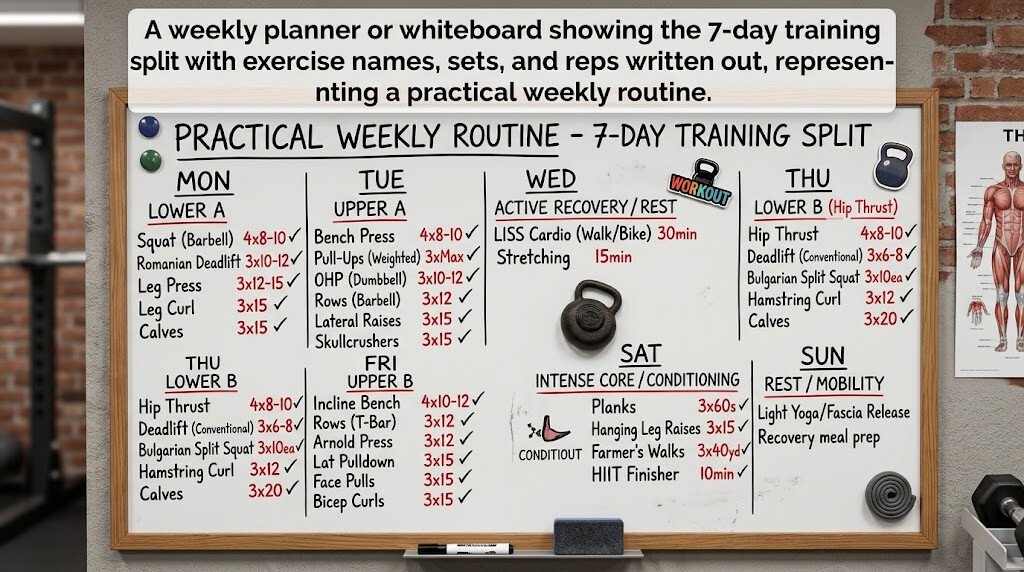
A Sample Weekly Routine for Men’s Stamina and Sexual Wellness
Here’s how to put it all together in a realistic week. Total time commitment: about 5–6 hours.
| Day | Focus | Details | Time |
| Mon | Strength A (lower + core) | Squat, RDL, lunges, knee raises, plank | 50 min |
| Tue | Zone 2 cardio | 35-min run, bike, or row | 40 min |
| Wed | Pelvic floor + mobility | 3 Kegel sets, 15-min hip/ankle mobility, 10-min breathing | 30 min |
| Thu | Strength B (upper + posterior) | Bench, rows, pull-ups, hip thrust, farmer’s carry | 50 min |
| Fri | Zone 2 cardio | 40-min walk, swim, or cycle | 45 min |
| Sat | HIIT + Zone 2 | 15-min HIIT (bike or rower) + 20-min easy cooldown | 40 min |
| Sun | Active recovery | 30-min walk, light stretching, or a casual sport | 30 min |
Progression (weeks 1–8):
- Weeks 1–2: Learn the movements, focus on form. Use lighter weights.
- Weeks 3–4: Add 5–10 lb (2–5 kg) to compound lifts. Extend zone 2 sessions by 5 minutes.
- Weeks 5–6: Add one more HIIT round. Progress Kegel holds to 7 seconds.
- Weeks 7–8: Add a 4th zone 2 session or extend one to 50 minutes. Test your resting heart rate and note improvements in recovery.
Safety Notes and Who Should Check With a Doctor First
- Cardiovascular history: If you have chest pain, dizziness, uncontrolled blood pressure, or a history of heart disease, get clearance from your physician before starting a new exercise program.
- Erectile changes as a warning sign: New or worsening erectile difficulties can be an early marker of cardiovascular disease. If you notice changes, see your doctor for a basic workup (blood pressure, lipid panel, fasting glucose) before assuming it’s “just stress.”
- Pelvic floor pain: If Kegels cause pain in the perineum, lower back, or testicles, stop and see a pelvic floor physical therapist. Over-tightening can be just as problematic as weakness.
- Medications: If you take blood pressure medications, anticoagulants, or any prescription that affects blood flow, talk to your doctor before adding high-intensity intervals or heavy lifting.
- Age considerations: Men over 50 should progress weights and cardio intensity more gradually and prioritize joint-friendly options (cycling, swimming, rowing over running).
If you’re managing a chronic condition, are post-surgical, or are over 65, a physical therapist or sports-medicine physician can tailor this plan to your specific needs.
F.A.Q.
How long should men exercise to improve stamina and sexual wellness?
Aim for at least 150 minutes of moderate cardio plus two 45–50 minute strength sessions per week, as outlined in the CDC physical activity guidelines. Most men notice improved breathing and recovery within 4–6 weeks, with more noticeable changes in sexual wellness by 8–12 weeks of consistent training.
Can cardio alone improve erectile function in men?
Aerobic exercise improves endothelial function and nitric oxide availability, which are directly involved in erectile physiology. A 2019 meta-analysis in the Journal of Sexual Medicine found that regular aerobic exercise was associated with improved erectile function scores, particularly in men with mild to moderate symptoms [VERIFY]. However, combining cardio with pelvic floor training and strength work gives you the most comprehensive benefit.
How do Kegel exercises help men’s stamina?
The pelvic floor muscles help trap blood in the erectile tissue during an erection and control the pace of ejaculation. Regular Kegel training (3 sets of 10, daily) strengthens these muscles, which can improve erection firmness, duration, and ejaculatory control. Most men feel a difference in 4–6 weeks of consistent practice.
What is the best single workout for male sexual wellness?
There’s no single “best” workout, but a lower-body compound movement like the barbell back squat or hip thrust, combined with 30 minutes of zone 2 cardio on the same or next day, hits the cardiovascular, muscular, and hormonal pathways that matter most. Pair it with daily pelvic floor work for the full picture.
How much sleep do men need for sexual health?
Aim for 7–9 hours of quality sleep per night. Research links less than 6 hours of sleep to lower testosterone, higher cortisol, and impaired vascular function. Consistent sleep timing matters as much as duration—try to go to bed and wake within a 30-minute window every day.
Does strength training really affect sexual performance?
Yes, indirectly but meaningfully. Heavy compound lifts stimulate acute testosterone and growth-hormone responses, improve insulin sensitivity, and build the lower-body endurance you need for physical stamina. Over time, better body composition from strength training also reduces the aromatization of testosterone to estrogen.
Conclusion
How can men improve stamina and sexual wellness naturally? The answer is a consistent, multi-pronged routine: 150+ minutes of zone 2 cardio, one HIIT session, two strength sessions focused on compound lower-body and core movements, daily pelvic floor training, 7–9 hours of sleep, and stress-management habits that keep your parasympathetic nervous system in the driver’s seat. You don’t need supplements, procedures, or a perfect body. You need a plan you’ll actually follow, progressive overload over weeks, and patience.
Start where you are this week. Pick two or three elements from the sample routine above, do them consistently for 8 weeks, and track how you feel—your resting heart rate, your recovery between sets, your energy at 3 p.m., and your confidence. The body responds to consistency far more than to intensity.
If you’re over 40 or managing a health condition, our guide on how to increase metabolism and energy naturally after 40 has additional training and lifestyle adjustments for that age range.