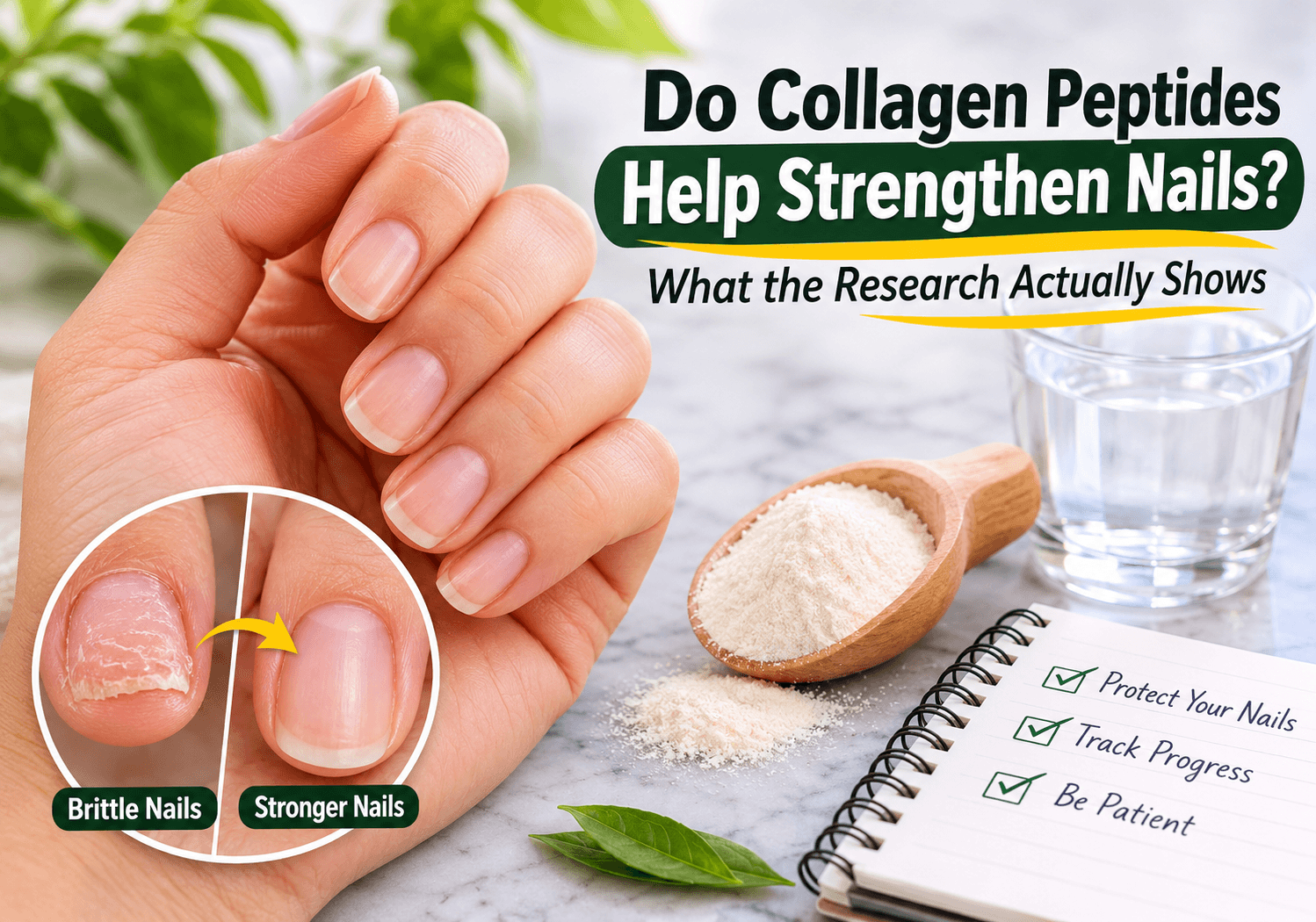
Do collagen peptides help strengthen nails, or is that just another promise from the supplement aisle? If your nails split, peel, or snag on a barbell, a tub of collagen powder can look like an easy fix. The honest answer is more interesting than a simple yes or no.
Here is what we know. One small clinical trial tested collagen peptides in people with brittle nails, and the results were encouraging. A lot of marketing has since been built on that single study. Meanwhile, basic nail care and a check for medical causes often matter more than any powder.
Think of this article the way a coach walks a client through a new supplement. What does the evidence say? How big is the possible upside? What could go wrong? How do you test it fairly on yourself? By the end, you will know whether a six-month collagen trial makes sense for you.
Because this topic involves supplements and your health, check with your doctor before starting anything new. That is especially true if you have a medical condition, take medicines, are pregnant or breastfeeding, or have nail changes you cannot explain.
Quick Answer Do collagen peptides help strengthen nails? Possibly. One small, open-label trial found that 2.5 g a day for 24 weeks was linked to faster nail growth and fewer broken nails in women with brittle nails. But there was no placebo group, and larger studies are missing. Treat collagen as a maybe, not a fix.
Why Nails Get Brittle in the First Place
Before you spend money on a supplement, it helps to know what you are trying to fix. Your nails are part of your skin. They are made of layers of the protein keratin and grow from the base of the nail, under the cuticle, according to Mayo Clinic. New cells form there, then harden and get pushed toward the fingertip.
Brittle nails are common. A 2019 review in Dermatology and Therapy reports that nail fragility affects up to 20% of the population, especially women over 50. It shows up more in fingernails than in toenails. Typical signs include nails that split, flake, crumble, or feel soft and lose their spring.
Doctors sort brittle nails into two broad groups. The first is idiopathic brittle nail syndrome, which means there is no clear cause. The second is nail fragility caused by something else, such as inflammatory nail disorders, infections, systemic diseases, injury, or changes in how much water the nail holds, the same review explains.
Everyday habits count too. Mayo Clinic notes that long soaks in water, frequent contact with cleaning chemicals, and acetone nail polish remover can all wear nails down.
That matters for our question. If your nails break because of hot dishwater, harsh cleaners, or an undiagnosed skin condition, a collagen powder may never touch the real cause. A good coach checks the basics before adding a new variable.
Coach’s Tip: Before you buy anything, track your nails for two weeks. Note when each break happens, what you were doing, and whether the damage is at the tip, along the sides, or in peeling layers. A pattern like “always after dishes” or “always after heavy grip work” points to a free fix.

Gym habits can add to the problem. Rough bar knurling can catch a nail edge, and frequent hand washing or sanitizer can leave hands and cuticles dry. Those are practical risks rather than study results, but they are the reason we start with protection.
Do Collagen Peptides Help Strengthen Nails? What the Research Says
The evidence comes down to one nail-specific trial, plus related research on skin. Here is how each piece fits.
The Key Trial: Hexsel et al., 2017
The main evidence for collagen peptides for nails is a 2017 trial in the Journal of Cosmetic Dermatology, led by Dr. Doris Hexsel and indexed on PubMed. It was an open-label, single-center study. That means the researchers and participants knew everyone was taking the supplement.
Twenty-five participants took 2.5 grams of a specific bioactive collagen peptide, a branded ingredient called VERISOL, once a day for 24 weeks. They then stopped for 4 weeks. A physician measured nail growth rate, how often nails cracked or chipped, and overall brittle-nail symptoms.
| What was measured | What the study reported |
| Nail growth rate | Increase of about 12% |
| Frequency of broken nails | Decrease of about 42% |
| Global clinical improvement in brittle nails | 64% of participants |
| Improvement 4 weeks after stopping | 88% of participants |
Those numbers sound impressive, so keep them in proportion. A 12% faster growth rate is a modest change. For most people, the practical win is the drop in breakage, because a nail that stops snapping keeps its length.
What the Trial Cannot Tell Us
A good coach is honest about limits. This study has several, and they matter when you decide how much to trust the result.
- It was small. Twenty-five people is a starting signal, not a verdict.
- It had no placebo group. When everyone knows they are taking something, expectations and extra care can change results. Nails also vary on their own over time. [VERIFY: confirm in the full text that there was no control arm.]
- It tested one product at one dose. The result applies to a specific peptide at 2.5 g a day. A generic powder with a different peptide profile may not behave the same way.
- The ingredient is branded. Some authors may be connected to the company that makes it. [VERIFY: check author affiliations and funding statement in the full text.]
- It has not been repeated in what we found. [VERIFY: search PubMed for newer randomized, placebo-controlled nail trials before publishing.]
Common Mistake: Reading “42% fewer broken nails” as a promise. It is the average result in a small, uncontrolled group. Your result could be bigger, smaller, or zero.
What About the Skin Studies?
Collagen has a much bigger research base for skin. A 2023 systematic review and meta-analysis in Nutrients pooled 26 randomized trials with 1,721 participants. It found that hydrolyzed collagen improved skin hydration and elasticity compared with placebo, in studies lasting 2 to 12 weeks. The authors also flagged biases in the included trials and called for larger studies.
An earlier meta-analysis of 19 trials with 1,125 participants reported favorable results for skin hydration, elasticity, and wrinkles, with about 90 days of use.
These findings are useful background. They suggest oral collagen is not a pure gimmick. But skin and nails are different tissues, so skin results cannot prove a nail benefit. They simply make the nail result more plausible.
Why Collagen Might Help (and Why We Are Not Sure)
Here is the catch: nails are mostly keratin, not collagen. So why would a collagen supplement help?
The trial authors proposed that digested collagen provides amino acids and small peptides that may act as signals for the tissue around the nail. [VERIFY: confirm this mechanism statement in the full text of Hexsel et al.] That is a hypothesis, not a proven pathway. Another simple possibility is that extra protein helps when your intake is low.
The brittle-nail review above notes that vitamins (especially biotin), trace elements, and amino acids (especially cysteine) have been reported as useful in idiopathic nail fragility. Collagen is not a rich source of cysteine, the sulfur-containing amino acid that keratin relies on. [VERIFY: confirm collagen’s amino acid profile with an NIH or university source.] This is one reason to keep expectations modest.
Do Collagen Peptides Help Strengthen Nails More Than Biotin?
Biotin (vitamin B7) is the other big name in nail supplements, so most readers want a direct comparison. The short version: neither has strong evidence, and they carry different risks.
| Option | What the evidence looks like | Main drawback |
| Collagen peptides | One open-label trial (25 people, 2.5 g a day, 24 weeks) with faster growth and fewer breaks | No placebo group; one branded product; ongoing cost |
| Biotin | Small studies, mostly older; true deficiency is rare | High doses can distort lab tests |
| Nail protection (gloves, moisturizer, acetone-free remover) | Standard self-care advice from Mayo Clinic | Needs a daily habit; results are gradual |
| Medical check | Treating the underlying cause is the first step when one exists | Requires an appointment |
The Biotin Problem Worth Knowing
The brittle-nail review lists biotin first among vitamins reported to be useful for idiopathic nail fragility. A review of the evidence for biotin in nail disease also notes that biotin deficiency is exceedingly rare. [VERIFY: confirm exact wording and the size of the older biotin studies in the full text.] Deficiency is one of the reasons the NIH Office of Dietary Supplements says most people get enough from food. [VERIFY: confirm the NIH adequate intake figure of 30 mcg per day for adults.]
The safety issue is the bigger story. The FDA has warned that biotin in supplements can cause falsely high or falsely low results on certain lab tests. The agency has noted supplements with 20 mg per pill, and some with up to 100 mg. That is a large amount compared with the daily adequate intake.
This connects to collagen in a sneaky way. Many “hair, skin, and nails” collagen blends add biotin. You might buy a collagen product and end up taking a high biotin dose without realizing it. Always read the supplement facts panel.
If you want to understand how vitamin gaps relate to energy and body function in general, our guide on which vitamins support metabolism when you are deficient covers the basics. For the wider picture of B vitamins in the body, see this overview of nutrients that support normal energy metabolism.
How to Test Collagen Peptides for Nails: A 6-Month Plan
If you decide to try collagen, treat it like a fair experiment. This is the same approach a coach uses when testing any new variable: change one thing, track it, and judge it on a schedule.
- Rule out medical causes first. If your nails changed suddenly, look different from usual, or come with pain or swelling, see your doctor before supplementing.
- Fix nail protection for 2 to 4 weeks. Wear gloves for dishes and cleaning products, use an acetone-free remover, and moisturize your nails and cuticles daily. Mayo Clinic recommends these steps.
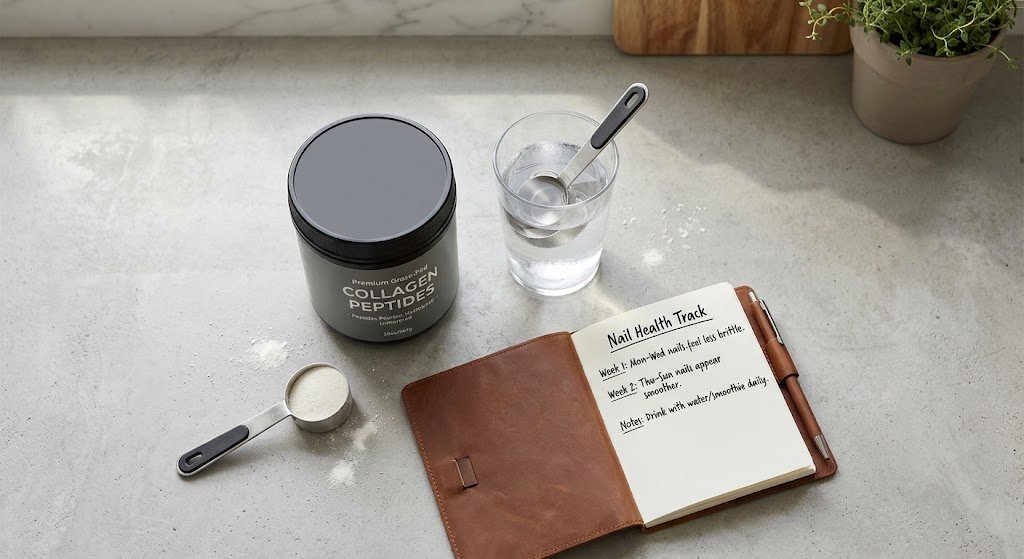
- Set a baseline. Take photos of your nails once a week in the same lighting. Count how many nails break each month and note any peeling.
- Choose a product with a clear label. Look for collagen peptides or hydrolyzed collagen, a stated grams-per-serving, and no hidden high-dose biotin.
- Anchor to the studied dose. The only nail trial used 2.5 g a day. I did not find evidence that larger amounts work better for nails.
- Take it daily at a time you will remember. There is no nail-specific research on the best time of day, so pick what you will stick with.
- Judge at 12 and 24 weeks. The trial ran 24 weeks, so plan on months, not days.
- Stop if nothing changes. No improvement after about 24 weeks means collagen is probably not your missing piece.
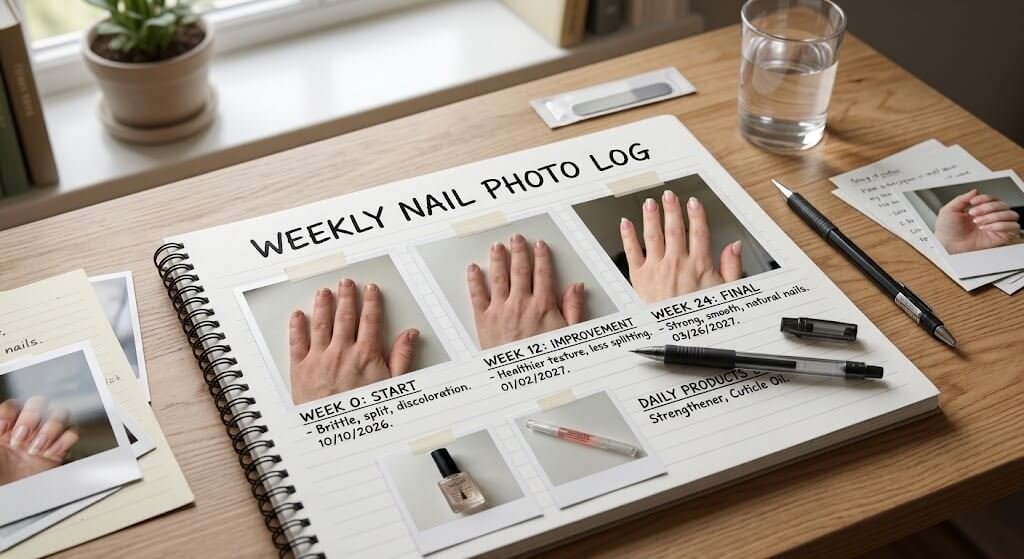
Coach’s Tip: Keep the tracking simple. A tally of breaks per month takes ten seconds and mirrors what the trial measured. If the tally drops and you also changed your hand-care habits, give yourself credit for both.
Common Mistake: Starting collagen, a new biotin gummy, a nail hardener, and a new hand cream in the same week. If your nails improve, you will not know why. If you get a reaction, you will not know the cause. Change one thing at a time.
What to Look for on the Label
Supplement labels can be confusing, and marketing claims are loud. Use this checklist before you buy.
- Form: “collagen peptides” or “hydrolyzed collagen,” not plain gelatin.
- Dose per serving: a clear number in grams, so you can compare it with the 2.5 g used in the trial.
- Source: bovine, porcine, or marine. This matters if you have allergies or dietary limits.
- Add-ins: check for biotin, vitamin C, and other extras, and note the amounts.
- Testing: a third-party testing seal is a good sign, though not a guarantee.
- Claims: be wary of “grows nails in days” or “repairs damage overnight.”
For a deeper walkthrough of reading supplement panels, see our coach’s guide to evaluating ingredients in supplements. It was written for weight-management products, but the label-reading method applies here too.
Do You Need More Protein Instead?
Collagen is a protein, so it is fair to ask whether you simply need to eat more protein overall. If you train hard or eat very little, your total intake matters for far more than nails. Our guide to protein intake and metabolism explains how to think about it. Nobody has shown that total protein fixes brittle nails, but it is a sensible thing to review.
Safety Notes: Who Should Be Careful
Supplements are not risk-free just because they are sold over the counter. Talk with your doctor or pharmacist first if any of these apply to you.
- You take medicines or have a medical condition. Your doctor can check for interactions and for causes of nail changes.
- You are pregnant or breastfeeding. Ask before starting any new supplement.
- You have food allergies. Collagen comes from animal or fish sources, so check the label for the source and for allergens.
- You will have blood work soon. Tell your clinic about any biotin, including biotin inside beauty blends. The FDA warns it can skew results.
- Your nails keep getting worse. Persistent fragility can be secondary to other conditions, as the brittle-nail review explains. A powder should never delay a medical evaluation.
Supplement quality also varies between brands, so a cautious approach pays off. Our overview of which supplements may support weight management safely shares a general safety mindset that carries over to any supplement decision.
Nail Care Habits That Do Most of the Work
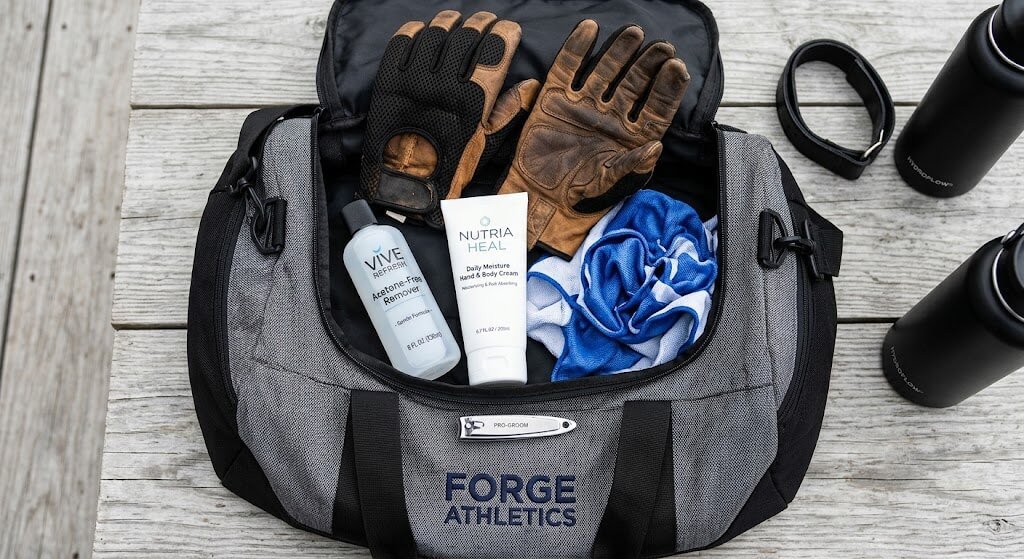
Here is the unglamorous truth: daily protection usually beats any capsule or powder. Mayo Clinic advises being as gentle as possible with your nails. It recommends wearing gloves for dishes and cleaning products, choosing an acetone-free polish remover, and using a daily moisturizer on nails and cuticles. It also says a product designed to harden nails can help them resist tearing and splitting. Keeping nails clean and dry, and not biting or picking at cuticles, helps prevent infection.
For lifters and gym-goers, a few extra habits help:
- Dry your hands fully after washing, then apply moisturizer.
- Keep nails trimmed so they do not catch on bar knurling, handles, or cable attachments.
- Wear gloves for chores that mean long contact with water or cleaning products.
Simple Version and Full Version
Simple version (start here): gloves for dishes, an acetone-free remover, and daily moisturizer on nails and cuticles. No supplement needed.
Full version (add on when ready): the simple routine, plus a nail hardener, plus the 6-month tracking plan above, plus a doctor visit if nothing improves.
When to See a Doctor About Brittle Nails
Brittle nails are often a nuisance rather than a danger. But nails can also reflect other health problems. Mayo Clinic notes that a doctor may do a more thorough evaluation to see whether weak nails are tied to an underlying issue, such as psoriasis, lichen planus, or dermatitis. The brittle-nail review adds that infections and systemic diseases can be behind nail fragility.
Book a visit if nails change color or shape, become thick or painful, separate from the nail bed, or keep getting worse despite good care. [VERIFY: confirm this red-flag list against a Mayo Clinic or NIH nail health page.] Bring a list of your supplements, including biotin.
FAQ: Collagen Peptides and Nails
How long does it take collagen to strengthen nails? In the main trial, people took collagen peptides for 24 weeks, and improvements were measured over that period. So plan on several months, not weeks. If you see no change after about 12 to 24 weeks, collagen probably is not the missing piece for you.
Is collagen or biotin better for nails? Neither has strong evidence. Collagen has one small open-label trial, while biotin has small, older studies and rarely corrects a true deficiency. The bigger difference is safety: high-dose biotin can distort lab tests, according to the FDA. Ask your doctor before choosing, and check labels before combining them.
How much collagen should I take for nails? The only nail trial used 2.5 grams of a specific collagen peptide daily. I did not find research showing larger doses work better for nails. Use the studied amount as your anchor, check your product’s serving size, and ask a doctor or pharmacist if you take medicines.
Can collagen make nails grow faster? In the 2017 trial, nail growth rate increased about 12% after 24 weeks. That is a modest change from a small, open-label study, so it is not a guarantee. Gentle nail care often matters more day to day, because fewer breaks means more length you actually keep.
Why are my nails still brittle if I take collagen? Brittle nails have many causes, including water exposure, chemicals, infections, skin conditions, and systemic illness. Collagen does not address those. Review your nail habits first, then ask a doctor to look for underlying issues if nails stay weak, change color or shape, or become painful.
Is collagen safe to take every day? The studies we reviewed used daily doses, but safety depends on you. Allergies to the animal or fish source, medicines, pregnancy, and other conditions all matter. Check the label for allergens and ask a doctor or pharmacist before starting, especially if you have a medical condition.
Conclusion: So, Do Collagen Peptides Help Strengthen Nails?
So, do collagen peptides help strengthen nails? Possibly, and the one nail trial we have is encouraging: faster growth and fewer broken nails over 24 weeks in a small group. But that study was open-label, had no placebo group, and tested one branded product. That is a reason for curiosity, not for big promises.
The coach’s plan is simple. Protect your nails first, rule out medical causes, and track a baseline. If you still want to try collagen peptides for nails, use the studied dose, change only one thing at a time, and judge the result at 12 and 24 weeks. If nothing changes, stop and put the money toward better hand care.