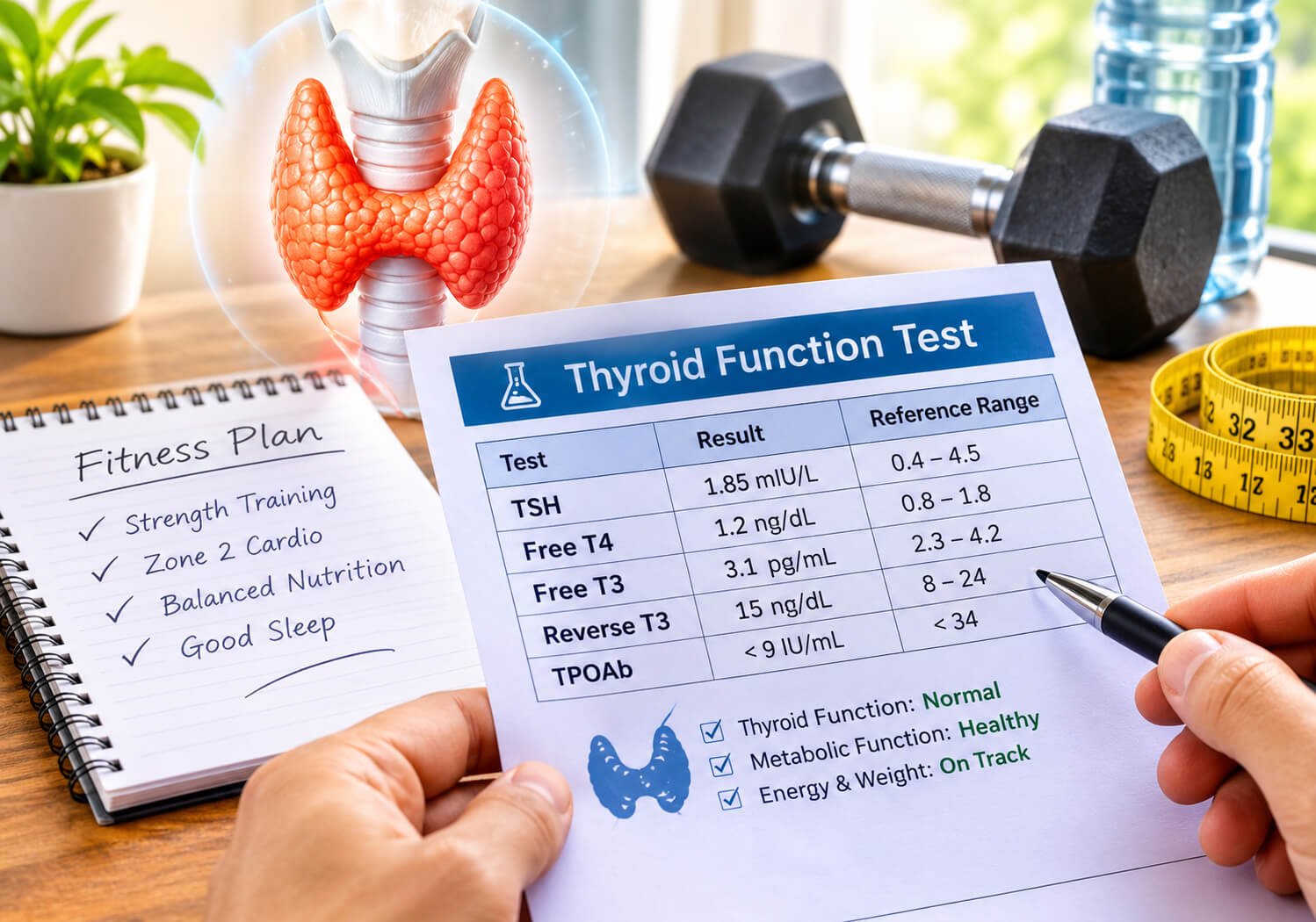
You are training hard four days a week, tracking your calories diligently, getting seven to eight hours of sleep, and yet the bathroom scale will not budge. To make matters worse, your energy crashes by mid-afternoon, your workout recovery feels unusually slow, and your limbs feel like lead during basic compound lifts. When progress halts despite solid adherence, many lifters and fitness enthusiasts ask their doctor for blood work.
Understanding your internal physiology is critical when external variables are tightly controlled. If your metabolic engine is idling low due to endocrine imbalances, no amount of standard caloric restriction will fix the root cause. This guide breaks down what a thyroid function test shows, how to interpret your lab markers, and how thyroid health directly shapes your fitness performance and body composition.
Quick Answer
A thyroid function test measures specific hormones—primarily Thyroid-Stimulating Hormone (TSH), Free T4 (Thyroxine), and Free T3 (Triiodothyronine)—in your bloodstream. It shows whether your thyroid gland is overactive (hyperthyroidism) or underactive (hypothyroidism). These results help explain unexplained weight changes, chronic fatigue, metabolic slowing, body temperature regulation issues, and poor recovery from exercise.
The Thyroid-Metabolism Connection: Why It Matters for Fitness
The thyroid is a butterfly-shaped endocrine gland located at the base of your neck. Despite weighing less than an ounce, it functions as the master thermostat for your body’s resting energy expenditure.Every cell in your body relies on thyroid hormones to regulate metabolic speed. According to research published in Physiological Reviews, thyroid hormones directly govern your basal metabolic rate (BMR), protein synthesis, enzyme activity, and cellular oxygen consumption (Yau & Yen, 2020).
When thyroid function drops, your body’s primary furnace slows down. This impacts how efficiently you convert food into usable ATP (energy), synthesize new muscle protein after heavy resistance training, and burn stored adipose tissue.
What Does a Thyroid Function Test Show? The Key Markers Explained
A standard blood draw does not look at just one variable. A complete panel evaluates the signaling pathway between your brain and your thyroid gland, alongside active circulating hormone levels.
| Lab Marker | Full Name | Physiological Role | What High Levels Indicate | What Low Levels Indicate |
| TSH | Thyroid-Stimulating Hormone | Pituitary signal instructing the thyroid to produce hormones | Hypothyroidism (underactive thyroid) | Hyperthyroidism (overactive thyroid) |
| Free T4 | Free Thyroxine | Main storage hormone produced directly by the thyroid gland | Overactive thyroid output | Underactive thyroid or poor production |
| Free T3 | Free Triiodothyronine | Active hormone that binds to cellular receptors to drive metabolism | Hyperthyroidism, high metabolic output | Sluggish conversion, metabolic adaptation |
| Reverse T3 | Reverse T3 (rT3) | Inactive mirror image of T3; blocks active T3 receptors | High stress, severe caloric deficits, overtraining | Normal metabolic state |
| TPOAb | Thyroid Peroxidase Antibodies | Immune system markers targeting thyroid tissue | Autoimmune thyroid disease (e.g., Hashimoto’s) | Normal immune profile |

1. Thyroid-Stimulating Hormone (TSH)
TSH is produced by the pituitary gland in your brain. Think of TSH as the brain shouting at the thyroid to wake up and work.
- High TSH: Indicates your brain is sending strong signals because circulating thyroid hormone levels are too low (Hypothyroidism).
- Low TSH: Suggests circulating hormone levels are high, so your brain stops signaling (Hyperthyroidism).
2. Free T4 (Thyroxine)
T4 is the primary pro-hormone released by your thyroid gland. It circulates bound to proteins, but the “Free” portion is unbound and available for tissue conversion. T4 itself is relatively inactive; it must lose an iodine molecule in peripheral tissues (like your liver and skeletal muscle) to become active T3.
3. Free T3 (Triiodothyronine)
Free T3 is the active driver of cellular thermogenesis and metabolic rate. It binds to receptors inside your mitochondria, driving metabolic processes. If your Free T3 drops, energy expenditure drops, and fatigue sets in regardless of TSH levels.
4. Reverse T3 (rT3)
Under conditions of extreme physical stress, severe caloric restriction, or chronic overtraining, the body converts T4 into Reverse T3 instead of active Free T3. Reverse T3 binds to the same cellular sites as T3 but acts as a brake, preventing active metabolism to conserve energy.
How Thyroid Function Affects Weight Loss, Muscle, and Energy
Understanding what affects metabolism and body weight requires looking closely at thyroid hormones.
Thyroid and Fat Loss
If your thyroid function test reveals low TSH responsiveness or low Free T3, your resting daily caloric burn drops. Research in Endocrine Reviews demonstrates that even subtle variations in thyroid hormones within the standard normal range correlate with changes in body mass index and resting metabolic rate (Mullur et al., 2014). When thyroid activity drops, your total daily energy expenditure (TDEE) decreases, making a standard energy deficit far less effective.
Muscle Building and Protein Synthesis
Thyroid hormones work synergistically with growth hormone and IGF-1 to stimulate muscle tissue repair. Low active T3 reduces the rate of cellular protein synthesis. This means longer muscle soreness (DOMS) after squat or deadlift sessions, reduced work capacity, and potential muscle loss during cutting phases.
Daily Energy and Workout Recovery
Thyroid hormones help maintain cardiac output and muscular contraction speed. When T3 is sub-optimal, you may experience:
- Lethargy during early morning training sessions.
- Rapid fatigue under standard working loads (e.g., 3 sets of 8 reps at 70% 1RM).
- Brain fog, cold hands/feet, and sluggish intestinal motility.
Interpreting Your Results: Hypothyroidism vs. Hyperthyroidism
When you receive your lab reports, your doctor will evaluate your numbers against reference ranges. Here is how metabolic symptoms typically align with laboratory outcomes:Coach’s Tip: The Overtraining & Dieting Trap
Aggressive caloric deficits combined with high-volume cardio can suppress peripheral conversion of T4 to active T3, driving up Reverse T3. If you have been dieting on 1,200 calories per day while performing heavy conditioning and your scale is stuck, your low energy may be driven by metabolic adaptation rather than lack of effort. You cannot out-train a suppressed thyroid signal.
What to Do If Your Thyroid Function Test Results Show Imbalances
If your thyroid function test shows low active hormone levels or elevated TSH, work alongside an endocrinologist or primary care physician. Here is how to adjust your training and nutrition variables while managing thyroid health:
1. Adjust Your Training Volume and Intensity
When thyroid markers are sub-optimal, your recovery bandwidth shrinks. Continuing to push high-intensity functional workouts or extreme volume will only elevate cortisol, further suppressing T3 conversion.
- Prioritize Low-Impact Strength: Focus on basic heavy compound lifts with lower total sets and longer rest intervals (2 to 3 minutes).
- Limit Excessive HIIT: Swap daily high-intensity intervals for moderate Zone 2 aerobic work (walking, light cycling).
- Track Recovery Markers: Monitor morning resting heart rate and heart rate variability (HRV).
2. Avoid Aggressive Caloric Deficits
Prolonged, severe caloric deficits tell the brain to conserve energy, downregulating T3 production.
- Implement periodic diet breaks at maintenance calories every 4 to 8 weeks during weight management phases.
- Ensure adequate carbohydrate intake; carbohydrates support the hepatic conversion of T4 into active T3 (Spaulding et al., 1976).
- Read our complete guide on how to support metabolism naturally for weight management to avoid severe metabolic adaptation.
3. Focus on Key Dietary Micronutrients
The thyroid gland relies on specific dietary minerals for hormone synthesis and activation:
- Iodine: Essential structural component of T3 and T4 molecules.
- Selenium: Required by deiodinase enzymes to convert T4 into active Free T3.
- Zinc: Supports TSH secretion and thyroid hormone production.
Common Mistake: Blindly Supplementing High-Dose Iodine
Many people assume that taking high-dose kelp or iodine supplements will automatically fix a slow thyroid. However, excessive iodine intake can actually trigger or worsen thyroid gland inflammation in individuals with underlying autoimmune conditions like Hashimoto’s. Never start high-dose iodine protocols without clinical testing.
4-Week Thyroid-Friendly Strength & Recovery Routine
This 4-week training structure is designed to preserve lean muscle mass while keeping systemic stress manageable for individuals dealing with mild fatigue, thyroid recovery phases, or metabolic adaptation.
Weekly Schedule Overview
- Monday: Upper Body Strength (Moderate Volume)
- Tuesday: Zone 2 Cardio & Mobility (30 min)
- Wednesday: Lower Body Strength (Moderate Volume)
- Thursday: Active Recovery / Complete Rest
- Friday: Full Body Compound Strength
- Saturday: Light Outdoor Walking (45 min)
- Sunday: Complete Rest

Workout Routine Table
| Exercise | Sets | Reps | Rest Period | Tempo | Target Load |
| Goblet Squat | 3 | 8-10 | 120 sec | 3-0-1-0 | Moderate (~60-70% 1RM) |
| Dumbbell Romanian Deadlift | 3 | 8-10 | 120 sec | 3-1-1-0 | RPE 7 (3 reps in reserve) |
| Neutral Grip DB Bench Press | 3 | 10-12 | 90 sec | 2-0-1-0 | Moderate |
| Lat Pulldowns or Inverted Rows | 3 | 10-12 | 90 sec | 2-1-1-1 | Focus on upper back squeeze |
| Standing DB Overhead Press | 2 | 12-15 | 60 sec | 2-0-1-0 | Light to moderate |
| Pallof Press (Core) | 3 | 12 per side | 60 sec | Hold 2s | Controlled cable/band tension |
Frequently Asked Questions
Can a thyroid test explain why I can’t lose weight?
Yes. A thyroid function test shows whether low levels of Free T3 or high TSH are reducing your basal metabolic rate. If your thyroid is underactive, your daily energy expenditure decreases, making weight loss difficult even in a calorie deficit.
Why is my thyroid test normal if I still feel constantly exhausted?
“Normal” reference ranges in standard blood panels are wide. Your TSH may sit at the high end of normal (e.g., 4.0 mIU/L), which can still cause symptoms in sensitive individuals. Additionally, stress, poor sleep, low ferritin, or vitamin deficiencies can mirror thyroid fatigue.
What are normal TSH levels for weight loss?
Clinical reference ranges for TSH generally span 0.4 to 4.5 mIU/L. Many functional medicine specialists and endocrinologists note that individuals often feel best and maintain optimal metabolic output when TSH sits between 1.0 and 2.0 mIU/L, though individual baseline needs vary.
What is the difference between T3 and T4?
T4 (thyroxine) is the inactive storage hormone produced directly by the thyroid gland. T3 (triiodothyronine) is the active hormone created when T4 loses an iodine atom in peripheral tissues. T3 is responsible for regulating your cellular energy expenditure.
How often should I get my thyroid checked if I have symptoms?
If you have symptoms of hypothyroidism or hyperthyroidism, request a full thyroid panel (TSH, Free T4, Free T3, TPO antibodies) from your doctor. If you are starting or adjusting thyroid medication, tests are typically re-checked every 6 to 8 weeks.
Can severe dieting or overtraining cause a abnormal thyroid test?
Yes. Chronic heavy exercise combined with low caloric availability suppresses the pituitary-thyroid axis, lowering Free T3 and elevating Reverse T3. This is a survival mechanism designed to prevent energy depletion during stress.
Conclusion
Understanding what a thyroid function test shows gives you real clarity when fitness progress stalls. Rather than cutting calories further or adding more cardio sessions, interpreting your TSH, Free T4, and Free T3 markers helps you address the root cause of fatigue and weight plateaus. Work alongside your medical physician to evaluate your lab work, adjust your training stress, and adopt an evidence-based approach to metabolic health.