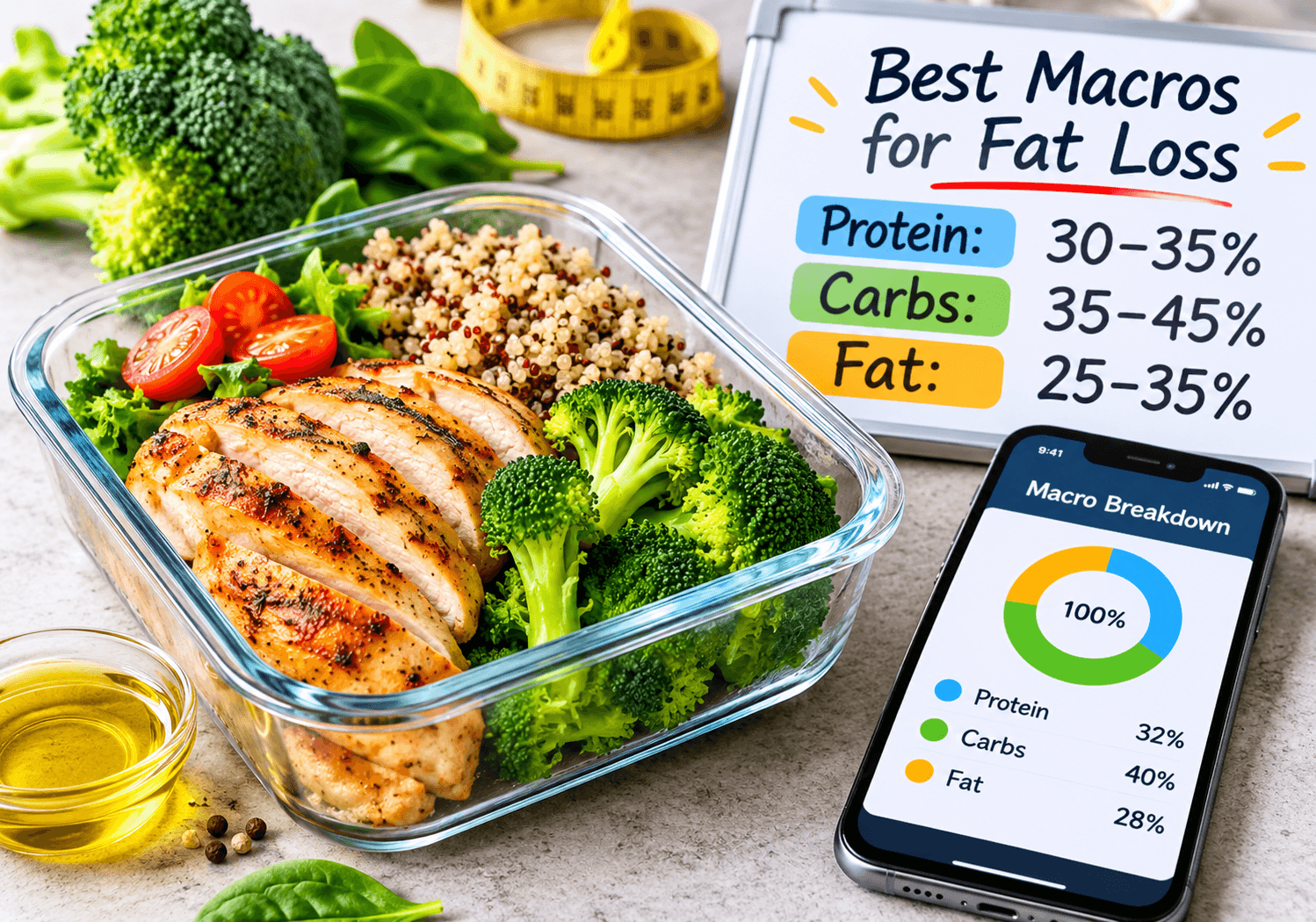
You’ve been counting calories for weeks, but the scale barely moved. You’re eating “clean,” yet you still feel hungry by 3 p.m. and your strength in the gym is slipping. Here’s the thing most people miss: best macros for fat loss aren’t about picking one magic ratio. They’re about finding the right balance of protein, carbs, and fat that keeps you full, protects your muscle, and makes a caloric deficit sustainable for months—not just a few hard weeks.
I’ve coached hundreds of clients through cutting phases, and the number one reason people stall isn’t a bad workout. It’s a macro split that leaves them starving, sluggish, or losing the very muscle they’re trying to show off. This guide breaks down what actually works, with specific numbers you can plug in today.
QUICK ANSWER
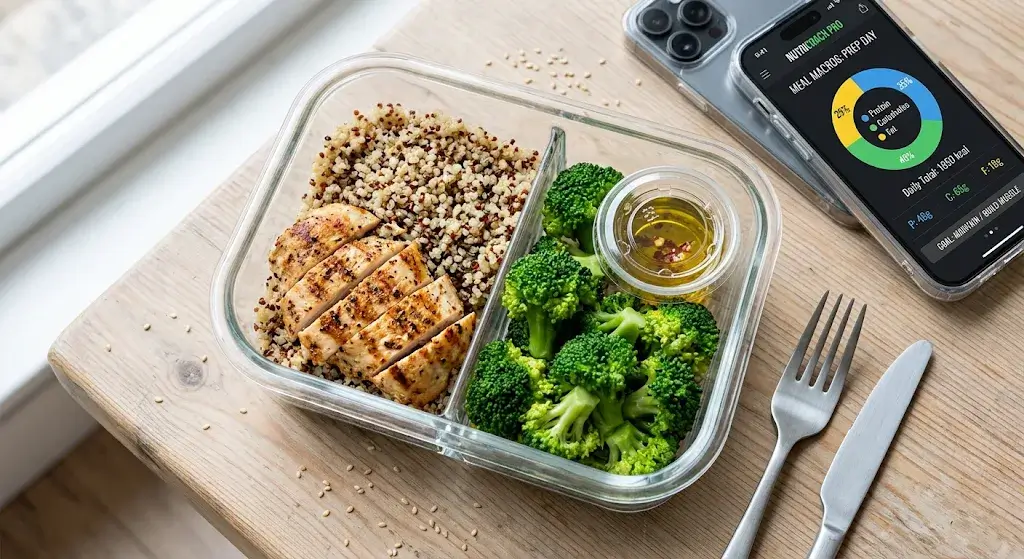
The best macros for fat loss are roughly 30–35% protein, 35–45% carbs, and 25–35% fat, built around a 15–25% caloric deficit. Protein should hit 0.7–1 g per lb of bodyweight (1.6–2.2 g/kg) to protect lean mass. Adjust carbs and fat based on your training volume and hunger.
What the Research Says About Macros and Fat Loss
The Caloric Deficit Comes First
Before you worry about splitting your plate into exact percentages, understand one non-negotiable: fat loss requires you to consume fewer calories than you burn. The CDC’s physical activity and nutrition guidance reinforces that energy balance drives body composition change. No macro ratio overrides a consistent deficit.
That said, how you split those calories changes your experience dramatically. Two people eating 1,800 calories a day can feel completely different if one gets 120 g of protein and the other gets 60 g. The higher-protein person typically feels fuller, preserves more muscle, and has a slightly higher resting burn.
Protein: The Non-Negotiable
Protein is the macro you should lock in first when cutting. The Dietary Guidelines for Americans 2020–2025 set a broad range of 10–35% of calories from protein, but for someone in a caloric deficit who’s still training, the lower end won’t cut it.
Research consistently shows that higher protein intake during a deficit helps preserve lean body mass. A meta-analysis published in the American Journal of Clinical Nutrition found that protein intakes of 1.6 g/kg/day (about 0.7 g/lb) were associated with greater fat loss and less lean-mass loss compared to lower intakes [VERIFY]. The American College of Sports Medicine (ACSM) recommends that active individuals aim for 1.4–2.0 g/kg/day to support muscle maintenance and repair.
Protein also has the highest thermic effect of food of the three macros. Your body spends roughly 20–30% of the calories in protein just digesting it, versus 5–10% for carbs and 0–3% for fat. That means a 30 g chicken breast costs your body about 6–9 extra calories to process compared to the same calories from fat.
On top of that, protein is the most satiating macronutrient. It blunts the hunger hormones ghrelin and increases fullness signals like PYY and GLP-1, which is why people on higher-protein diets report less snacking between meals. If you want to understand the hormonal side of this, I wrote a deeper breakdown in how protein intake affects hunger and fullness hormones.
Carbs: Fuel for Training
Carbs get a bad reputation during cutting, but slashing them to 30 g a day is a recipe for poor training performance and irritability. Your muscles and central nervous system rely on glycogen (stored carb) for high-intensity work. Without enough fuel, your squats feel heavy, your sprints feel short, and your recovery slows.
The sweet spot for most people in a deficit is 35–45% of calories from carbs, with the bulk of those carbs timed around your training window. If you lift at 6 p.m., that’s when you want your oatmeal, rice, or sweet potato. A lighter carb intake on rest days (maybe 20–25% of calories) can help widen the deficit without making you feel starved.
Fiber is a sub-category of carbs that deserves its own mention. Soluble fiber slows digestion, flattens blood-sugar spikes, and extends fullness. The research on dietary fiber and appetite suggests that 25–30 g of fiber per day supports better satiety and more stable energy. Aim for vegetables, legumes, and whole grains to hit that number without adding a ton of calories.
Fats: Hormone Support and Satiety
Dietary fat keeps your hormones functioning properly. Testosterone, estrogen, cortisol, and thyroid hormones all require cholesterol and fatty acids as building blocks. Dropping below 20% of calories from fat (or below roughly 40 g/day for most women and 50 g/day for most men) can disrupt these systems.
Fat also slows gastric emptying, which means you feel full longer after a meal. A small drizzle of olive oil on your salad or a quarter-avocado on toast adds 15–20 g of fat that keeps you satisfied until your next meal.

Macro Ratios for Fat Loss: A Practical Breakdown
Here’s a simple table you can screenshot and keep on your phone. These ranges work for most adults in a moderate caloric deficit (15–25% below maintenance) who are still doing resistance training.
| Macro | % of Calories | Grams (per 1,800 cal/day) | Grams (per 2,200 cal/day) | Why This Range |
| Protein | 30–35% | 135–157 g | 165–192 g | Protects lean mass, maximizes satiety, highest thermic effect |
| Carbs | 35–45% | 157–202 g | 192–247 g | Fuels training, supports recovery, prevents irritability |
| Fat | 25–35% | 50–70 g | 61–86 g | Hormone support, satiety, nutrient absorption |
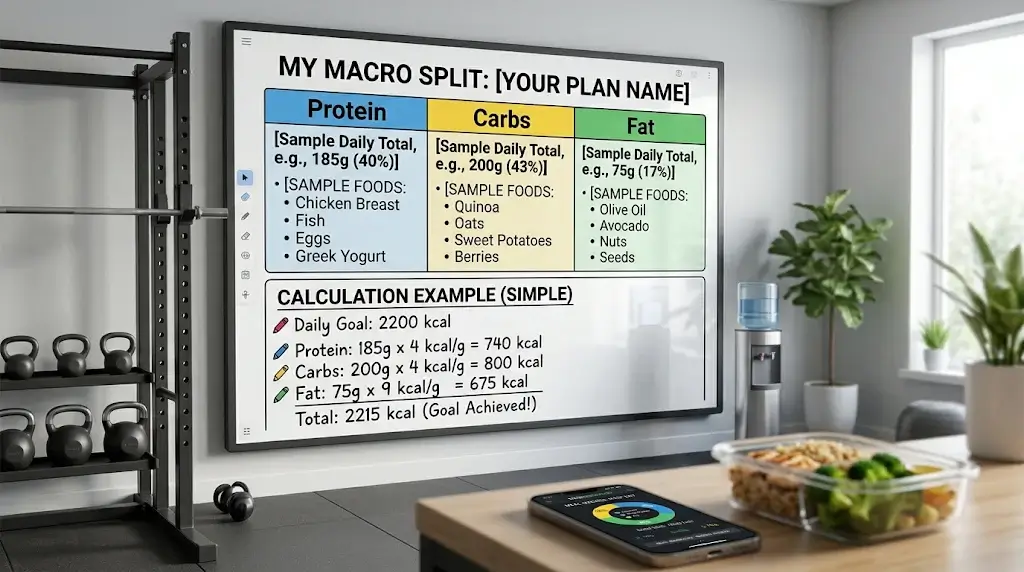
How to read this: If you’re a 160-lb (73 kg) woman cutting at 1,800 calories, you’d target roughly 140 g protein, 175 g carbs, and 60 g fat. A 190-lb (86 kg) man cutting at 2,200 calories might aim for 180 g protein, 220 g carbs, and 75 g fat.
COACH’S TIP
Don’t obsess over hitting exact grams every single day. Aim for your targets on a weekly average. If you eat 150 g protein Monday through Friday and 130 g on the weekend, your weekly average is still solid. The stress of tracking to the gram often makes people quit the whole process.
How to Calculate Your Macros for Fat Loss (Step-by-Step)
You don’t need a nutrition degree. Here’s the process I walk clients through:
- Find your maintenance calories. Use a TDEE calculator as a starting point, then adjust based on 1–2 weeks of weighing your food and tracking the scale. If the scale is flat, you’re at maintenance. A more detailed look at what affects metabolism and body weight can help you understand why your number might be higher or lower than the calculator says.
- Set your deficit. Subtract 15–25% from your maintenance number. For a 2,400-calorie maintenance, that’s 1,800–2,040 calories. A 20% deficit is a good default.
- Lock in protein first. Multiply your bodyweight in pounds by 0.7–1.0. A 160-lb person targets 112–160 g protein. A 200-lb person targets 140–200 g. Convert to calories (protein × 4) and subtract from your total.
- Set fat at 25–30% of remaining calories. Multiply your total calories by 0.25–0.30, then divide by 9 (calories per gram of fat). This keeps you in a safe hormonal range.
- Fill the rest with carbs. Whatever calories are left after protein and fat go to carbs. Divide by 4 to get grams.
- Adjust after 2 weeks. If you’re losing more than 1% of bodyweight per week, you might be in too big a deficit—bump carbs up by 20–30 g. If the scale isn’t moving, trim 10–15 g of carbs or fat.
Easier Version (No App Needed)
If a macro-tracking app feels overwhelming, use the hand method as a rough guide:
- Protein: 3–4 palm-sized portions of lean meat, fish, tofu, or Greek yogurt per day.
- Carbs: 1–2 fist-sized portions of starchy food (rice, potatoes, oats) per day, more on training days.
- Fat: 1–2 thumb-sized portions of oil, nuts, or avocado per day.
This won’t be as precise as an app, but it gets you in the right ballpark and removes the mental load.
Harder Version (Precision Tracking)
For competitive athletes or anyone who wants tighter control, use a tracker like MyFitnessPal or Cronometer. Log every food for 14 days. Calculate your weekly average for each macro. Compare against the table above and adjust one variable at a time.
Sample Daily Meal Plan for Fat Loss (1,800 Calories)
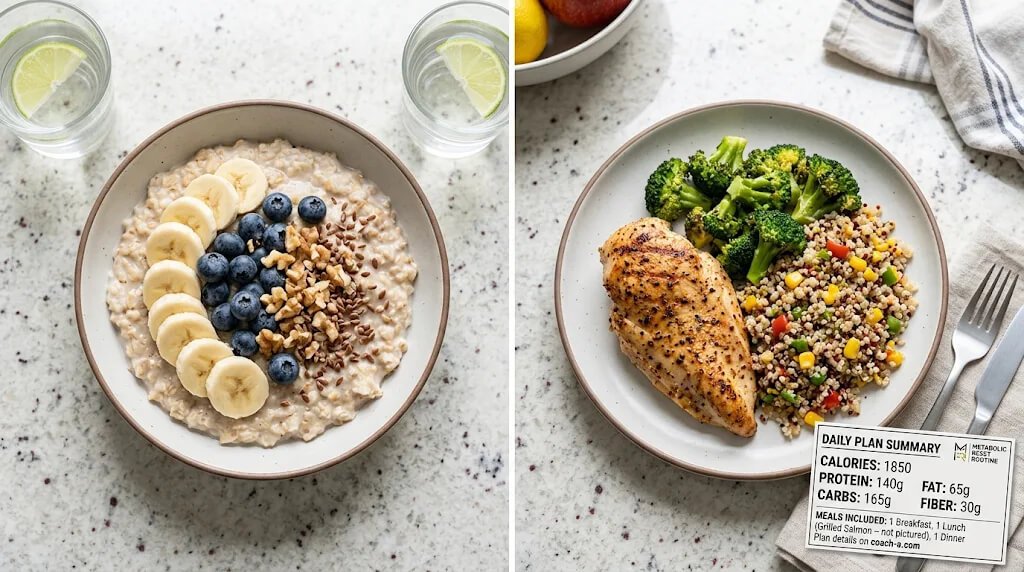
Here’s what a day looks like for a 160-lb woman hitting roughly 140 g protein, 170 g carbs, and 60 g fat:
| Meal | Food | Protein | Carbs | Fat |
| Breakfast | 3 whole eggs + 2 egg whites scrambled with spinach; 1 slice whole-grain toast | 28 g | 12 g | 14 g |
| Lunch | 6 oz grilled chicken breast; ¾ cup cooked quinoa; large mixed salad with 1 tbsp olive oil vinaigrette | 45 g | 38 g | 10 g |
| Snack | ¾ cup plain Greek yogurt (2%); ½ cup mixed berries; 10 almonds | 20 g | 15 g | 8 g |
| Dinner | 6 oz baked salmon; 1 medium sweet potato; steamed broccoli with lemon | 42 g | 35 g | 14 g |
| Pre-bed (optional) | 1 scoop whey protein in water | 25 g | 3 g | 1 g |
| Totals | ~160 g | ~103 g | ~47 g |
Note: Add an extra 50–70 g of carbs (a banana, a small rice bowl, or a serving of oats) on heavy training days to hit the 170 g target. The exact numbers will shift based on your bodyweight and activity level.
Common Mistakes With Fat Loss Macros
COMMON MISTAKE
Cutting protein to “save calories” for more carbs. I see this constantly. Someone on a 1,800-calorie plan drops protein to 90 g to fit in a bigger bowl of pasta. Within three weeks, their strength drops, they feel hungrier, and they lose a mix of fat and muscle. Fix: protect your protein target first. If you need more carbs, take them from fat, not protein.
Other mistakes I see regularly:
- Going too low on fat. Below 40–50 g/day, you risk hormonal disruption, dry skin, and poor absorption of vitamins A, D, E, and K.
- Ignoring fiber. If your carbs are all white rice and bread, you’ll be hungry 90 minutes after eating. Swap in vegetables, beans, and whole grains.
- Not adjusting for training days. You burn more on a heavy leg day. Eating the same 150 g carbs on a rest day and a 90-minute HIIT session is a mismatch.
- Tracking alcohol as “zero.” A 16-oz (473 ml) IPA is roughly 200 calories of “empty” energy that displaces protein and fiber. If you drink, count it.
- Expecting the scale to move every day. Water fluctuation, sodium intake, and training-induced inflammation can mask fat loss for 5–7 days. Track a weekly average, not a daily number.
Safety Notes and When to See a Professional
A moderate caloric deficit with balanced macros is safe for most healthy adults. However, check with a doctor or registered dietitian before starting a cutting phase if you:
- Have a history of disordered eating or a diagnosed eating disorder
- Are managing a metabolic condition (diabetes, thyroid disorder, PCOS)
- Are pregnant, postpartum, or breastfeeding
- Are under 18 or over 65 with chronic health conditions
- Are taking medications that affect appetite, blood sugar, or nutrient absorption
If you’re a woman over 40, hormonal shifts can make a standard macro split less effective. You may need to lean harder on protein and resistance training to counteract the natural decline in muscle mass. A practical guide for that phase is available in how to increase metabolism naturally after 40.
Red flags to stop and get medical advice: dizziness, heart palpitations, extreme fatigue, hair loss, or a rapid drop of more than 2% bodyweight per week.
Related Tips for Better Results
Macros are the engine, but a few supporting habits make the whole system run smoother:
- Pair your cut with resistance training. You can lose fat on a deficit with zero exercise, but adding 2–3 sessions of compound lifts (squats, deadlifts, rows, presses) per week tells your body to keep the muscle. The ACSM’s position stand on resistance training recommends 2–3 full-body sessions per week for general health, and that minimum applies even more during a cut.
- Don’t skip your warm-up. Five to ten minutes of light cardio and dynamic stretches before lifting reduces injury risk, which matters when you’re already in a deficit and recovering slower.
- Sleep 7–9 hours. Poor sleep raises cortisol and ghrelin (the hunger hormone) and lowers leptin (the fullness hormone). That makes your macro targets harder to hit because you’re genuinely hungrier. Understanding how sleep affects metabolism and weight management can help you prioritize rest as seriously as your meal plan.
- Walk more. Adding 7,000–10,000 steps a day (roughly 3–5 miles / 5–8 km) of low-intensity walking can add 200–400 calories of expenditure without the fatigue that makes you overeat at dinner.
- Refeed strategically. Once a week, bump carbs to maintenance for a single meal or day. This can help reset leptin, reduce psychological stress, and keep your training performance sharp. Boosting metabolic flexibility without crash dieting covers this in more detail.
- Track your hunger, not just your weight. If you’re consistently ravenous by 3 p.m., your protein or fiber is probably too low. If you’re constantly tired, your carbs might be too low. Your body gives you data—use it.
For a broader look at what helps control hunger during weight loss, the protein-and-fiber combination is the most evidence-backed strategy.
FAQ
What are the best macro ratios for fat loss?
Aim for 30–35% protein, 35–45% carbs, and 25–35% fat within a 15–25% caloric deficit. Protein should hit 0.7–1 g per lb of bodyweight. Adjust carbs and fat based on your training volume, hunger, and how you feel after two weeks.
Should I cut carbs or fats to lose weight?
Neither is the “right” answer. Cutting protein is the real mistake. If you need to reduce calories, trim fat first (it’s 9 cal/g vs. 4 for protein and carbs), then reduce carbs on rest days. Keeping carbs around your training window preserves performance and mood.
How much protein do I need per day for fat loss?
Target 0.7–1.0 g per pound of bodyweight (1.6–2.2 g/kg). A 150-lb (68 kg) person aims for 105–150 g; a 200-lb (91 kg) person aims for 140–200 g. Spread it across 3–5 meals to maximize muscle protein synthesis throughout the day.
Do macros matter more than total calories for fat loss?
No. Total calories determine whether you lose, maintain, or gain weight. Macros determine how you feel, how much muscle you keep, and how sustainable the deficit is. A 1,800-calorie day with 140 g protein will outperform a 1,800-calorie day with 70 g protein in every metric that matters.
What macros should I eat on rest days vs. training days?
On training days, keep carbs at the higher end of your range (40–45% of calories) to fuel your session. On rest days, drop carbs to 30–35% and shift those calories toward protein and fat. This “carb cycling” approach helps widen the deficit without making you feel under-fueled on hard days.
Can I lose fat without tracking macros?
Yes, if you use portion control (the hand method), prioritize protein at every meal, eat fiber-rich vegetables, and maintain a consistent caloric deficit. Tracking is a tool, not a requirement. If it stresses you out, the hand method plus 2–3 weekly weigh-ins is a perfectly valid alternative.
Conclusion
The best macros for fat loss aren’t a one-size-fits-all formula printed on a supplement label. They’re a practical framework: protect your protein, fuel your training with enough carbs, keep your fats in a range that supports your hormones, and build it all inside a moderate caloric deficit. Start with the 30/40/30 split (protein/carbs/fat), adjust one variable at a time every two weeks, and listen to your hunger, energy, and strength in the gym.
You don’t need a perfect plan. You need a good enough plan you can stick to for 12–16 weeks. That consistency, paired with regular resistance training and enough sleep, is what actually changes your body composition. Grab a pen, run the numbers from the step-by-step section above, and start tracking tomorrow. Your future self will thank you when you step on the scale and see the trend line finally pointing down.