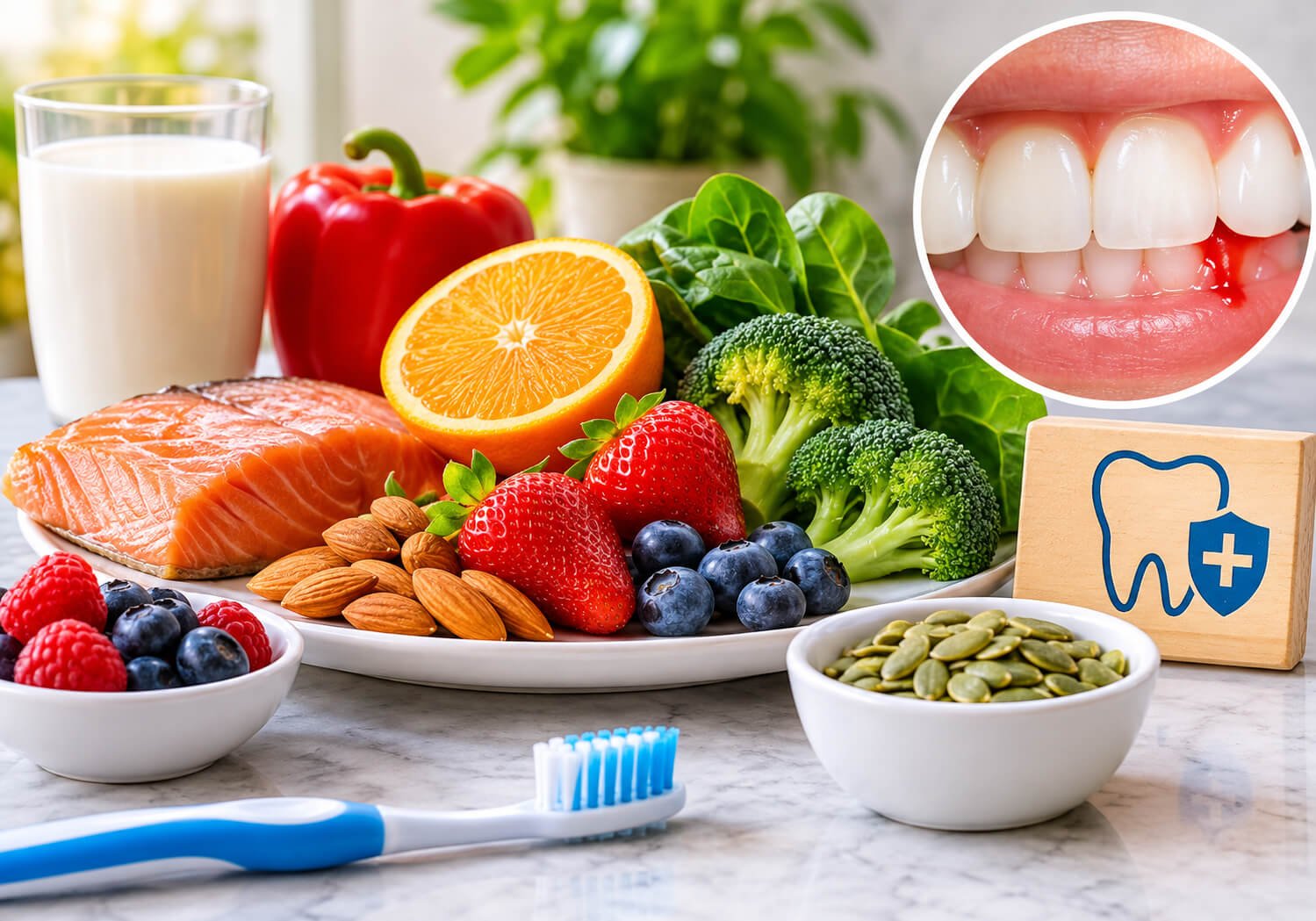
Bleeding gums are one of the most common complaints I hear from clients who think they’re “just getting older.” In most cases, the cause is plaque buildup or a missed dental cleaning. But a growing body of research points to a second, often overlooked factor: your nutrient intake. The right vitamins and minerals for bleeding gum health can strengthen the tissue that holds your teeth, support the small blood vessels in your gums, and keep your immune system from overreacting to the bacteria that live in your mouth.
This guide breaks down exactly which nutrients matter, how much you need, where to get them from food, and when a supplement makes sense. No jargon, no hype—just practical information you can use at your next grocery run or pharmacy visit.
Quick Answer
The most important vitamins and minerals for bleeding gum health are vitamin C (supports collagen and capillary strength), vitamin K (helps blood clot properly), vitamin A (maintains gum mucosa), and the B-vitamin complex (reduces inflammatory response). Key minerals include iron, zinc, calcium, and magnesium. Getting adequate amounts through a varied diet is the first step; supplements fill gaps when dietary intake falls short.
Why Gums Bleed: The Nutrition Connection
Healthy gums are made of connective tissue, small blood vessels, and a protective mucosal lining. When any of those structures weakens, even gentle brushing can cause bleeding.
Three things drive most gum bleeding:
- Inflammation. Bacteria in dental plaque trigger an inflammatory response. If your body lacks the antioxidants and anti-inflammatory nutrients to keep that response in check, the gums swell and bleed more easily.
- Weak collagen. The connective tissue that anchors your teeth and lines your gums is built from collagen. Without enough vitamin C, zinc, and copper, collagen synthesis slows, and the tissue becomes fragile.
- Poor clotting and repair. After minor damage (a hard brush, a piece of food), your gums need to seal the wound. Vitamin K, iron, and several B vitamins support that repair cycle.
The World Health Organization identifies poor nutrition as a contributing factor to periodontal disease alongside tobacco use and uncontrolled diabetes. In other words, your plate matters just as much as your toothbrush.
The Key Vitamins for Bleeding Gum Health
Vitamin C (Ascorbic Acid)
Vitamin C is the single most studied nutrient in periodontal research. It is a required cofactor for collagen synthesis—the process that builds the structural protein holding your gum tissue together. It also acts as a potent antioxidant, neutralizing the free radicals produced when immune cells attack gum bacteria.
Why it matters for bleeding gums: A deficiency in vitamin C weakens capillaries (the tiny blood vessels in your gums), making them rupture with minimal pressure. Severe deficiency causes scurvy, a condition where gums bleed profusely and teeth loosen. Even mild, subclinical deficiency can increase gum bleeding and slow healing after a dental procedure.
How much you need: The recommended dietary allowance (RDA) for adults is 75 mg for women and 90 mg for men, per the NIH Office of Dietary Supplements. Smokers need an additional 35 mg. For gum health specifically, many periodontal researchers suggest aiming for 100–200 mg per day through food and, if needed, a supplement.
Best food sources: Bell peppers (one medium red pepper has about 152 mg), strawberries (one cup ≈ 89 mg), kiwi, oranges, broccoli, and tomatoes.
Vitamin K (Phylloquinone and Menaquinone)
Vitamin K activates clotting factors in your blood. Without it, even a tiny cut in your gum tissue can bleed longer than it should. It also plays a role in maintaining the mineralization of alveolar bone—the jawbone that supports your teeth.
Why it matters for bleeding gums: If your gums are already inflamed and the capillaries are fragile, efficient clotting becomes critical. Vitamin K helps ensure that once a small vessel does break, the bleeding stops quickly.
How much you need: The RDA is 120 µg for adult men and 90 µg for adult women, according to the NIH Vitamin K fact sheet.
Best food sources: Kale, spinach, collard greens, Brussels sprouts, and natto (fermented soybeans). A half-cup of cooked kale provides roughly 443 µg of vitamin K1.
Coach’s Tip: If you take a blood-thinning medication like warfarin, talk to your doctor before increasing vitamin K intake or starting a supplement. Vitamin K directly interacts with how warfarin works, and sudden changes in intake can affect your INR levels.
Vitamin A (Retinol and Beta-Carotene)
Vitamin A maintains the integrity of mucous membranes, including the thin tissue lining your gums and the inside of your cheeks. It also supports immune cell function, helping your body manage the low-grade bacterial challenge present in every mouth.
Why it matters for bleeding gums: A mucosal lining that is dry, thin, or poorly maintained is more prone to micro-tears during brushing or chewing. Vitamin A keeps that lining supple and resistant to damage.
How much you need: The RDA is 900 µg RAE (retinol activity equivalents) for men and 700 µg RAE for women, per the NIH Vitamin A fact sheet.
Best food sources: Liver, sweet potatoes, carrots, pumpkin, eggs, and fortified dairy. Beta-carotene in orange and green vegetables is converted to active vitamin A in the body.
B-Vitamin Complex (B2, B3, B6, B12, Folate)
The B vitamins work as a team to reduce the inflammatory response in gum tissue and support cell turnover in the oral mucosa.
- Riboflavin (B2): A deficiency is linked to angular cheilitis (cracked corners of the mouth) and a magenta tongue, both signs that oral tissue repair is impaired.
- Niacin (B3): Supports the health of the oral mucosa and helps manage the inflammatory cascade triggered by plaque bacteria.
- Pyridoxine (B6) and Folate (B9): Both are involved in one-carbon metabolism, a pathway critical for DNA repair in rapidly dividing cells like those in your gum tissue.
- Cobalamin (B12): A deficiency can cause glossitis (a swollen, sore tongue) and impair the healing of oral wounds. You can learn more about B12’s broader roles in our guide to vitamin B12 and daily energy.
How much you need: RDAs vary by vitamin. For example, B12 is 2.4 µg/day for most adults, folate is 400 µg DFE, and B6 is 1.3–1.7 mg. The NIH ODS B-vitamin fact sheets provide full details.
Best food sources: Eggs, lean meats, legumes, fortified cereals, leafy greens (folate), and nuts.
The Key Minerals for Gum Health
Iron
Iron is a component of hemoglobin, the protein that carries oxygen to every cell in your body—including the cells in your gums. It also supports the function of immune cells that patrol the oral cavity.
Why it matters for bleeding gums: Iron deficiency anemia reduces oxygen delivery to gum tissue, slowing repair and making the tissue more vulnerable to infection and bleeding. If your gums bleed and you also feel fatigued, pale, or short of breath, ask your doctor to check your ferritin and hemoglobin levels.
How much you need: 8 mg/day for adult men and postmenopausal women; 18 mg/day for premenopausal women, per the NIH Iron fact sheet.
Best food sources: Red meat, poultry, lentils, spinach, tofu, and fortified grains. Pairing iron-rich plant foods with a source of vitamin C (like squeezing lemon over lentils) can boost absorption by 2–3 times.
Zinc
Zinc is a cofactor for over 300 enzymes involved in wound healing, immune function, and DNA synthesis. It also has direct anti-inflammatory properties in oral tissue.
Why it matters for bleeding gums: Research in periodontal journals has shown that zinc levels tend to be lower in patients with active periodontitis. Zinc helps reduce the production of inflammatory cytokines in gum tissue and supports the repair of damaged mucosa. You can read more about zinc’s broader roles in our article on zinc supplementation and health.
How much you need: 11 mg/day for men and 8 mg/day for women.
Best food sources: Oysters, beef, pumpkin seeds, chickpeas, and yogurt.
Calcium
Calcium is the primary mineral in bone. The alveolar bone that surrounds and supports your tooth roots is living bone, and it remodels continuously.
Why it matters for bleeding gums: While calcium doesn’t directly stop gum bleeding, maintaining adequate calcium intake supports the jawbone structure. In advanced periodontal disease, the alveolar bone resorbs, and teeth lose their support. Sufficient calcium, along with vitamin D and vitamin K, helps keep that bone density intact.
How much you need: 1,000 mg/day for most adults; 1,200 mg/day for women over 50 and men over 70.
Best food sources: Milk, yogurt, cheese, sardines (with bones), tofu made with calcium sulfate, and fortified plant milks.
Magnesium
Magnesium works alongside calcium and vitamin D in bone metabolism. It also helps regulate the inflammatory response and supports over 600 enzymatic reactions in the body.
Why it matters for bleeding gums: Chronic low-grade inflammation in the gums is a hallmark of gingivitis and periodontitis. Magnesium has been shown in studies to reduce markers of systemic inflammation, which may indirectly support a calmer gum environment.
How much you need: 400–420 mg/day for men and 310–320 mg/day for women.
Best food sources: Almonds, cashews, dark chocolate (70%+ cacao), avocado, black beans, and spinach.

How These Nutrients Work Together
No single vitamin or mineral operates in isolation. Here’s how the key players interact for gum health:
- Vitamin C + Zinc + Copper → Collagen synthesis. All three are required to build the collagen fibers that give gum tissue its tensile strength.
- Vitamin K + Calcium + Vitamin D → Alveolar bone maintenance. Vitamin K activates the protein osteocalcin, which “locks” calcium into the bone matrix.
- Vitamin C + Iron → Oxygen transport and antioxidant protection. Iron carries oxygen; vitamin C keeps iron in its absorbable form and protects cells from iron-induced oxidative damage.
- B vitamins + Folate → Cell turnover and DNA repair. The oral mucosa renews itself roughly every 7–14 days. B vitamins fuel that rapid cell division.
- Magnesium + Calcium → Inflammation regulation and bone remodeling. The two minerals work in a ratio (roughly 2:1 calcium to magnesium) that supports both structural integrity and a balanced inflammatory response.
Think of it like a construction crew. Vitamin C is the engineer drawing the blueprints (collagen), calcium is the brick, vitamin K is the mortar, iron is the delivery truck, and the B vitamins are the foremen keeping the schedule on track. Remove one, and the whole project slows down.
For a broader look at how essential nutrients support overall metabolic health, see our guide on which nutrients support normal energy metabolism.
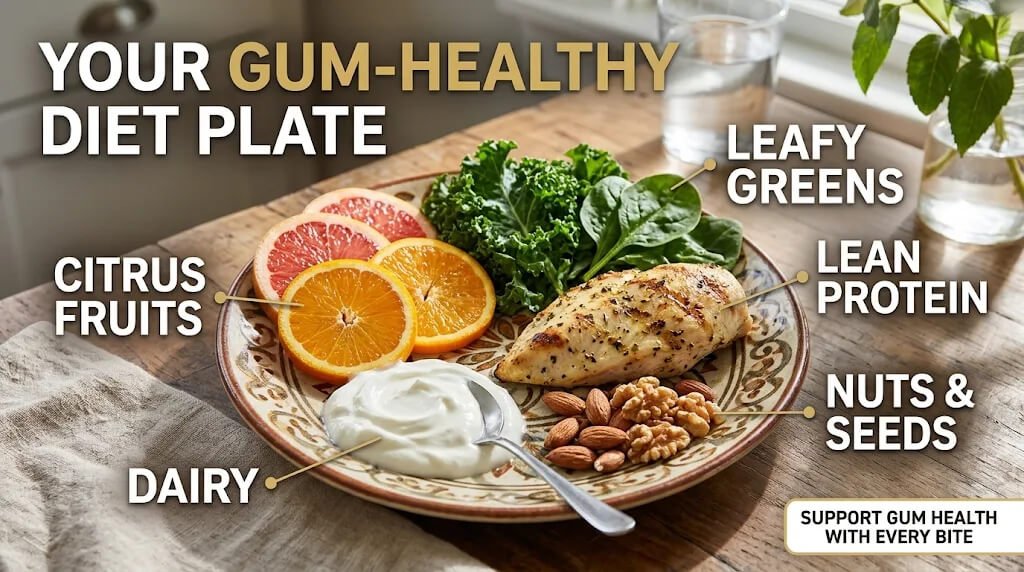
Food Sources: Building a Gum-Healthy Plate
Before reaching for a supplement bottle, try to cover your bases with food. Here’s a simple daily framework:
| Meal / Snack | Gum-Healthy Choices | Key Nutrients Delivered |
| Breakfast | Oatmeal with strawberries, a boiled egg, and a handful of walnuts | Vitamin C, B2, B12, zinc, magnesium |
| Lunch | Lentil and spinach salad with lemon dressing and a slice of whole-grain bread | Folate, iron, vitamin K, vitamin C (lemon boosts iron absorption) |
| Snack | Greek yogurt with pumpkin seeds and a kiwi | Calcium, zinc, vitamin C, B12 |
| Dinner | Baked salmon with sweet potato and steamed broccoli | Vitamin A, omega-3 fatty acids, vitamin C, magnesium, B6 |
| Evening (optional) | A small square of dark chocolate (70%+) with a few almonds | Magnesium, zinc, antioxidants |
This plate doesn’t require exotic ingredients. The goal is variety across the week so you rotate through different nutrient sources. If you follow a restricted diet (vegan, very low-calorie, or a diet that eliminates entire food groups), you’re more likely to miss one or more of the nutrients above.
Common Mistake: Relying on a single “superfood” or a high-dose megavitamin pill and skipping a balanced diet. The body needs dozens of micronutrients working in concert. A 1,000 mg vitamin C tablet won’t compensate for a diet that’s low in zinc, folate, and vitamin K. Build the foundation with food first; supplement only the gaps.
Supplement Guidance: Do You Need Pills?
For most people who eat a varied diet, a standard multivitamin is not necessary for gum health. However, certain groups may benefit from targeted supplementation:
- Smokers and heavy alcohol users lose vitamin C and B vitamins at higher rates. An extra 35 mg of vitamin C and a B-complex may help close the gap.
- People following restrictive diets (strict vegan, very low-calorie, or those who avoid leafy greens) may be low in B12, vitamin K, zinc, or calcium.
- Older adults (65+) often have reduced absorption of B12, calcium, and vitamin D. A supplement can help maintain levels.
- People on long-term medications such as warfarin (affects vitamin K), metformin (can lower B12), or PPIs (reduce magnesium and calcium absorption) should talk to their doctor about targeted testing.
Practical dosing guidance (general, not medical advice):
- Vitamin C: 100–200 mg/day (upper tolerable limit is 2,000 mg)
- Vitamin K1: 90–120 µg/day (avoid megadoses if on anticoagulants)
- Zinc: 8–11 mg/day (do not exceed 40 mg/day long-term without supervision)
- Iron: Only supplement if a blood test confirms deficiency. Excess iron is harmful.
- B-complex: Follow the RDA on the label; most multivitamins cover this adequately.
If you’re considering a multivitamin, look for one that provides 100% of the Daily Value for the B vitamins, vitamin C, vitamin A, zinc, and magnesium. You can explore more on addressing nutrient gaps with the right supplements to make an informed choice.

When Nutrition Isn’t Enough: See a Dentist
Here’s the part I have to say clearly, because I’ve seen too many clients try to “out-nutrition” a periodontal problem:
Bleeding gums are most often a sign of gingivitis or early periodontitis, and the primary treatment is professional dental care, not a vitamin pill.
- If your gums bleed every time you brush or floss, schedule a dental cleaning and exam.
- If you notice pus, receding gums, loose teeth, or a persistent bad taste, see a dentist or periodontist promptly.
- If you have diabetes, uncontrolled blood pressure, or are on immunosuppressive medication, gum bleeding warrants a medical workup in addition to dental care.
Nutrition supports the healing process and helps prevent recurrence, but it will not remove the hardened tartar (calculus) that sits below the gumline and drives chronic inflammation. Only a dental professional can do that.
For more on how systemic inflammation affects tissue repair, including oral tissue, see our article on anti-inflammatory nutrition and omega-3 fatty acids.
Safety Notes and Who Should Be Cautious
- Pregnant or breastfeeding women need extra folate (600 µg DFE) and iron, but should avoid high-dose vitamin A (preformed retinol above 10,000 IU can be harmful to a developing baby). Beta-carotene from food is safe.
- People on anticoagulant medications (warfarin, apixaban, rivaroxaban) must keep vitamin K intake consistent and should not start or stop a vitamin K supplement without medical guidance.
- People with kidney disease may need to limit potassium, calcium, and phosphorus intake. Check with a nephrologist before taking mineral supplements.
- Children under 12 should get nutrients from food. If a supplement is needed, use a pediatric formulation and follow a pediatrician’s dosing.
- If you are taking iron, zinc, or calcium supplements, space them at least 2 hours apart from each other and from thyroid medication or certain antibiotics, as they compete for absorption.
This article is for general information and is not a substitute for advice from a doctor, dentist, or registered dietitian. If your gums bleed frequently, are swollen, or you notice any change in their appearance, make an appointment with your dental care provider.

FAQ
What vitamin deficiency causes bleeding gums?
The most well-known is vitamin C deficiency (scurvy), which weakens capillaries and impairs collagen. However, mild deficiencies in vitamin K, vitamin A, iron, and several B vitamins can also contribute to gum bleeding by reducing tissue repair, clotting efficiency, or immune regulation.
Does vitamin C actually help with bleeding gums?
Yes. Vitamin C is essential for collagen synthesis and capillary integrity. Research published in periodontal journals links adequate vitamin C intake to reduced gum inflammation and faster healing after dental procedures. The RDA is 75–90 mg/day, with smokers needing an extra 35 mg.
What minerals are most important for gum health?
Iron (oxygen delivery and immune function), zinc (wound healing and anti-inflammatory action), calcium (alveolar bone support), and magnesium (inflammation regulation) are the four most relevant minerals. Getting them through a varied diet is the most effective approach.
Can vitamin K stop bleeding gums?
Vitamin K supports normal blood clotting, so adequate intake helps ensure that minor gum bleeding stops promptly. However, it will not resolve the underlying inflammation or infection that causes the gums to bleed in the first place. A dental visit is still necessary.
Do multivitamins help with gum disease?
A standard multivitamin can help close small nutrient gaps, but it is not a treatment for gingivitis or periodontitis. Professional dental cleaning, consistent brushing and flossing, and addressing any underlying medical conditions (like diabetes) are the primary interventions.
How much vitamin C do I need specifically for gum health?
The RDA is 75 mg (women) or 90 mg (men) per day. Many periodontal researchers suggest 100–200 mg/day for optimal collagen support and antioxidant protection in gum tissue. One medium orange provides about 70 mg; a red bell pepper provides about 152 mg.
Conclusion
The vitamins and minerals for bleeding gum health—vitamin C, vitamin K, vitamin A, the B-vitamin complex, iron, zinc, calcium, and magnesium—work as an integrated system to build strong collagen, maintain a healthy mucosal lining, support efficient clotting, and keep the inflammatory response in check. The most reliable way to get them is through a varied, colorful diet that includes fruits, vegetables, lean protein, whole grains, and dairy or fortified alternatives.
Supplements can fill specific gaps, especially for smokers, people on restricted diets, older adults, or those on medications that affect nutrient absorption. But no pill replaces a professional dental cleaning, a soft-bristle toothbrush, daily flossing, and a check-up every six months.
If your gums bleed more than occasionally, make that dental appointment this week. Then build your plate around the nutrients outlined here, and you’ll give your gums the best possible foundation for staying pink, firm, and bleed-free.