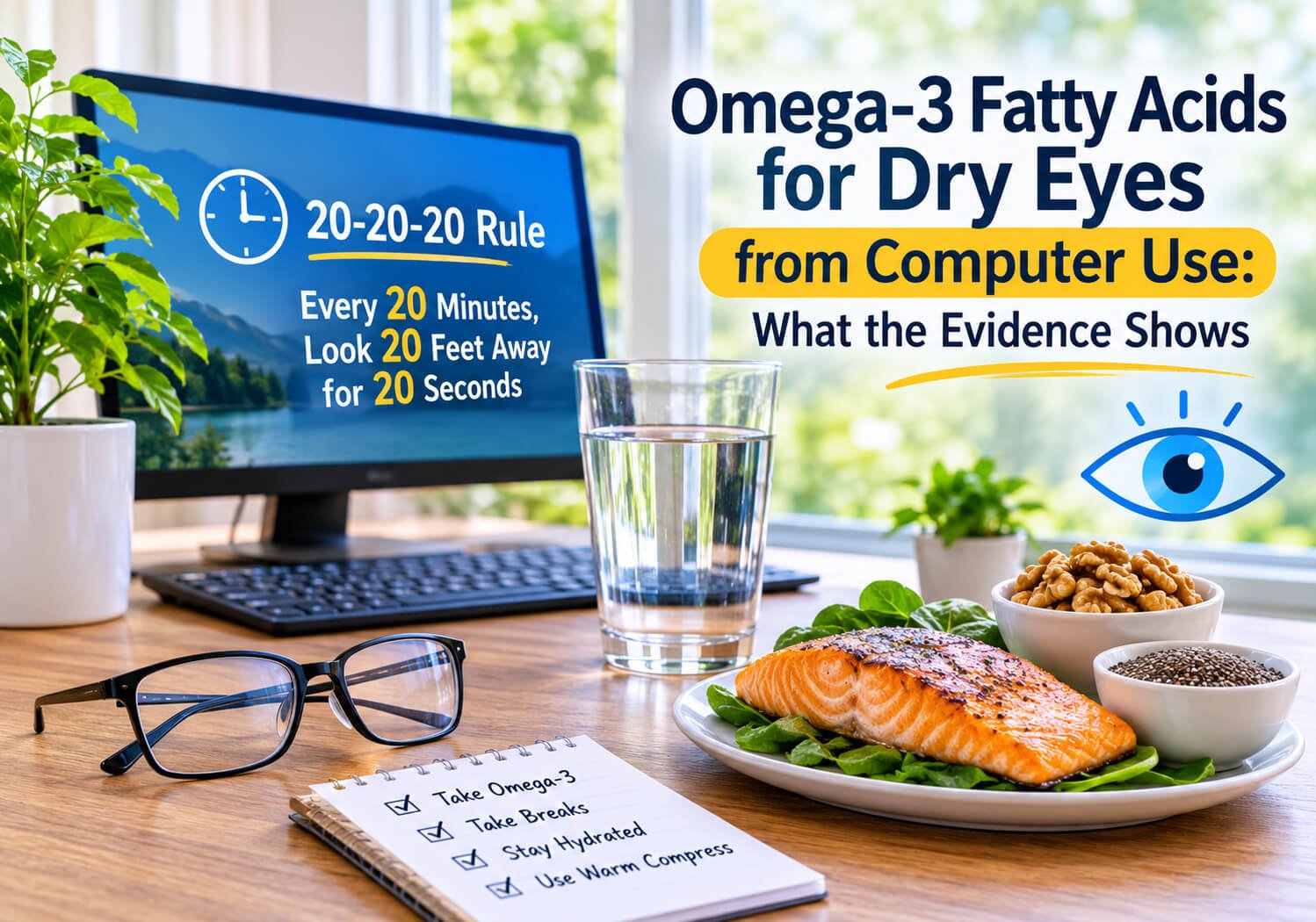
You stare at a monitor for eight, ten, twelve hours. By 3 p.m., your eyes burn, sting, and feel gritty. You blink more, rub harder, and reach for artificial tears. Sound familiar? If you work at a desk, manage spreadsheets, or code for a living, computer vision syndrome is not a myth—it is a daily reality for millions of screen-based workers.
One of the most searched questions in office-worker wellness is whether omega-3 fatty acids for dry eyes from computer use actually make a difference. The short answer: research suggests they may, but they are one piece of a larger strategy. Let me walk you through what the science says, how to use omega-3s practically, and what else you can do so your eyes stop screaming at you by mid-afternoon.
Quick Answer: Omega-3 fatty acids (EPA and DHA) are structural components of the lipid layer of your tear film. Research suggests that adequate omega-3 intake may reduce tear evaporation and lower ocular surface inflammation linked to meibomian gland dysfunction, a common cause of dry eyes during prolonged screen use. Typical studied doses range from 1,000 mg to 2,000 mg of combined EPA + DHA per day. Pair supplementation with the 20-20-20 rule, proper screen ergonomics, and adequate hydration for the best results.

What Happens to Your Eyes During Prolonged Screen Time
Before we talk about omega-3s, you need to understand the mechanical problem. When you focus on a close, fixed-distance screen, two things go wrong almost immediately:
- Your blink rate drops. Normal resting blink rate is about 15–20 blinks per minute. During concentrated screen work, it can fall to 5–7 blinks per minute, according to research published in ophthalmology journals indexed on PubMed. Fewer blinks mean less even spreading of the tear film across your cornea.
- Your tear film destabilizes faster. The tear film is a thin, three-layer coating (mucin, aqueous, and lipid) that keeps the ocular surface smooth and lubricated. The outermost lipid layer is secreted by the meibomian glands—tiny oil-producing structures along the edges of your eyelids. When you blink less, that lipid layer thins, the aqueous layer evaporates, and you get that burning, sandy feeling.
Over hours, this cycle of incomplete blinking and rapid evaporation leads to what clinicians call computer vision syndrome or digital eye strain. Symptoms include dryness, blurred vision, eye fatigue, headaches, and neck tension. The American Optometric Association recommends the 20-20-20 rule—every 20 minutes, look at something 20 feet (6 m) away for at least 20 seconds—to give your focusing muscles and tear film a reset.
The problem is that the 20-20-20 rule helps with the focusing-muscle fatigue, but it does not fix the underlying lipid deficiency or low-grade inflammation in the meibomian glands. That is where omega-3 fatty acids enter the picture.
How Omega-3 Fatty Acids Support the Tear Film
Your meibomian glands produce a complex oil (meibum) that coats the surface of each tear. That oil is rich in specific fatty acids, including omega-3s. When your body has adequate EPA and DHA, the meibum is more fluid, spreads more evenly, and evaporates more slowly. Think of it like the difference between a thin, rancid oil and a fresh, stable one on a pan. The fresh oil keeps moisture in; the rancid one breaks down and lets everything dry out.
Here is what the research points to:
- Reduced tear evaporation. A stable lipid layer slows the rate at which the aqueous (water) layer evaporates. Studies indexed on PubMed have shown that subjects with higher omega-3 status tend to have a thicker, more stable lipid layer and lower tear-break-up time (a clinical measure of tear film stability).
- Lower ocular surface inflammation. EPA and DHA are precursors to specialized pro-resolving mediators (resolvins, protectins, maresins) that actively dial down inflammatory signaling in tissues, including the conjunctiva and meibomian glands. Chronic low-grade inflammation in those glands is a hallmark of meibomian gland dysfunction, the most common cause of evaporative dry eye.
- Improved gland function. Some clinical trials have reported that omega-3 supplementation over 8–12 weeks can increase meibum quality and reduce the severity of dry-eye symptoms in patients with meibomian gland dysfunction. [VERIFY: specific trial citation]
The National Center for Complementary and Integrative Medicine (NCCIH), part of the NIH, notes that omega-3 fatty acids from fish and fish oil supplements are well-studied for cardiovascular and anti-inflammatory effects, and that research into their role in ocular surface health is ongoing but promising. You can read their overview on the NCCIH omega-3 fact sheet.
Coach’s Tip: Think of omega-3s the way I think about electrolytes for a long run. They are not a magic fix, but they support the system that keeps you going. If you are only taking fish oil and still staring at a 27-inch (69 cm) monitor for ten hours with zero breaks, the supplement is working against a losing battle. Pair it with behavioral changes, and you will feel the difference.
What the Research Says About Omega-3 Fatty Acids for Dry Eyes from Computer Use
I want to be straightforward: the evidence is encouraging but not yet conclusive. Here is where things stand as of the latest peer-reviewed literature:
What is supported:
- Omega-3 fatty acids are a structural and functional component of the meibomian gland secretion. This is well-established in ophthalmology and biochemistry research.
- Inflammatory dry eye (including meibomian gland dysfunction) is associated with altered fatty acid profiles in meibum, including lower omega-3 to omega-6 ratios.
- Multiple small-to-moderate clinical trials have reported improvements in tear-break-up time, Schirmer test scores (a measure of tear production), and patient-reported dryness scores after 8–12 weeks of omega-3 supplementation. [VERIFY: specific trial citations from PubMed]
- The anti-inflammatory pathway (resolvins, protectins) is well-characterized in the broader literature on EPA and DHA, and the same pathways are present in ocular surface tissue.
What is still uncertain:
- The optimal dose specifically for screen-induced dry eye (as opposed to general dry eye syndrome) has not been firmly established in large, randomized trials.
- How long it takes to see a noticeable difference varies by individual, baseline omega-6 status, and severity of gland dysfunction.
- Whether plant-based ALA (from flaxseed, chia, walnuts) is as effective as preformed EPA/DHA for ocular surface health is less clear, because the conversion of ALA to EPA and DHA in the human body is relatively low (often estimated at less than 10% for EPA and less than 0.5% for DHA). [VERIFY: conversion rate figures]
The bottom line: omega-3 fatty acids for dry eyes from computer use are a reasonable, low-risk supportive strategy, especially if your diet is low in fatty fish. They are not a replacement for seeing an eye care professional if your symptoms are severe, persistent, or worsening.
Dosage, Sources, and Timing: A Practical Guide
Here is a straightforward breakdown to help you decide what to take and when.
Dosage
Most clinical trials on omega-3 and dry eye have used combined EPA + DHA doses in the range of 1,000 mg to 2,000 mg per day. Some protocols have gone up to 3,000 mg for more severe meibomian gland dysfunction under medical supervision.
| Goal | Combined EPA + DHA | Typical source | Notes |
| General eye-health maintenance | 500–1,000 mg | 1–2 servings of fatty fish per week, or one standard fish oil capsule | Pair with the 20-20-20 rule |
| Active dry-eye symptoms from screen use | 1,000–2,000 mg | Fish oil or algal DHA supplement, taken with food | Give it 6–12 weeks before judging results |
| Clinically diagnosed meibomian gland dysfunction | 2,000–3,000 mg | As directed by an ophthalmologist or optometrist | Monitor for any GI side effects |
Common Mistake: Taking a “1,000 mg fish oil” capsule and assuming that means 1,000 mg of EPA + DHA. Most standard capsules contain about 300 mg EPA + 200 mg DHA (500 mg combined) per 1,000 mg of total fish oil. Check the label for the actual EPA and DHA content, not the total oil weight. You may need two or three capsules to hit your target.
Food sources vs. supplements
You can get EPA and DHA from food:
- Fatty fish: salmon, mackerel, sardines, herring, anchovies. A 3.5-ounce (100 g) serving of salmon provides roughly 2,000–2,500 mg of combined EPA + DHA.
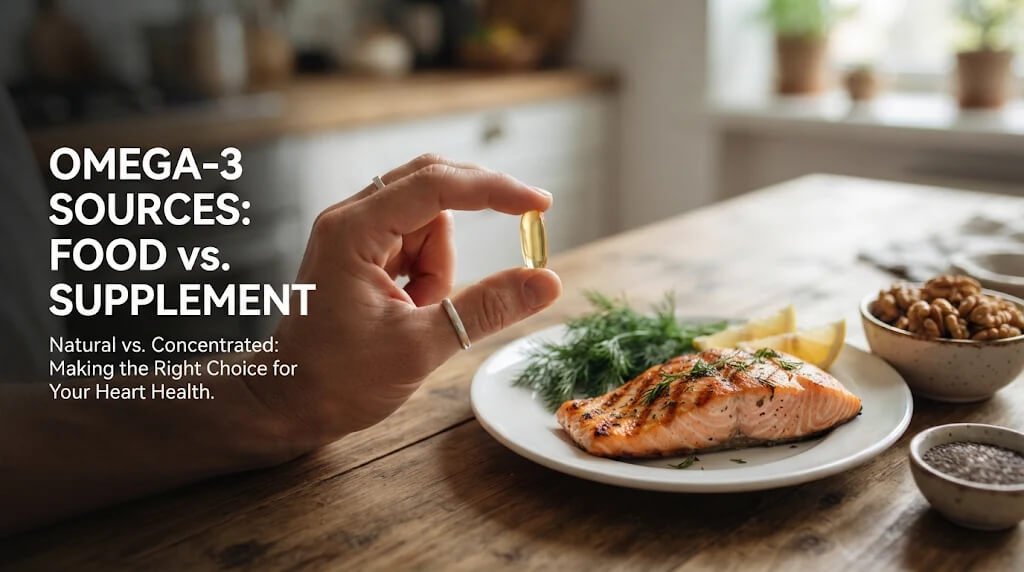
- Plant-based ALA sources: flaxseed, chia seeds, walnuts, canola oil. These provide alpha-linolenic acid, which the body can partially convert to EPA and DHA, but conversion is inefficient. If your diet is predominantly plant-based, an algal oil DHA supplement is a practical option.
If you eat fatty fish twice a week, you are likely getting a solid baseline of omega-3s. If you eat fish once a month or less, a supplement fills a real gap.
Timing
Take your omega-3 supplement with a meal that contains some fat (avocado, olive oil, eggs, nuts). Fat-soluble absorption is better with food. Many people take it with lunch to avoid the “fishy burp” effect at bedtime. Consistency matters more than the exact time of day.
A Step-by-Step Protocol for Screen Workers
Here is a practical, daily routine I would recommend to any client who spends more than six hours at a screen. Think of it as a “recovery protocol” for your eyes, the same way you would structure a cool-down after a workout.
The Basic Protocol (easier version)
- Morning: Take your omega-3 supplement (1,000–2,000 mg EPA + DHA) with breakfast.
- Every 20 minutes: Look at something 20 feet (6 m) away for 20 seconds. Set a phone reminder if you need one.
- Mid-morning (around 10 a.m.): Do a 30-second “blink reset.” Close your eyes fully, hold for 2 seconds, open. Repeat 10 times. This manually re-spreads the tear film.
- Lunch: Eat a meal that includes a source of omega-3s (salmon, sardines, a tablespoon of ground flaxseed on your salad).
- Afternoon (around 3 p.m.): Apply preservative-free artificial tears if your eyes feel dry. Use a warm compress (a clean, warm washcloth held over closed eyelids for 5–10 minutes) to help the meibomian glands release their oil.
- Evening: Dim your screen brightness, enable a blue-light filter or night-mode setting, and stop screen use at least 60 minutes before bed.
The Comprehensive Protocol (harder / more thorough version)
Everything in the basic protocol, plus:
- Twice daily warm compresses (morning and evening) for 10 minutes, followed by gentle eyelid massage (rub your closed eyelids in a circular motion for 30 seconds) to express meibum.
- A humidifier in your workspace, especially in dry climates or during winter heating season. Aim for 40–60% relative humidity.
- Position your monitor so the top of the screen is at or slightly below eye level, about an arm’s length (20–28 inches / 50–70 cm) away. This tilts your eyelids slightly downward, reducing the exposed surface area of the cornea and slowing evaporation.
- Add lutein and zeaxanthin to your daily routine (found in eggs, spinach, kale, or a supplement at 10 mg lutein + 2 mg zeaxanthin). These carotenoids accumulate in the macula and support retinal health, though they address a different part of eye health than omega-3s.
- Track your symptoms in a simple journal or phone note for 4–6 weeks. Note the time of day your eyes feel worst, how long you go between breaks, and whether the omega-3 + protocol combination is reducing the severity.
Coach’s Tip: The warm compress and eyelid massage step is the one most people skip, and it is the one that makes the biggest practical difference for meibomian gland function. It takes five minutes. Do it the way you would do a foam-roll after a leg day—non-negotiable, part of the routine.
Safety Considerations and Who Should Be Cautious
Omega-3 supplements are generally well-tolerated at the doses discussed here, but a few things to keep in mind:
- Blood-thinning effect. At higher doses (above 3,000 mg combined EPA + DHA per day), omega-3s can have a mild antiplatelet effect. If you are on anticoagulant medication (warfarin, apixaban, etc.) or have a bleeding disorder, talk to your doctor before starting a supplement.
- Allergies. If you have a fish or shellfish allergy, choose an algal oil DHA/EPA supplement instead of fish oil.
- GI discomfort. Some people experience mild nausea, heartburn, or “fishy” aftertaste. Taking the supplement with food and choosing a enteric-coated or “burp-less” formulation can help.
- Pregnancy and breastfeeding. DHA is important for fetal and infant development, but the appropriate dose and form should be confirmed with your OB/GYN or midwife.
- Children and adolescents. Dosing for younger people is different. Do not give adult-dose fish oil to a child without pediatric guidance.
If your dry-eye symptoms are severe, persistent (lasting more than a few weeks despite basic self-care), accompanied by redness, light sensitivity, or vision changes, see an ophthalmologist or optometrist. Dry eye can be a symptom of autoimmune conditions (Sjögren’s syndrome), medication side effects, or other ocular issues that need professional diagnosis.
Related Tips for Reducing Computer Eye Strain
Omega-3s are one tool. The following habits, drawn from optometric and occupational-health guidance, work alongside supplementation:
- Adjust screen brightness and contrast to match your surroundings. A bright screen in a dark room (or vice versa) increases visual fatigue.
- Use a blue-light filter or enable “night mode” / “eye comfort shield” on your device, especially in the evening. While the evidence on blue light and dry eye specifically is mixed, reducing overall light intensity in the evening supports both eye comfort and sleep quality.
- Stay hydrated. Dehydration reduces the aqueous layer of your tear film. Aim for consistent water intake throughout the day rather than chugging a liter at lunch.
- Manage your workspace lighting. Reduce glare on the screen with an anti-glare filter or by repositioning your monitor away from windows and overhead lights.
- Take real breaks. Every 90 minutes, step away from the screen for 5–10 minutes. Walk to get water, stretch your neck and shoulders, and let your eyes focus on a distant object. This is the same principle as deloading in a strength program—periodic rest prevents cumulative strain.
- Prioritize sleep. Inadequate sleep is linked to increased inflammatory markers and reduced tear production. If you are sleeping less than seven hours, your eyes are working at a deficit before you even sit down at your desk. The connection between sleep quality and overall metabolic and hormonal health is well-documented, and your ocular surface is no exception. For a deeper look at how sleep affects your body’s recovery systems, see how sleep affects metabolism and weight management.

FAQ
How much omega-3 do I need for dry eyes from computer use?
Most clinical studies on omega-3 and dry eye have used 1,000 mg to 2,000 mg of combined EPA and DHA per day. Start at the lower end, take it with a meal, and give it 6–12 weeks before assessing whether your symptoms have improved. Check the supplement label for actual EPA + DHA content, not total oil weight.
Can omega-3 supplements replace artificial tears?
No. Omega-3s support the lipid layer and reduce inflammation over weeks. Artificial tears provide immediate surface lubrication. For a screen worker, the practical approach is to use preservative-free artificial tears as needed during the day and take omega-3s daily as a longer-term supportive measure. They address different parts of the problem.
How long does it take for omega-3 to help dry eyes?
In clinical trials, measurable improvements in tear-film stability and symptom scores have been reported after 8 to 12 weeks of consistent supplementation. You may not notice a dramatic change in the first two weeks. Consistency is key—take it daily with food, and track your symptoms to see the trend.
Are plant-based omega-3s (flaxseed, chia) as effective as fish oil for dry eyes?
Plant sources provide ALA, which the body converts to EPA and DHA, but the conversion rate is low. If you are strictly vegetarian or vegan, an algal oil supplement that provides preformed DHA (and sometimes EPA) is a more direct route. Flaxseed and walnuts are still healthy additions to your diet, but they may not deliver enough EPA/DHA to meaningfully affect the meibomian gland lipid layer.
Should I take omega-3 in the morning or evening?
There is no strong evidence that timing matters for ocular benefit. The practical recommendation is to take it with a meal that contains some dietary fat for better absorption. Many people prefer morning or lunch to avoid any aftertaste at bedtime. Pick the time you will actually remember and stick with it.
Do I need a prescription for omega-3 supplements for eye health?
No. Omega-3 fish oil and algal oil supplements are available over the counter. However, if you have a diagnosed eye condition, are on blood-thinning medication, or are pregnant, check with your doctor or eye care provider before starting a new supplement, especially at higher doses.
Conclusion: Making Omega-3 Fatty Acids for Dry Eyes from Computer Use Part of Your Daily Routine
If you spend the bulk of your workday staring at a screen, your eyes are doing a repetitive, low-grade “exercise” that they were not designed to sustain for ten hours straight. Reduced blinking, a thinning lipid layer, and low-grade meibomian gland inflammation add up to that familiar mid-afternoon burn.
Omega-3 fatty acids for dry eyes from computer use are not a cure, and they will not fix a broken blink habit or a monitor that is three inches from your face. But the research suggests they are a sensible, low-risk way to support the tear film’s lipid layer, reduce ocular surface inflammation, and give your meibomian glands the raw materials they need to produce a stable, protective oil.
Start with 1,000 mg of combined EPA + DHA daily, taken with food. Layer in the 20-20-20 rule, a warm compress, proper screen ergonomics, and consistent hydration. Give the protocol six to eight weeks before you judge whether it is working. And if your symptoms are severe, persistent, or getting worse, make an appointment with an eye care professional. Your eyes are the one piece of equipment you cannot swap out, and they deserve the same structured care you would give any other part of your body.
For a broader look at how omega-3s interact with inflammation and tissue hydration beyond the eyes, you can explore omega-3 fatty acids and skin hydration. And if you are looking for additional antioxidant support for overall eye and skin health, astaxanthin supplements are worth a conversation with your doctor.