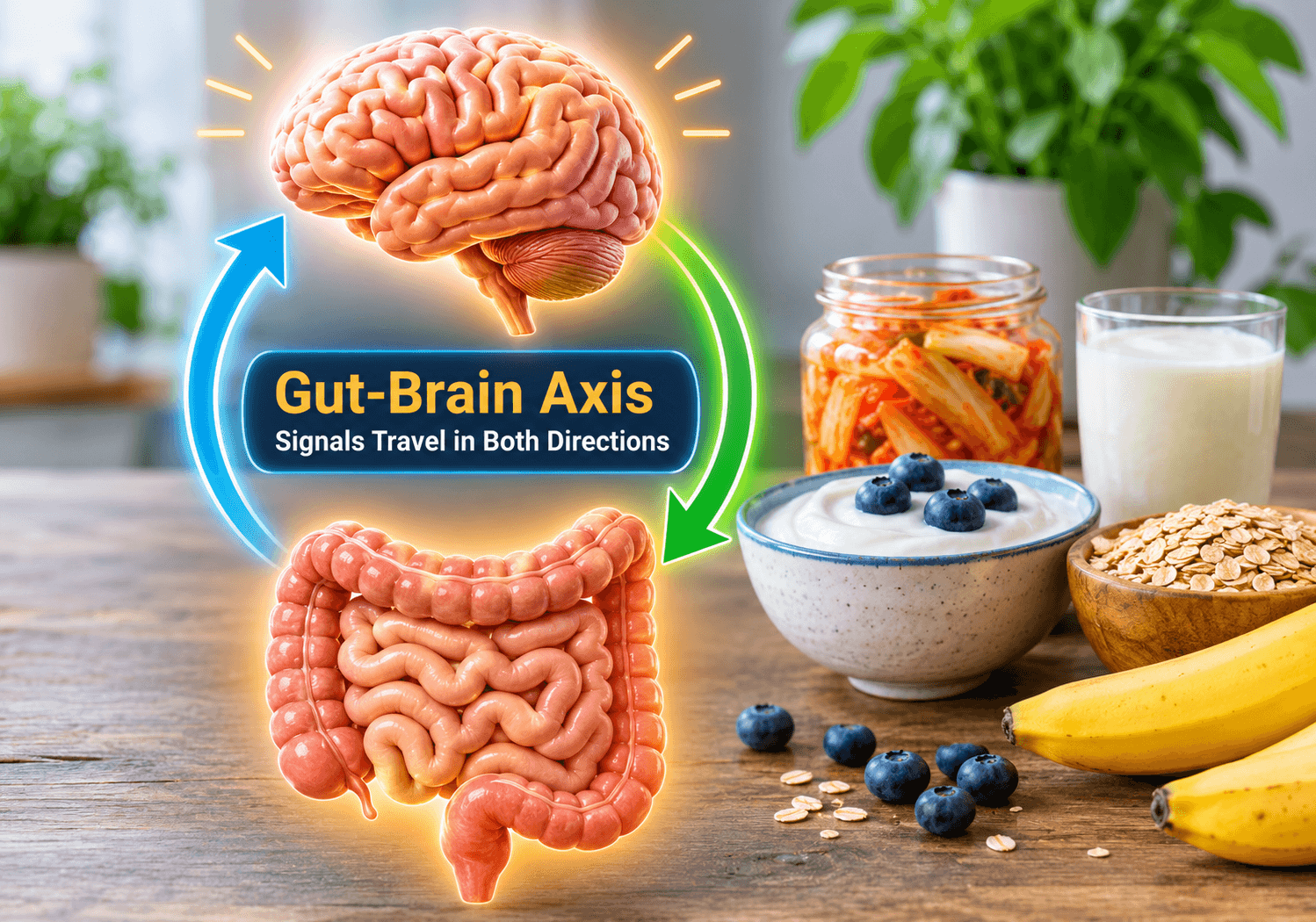
What Is the Gut-Brain Axis and How Do Probiotics Affect It? A Coach’s Evidence-Based Guide
You have probably felt your gut and brain talk to each other without naming it: butterflies before a big lift, a nervous stomach before a competition, or that wired-but-tired feeling when training stress piles up. That conversation has a name, the gut-brain axis, and probiotics are one of the tools people use to influence it. This guide explains what the gut-brain axis actually is, how probiotics affect it, what the research does and does not show, and how a lifter or regular gym-goer can put all of it to work with food, training, and smart choices. I will keep the science honest: the gut-brain connection is real, but probiotic benefits are strain-specific and more modest than most marketing suggests.
Quick Answer: The gut-brain axis is the two-way communication network linking your gut and your brain through the vagus nerve, gut hormones, the immune system, and gut bacteria. Probiotics can influence this axis by changing gut bacteria, producing short-chain fatty acids, and affecting stress signals. Research suggests small but real benefits for mood and some digestive symptoms, not dramatic cures.
What Is the Gut-Brain Axis?
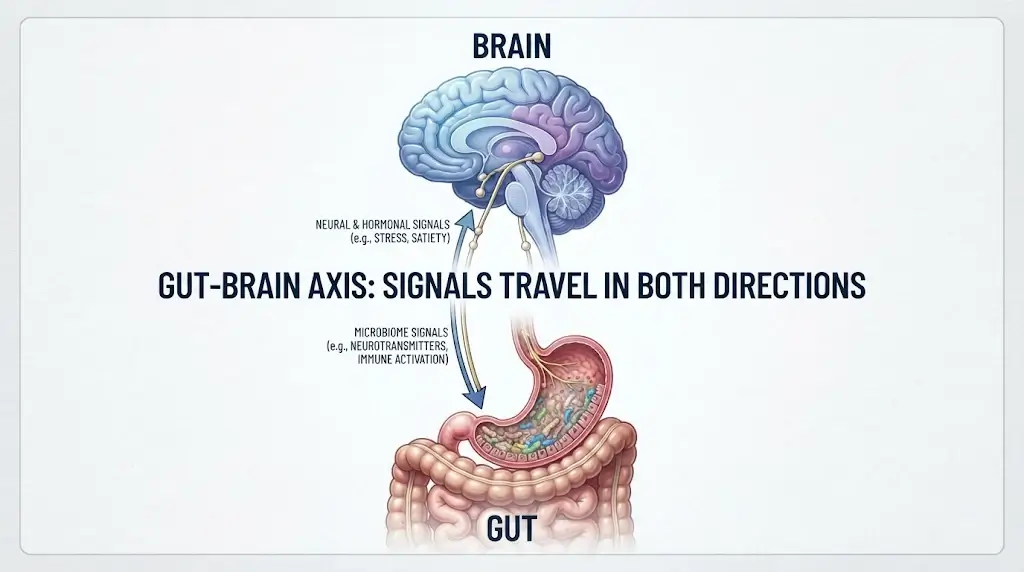
The gut-brain axis is the bidirectional communication network between your central nervous system and your digestive system. Signals pass both ways: your brain tells your gut when to move food along and when to release stomach acid, and your gut sends constant status reports back to your brain about what is happening down there [1].
This is not a metaphor. Your digestive tract has its own nervous system, called the enteric nervous system, often called the “second brain.” It has hundreds of millions of neurons embedded in the walls of your gut, more than your spinal cord, and it can operate independently of your brain while still communicating with it constantly.
Three main channels carry the traffic between gut and brain:
- Neural signaling. The vagus nerve is the main highway. It physically connects your gut to your brainstem and carries sensory information upward and commands downward.
- Hormonal signaling. Your gut releases hormones such as ghrelin, peptide YY, and GLP-1 that influence hunger, fullness, and stress responses, all of which register in the brain.
- Immune signaling. Roughly 70 to 80 percent of your immune cells live in and around your gut. Inflammatory signals from the gut can reach the brain and influence mood and energy.
When researchers describe the “microbiota-gut-brain axis,” they are adding a fourth player to that map: the trillions of bacteria, fungi, and other microbes living in your intestines, collectively called the gut microbiome [2].
How the Gut-Brain Connection Shows Up in Daily Life
The gut-brain connection explains a lot of everyday experiences. Stress can trigger stomach upset, diarrhea, or appetite changes, and a troubled gut can send signals that contribute to anxiety or low mood. Harvard Health notes that the relationship runs both ways: gastrointestinal distress can be the cause or the result of anxiety and stress, which is why gut symptoms and mood problems often show up together [3].
As a coach, I see the gut-brain connection most clearly in two situations: nervous lifters whose stomachs shut down before heavy attempts, and clients in a hard training block who report bloating, irregular digestion, and worse sleep at the same time. Both are the axis doing its job, sometimes a little too enthusiastically.
What Are Probiotics?
Probiotics are live microorganisms that, when taken in adequate amounts, confer a health benefit on the host, according to the definition used by the International Scientific Association for Probiotics and Prebiotics and cited by the National Institutes of Health [4].
Two distinctions matter here, and most product marketing blurs them:
- Strain specificity. Probiotic microorganisms are named by genus, species, and strain, for example Lacticaseibacillus rhamnosus GG. A benefit shown for one strain does not transfer automatically to another, even a close relative. This is the single most important fact about probiotics and the one most supplement ads ignore.
- Probiotics vs. prebiotics. Probiotics are the live bacteria themselves. Prebiotics are fibers, such as inulin and other fermentable carbohydrates, that feed the bacteria already living in your gut. Products containing both are called synbiotics [4].
You can get probiotics from fermented foods such as yogurt with live active cultures, kefir, kimchi, sauerkraut, miso, tempeh, and kombucha, or from capsules and powders. Harvard Health notes that many fermented foods count as probiotic foods, with yogurt being the most widely palatable starting point [5].

How Probiotics Affect the Gut-Brain Axis
Probiotics affect the gut-brain axis through several overlapping mechanisms. Here is the practical version of each one.
1. They change what your gut bacteria produce
Gut bacteria ferment dietary fiber and produce short-chain fatty acids, especially butyrate, acetate, and propionate. These compounds feed the cells of your gut lining and can signal to the brain through immune, endocrine, and neural routes. Reviews identify short-chain fatty acids as one of the key mediators of microbiota-gut-brain communication [6]. In plain terms: fiber in, signaling molecules out. That is also why prebiotic foods matter as much as the probiotics themselves.
2. They interact with gut-produced neurotransmitters
Certain gut bacteria produce or influence compounds involved in neurotransmitter signaling, including serotonin precursors and GABA-related activity. The gut produces a large share of the body’s serotonin, and microbial activity influences this chemistry, which is part of why researchers study probiotics for mood at all [2].
3. They influence stress hormones
The gut and brain talk through the HPA axis, the hormonal system that governs your stress response. A 2026 meta-analysis of trials in healthy working adults found that probiotic supplementation was associated with a small but statistically significant reduction in cortisol, a key biomarker of physiological stress, alongside modest improvements in symptoms of depression, anxiety, and stress [7]. The effect sizes were small, which is honest coach-speak for “helpful support, not a transformation.”
4. They support the gut lining and immune signaling
Probiotic strains can help maintain the intestinal barrier, the lining that keeps gut contents where they belong. A compromised barrier lets inflammatory signals escape into circulation, and inflammation is one of the routes through which gut state reaches the brain. The NIH fact sheet notes that probiotics exert effects through a wide variety of mechanisms, some shared across strains and some unique to a particular species or strain [4].

What the Research Actually Shows
Here is the honest scoreboard, based on controlled trials and meta-analyses.
Mood and stress: small, consistent, real effects in some populations. A meta-analysis of 34 controlled trials found probiotics produced small but significant improvements in depression and anxiety scores, with larger effects in clinical samples than in healthy community samples [8]. More recent reviews in working adults reach similar conclusions: modest but statistically significant benefits [7]. Nobody should replace therapy or medication with a probiotic capsule, but as an adjunct, the signal is positive.
IBS and digestive symptoms: mixed, strain-dependent. Some probiotics show promise for irritable bowel syndrome symptoms, but benefits have not been conclusively demonstrated, and 2021 guidelines from the American College of Gastroenterology recommend against probiotics for global IBS symptoms based on very low-quality evidence [9]. Translation: if you have IBS, talk to a gastroenterologist rather than self-prescribing from an influencer’s shelf.
The dose and duration reality. Most positive mood and stress trials ran for at least four weeks, often eight to twelve, using doses in the range of one to ten billion CFUs (colony-forming units) per day. Benefits appear to be strain- and dose-dependent, so “any probiotic, any dose, any duration” is not a reasonable expectation.
The bottom line. Probiotics may help modulate the gut-brain axis in ways that support mood, perceived stress, and some digestive comfort. They are not a shortcut around sleep, diet quality, and training management, which move the same dials with bigger levers.
The Gut-Brain Axis and Your Training
This is where the topic gets practical for readers of a fitness site, because training and the gut-brain axis influence each other in both directions.
Exercise improves your gut microbiome. A meta-analysis of 25 exercise-intervention studies in adults found that regular exercise significantly increased alpha diversity of gut microbiota, a standard marker of a healthier, more varied gut bacterial community [10]. In practical terms, meeting the CDC recommendation of at least 150 minutes of moderate aerobic activity plus two days of muscle-strengthening work per week is one of the most reliable, free ways to support your gut-brain axis [11].
Hard training stresses the gut. Intense, prolonged exercise, especially in heat, increases intestinal permeability and can drive GI symptoms; reviews in athletes note that 30 to 90 percent of marathon and triathlon participants report GI complaints, and that specific probiotic strains may help maintain gut-barrier integrity in trained populations [12].
The coach’s read on all this: moderate, consistent training supports the axis; chronic overreaching works against it. If your gut falls apart every time you ramp up volume, that is information about your recovery, not just your stomach.
Coach’s Tip: If you are starting a probiotic or a fermented-food habit, start it during a normal training week, not the week of a competition or a max-out attempt. New strains and new fermented foods can change digestion and gas production for the first week or two. Give your gut time to adapt before you find out mid-workout.
How to Support Your Gut-Brain Axis in Practice
You do not need a cabinet full of capsules. Rank these in order of evidence and cost.
Food first: probiotic and prebiotic foods
Aim for one or two servings of fermented foods daily and fiber at every meal. Good probiotic foods include yogurt with live active cultures, kefir, kimchi, sauerkraut (look for unpasteurized, refrigerated versions, since pasteurization kills the live bacteria), miso, tempeh, and kombucha [5]. Feed those bacteria with prebiotic fiber from oats, beans, onions, garlic, bananas, and other plants. If you want the details on why fiber and fullness matter for weight goals, see our guide on how soluble fiber helps control appetite and our overview of dietary fiber and weight management.
Choosing a probiotic supplement, if you use one
If you decide a supplement is worth trying, judge it on four things rather than CFU-count bragging rights:
- Named strains. The label should list genus, species, and strain for every organism, not just “probiotic blend.”
- CFUs at expiry, not at manufacture. Bacteria die in the bottle; reputable brands guarantee potency through the shelf life.
- A strain or formula actually studied in humans for the outcome you care about, at the dose used in those studies.
- Storage requirements you can actually live with, since some strains need refrigeration.
Also know the regulatory reality: probiotic supplements are not reviewed by the FDA the way drugs are, so manufacturers do not have to prove the quality or even the contents of their products before sale [13]. Buy from brands that use third-party testing.
A simple four-week self-test
Because individual responses vary, run a cheap experiment on yourself:
- Weeks 1 to 4: Keep a daily one-line log of digestion (bloating, regularity), energy, sleep quality, and stress on a 1 to 5 scale. Add one fermented food or a named-strain probiotic at a consistent time of day.
- Compare week 4 to week 1. Look for trends, not single bad days.
- Decide. If you notice clear improvement, continue. If nothing changes after four weeks, that product is probably not doing anything for you, and you can save the money.
Common Mistake: Buying a probiotic for “gut-brain health” while sleeping six hours, eating almost no fiber, and training to failure five days a week. The gut-brain axis responds most strongly to sleep, diet, and training stress. A capsule on top of poor basics is like adding a spoiler to a car with flat tires. If stress and cravings are your real problem, start with behavior: our guide on managing food cravings without supplements covers that foundation, and our piece on sleep and weight-management hormones explains why sleep is the highest-leverage fix.
Safety Notes: Who Should Check With a Doctor First
Probiotics have a long history of apparently safe use in healthy people, but few studies have examined safety in detail, and serious infections have been reported in vulnerable groups, including premature infants, which led the FDA to warn healthcare providers about that risk [9].
Check with your doctor or a registered dietitian before taking probiotic supplements if you:
- are immunocompromised, critically ill, or hospitalized;
- have a central venous catheter or are recovering from major surgery;
- have a serious underlying illness affecting the gut, pancreas, or immune system;
- are pregnant or breastfeeding and considering supplements beyond food.
And if you have ongoing digestive symptoms, see a gastroenterologist before experimenting. Persistent pain, blood in stool, or unexplained weight loss are reasons for a proper workup, not a supplement purchase.
FAQ
Do probiotics actually reach the brain?
Not directly in any meaningful sense. They act in the gut, changing bacterial populations, metabolites such as short-chain fatty acids, and local immune signaling. Those signals then travel to the brain through the vagus nerve, hormones, and immune pathways. The effect is indirect, which is why it is modest rather than dramatic.
How long do probiotics take to work for mood and stress?
Give any trial at least four weeks, ideally eight. Most controlled trials showing mood or cortisol benefits ran for four to twelve weeks, and effects appear strain- and dose-dependent. If a product claims instant calm, that is marketing, not evidence.
Are probiotics better as supplements or as fermented foods?
For general gut support, fermented foods are a reasonable starting point and add nutrients besides. Supplements make sense when you want a specific studied strain at a known dose. The NIH notes that not all foods and supplements labeled as probiotics have proven health benefits, so check labels either way [4].
Can gut bacteria really affect mood?
Yes, in controlled trials the effects are small but statistically significant for depression and, to a lesser degree, anxiety. That is supportive evidence, not proof that a probiotic will change how you feel. Sleep, exercise, social connection, and professional care for mental health remain the big levers.
Does exercise help the gut-brain connection?
It appears to. Regular exercise is associated with greater gut microbiota diversity, and interventions over eight weeks or more show measurable shifts [10]. Very intense or poorly recovered training can push things the other way, so consistency beats heroics.
Are probiotics safe for everyone?
They have a strong safety record in healthy people, but not in everyone. Immunocompromised and critically ill patients face rare but documented infection risks, so medical guidance matters in those cases [9]. When in doubt, ask your doctor.
Conclusion
The gut-brain axis is a real, two-way communication network running through the vagus nerve, gut hormones, the immune system, and trillions of gut bacteria. Probiotics affect this axis by shifting bacterial populations, producing short-chain fatty acids, and modulating stress and inflammatory signals, and the research supports small but meaningful benefits for mood, perceived stress, and some digestive symptoms when the right strains are used at adequate doses for at least a month. For most people, the highest-value stack is unglamorous: regular training that meets the 150-minute weekly benchmark, two days of strength work, plenty of fiber, one or two daily servings of fermented foods, and consistent sleep. Understanding what the gut-brain axis is and how probiotics affect it lets you use them as a supporting tool rather than a magic bullet, and that is exactly how the evidence says they work.