
Tossing and turning at night while your mind replays every stress of the day wears down both your workouts and your daily energy. As a coach who helps busy adults balance training, recovery, and real-life pressure, I often see people reach for sleep aids or extra caffeine when what their nervous system really needs is better recovery habits and smart nutritional support. Understanding the best magnesium for sleep and anxiety in adults starts with knowing what magnesium can actually do, which forms make sense, and how it fits alongside your daily routine.
Please check with a doctor or qualified healthcare provider before starting any new supplement, especially if you take prescription medications or manage health conditions.
Quick Answer
For most adults looking for relaxation and better rest, magnesium glycinate is often favored because it pairs magnesium with glycine and tends to be gentler on the stomach than forms like magnesium citrate. Still, research on magnesium for sleep and anxiety shows mixed or modest results, so it works best alongside consistent sleep habits and medical guidance.
How Magnesium Connects to Sleep, Stress, and Nervous System Calm
Magnesium is an essential mineral involved in hundreds of body reactions, including muscle function, energy production, and nerve signaling, as outlined by the NIH Office of Dietary Supplements magnesium fact sheet. When your stress levels climb or your sleep schedule slips, recovery takes a hit in the gym and at home. Good sleep also supports healthy hormone and metabolic balance, a link we explore further in our guide on how sleep affects metabolism.
Researchers have looked closely at how magnesium interacts with pathways tied to calm and rest, including GABA and NMDA signaling and the body’s stress response. A systematic review and meta-analysis in Nutrients examined randomized trials on magnesium supplementation and reported modest improvements in subjective anxiety measures in certain stressed or vulnerable groups, while noting that study designs and baseline magnesium status vary widely. Similarly, evidence on sleep quality suggests magnesium may help some adults with poor sleep or low dietary intake, though it is not a cure-all for insomnia or anxiety disorders, according to general clinical guidance from Harvard Health Publishing .
Coach’s Tip
Think of magnesium as supporting your recovery foundation rather than flipping an “off switch” on a racing mind. Pairing an evening wind-down routine—like dimming lights, stepping off your phone, and doing 5 minutes of slow nasal breathing—usually does more for your nervous system than adding a pill to a chaotic bedtime routine.

Comparing Common Forms of Magnesium for Adults
Walk down any supplement aisle and you will see dozens of labels claiming calm, sleep, or stress relief. The catch is that “magnesium” on the front of a bottle is bound to another molecule, and that pairing affects how well it is absorbed and how your stomach tolerates it.
| Form of Magnesium | Common Uses & Characteristics | Digestive Tolerance | Practical Coaching Takeaway |
| Magnesium glycinate | Bound to the amino acid glycine; widely chosen for evening relaxation routines | Often well tolerated; less likely to loosen stools | A practical starting point for adults focused on sleep and calm, if approved by a doctor |
| Magnesium citrate | Often used to support bowel regularity; absorbed fairly well in studies | Can cause loose stools or cramping at higher doses | Better suited if mild constipation is also an issue, rather than late-night calm |
| Magnesium oxide | High elemental magnesium by weight, lower bioavailability | More likely to cause GI upset or loose stools | Less ideal as a primary option for sleep or anxiety support |
| Magnesium L-threonate | Marketed for brain and cognitive support; studied in early research | Generally well tolerated, though pricier | Often costlier per serving; limited long-term sleep data compared to basic habits |
| Magnesium taurate | Bound to taurine, an amino acid studied in cardiovascular and nerve contexts | Usually moderate to good tolerance | Worth discussing with a clinician if you want a non-laxative option |
Always check the Supplement Facts panel for elemental magnesium, which tells you the actual weight of the magnesium mineral rather than the whole compound. According to the NIH Office of Dietary Supplements magnesium fact sheet, the Recommended Dietary Allowance (RDA) for most adult men is 400–420 mg per day and for most adult women is 310–320 mg per day from food and supplements combined, while the Tolerable Upper Intake Level (UL) for supplemental magnesium in adults is 350 mg per day unless a doctor advises otherwise.
Common Mistake
Many adults grab a bottle that says “500 mg magnesium” on the front, take it all at once on an empty stomach, and wake up with stomach cramps or diarrhea. Starting with a smaller dose—such as 100–200 mg of elemental magnesium—and taking it with a light evening snack helps you test how your stomach responds.

How to Choose a Quality Supplement Without Getting Overwhelmed
Because dietary supplements in the United States are not approved by the FDA for safety and effectiveness before they hit shelves, quality control matters, as noted by the National Center for Complementary and Integrative Health . A clean label and independent testing help reduce the risk of under-dosing or unwanted contaminants.
When I help clients compare options, we use a simple checklist:
- Look for third-party testing: Seals from organizations such as NSF International or USP indicate independent verification of ingredient identity and purity.
- Match the form to your goal: Avoid high-dose laxative-leaning forms late at night if you do not want middle-of-the-night bathroom trips.
- Keep the ingredient list simple: Skip products loaded with heavy proprietary blends or extra stimulants and sedatives unless your doctor specifically recommends them.
- Check capsule vs. powder: Capsules offer pre-measured convenience, while powders allow smaller step-up doses if you mix them into water or herbal tea.
If you already track how evening habits affect your appetite, stress, and recovery, you may also like our breakdown of natural supplements for evening cravings and how stress hormones show up in daily routines in our guide on adaptogens for cortisol and stress.
Food First and Evening Habits That Reinforce Calm
Supplements work best on top of steady daily basics. Leafy greens like spinach, pumpkin seeds, almonds, black beans, and whole grains all contribute magnesium to your diet, and food sources do not count toward the 350 mg supplemental upper limit described by the NIH Office of Dietary Supplements magnesium fact sheet. If your daytime eating is rushed or low in whole foods, tightening up meals often helps energy and mood more than any capsule. For broader context on how nutrients support daily energy, see our overview of nutrients for normal energy metabolism.
Movement and breathwork also shape how easily you wind down after a long day. Regular moderate exercise supports sleep quality and stress resilience over time, as highlighted in HHS Physical Activity Guidelines though intense late-evening sessions right before bed can leave some people wired.
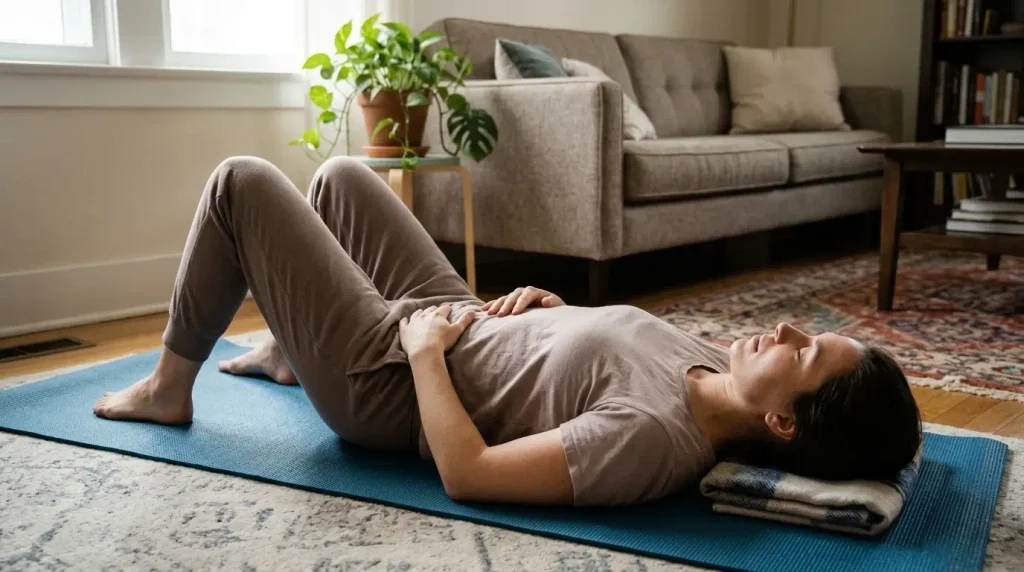
A Simple 12-Minute Evening Wind-Down Routine
You do not need an hour of stretching to signal to your body that the workday is over. Try this low-friction routine 45–60 minutes before bed on weeknights:
- Settle and breathe (3 minutes): Lie on your back or sit comfortably with knees bent. Inhale quietly through your nose for 4 seconds, letting your lower ribs and belly expand gently, and exhale slowly for 6 seconds. Do 8–10 slow breaths.
- Gentle hip and thoracic release (5 minutes): Do 2 sets of cat-cow for 6–8 slow reps (about 3 seconds per breath cycle), followed by a 30–45 second child’s pose or figure-four stretch per side. Keep effort easy—around a 3–4 out of 10—so you feel a mild stretch, never sharp pain.
- Progressive muscle relaxation (4 minutes): Starting at your feet and moving up to your calves, thighs, glutes, shoulders, and jaw, gently tense each area for 3–5 seconds at a light 30–40% effort, then let go completely for 10 seconds. Notice the contrast between tension and softness.
- Easier version (regression): If getting down on the floor feels stiff or uncomfortable, do the slow breathing and seated shoulder/neck release in a supportive chair for 5–7 minutes. Rest your feet flat on the floor and keep your eyes softly closed.
- Harder version (progression): Add a 10–15 minute easy walk outside at dusk (about 0.5–1 mile / 0.8–1.6 km at a relaxed conversational pace) before the floor routine, or extend your slow nasal exhale to 7–8 seconds if it feels smooth and unforced.
Even natural minerals can cause side effects or interact with medications. High intakes of magnesium—especially from supplements or laxatives—can trigger nausea, abdominal cramping, and diarrhea, and very high levels can pose serious risks, particularly for people with reduced kidney function, according to the Mayo Clinic .
Keep these safety guardrails in mind before deciding on the best magnesium for sleep and anxiety in adults:
- Kidney issues: If you have kidney disease or impaired kidney clearance, speak with a physician before taking supplemental magnesium.
- Medication interactions: Magnesium can bind to certain antibiotics and osteoporosis medications or interact with blood pressure drugs and muscle relaxants; spacing doses or choosing alternatives may be necessary.
- Persistent sleep or anxiety symptoms: If trouble sleeping lasts more than a few weeks or anxiety interferes with work, relationships, or daily functioning, get evaluated by a healthcare professional rather than relying solely on supplements.
If you are exploring non-stimulant ways to support calm energy and daily resilience alongside lifestyle changes, you might also find our guide on non-stimulant supplements for metabolism and our overview of ways to improve energy without caffeine helpful.

What is the best magnesium for sleep and anxiety in adults? For many adults, magnesium glycinate is a practical option because it combines magnesium with glycine and tends to be gentler on digestion than magnesium citrate or oxide. However, clinical evidence for sleep and anxiety is modest, so it works best alongside consistent sleep habits and a doctor’s input.
Does magnesium help with anxiety and trouble sleeping? Research suggests magnesium may modestly support relaxation and sleep quality in some adults, especially those with low intake or high stress, as summarized by the NIH Office of Dietary Supplements magnesium fact sheet. It does not replace medical care for clinical anxiety or chronic insomnia.
How much magnesium should I take before bed for sleep? Many adults start with 100–200 mg of elemental magnesium in the evening after checking with a doctor. The NIH supplemental upper limit for most adults is 350 mg per day from supplements alone, unless a healthcare provider recommends a specific therapeutic plan.
Can magnesium cause stomach upset at night? Yes. Forms like magnesium oxide or citrate—or taking a large dose all at once—can cause cramping, loose stools, or nausea that disrupts sleep. Starting with a lower dose and taking it with a small evening snack often improves tolerance.
How long does magnesium take to help with sleep and stress? Some people notice a subtle calming effect within a few days to a week, while others see little change or need two to three weeks alongside steady sleep routines. If nothing improves after a few weeks, reassess your sleep habits and talk with a clinician.
Can you take magnesium every night safely? Many healthy adults take modest daily doses of magnesium safely over time, provided they stay within appropriate limits and have healthy kidneys. Always check with a doctor or pharmacist first if you take daily medications or have kidney concerns.
Conclusion: Making a Smart, Calm Choice
Finding the best magnesium for sleep and anxiety in adults comes down to realistic expectations, clean ingredient choices, and strong daily habits. Magnesium glycinate or another gentle form may modestly support relaxation for some people, yet consistent bedtimes, stress management, and medical guidance remain the real anchors of lasting rest.
This article is for general information and is not a substitute for advice from a doctor or physical therapist.